Last updated: 5 September 2026
TL;DR: Part-time workers are protected from less favourable treatment because of their part-time status, and most entitlements apply pro rata. GOV.UK gives the example that a part-timer working half the hours of a colleague receiving a £1,000 bonus should get £500. Differences are only lawful where there is objective justification.
Most veterinary practices run on part-time staff. Nurses on three days, a receptionist on school hours, a vet who does Mondays and Thursdays. It is the normal shape of the profession, and it is also where the quiet inequalities gather, usually without anyone intending them.
Part-time workers are protected from being treated worse purely because they work fewer hours. GOV.UK is direct that part-time workers must not be treated less favourably than equivalent full-time workers simply because they are part-time.
The comparison is with a full-time colleague doing broadly similar work for the same employer. In a practice that usually means comparing a three day nurse with a five day nurse, not with a vet.
Part-time is a working pattern, not an employment status. A part-time nurse on fixed days is an employee with the full set of rights, and is not the same thing as a bank or casual worker, as our guide to employment status explains.
There is an equality dimension too. Part-time roles are disproportionately held by women, so treatment that disadvantages part-time workers can raise sex discrimination questions alongside the specific protection.
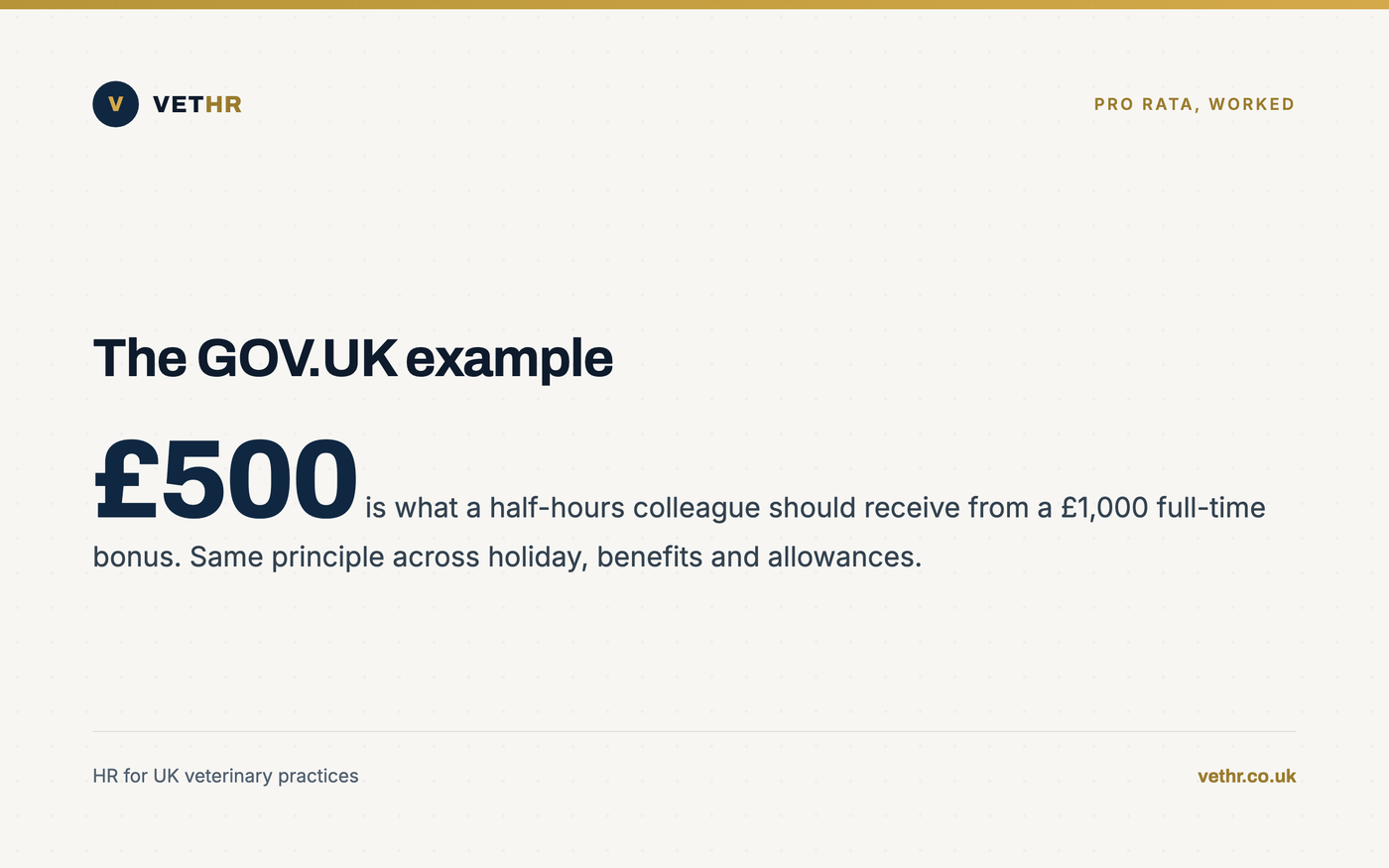
Proportionately to hours worked, applied consistently rather than by feel. GOV.UK gives the worked example: where a full-time worker receives a £1,000 bonus and a part-timer works half the hours, the part-timer should receive £500.
Calculate holiday for part-time workers in hours rather than days for anyone not working a standard five day week. Days are the source of most errors, because a nurse working three long shifts loses out badly if her leave is counted the same way as a colleague on five short ones.
Bank holidays need the same treatment. A pro rata allocation of bank holidays, given as hours, avoids the classic unfairness where the Monday and Friday people gain and the Tuesday to Thursday people lose, as our guide to bank holiday entitlement sets out.
Start from the statutory floor. GOV.UK confirms that almost all workers are entitled to 5.6 weeks’ paid holiday a year, capped at 28 days, and the pro rata calculation applies that same 5.6 weeks to whatever the person’s week actually looks like.
Automate it if you can. Manual pro rata calculations for a team of fifteen with six different patterns are slow and easy to get wrong, which is why our holiday calculations system exists.
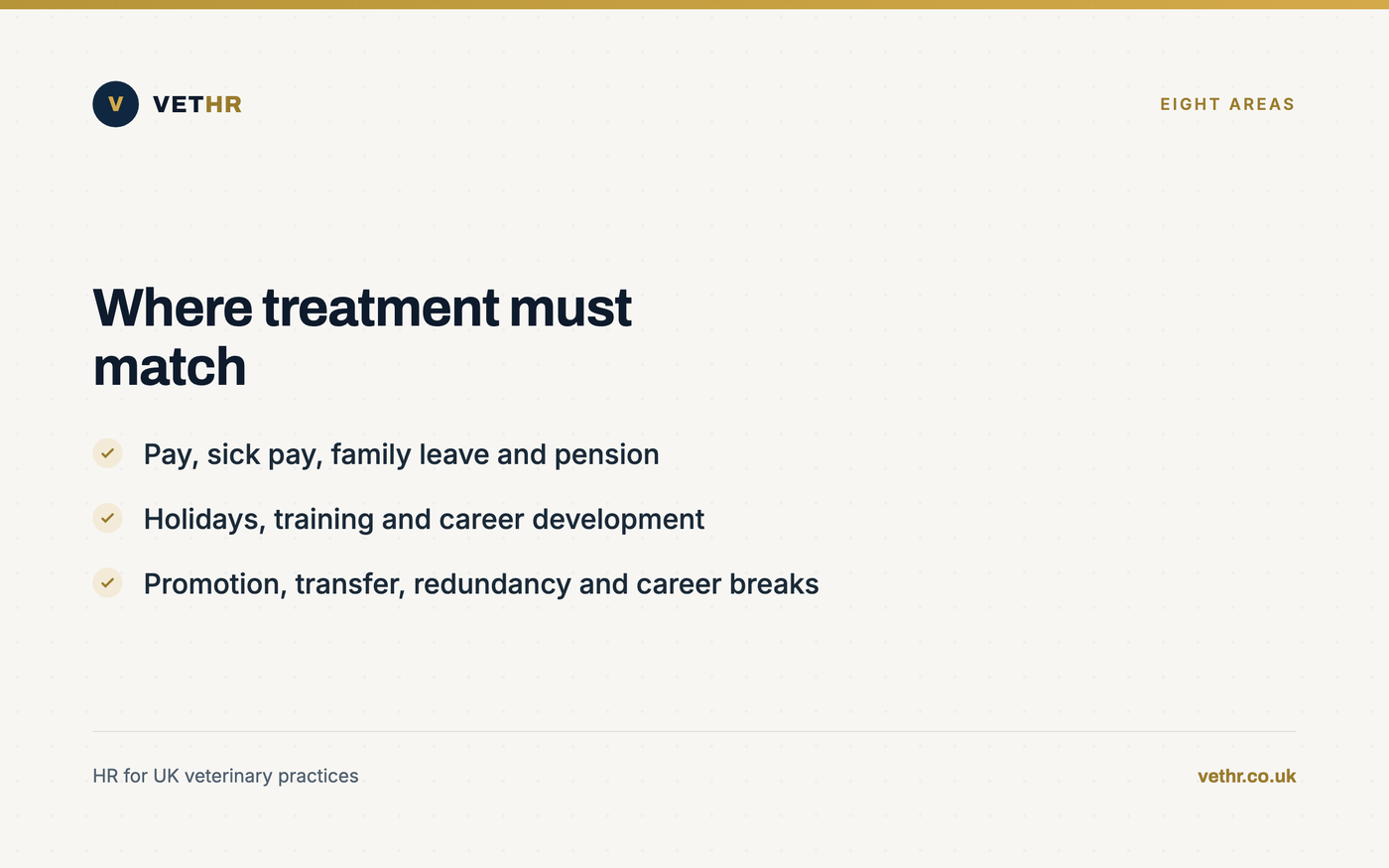
GOV.UK sets out the areas where part-time staff must receive the same consideration as full-time colleagues, applied pro rata where proportion makes sense.
Number seven is the one that produces claims. Selecting part-time workers first in a redundancy exercise, without an objectively justified reason, is both less favourable treatment and a potential sex discrimination claim, as our guide to redundancy covers.
Watch communication as well. Part-time workers miss whatever is announced on the days they are not in, so a practice that briefs changes verbally at Tuesday handover has effectively created two tiers of information without ever intending to.
Number six is the one that costs you people. Training that is always scheduled on a Friday excludes everyone who does not work Fridays, which over a year becomes a genuine career disadvantage nobody ever decided to impose.
By sharing the unpopular work in proportion, not by exempting anyone from it. The two failure modes are opposite: part-time staff who never do a weekend, and part-time staff who do nothing but.
Full-time staff notice exemptions for part-time workers faster than anything else. A nurse doing every second weekend while a three day colleague does none is a resentment problem that will be described as something else entirely at the exit interview.
Fixed days are usually the whole reason someone works part-time, so tread carefully with changes. Childcare and caring arrangements are built around specific days, and moving them is a contractual and practical matter rather than a rota tweak, as our guide to building a veterinary rota covers.
The requirement does not shrink with the hours, so part-time workers carry the same annual total as everyone else. RCVS CPD is 35 hours a year for veterinary surgeons and 15 hours a year for registered veterinary nurses regardless of whether they work full-time or part-time.
That makes CPD proportionally harder for part-time staff, not easier. A nurse working two days a week has the same fifteen hours to complete out of a much smaller working year, and a pro rata training budget compounds the problem.
Fund the requirement rather than the fraction. Cutting a part-time nurse’s CPD budget in half while her regulatory obligation stays whole is difficult to justify and is exactly the kind of decision that surfaces in a grievance, as our guide to CPD requirements explains.
Six different working patterns and no consistent rule? A free 30-minute HR health check will straighten the entitlements out. Book your HR health check.
Where there is objective justification, meaning a genuine business reason rather than a preference. GOV.UK notes that employers may differentiate where they can demonstrate objective justification, and gives health insurance as an example where cost or an alternative offer may be relevant.
Write the reasoning down at the time. Justification constructed after a complaint always reads as justification constructed after a complaint, and in a small team the decision is usually remembered differently by the two people involved.
Test any proposed difference by describing it out loud to the person affected. If the sentence needs qualifying twice before it sounds fair, it will not survive a tribunal asking the same question more slowly.
Reasons that do not work include convenience, tradition, and the view that part-time staff are less committed. Reasons that might work relate to genuine operational requirements attached to the role itself.
Review any difference in how part-time workers are treated annually. Something justified when the practice had six staff and one site may be indefensible three years later, and nobody revisits these decisions unless a date forces them to.
The same entitlement, applied pro rata. Statutory leave is 5.6 weeks, so someone working three days a week gets 5.6 of their weeks. Calculating in hours rather than days is the safest method where shift lengths vary, which they usually do in veterinary practice.
Not because they are part-time. That is less favourable treatment unless objectively justified. Differences based on genuine factors such as experience, qualifications or a materially different role are a separate matter, and the reasoning should be recorded at the time.
Give a pro rata allocation, ideally expressed in hours. Otherwise staff who happen to work Mondays gain and those who do not lose, purely because of the days their pattern falls on. A proportional allowance they can book removes the anomaly entirely.
Yes. The RCVS requirement of 15 hours a year for registered veterinary nurses applies regardless of hours worked, and 35 hours applies to veterinary surgeons. Consider funding and rostering CPD in full rather than pro rata, because the obligation itself is not reduced.
Only by agreement where the days are contractual. Specific days are usually the reason the person works part-time at all, and imposing a change risks both a breach of contract and an indirect discrimination claim. Discuss it, allow notice, and confirm any agreement in writing.
Part-time workers are not a concession a practice makes; they are how most veterinary teams are actually staffed. Treating the pattern as a lesser form of employment costs experienced nurses who have no intention of returning to five days for anyone.
Calculate everything in hours, share the unpopular shifts in proportion, fund CPD in full and record the reasoning behind any difference. Our holiday calculations and HR consultancy handle the arithmetic, and the free HR health check will find the anomalies you have not spotted.
The Vet HR Team provides HR consultancy and white-labelled staff systems exclusively to UK veterinary practices. Discrimination questions are legal matters; take advice where a difference is contested.
Contracts, rotas, holiday, a difficult conversation. Tell us what you are dealing with and we will come back within one working day. Nothing to sign up to.
Got it. We will come back to you within one working day. If you do not see a reply, please check your spam folder.
