Last updated: 27 June 2026
TL;DR: Bank holiday entitlement for veterinary staff is not a separate legal right. The law gives 5.6 weeks of paid leave a year, capped at 28 days, and bank holidays can sit inside that or on top of it, depending entirely on the contract. There is no statutory right to take a bank holiday off, and no automatic extra pay for working one. Get the wording clear, pro-rata fairly for part-timers, and the rota stops causing arguments.
Few rota questions cause as much quiet friction as bank holidays. A practice that opens through the August Monday, a part-time nurse who never works Fridays, a new hire who assumed the Christmas closure was a paid bonus. Getting the rules right is mostly about clear wording, not complex law. This guide settles them, then shows how to write them down so the next bank holiday runs without a single awkward conversation.
Either, and the contract decides which. Bank holiday entitlement for veterinary staff is not a standalone right; by law your team gets 5.6 weeks of paid holiday a year, and an employer can choose to count the bank holidays inside that figure or to grant them separately on top. There is no default that says bank holidays must be extra. Whatever your contract states is what applies.
The statutory floor is the anchor. GOV.UK confirms that almost all workers are legally entitled to 5.6 weeks’ paid holiday a year, and that this is capped at 28 days for someone working five days a week or more, in its holiday entitlement guidance. Eight bank holidays plus four weeks of annual leave is the common way that 28 days gets filled.
This is exactly where contracts diverge. GOV.UK is explicit that “bank holidays do not have to be given as paid leave” and that an employer “can choose to include bank holidays as part of a worker’s statutory annual leave”. So one practice down the road may give 28 days inclusive of bank holidays, and another may give 28 days plus the bank holidays on top. Both are lawful. Both feel very different to staff.
The trap is silence. If a contract says “20 days plus bank holidays” but the rota treats bank holidays as ordinary working days, you have promised something you are not delivering. The wording and the practice have to match, which is the single most common error we untangle on a health check.
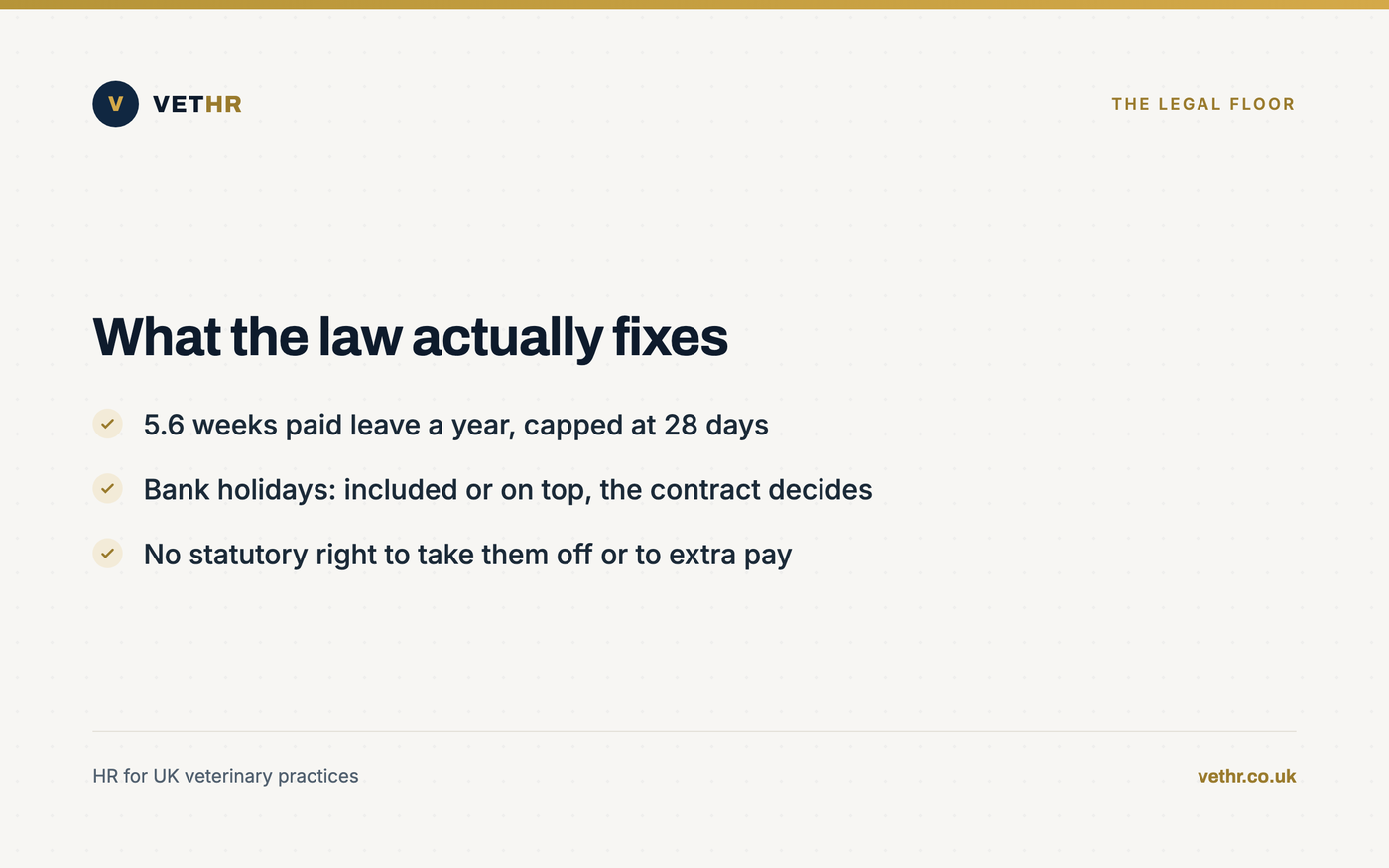
No. There is no statutory right to take a bank holiday off, and no automatic right to extra pay for working one. Whether someone has to work a bank holiday is up to the employer, set through the contract and the rota. For a practice that runs consults or out-of-hours cover, that is the rule that makes the day possible.
Acas puts it plainly: “Whether a worker has to work on bank holidays is up to their employer.” There is no special legal status that lets a registered nurse decline the Easter Monday shift simply because it is a bank holiday, as long as the contract and rota are clear, in its guidance on bank holidays and Christmas.
The flip side protects the worker too. Acas confirms that if someone works on a bank holiday, “they must still get their full 5.6 weeks of statutory holiday entitlement as paid time off”. Working the day does not quietly erase a chunk of their annual leave. They simply take that leave on other days instead.
When you open on a bank holiday, you rota staff as on any other day and pay them their normal rate unless the contract promises more. The day is no longer their leave; it is a working day. To keep things fair, most practices give those staff the equivalent time back to take later, so nobody loses out for being on the rota.
The mechanism rests on a single fact already established: the 5.6 weeks is fixed. If your contract counts bank holidays within that 28 days, but the practice is open and a vet works the day, that vet has used a working day rather than a holiday. They are owed a day of leave to take elsewhere, because Acas confirms the full statutory entitlement must still be received as paid time off.
This is why “time back in lieu” is the cleanest approach for an open practice. You bank the bank holiday for whoever works it and let them spend it when the diary is quieter. The alternative, paying it out, is restricted: Acas states “a worker cannot get paid in lieu of bank holidays” unless that leave is part of an unused balance when they leave the job. So in-year, time back is the practical route, not cash.
A short rota note here saves grief. If the New Year’s Day cover is shared across two nurses, log who worked and the lieu day each is owed at the moment you build the rota, not three months later when memory has gone vague. A veterinary rota system that tracks this automatically removes the end-of-year reconciliation entirely.
Not sure whether your contracts say “plus bank holidays” or “inclusive of bank holidays”, or whether your rota matches either? A 30-minute conversation usually makes it clear. Book a free HR health check and we will read your wording, look at how you run bank holidays today, and tell you honestly where it is fair and where it could land you in an argument. Nothing sold for the sake of it.
You give part-time staff a pro-rata share of bank holidays based on the days they work, not the full eight days a full-timer enjoys. The fair method is to calculate their total leave as a proportion of a week, then fold bank holidays into that figure, so the nurse who never works Mondays is neither short-changed nor handed a windfall.
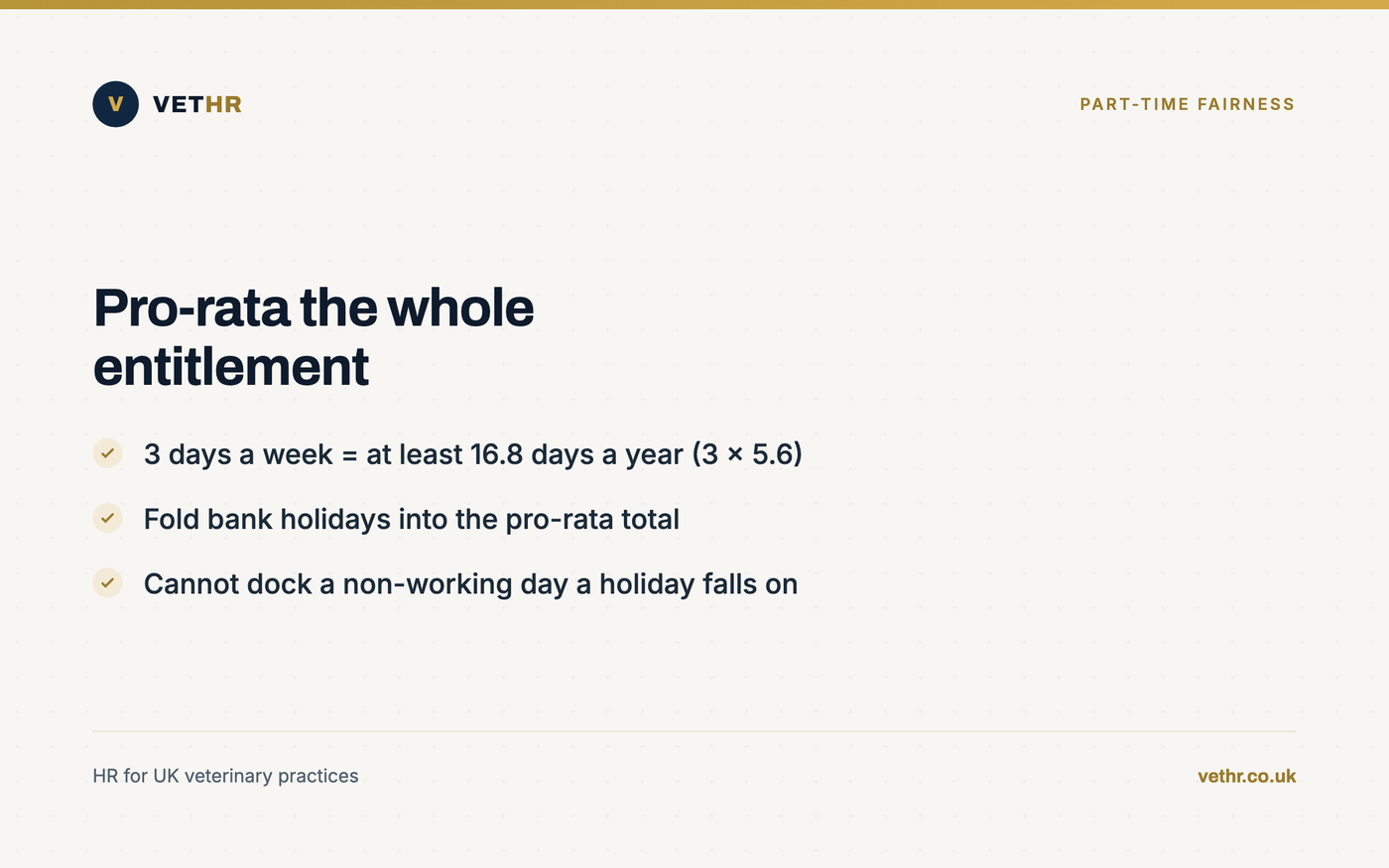
Start from the statutory sum. GOV.UK explains that a part-timer’s 5.6 weeks still applies, so someone working three days a week is entitled to at least 16.8 days’ leave a year, which is 3 multiplied by 5.6. That total already covers their fair share of bank holidays; you do not add eight more on top.
The unfairness creeps in when bank holidays are handled separately and most fall on Mondays. A full-timer gets all eight off paid. A part-timer who never works Mondays would get none, while a part-timer who only works Mondays would lose a disproportionate share of their leave. Pro-rating the whole entitlement, bank holidays included, smooths that out so the day a holiday lands on stops mattering.
One protection is worth stating clearly. Acas confirms that where a bank holiday falls on a day a part-timer does not normally work, “the employer cannot make them use that day as part of their holiday entitlement”. You cannot dock a Friday-only nurse for the Monday she was never going to work. Our holiday calculations handle this pro-rata maths so the figures are right and defensible.
There is no legal duty to pay more for a bank holiday, so the answer is whatever your contract offers. Many practices give time back in lieu, some pay an enhanced rate as a goodwill gesture, and some do nothing beyond normal pay. The law sets the floor; your reward policy sets everything above it.
Normal pay is the legal baseline. Because there is no statutory bank holiday premium, a vet working Christmas Day is owed their ordinary rate unless the contract says otherwise. Time-and-a-half or a day in lieu are common in practice, but they are choices you make to keep staff willing, not obligations.
Whatever you choose, write it down and apply it the same way every time. The fastest way to breed resentment is paying one nurse extra for Boxing Day and giving another only a lieu day for the same shift. Consistency, recorded in the contract and visible on the rota, is what staff actually judge as fair, more than the size of the enhancement itself.
The contract should state the total leave figure, say plainly whether bank holidays are included or on top, explain how part-timers are pro-rated, and set out what happens when someone works a bank holiday. Four clear lines remove almost every dispute, because they replace assumption with a written rule everyone can check.
The leave year matters too, because the 28-day cap and the 5.6 weeks are both annual figures. Define when your leave year starts and how unused lieu days carry over, if at all. Vague carry-over rules are where a tidy bank holiday policy quietly unravels by March.
If your current contracts are silent or contradictory on any of this, fix the wording before the next bank holiday, not after a grievance. Clear veterinary HR consultancy and properly drafted contract terms cost far less than the goodwill lost when a long-serving nurse feels short-changed over a Monday in May.
They can be, if the contract says so. GOV.UK confirms an employer can include bank holidays within the statutory 5.6 weeks, or grant them on top. There is no automatic right to bank holidays as extra leave, so the contract wording decides whether your team gets 28 days inclusive of bank holidays or 28 days plus them.
Yes. Acas confirms that whether a worker has to work bank holidays is up to the employer. For a practice running consults or out-of-hours cover, staff can be rota’d on a bank holiday provided the contract is clear. They still keep their full 5.6 weeks of paid leave, taken on other days instead.
No. There is no statutory right to extra pay for working a bank holiday, so normal pay is the legal minimum. Many practices offer enhanced pay or a day in lieu to keep staff willing, but these are contractual choices. Whatever you offer, apply it consistently and record it so the rota is seen as fair.
You pro-rata them. A part-timer’s 5.6 weeks is calculated on their contracted days, so someone working three days a week gets at least 16.8 days a year, bank holidays included. You cannot force a part-timer to use a bank holiday that falls on a day they never work as part of their leave.
Only when they leave. Acas states a worker cannot be paid in lieu of bank holidays unless they form part of holiday entitlement left unused when they leave the job. During employment, the fair approach for an open practice is a day back in lieu, taken when the diary allows, rather than a cash payment.
Bank holiday entitlement for veterinary staff feels complicated because the law gives almost no special rules. There is a fixed 5.6 weeks, capped at 28 days, and everything else, on top or included, paid or in lieu, full-time or pro-rata, is set by your contract. Get those four lines right and the arguments disappear, because nobody is guessing any more.
If you are not certain your contracts and rota agree, that is worth fixing now. Read how we work in veterinary HR consultancy, see how the holiday calculations handle pro-rata bank holidays, or simply book a free HR health check and we will give you a straight answer for your practice. No jargon, nothing sold that you do not need.
The Vet HR Team provides HR consultancy and white-labelled staff systems exclusively to UK veterinary practices.
—
Free tool: Calculate entitlement with the free holiday calculator
Read next: Holiday Entitlement for Part-Time Staff, Holiday Booking System for Veterinary Practices and Carrying Over Holiday in a Veterinary Practice.
Contracts, rotas, holiday, a difficult conversation. Tell us what you are dealing with and we will come back within one working day. Nothing to sign up to.
Got it. We will come back to you within one working day. If you do not see a reply, please check your spam folder.
