Last updated: 4 September 2026
TL;DR: Staff turnover costs a practice in seven places, and the recruitment fee is only one of them. Cover, overtime, lost consulting capacity, induction time, reduced productivity while someone learns, management hours and lost client goodwill all land before the replacement is fully effective. The RCVS reports 75% of vets intended to stay in the profession for five or more years in 2024, down from 79% in 2019.

Practices tend to budget for recruitment and treat everything else as bad luck. That is why the true cost of staff turnover stays invisible until the year end, when the freelance cover line looks strange and nobody can quite explain it. This guide puts a structure around the number so you can work out your own.
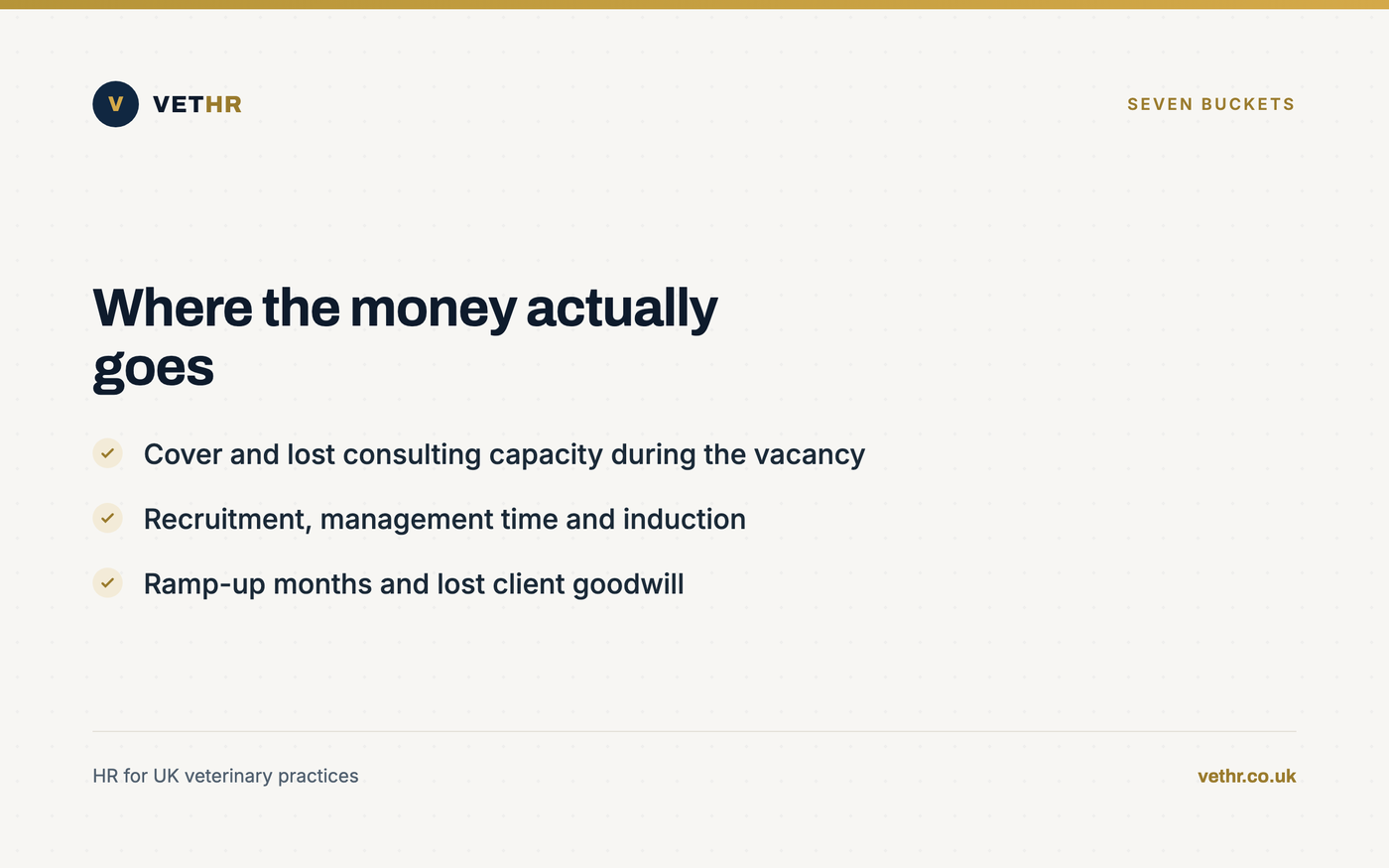
Staff turnover costs land in seven buckets, most of which never appear on a recruitment invoice. Listing them separately is the point, because a practice that only counts the agency fee is undercounting by a wide margin.
Buckets 1, 2 and 6 usually dwarf the rest. A vacancy that runs for four months in a practice with three vets does not cost you a quarter of a salary saved. It costs you the cover, the capacity and a team that finishes late every day.
Use your own figures rather than ours, but the shape is consistent. The SPVS 2025 salary survey reported a median salary package for all full-time vets of £58,277, with new graduate basic salaries at £35,000. Those numbers set the scale of what a vacancy displaces.
Now build the calculation with lines you can evidence from your own accounts:
Run that staff turnover calculation once for a real departure from the last two years and the total tends to surprise people. It is almost always a larger number than the pay rise, the CPD budget or the rota change that might have prevented the resignation, which is the entire argument for investing in retention.
Our guide to the real cost of a bad rota works through a related calculation for hours rather than headcount.
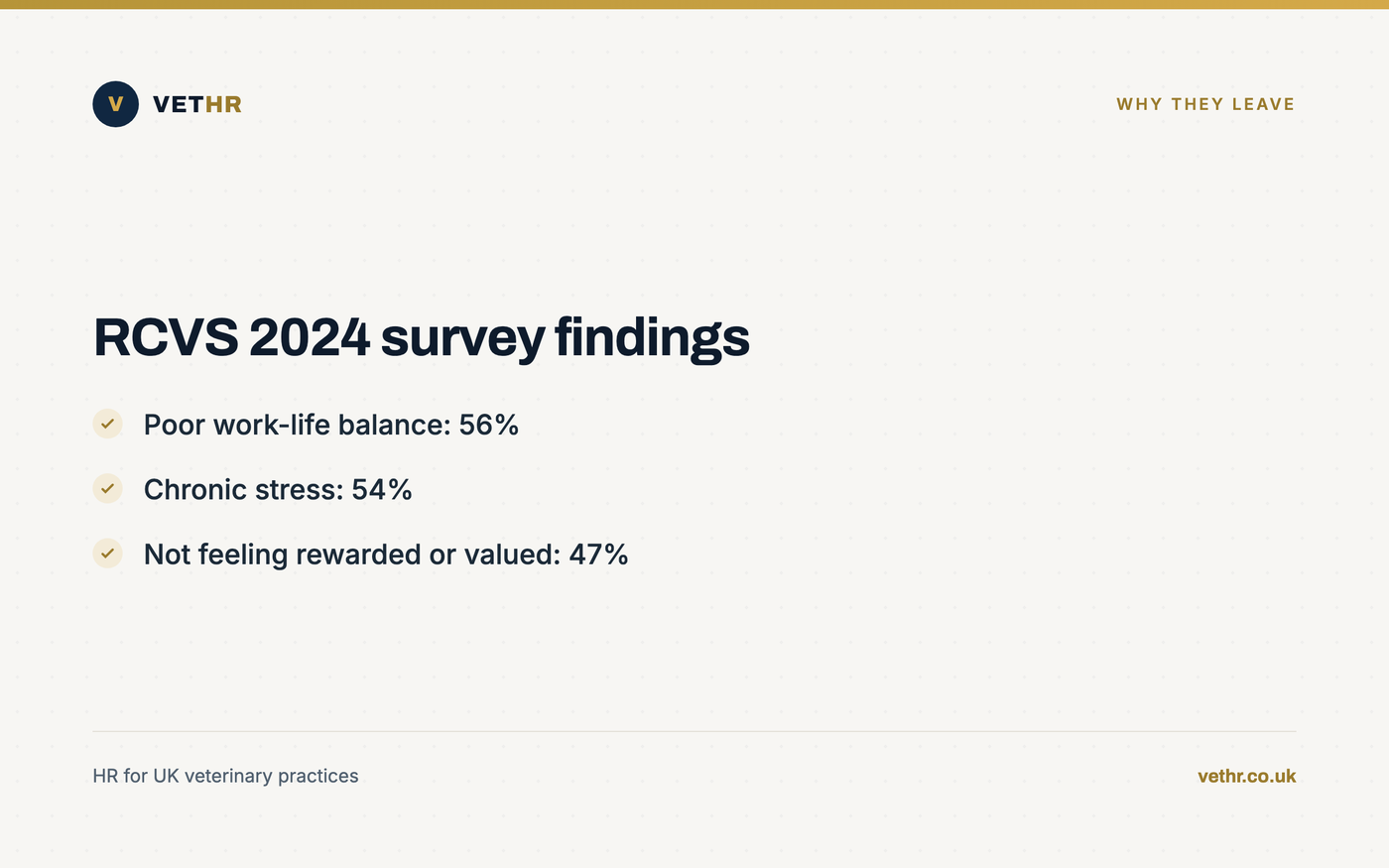
Mostly for reasons that are not about money. The RCVS 2024 Survey of the Veterinary Profession reports that among those intending to leave, the reasons given included poor work-life balance (56%), chronic stress (54%), and not feeling rewarded or valued in a non-financial sense (47%).
The same survey records 75% of veterinary surgeon respondents intending to stay in the profession for five or more years in 2024, compared with 79% in 2019, based on 6,987 responses from vets and 3,740 from veterinary nurses.
Read the three reasons again as management levers. Work-life balance is the rota. Chronic stress is workload, staffing levels and how emergencies are absorbed. Feeling valued is recognition and communication. All three are things a practice controls, and none of them requires a bigger pay budget to improve.
The nursing picture deserves separate attention. The same survey found conditions substantially affecting daily activities reported by 29% of veterinary nurses compared with 17% of vets, which is a meaningful difference when you are designing shifts and support.
Your staff turnover rate is leavers in the period, divided by average headcount in the period, multiplied by 100. Run it annually for the whole practice, then split it two ways, because the headline figure hides everything useful.
A small practice will see wild percentage swings from a single departure, so read the trend across three years rather than reacting to one figure. What matters is the pattern: whether staff turnover concentrates in one role, one branch, one shift pattern or one manager.
Because an early leaver costs everything and returns almost nothing. The practice pays the full recruitment and induction cost, absorbs the ramp-up, and then starts again before the person has reached the point of contributing at full speed.
Early staff turnover is also the most diagnosable kind. It usually traces to one of four things: an advert that described a job different from the reality, an induction that never happened properly, a rota that was presented as flexible and is not, or a probation period with no real conversations in it.
All four are fixable within a quarter. Our guides to onboarding a new vet in the first 90 days and the new starter checklist cover the first two directly.
More than the accounts will ever show. Every uncovered shift is absorbed by someone, and the people absorbing it are the ones you least want to lose. That is how one resignation becomes three over the following year, and it is the mechanism most practices miss.
The sequence is predictable. A vet leaves. The remaining vets pick up the out of hours and the overruns. Nurses cover longer days with fewer breaks. Nobody complains for the first two months because everyone understands it is temporary. By month four it is no longer temporary, and the second resignation arrives.
Two things break the cycle. Backfill cover early rather than testing how long the team can hold, even when the cover is expensive, and say out loud what the plan is and when it ends. Uncertainty is more corrosive than workload.
Track it in the rota rather than by instinct. If one nurse has covered nine extra shifts this quarter, that is a staff turnover risk with a name and a date on it. Our guide to managing burnout in a veterinary practice covers what to do next.
Lost someone this year and not sure why? A free 30-minute HR health check will look at the pattern with you. Book your HR health check.
The things the RCVS data points at, done consistently rather than dramatically. None of these is a perk. Each addresses one of the three stated reasons for leaving.
Practices often attack staff turnover with pay first, because it is the most visible lever. It matters, and it should be reviewed annually, but a competitive salary does not compensate for a rota that makes people miss their children’s bedtimes three nights a week.
There is no single published benchmark that applies to every practice, and small teams produce statistically noisy figures. Your own three-year trend, split by role and by length of service, is far more useful than any national average you could compare yourself against.
Yes. People retire, relocate, move into referral work or leave clinical practice, and a team with no movement at all can stagnate. The concern is not movement itself but concentration: several departures from one role, one branch or one shift pattern in a short period.
Rarely, and only where the reason for leaving was genuinely pay. Where the driver was workload, rota or feeling undervalued, a counter-offer buys a few months and leaves the underlying issue in place. It also sets a precedent your team will notice.
A spreadsheet with joiners, leavers, role, start date, end date and stated reason will do for a single site. The difficulty is consistency over years and across managers, which is where a staff records system earns its place. Bad data is what makes turnover invisible.
It can, indirectly. Accreditation standards require registered nursing cover and adequate staffing levels, so a practice that keeps losing RVNs may find a standard at risk. That makes retention a compliance question as well as a commercial one.
Nobody sets out to run a practice with high staff turnover. It happens because the cost is spread thinly across cover, overtime and lost capacity, and never appears as a single line anyone has to defend. Put it in one place and the business case for retention makes itself.
Most of the fixes are rota, communication and process rather than money. Our rota system and HR consultancy exist to make those changes stick, and the free HR health check is a good place to start the conversation.
The Vet HR Team provides HR consultancy and white-labelled staff systems exclusively to UK veterinary practices.
Contracts, rotas, holiday, a difficult conversation. Tell us what you are dealing with and we will come back within one working day. Nothing to sign up to.
Got it. We will come back to you within one working day. If you do not see a reply, please check your spam folder.
