Last updated: 27 June 2026
TL;DR: The cost of a bad rota in a veterinary practice is rarely one big invoice. It leaks out in five quiet places: overtime, freelance vet cover, burnout-driven turnover, payroll and compliance errors, and lost goodwill. Most owners never add it up, so it never gets fixed. Below we name each leak, anchor it to real figures, and build one clearly-labelled illustration so you can run the same maths for your own practice.
A rota feels like a free admin job: someone fills a grid, the week happens. It is not free. A poorly built one charges you every week in cash, hours and people, and the bill only shows up scattered across other line items. This is a calm look at where it hides and how to size it.
The cost of a bad rota is the sum of five leaks: extra overtime, expensive freelance vet cover, turnover when people burn out, errors in pay and compliance, and the goodwill you lose when the team stops trusting the schedule. None of these arrives as a single bill, which is exactly why they go unmeasured for years.
Poor rota planning is not about a messy spreadsheet. It is about hours that do not match demand, cover that is found late and dear, and a pattern that quietly grinds people down. The financial damage is real, but it sits in places an owner rarely totals up in one view.
There is good reason to take the people side seriously. In the RCVS Surveys of the Professions 2024, the share of vets intending to stay in the profession for five or more years fell to 75 percent, down from 79 percent in 2019, according to the RCVS. A rota is one of the few levers a practice fully controls to slow that drift.
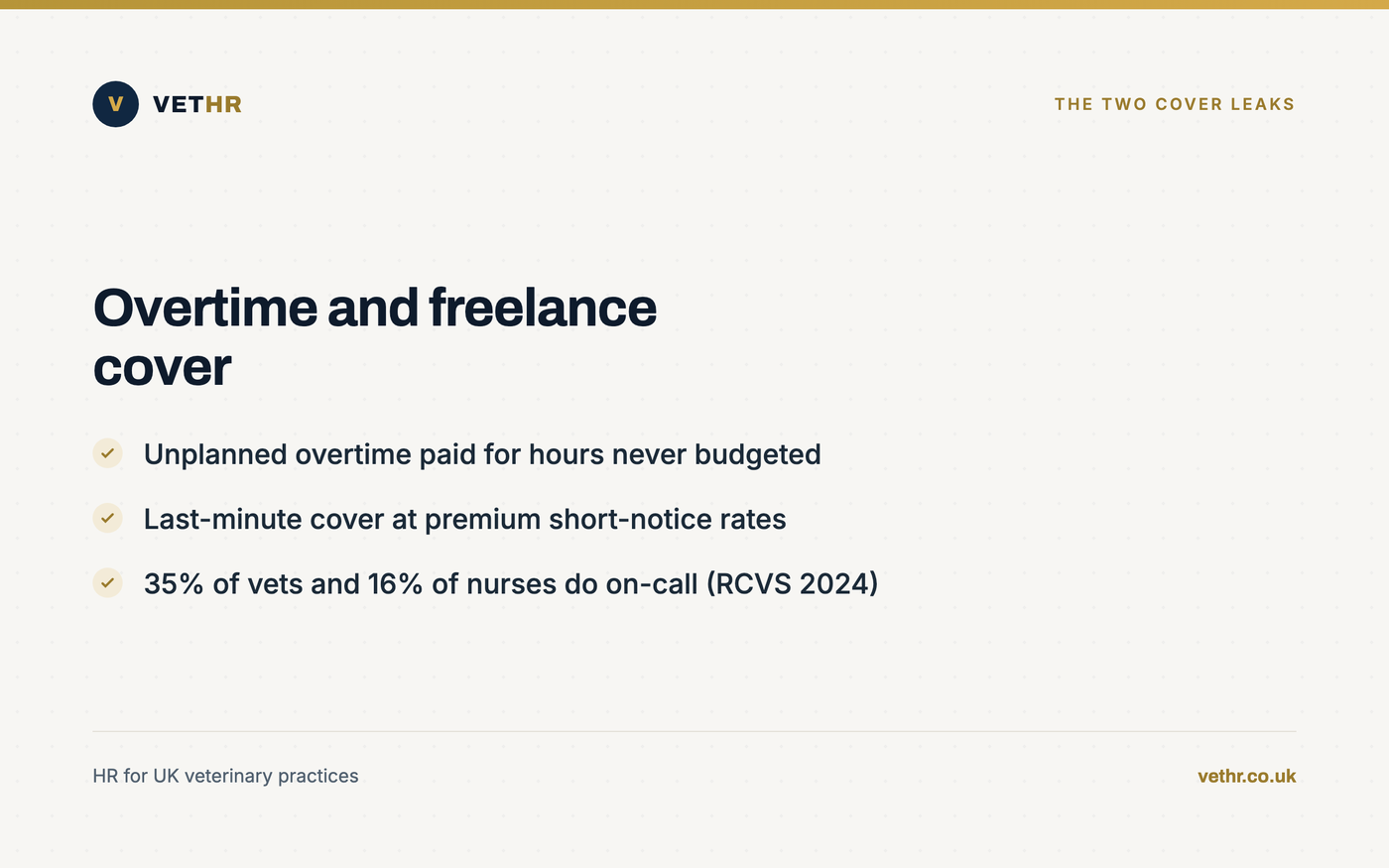
A poor rota drives up cost in two ways: it pays people for hours it did not plan, and it sends you to the market for freelance vet cover at short notice, when the price is highest. Both are symptoms of the same problem, a schedule that did not match the work to the week before the week began.
Overtime is the first leak. When shifts run short on cover, the people on shift stay late, and consults that overrun become paid hours nobody budgeted. The hours that matter are not the planned ones but the actual ones, and a rota that never compares the two cannot see the gap it is paying for.
The legal frame is worth naming. GOV.UK states that staff cannot work more than 48 hours a week on average, normally averaged over 17 weeks, unless they opt out in writing, on its maximum weekly working hours guidance. A rota that quietly pushes regulars over that line is not just costly, it is a risk you are carrying without a record.
Freelance vet cover is the second leak, and the more expensive one. Booked weeks ahead to fill a known gap, it is a planned cost. Booked the night before because the rota fell over, it is a premium you pay for the failure to plan. The same shift can cost very different amounts depending only on when you saw it coming.
Out-of-hours is where this bites hardest. The RCVS found that 35 percent of vets and 16 percent of veterinary nurses did on-call hours, per the RCVS 2024 survey. On-call is precisely where a bad rota leaves last-minute holes, and last-minute holes are filled at the highest rates available.
Turnover is the biggest hidden leak, because losing one good nurse or vet means recruiting, onboarding and covering the gap in between. The CIPD puts the median cost of recruiting an employee at 1,500 pounds, before you count the cover and lost productivity that sit on top of it.
That 1,500-pound figure comes from the CIPD Resourcing and Talent Planning Report 2022, which records the median cost to recruit per employee, as cited by the HSE and across UK HR reporting. It is the visible part of the bill: advertising, agency fees and the time spent shortlisting and interviewing. The invisible part is usually larger.
The rota link to turnover is direct. The RCVS 2024 survey lists the leading reasons people give for leaving the profession as poor work-life balance at 56 percent, chronic stress at 54 percent, and not feeling rewarded or valued in a non-financial sense at 47 percent, per the RCVS. A fair, predictable rota speaks directly to all three.
Think of it as a chain. A rota that keeps cancelling days off and dropping last-minute on-call burns people out. Burnout drives a resignation. The resignation triggers a recruitment cost, weeks of freelance vet cover at premium rates, and a tired team carrying the gap. The original cause was a schedule, not a salary.
Not sure how much your current rota is leaking? A 30-minute conversation usually surfaces it. Book a free HR health check and we will look at how you plan hours, fill cover and track actual time today, then tell you honestly where the money is going. No jargon, nothing sold for the sake of it.
Rota errors cost you twice: once in the wrong pay that goes out, and again in the trust that erodes when staff stop believing the schedule. Compliance gaps add a third cost, the records you cannot produce when someone asks. All three are cheap to prevent and expensive to unpick after the fact.
Pay errors are the obvious one. When hours live in memory and messages, overtime gets missed, a shift gets double-counted, and the correction lands next month with an apology. Each fix is small. The pattern, repeated across a year and a team, is not, and it quietly costs you credibility as well as cash.
Compliance is the leak with teeth. Acas states that working time records must be kept for two years from the date they were made, in its guidance on the working time rules. A rota that never captures actual hours leaves you unable to evidence rest breaks, the 48-hour position or who was genuinely on shift, which turns a routine query into a scramble.
The cure for all three is the same: plan and actual hours sitting together, captured at the time rather than recalled at the end of a long day. That is the difference between a rota that records what happened and a rota that hopes everyone remembers it correctly.
Here is the honest part. We cannot tell you your number, because it depends on your team, your rates and your rota. What we can do is build an illustration with clearly-stated assumptions, so you can swap in your own figures. The figures below are illustrative assumptions, not researched averages, except where a source is named.
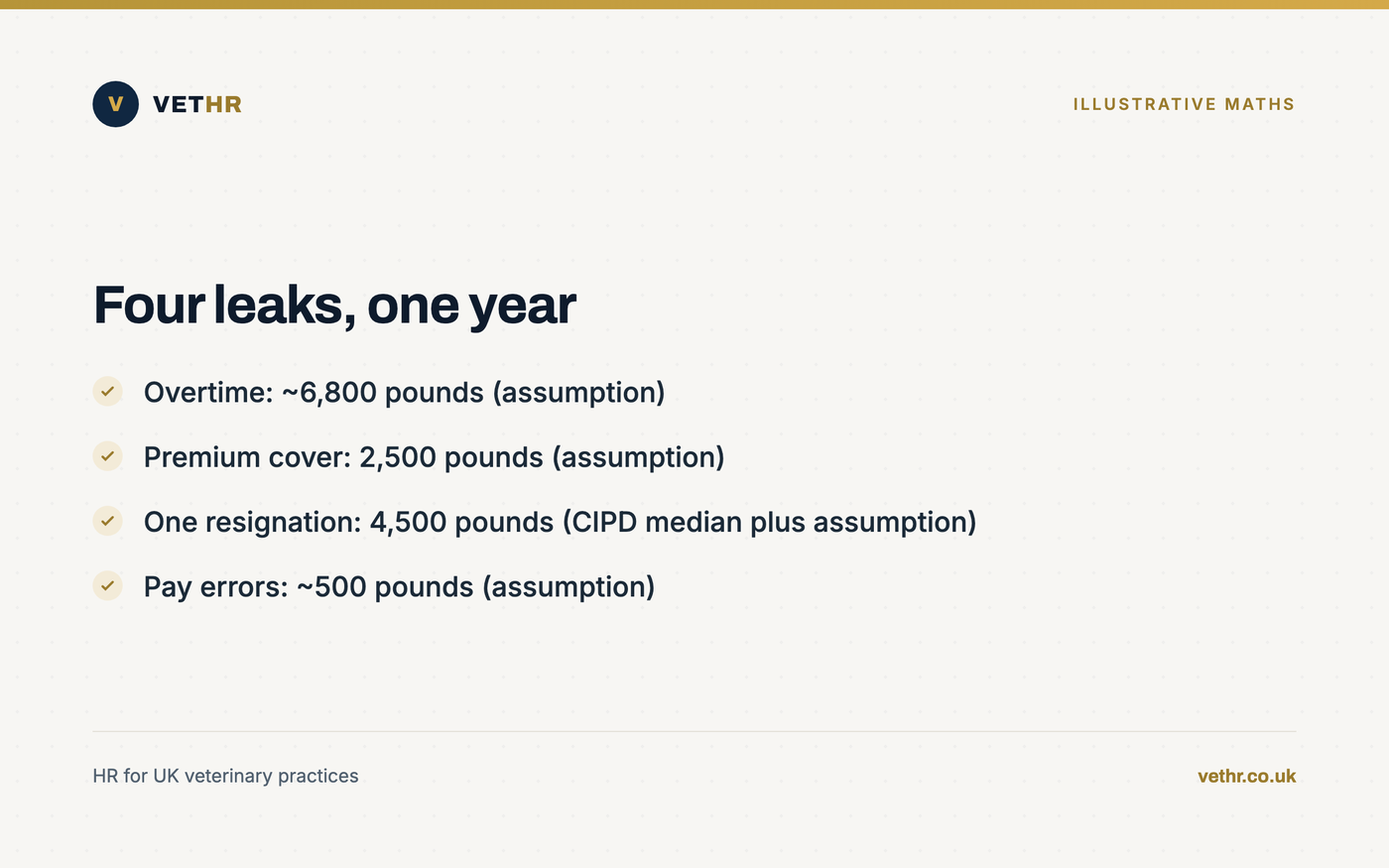
The illustration. Picture a six-vet, eight-nurse independent practice. We will assume four leaks over one year. Every pound figure here is an assumption we have chosen to show the method, not a measured market rate. The one anchored figure is the recruitment cost, which uses the CIPD median.
Add the illustration up and it comes to about 14,300 pounds in a single year, from four leaks, in one mid-sized practice. To be clear, every component except the 1,500-pound recruitment median is an assumption we picked to demonstrate the maths. Change the rates and you change the total, but the structure of the leak stays the same.
The point is not the headline number. It is that none of these four leaks ever appears on a line called “bad rota”. They hide in payroll, in invoices, in recruitment, in next month’s correction. Sized together, even on conservative assumptions, they usually dwarf the cost of fixing the schedule that caused them.
You stop the leaks by making the rota show its own costs: match hours to demand, capture actual time at the point of work, and surface cover gaps early enough to fill them at planned rates. The aim is a schedule that pays for itself by removing the scrambles it used to create.
Start with visibility. A veterinary rota system that links planned hours to actual ones lets you see overtime as it builds, instead of discovering it on a payslip. When the gap between planned and worked is visible weekly, it stops being a surprise and starts being a decision.
Then close the records gap. Clock in and out captures real timestamps, which turns the two-year working time record from a chore into a by-product, and makes pay errors far harder to introduce. Accurate hours in means accurate pay out, with an audit trail behind it.
Finally, treat the rota as part of retention, not just logistics. Our staff systems and HR consultancy are built around the same tools your team uses, so a fairer schedule, cleaner records and better cover planning pull in the same direction. The rota stops being a cost centre and starts being a quiet saving.
Usually turnover. A poor rota that burns people out can trigger a resignation, and the CIPD puts the median cost of recruiting an employee at 1,500 pounds before you count cover and lost productivity. Overtime and premium freelance vet cover are visible weekly, but the people cost is the largest and the most hidden.
Add four leaks for one year: unplanned overtime hours times your blended rate, the premium paid on last-minute cover versus planned cover, the recruitment and cover cost of any avoidable resignation, and pay-error corrections. Use your own rates rather than averages. Even on conservative assumptions, the total usually surprises owners who have never summed it in one view.
It contributes. The RCVS 2024 survey lists the top reasons for leaving the profession as poor work-life balance, chronic stress and not feeling valued, and a rota shapes all three. A fair, predictable schedule that protects rest and shares on-call evenly is one of the few retention levers a practice fully controls.
Because timing sets the price. Freelance vet cover booked weeks ahead to fill a known gap is a planned cost. The same shift booked the night before, because the rota fell over, is a premium for short notice. A rota that surfaces gaps early lets you fill them at planned rates instead of emergency ones.
Yes. Acas requires working time records to be kept for two years from the date they were made, and the legal weekly maximum is 48 hours on average unless staff opt out in writing. A rota that never captures actual hours cannot evidence either, which turns a routine request into a scramble and leaves the practice carrying unrecorded risk.
A bad rota does not send you an invoice. It splits its cost across overtime, freelance cover, recruitment and corrections, then hopes you never add them up. When you do, even on cautious assumptions, the schedule usually turns out to be one of the most expensive things in the practice that nobody was measuring.
If you want a straight read on your own number, start with the friction. Browse our veterinary rota system, see how it connects to clock in and out, or simply book a free HR health check and we will tell you honestly where your rota is leaking and what it would take to stop it.
The Vet HR Team provides HR consultancy and white-labelled staff systems exclusively to UK veterinary practices.
Free tool: Add up what your rota is costing you with the free rota cost calculator
Read next: The Veterinary Rota: 7 Mistakes That Burn Out Your Team.
Contracts, rotas, holiday, a difficult conversation. Tell us what you are dealing with and we will come back within one working day. Nothing to sign up to.
Got it. We will come back to you within one working day. If you do not see a reply, please check your spam folder.
