Last updated: 24 September 2026
TL;DR: Every payslip must be given on or before payday and must show earnings before and after deductions, the amount of any deduction that changes each pay period, and the number of hours worked where pay varies with time worked. That last requirement catches almost every veterinary practice that pays overtime, on-call or bank shifts.
A bank nurse worked three shifts in July, one of which ran four hours over because of an emergency caesarean. Her payslip shows a single figure and the word bank. She cannot tell whether the four hours are in it. Neither can the practice manager, without opening the rota, the clock in records and a spreadsheet. That pay statement does not meet the legal requirement, and it is entirely typical.
Almost everyone on your payroll. GOV.UK states that your employer must provide you with a payslip, with a short list of exceptions that includes contractors, freelancers, police officers, merchant seamen and certain fishing vessel crew.
In a veterinary practice that means every employee and worker gets one: full-time vets, part-time nurses, bank staff, weekend reception cover, kennel assistants and apprentices. Workers, not just employees, are in scope.
The one group people ask about is freelance vet cover. If they are genuinely self-employed and invoicing you, there is no payslip. If the working arrangement means they are really a worker, there is. Our note on employment status in a veterinary practice covers how to tell.
On or before payday. GOV.UK is specific about that, and it rules out the practice habit of handing out payslips at the end of the week after the money lands.
Electronic delivery is fine. An emailed PDF, or access through a staff portal, meets the requirement as long as it arrives in time and the person can actually open it. A document sitting in a system nobody has logged into for a year is not much use to anyone.
Self service access solves this permanently. Our page on employee self service for veterinary practices covers how staff get to their own documents without going through the practice manager.
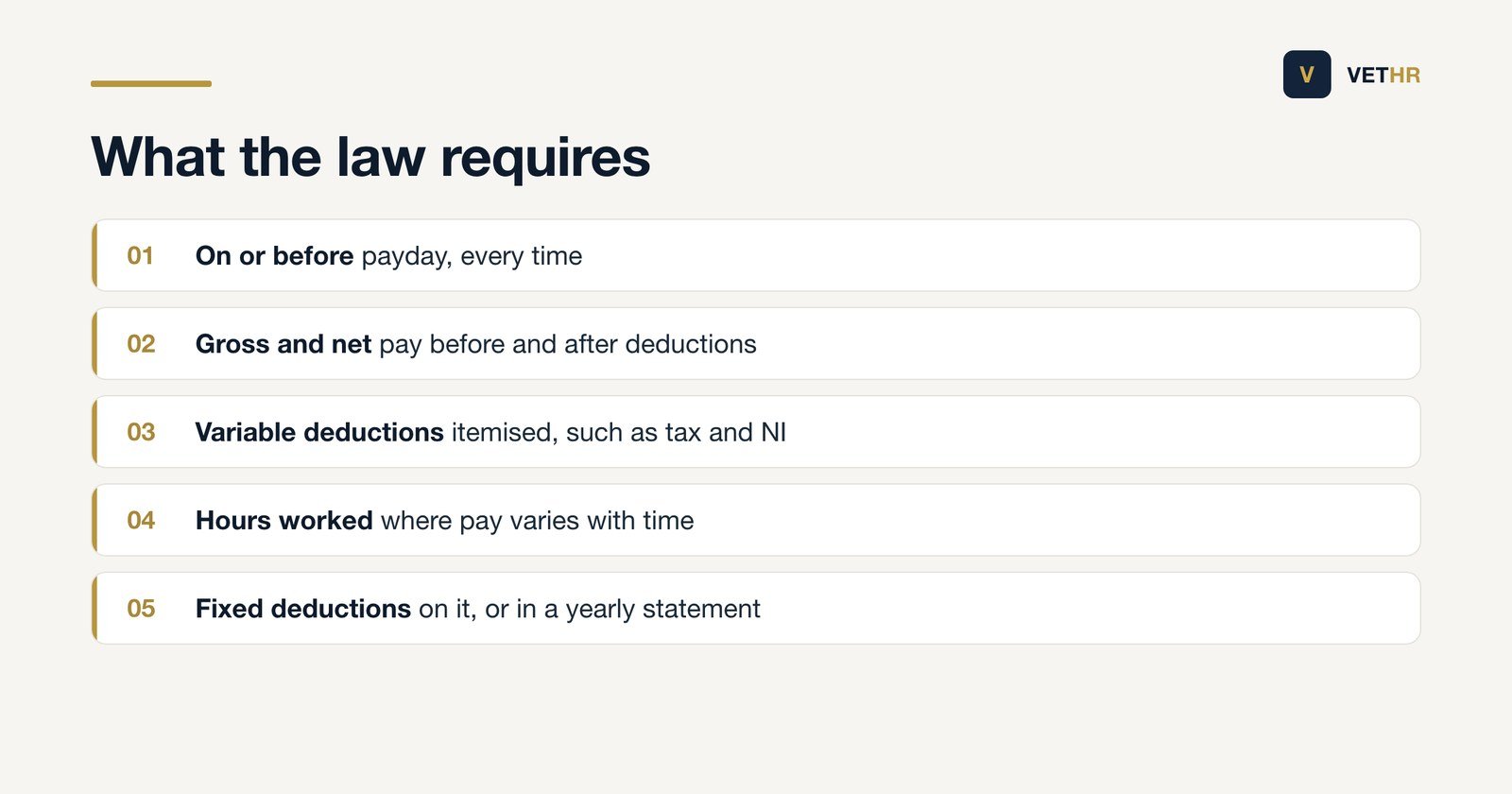
Three things are required on the face of it. GOV.UK sets out that a payslip must show earnings before and after any deductions, the amount of any deductions that may change each time you are paid, for example tax and National Insurance, and the number of hours worked if pay varies depending on time worked.
Most payroll software produces the first two without being asked. The third is the one that gets missed, because it depends on how your practice pays people rather than on the software.
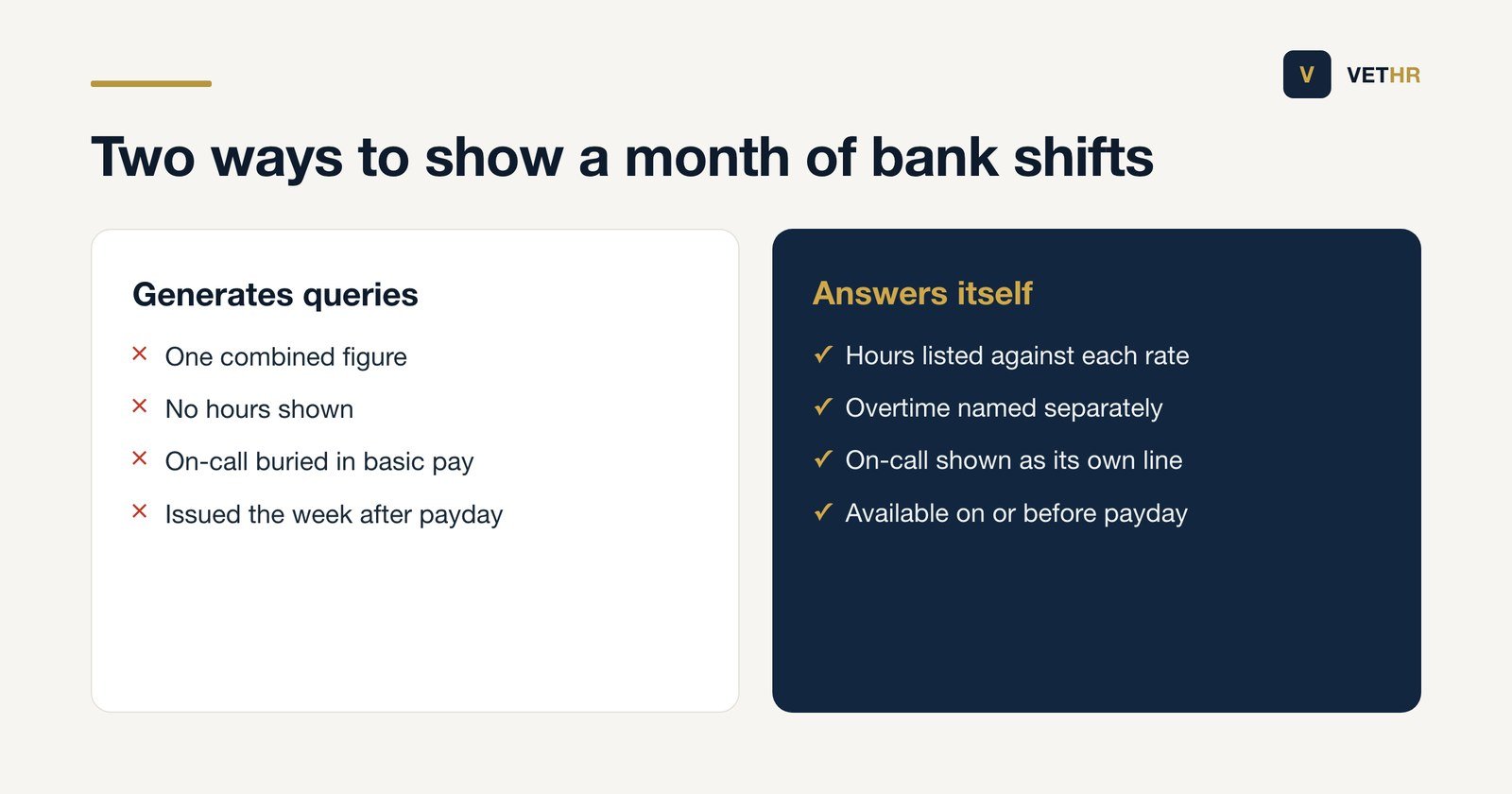
Good practice goes further than the minimum. Name every element: basic pay, overtime at the agreed rate, on-call allowance, out of hours sessions, bank shifts, holiday pay. A statement that lists what the money is for generates almost no queries at all.
If pay varies with time worked, the hours have to be shown. Read that against a typical veterinary payroll and the scope becomes obvious: bank staff, overtime, on-call call outs, weekend rates and anyone on an hourly contract.
Showing a single combined figure for a month of mixed shifts does not meet it. Where different rates apply, show the hours against each rate so the person can check the arithmetic themselves.
This is much easier when the hours come from a system rather than a memory. Our clock in and out system feeds actual worked hours straight into the payroll export, and the note on overtime for veterinary staff covers the rates that usually need separating.
There is a compliance benefit too. A statement that shows hours against rates is the simplest evidence you have that someone was paid at least the National Minimum Wage.
Set the rates up once, in the payroll software, rather than typing a total each month. A practice that calculates on-call by hand in a spreadsheet is carrying a monthly risk of error, and every error costs more in trust than it does in money.
Check one thing at random each month. Take a single member of staff, open the rota, open the clock in record and read across to the figures they were sent. If the three do not reconcile in under five minutes, the format is the problem, not the person checking it.
Deductions that stay the same every month, such as a season ticket loan repayment, can be explained either on the payslip itself or in a separate written statement. GOV.UK requires that statement to be sent before the first payslip it applies to, and updated annually.
In practice, putting the detail on the face of it is easier than running a separate document you will forget to update. If you do use a statement, diarise the annual refresh.
Remember that showing a deduction does not make it lawful. GOV.UK sets out when an employer can make deductions from pay, and our guide to deductions from wages in a veterinary practice covers the clause you need before you take anything.
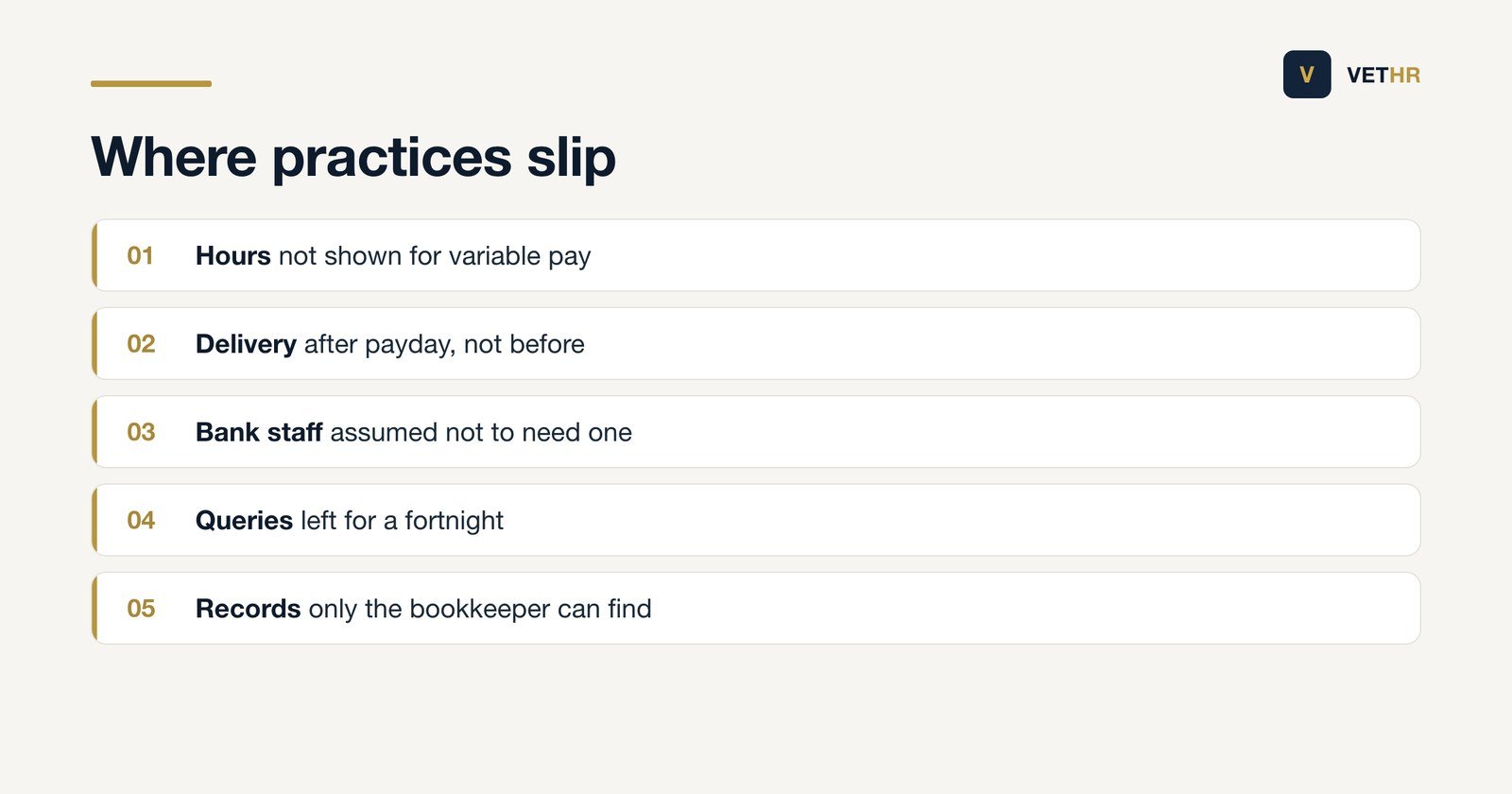
Answer it the same week. A pay query that sits for a fortnight becomes a grievance, and a grievance about money becomes a resignation faster than almost anything else in practice life.
Have one named person who owns payroll questions, and say who that is at induction. If the answer is that a mistake was made, say so, correct it in the next run or sooner, and tell the person the date.
Keep a short log of queries. Three queries a month about on-call is not three problems, it is one badly described pay element, and fixing the description fixes all three.
Most queries are not about dishonesty. They are about a figure nobody can explain, arriving at the end of a month when someone is already stretched. Explaining it quickly and in plain words settles almost all of them.
Keep the payroll records that sit behind each one: hours worked, rates applied, deductions and the payments made. HMRC and minimum wage enforcement both work backwards from these, and so does any tribunal claim about unpaid wages.
Store them where they are retrievable by someone other than the person who ran the payroll. Practices that lose a bookkeeper lose the ability to answer questions about the previous year, which is an avoidable problem.
Our note on veterinary payroll covers the handover between rota, hours and payroll, which is where most errors originate. If yours runs on three spreadsheets and a good memory, book a free 30-minute HR health check and we will map it.
Yes. Electronic payslips are acceptable provided they are available on or before payday and the person can access them. A portal works too, as long as staff actually have working logins and know where to look.
Yes. Workers are entitled to one, not just employees. Bank staff also fall squarely into the rule requiring hours to be shown, because their pay varies with the time they work.
The legal minimum does not require it, but showing it separately is strongly advisable. It answers the most common question staff ask, and it makes the position clear if holiday pay is ever queried later.
Correct it as quickly as you can and tell the person when the money will reach them. If the error was an overpayment, write to them with the total and a proposed schedule rather than adjusting the next payslip without warning.
They can ask, and in most cases it is easiest to provide copies. Payroll records are personal data, so a formal request can also be made as a subject access request, which brings its own time limits.
The legal test is short: on or before payday, pay before and after deductions, variable deductions itemised, hours shown where pay varies with time worked. The practical test is shorter still. Can the person holding it work out whether they were paid correctly?
If the answer is no, it is generating work for you every month. We fix the rota to payroll chain for independent practices through HR consultancy and the Vet HR staff systems.
The Vet HR Team provides HR consultancy and white-labelled staff systems exclusively to UK veterinary practices.
Contracts, rotas, holiday, a difficult conversation. Tell us what you are dealing with and we will come back within one working day. Nothing to sign up to.
Got it. We will come back to you within one working day. If you do not see a reply, please check your spam folder.
