Last updated: 24 September 2026
TL;DR: Contract changes have to be agreed by both sides, unless the contract itself contains a clause allowing the change. Consult first, explain why, listen to alternatives, and record what was agreed. Imposing a change risks breach of contract and constructive dismissal claims, and dismissal and re-engagement has its own statutory Code to follow.
The new rota goes up on a Thursday. Two nurses who have worked Monday to Friday for six years are now on a rolling pattern that includes alternate Saturdays. Nobody was asked. The practice sees an operational decision. The law sees contract changes made without agreement, and one of those nurses is already taking a photograph of the rota.
Acas states the position in one line: you must both agree to the changes, unless there is a clause in the contract that allows you to change without agreement. That is the whole test, and everything else in this article is about how to get there.
Agreement can be express, in a signed letter, or it can be inferred from conduct over time. Relying on the second is a gamble, because someone who works the new pattern under protest has not agreed to anything.
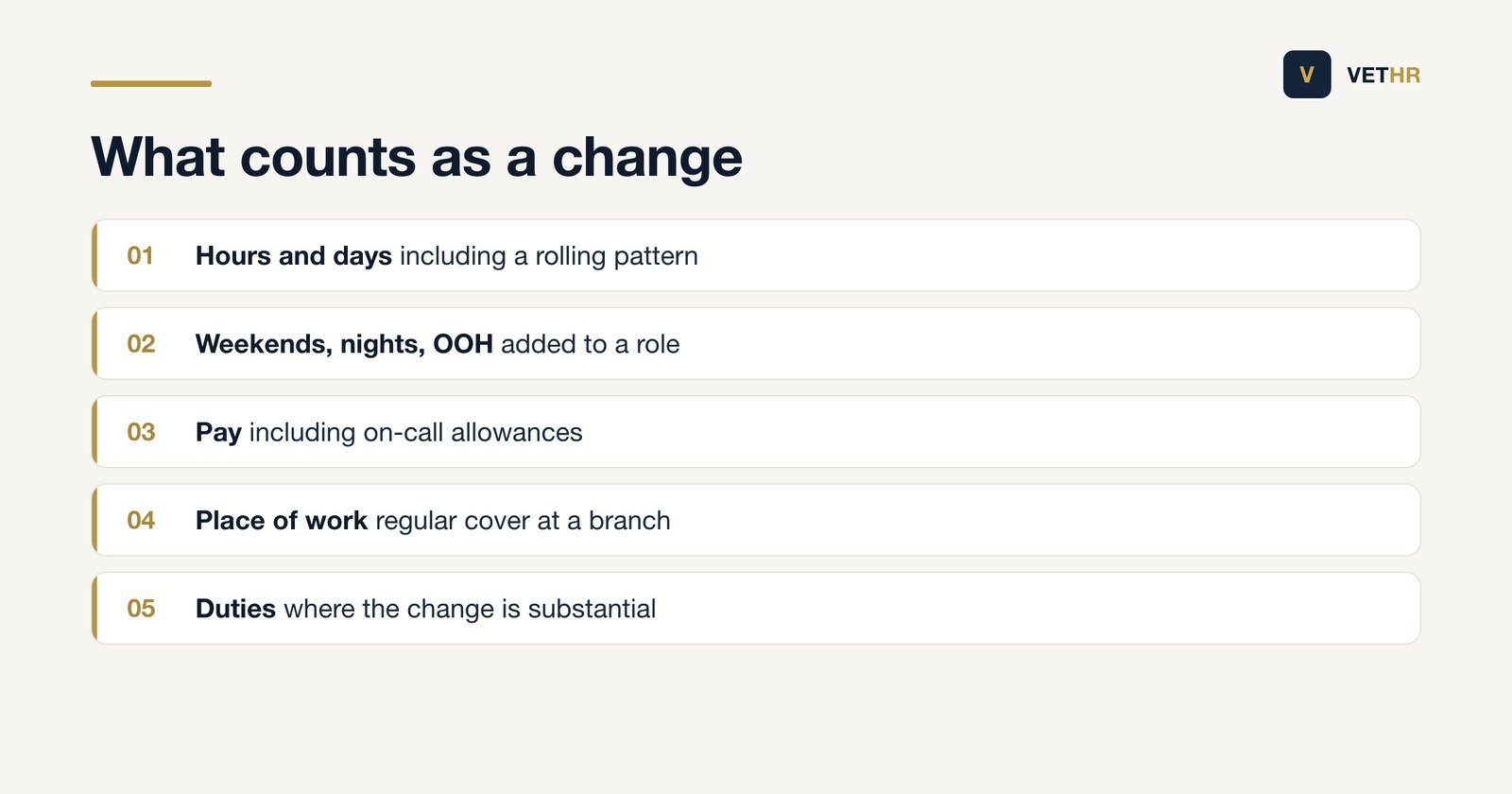
Practices get into trouble because contract changes rarely feel like contract changes. They feel like a new rota, a restructured branch, or a pay element being tidied up.
More than most owners think. These are the ones that come up in veterinary practice.
Notice that most of that list is rota and pay. That is where contract changes actually happen in this profession, not in a formal restructure. Our note on shift patterns in a veterinary practice covers the changes that most often cross the line.
There is a timing point too. A change agreed for a future date is easier to sell than one that starts next week, because people can plan around it. Where the business reason allows, give the change a start date at least a full rota cycle away and say clearly what happens in the meantime.
A well drafted clause can allow limited variation without fresh agreement, for example reasonable changes to shift start times or cover at a named second site. It is useful, and it is not a blank cheque.
A clause saying the practice may vary any term at any time will not carry a significant change on its own. The wider the clause, the less weight it holds when it matters, and using one to impose a large change still has to be reasonable.
Check what your contracts actually say before you plan anything. Many practices discover their template has no relevant clause at all. Our guide to employment contracts for veterinary staff covers what a workable version looks like.
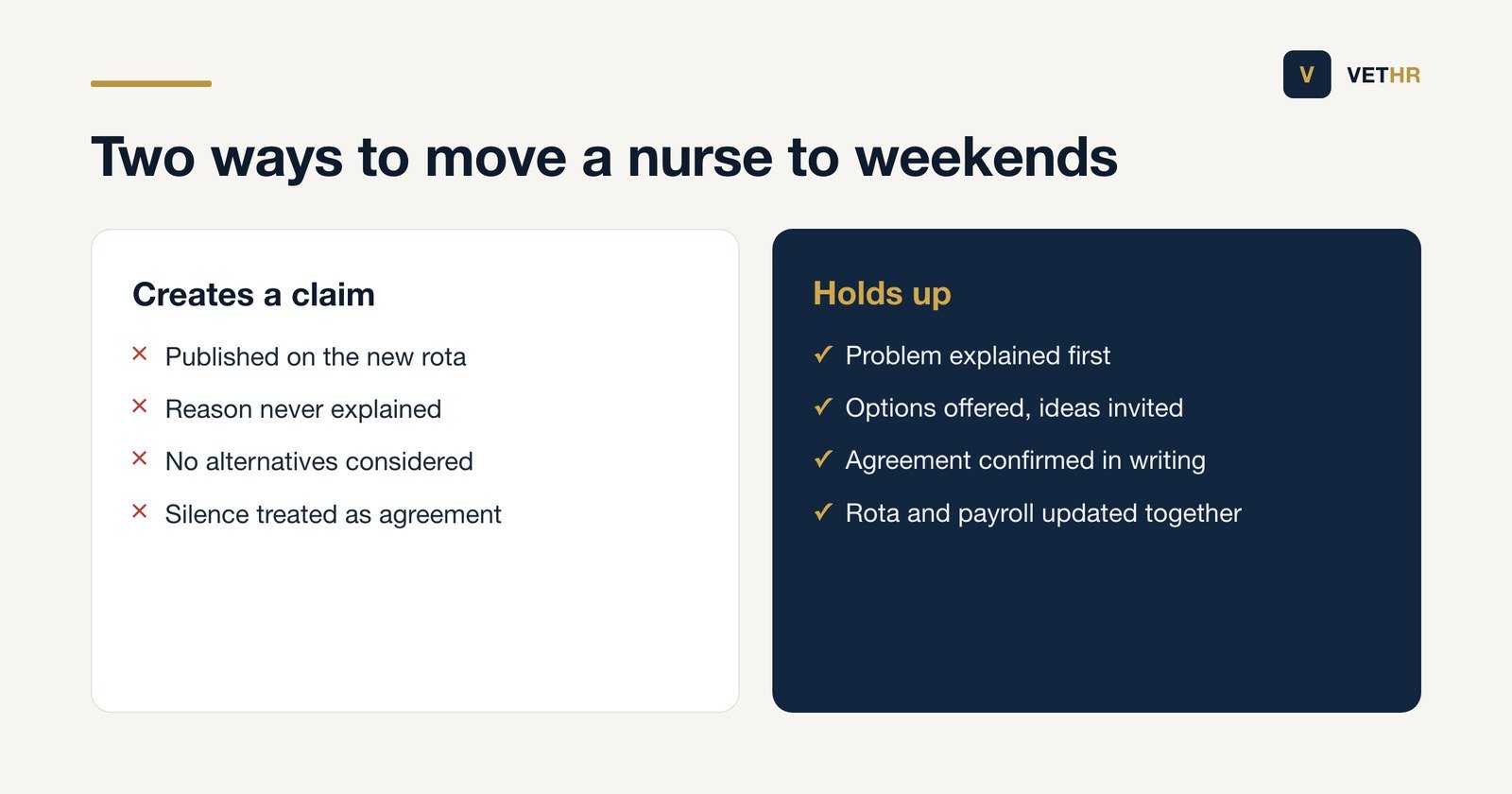
Acas guidance on an employer’s responsibilities when changing a contract says to explore alternatives first, make clear why you need the change, and always listen to staff and consider their proposals.
In a small practice that is five meetings, not a project. Explain the problem before you have chosen the solution. Set out the options. Ask for better ones. Give people time to think. Then confirm in writing.
The order matters more than the paperwork. Consultation that begins after the decision has been made is not consultation, and staff can always tell the difference.
Where the same change affects several people, run it as a group process with individual meetings. Our guide to restructuring a veterinary practice sets out that sequence in full.
Offer something in return where you can. Contract changes that cost a member of staff something, a Saturday or a predictable finish time, land very differently when they come with an adjustment to pay, an extra day of leave or first choice of the following year’s holiday. It does not have to be expensive to be meaningful.
Say what happens if the change does not work. A three month review, written into the letter, turns a permanent imposition into a trial that both sides can talk about again. Practices that offer a review get agreement far more often than those that do not.
Ask why, properly. Refusals to contract changes usually have a specific cause: childcare on a Thursday, a second job, a care responsibility, or a commute that does not work at 7am. Some of those can be designed around.
If agreement cannot be reached, imposing the change carries real risk. Acas lists the consequences plainly: claims for breach of contract or constructive dismissal, damaged working relationships, reduced commitment, discrimination concerns and possible industrial action.
That discrimination point deserves attention in a profession that is heavily female and heavily part-time. A rota change that disadvantages staff with childcare responsibilities is a risk beyond the contract itself. Our note on constructive dismissal in a veterinary practice covers where imposed changes usually end up.
Keep the change as narrow as the problem. If the difficulty is Saturday morning consults, change Saturday morning consults. Bundling several contract changes into one announcement because the letter is being written anyway is how a manageable conversation turns into a collective grievance.
Write to each person confirming what has changed, from what date, and what stays the same. One page. Ask for a signed copy back, and keep it with the original contract rather than in an email folder.
Update the rota system and payroll on the same day. Contract changes that live only in a letter get forgotten within two rota cycles, and then you have a second dispute about what was actually agreed.
Keep the consultation notes too. If a change is challenged a year later, the notes are the evidence that you explained the reason and considered the alternatives.
Dismissing someone and re-engaging them on new terms is the last resort, and Acas is clear that employers must follow the statutory Code of Practice on dismissal and re-engagement, with tribunals assessing whether the Code was followed.
It is getting harder. The government’s Employment Rights Act implementation timeline lists fire and rehire protections for January 2027, alongside a reduction in the unfair dismissal qualifying period to 6 months for dismissals from the same date.
For an independent practice, the practical message is straightforward. Plan contract changes early enough that you never need this route, and take advice before you consider it. Book a free 30-minute HR health check if a change is coming and you want to get the sequence right.
Only if the contract allows it or the person agrees. Moving someone from fixed days to a rolling pattern that includes weekends is one of the clearest examples of contract changes, however operationally necessary it feels.
There is no single statutory figure for agreed variations, so give enough time for genuine consultation and for people to rearrange their lives. For anything touching childcare or a commute, weeks rather than days.
Not necessarily. Someone working under protest, who has objected in writing, has not accepted the change. Relying on silence is a weak position, which is why written confirmation both ways matters.
Improvements still change the contract, but they rarely cause disputes. Confirm them in writing anyway, so that the current terms are always evidenced by a document rather than by memory.
Deal with that person individually rather than pressing ahead across the team. A tailored solution for one nurse is almost always cheaper than a dispute, and it does not set the precedent owners fear it does.
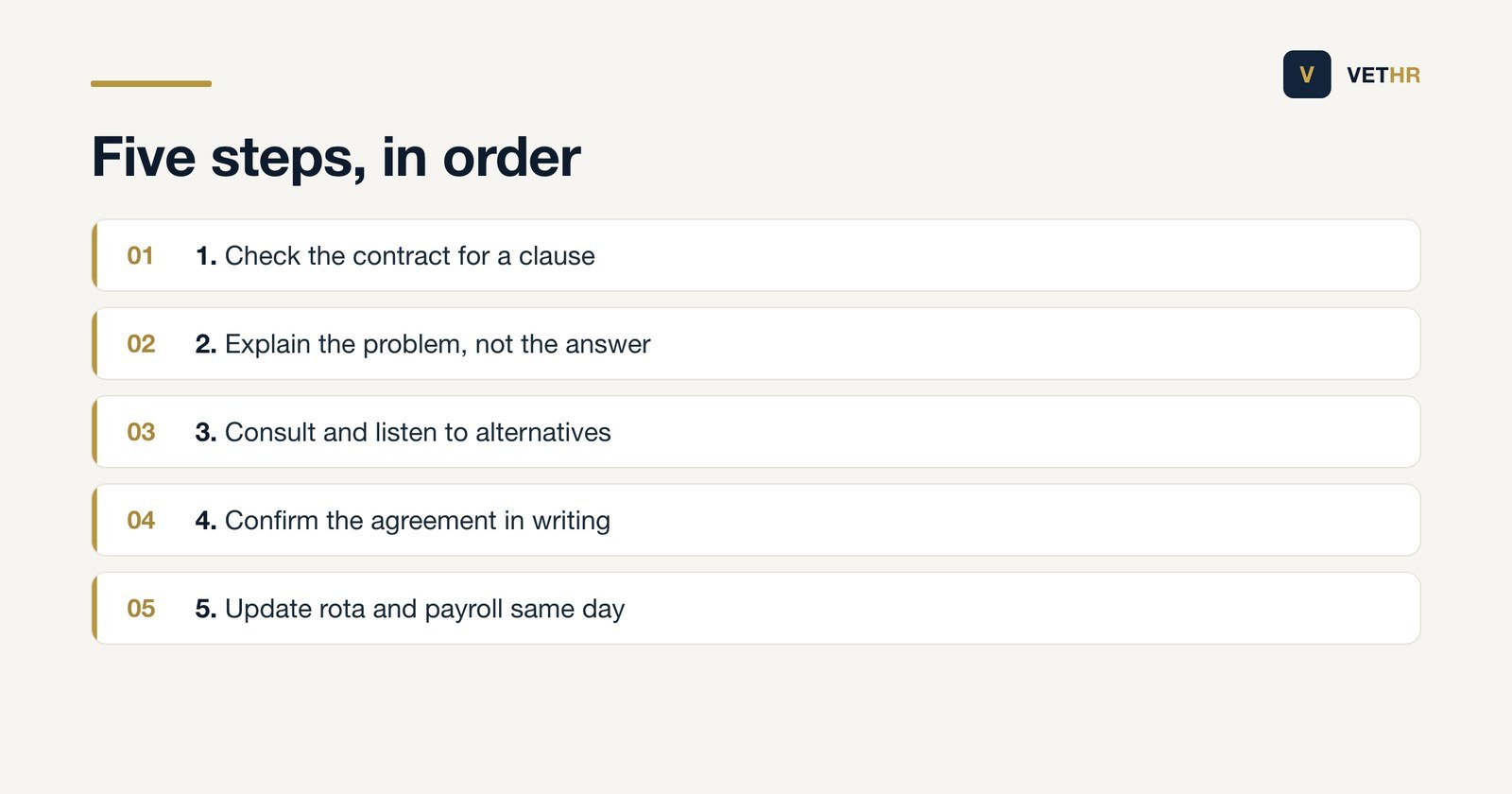
Check the contract for a clause. Explain the problem before choosing the solution. Consult and listen to alternatives. Confirm the agreement in writing. Update the rota and payroll the same day. Contract changes handled in that order almost never become claims.
If your templates have no flexibility clause, or you have a change coming that affects the whole rota, we help independent practices with both through employment contract drafting and fixed-price HR consultancy.
The Vet HR Team provides HR consultancy and white-labelled staff systems exclusively to UK veterinary practices.
Contracts, rotas, holiday, a difficult conversation. Tell us what you are dealing with and we will come back within one working day. Nothing to sign up to.
Got it. We will come back to you within one working day. If you do not see a reply, please check your spam folder.
