Last updated: 5 September 2026
TL;DR: A restructure that changes roles, hours, shifts or reporting lines without cutting headcount is a contract variation, not a redundancy, and it runs on completely different rules. You need agreement. You cannot simply impose new shift patterns, and from January 2027 dismissing somebody for refusing to accept changes to pay, hours or shift patterns is expected to become automatically unfair.
Any change to how the practice is organised that affects people’s terms without reducing the number of people. Merging two branch rotas. Moving from three long days to five short ones. Creating a head nurse layer. Changing who reports to whom. Moving somebody between sites.
Practices frequently call this a redundancy exercise because that is the only process they know, and that is the first mistake. If nobody’s job is disappearing, it is not a redundancy, and running a redundancy process where there is no redundancy is itself a problem.
Contractual terms can only be changed by agreement. That is the whole of it, and everything else is a way of getting to agreement or a consequence of not having it.
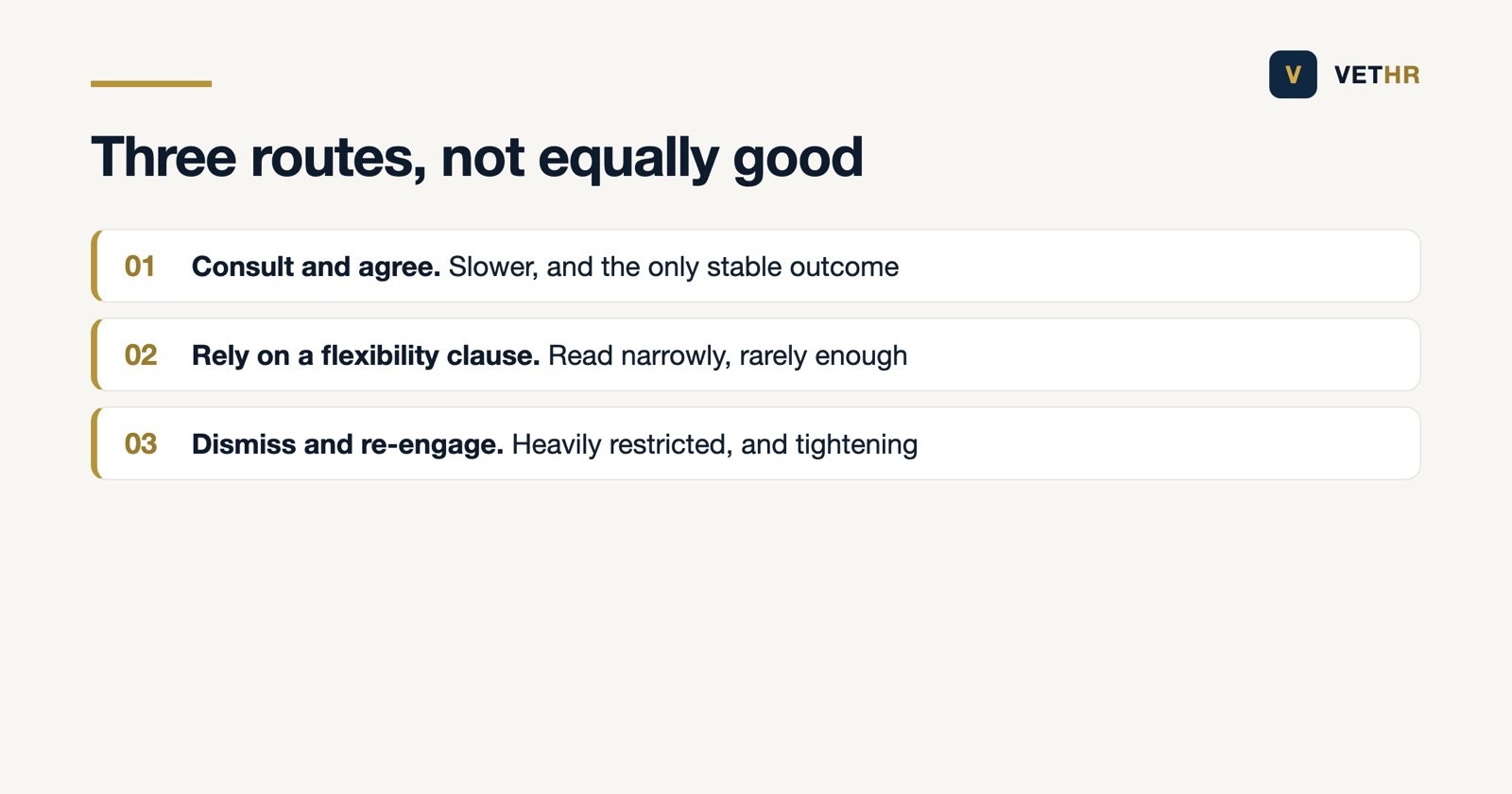
Three routes exist, and they are not equally good:
In a veterinary practice, route one is almost always the right answer, because the people affected are the people you cannot easily replace.
This is the part to plan around if a restructure is on your horizon.
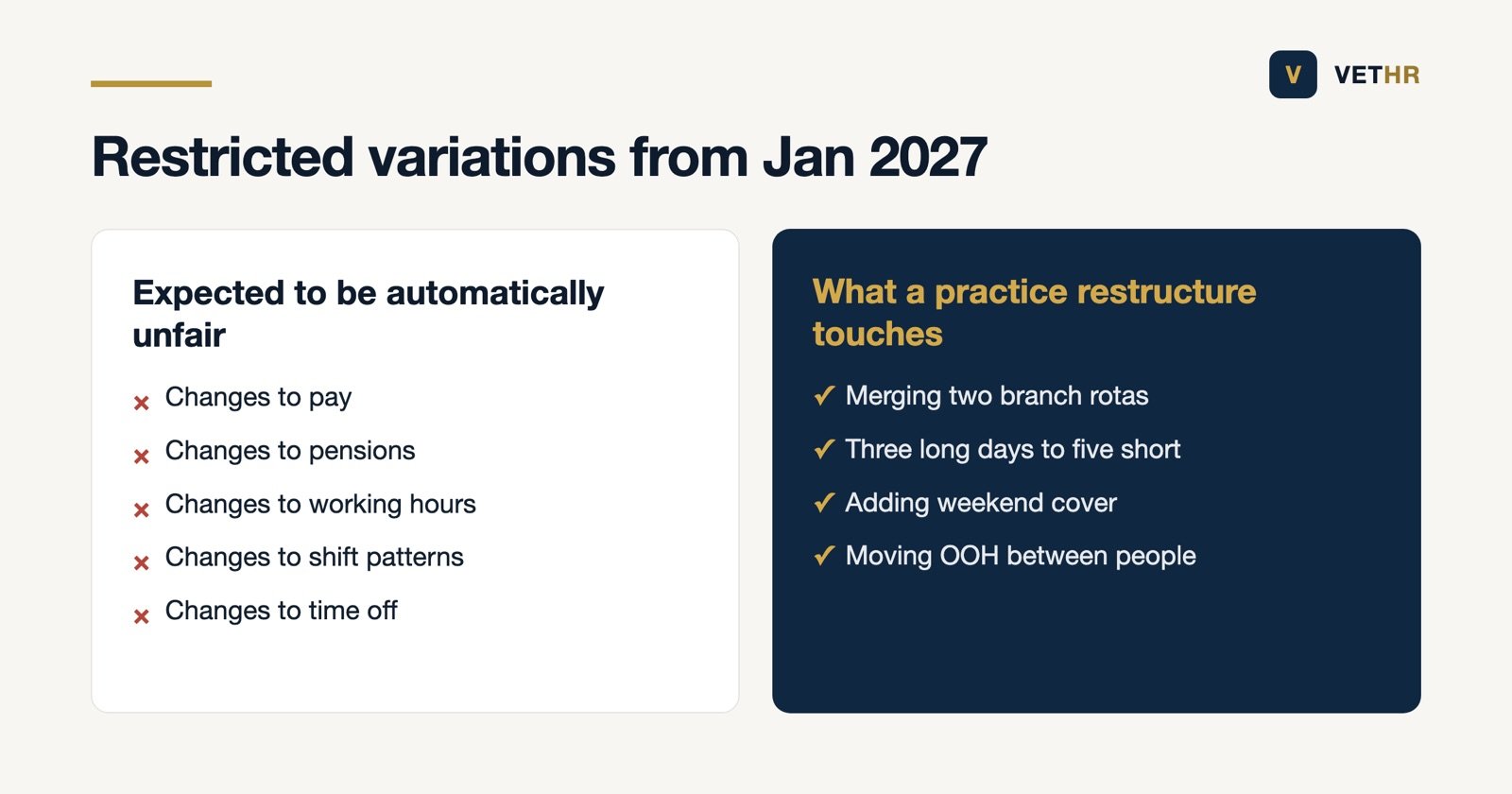
Under the Employment Rights Act 2025, dismissing an employee because they will not accept a restricted variation is expected to become automatically unfair, with the provisions anticipated to commence in January 2027. Restricted variations cover changes to pay, pensions, working hours, shift patterns and time off.
Read that list again with a practice restructure in mind. Working hours and shift patterns are precisely what a rota reorganisation changes. There is a narrow exception where the employer can show the change was needed to address financial difficulties threatening the business as a going concern, and that it could not reasonably have been avoided. That is a high bar and it is not the ordinary case of a practice wanting a better rota.
Until commencement the existing framework applies, alongside the statutory Code of Practice on dismissal and re-engagement, where an unreasonable failure to follow the Code can increase compensation. Either way, the direction of travel is clear: get agreement.
Our free redundancy and restructure pack has the consultation record, which works just as well for a restructure with no job losses.
Most objections to a restructure are predictions rather than facts. People are not arguing about the rota, they are arguing about what they imagine the rota will do to their week.
A defined trial with a genuine review date tests the prediction. It also changes the conversation from “agree to this permanently” to “try this and tell me what breaks”, which is a far easier thing to say yes to. Set the review date, hold it, and be genuinely prepared to change something as a result. A trial where nothing could ever change is just a delayed imposition and people can tell.
Almost every practice reorganisation is one of these, and each carries a different level of difficulty.
If your change is the first one on that list, allow twice as long as you think and start with the problem rather than the pattern.
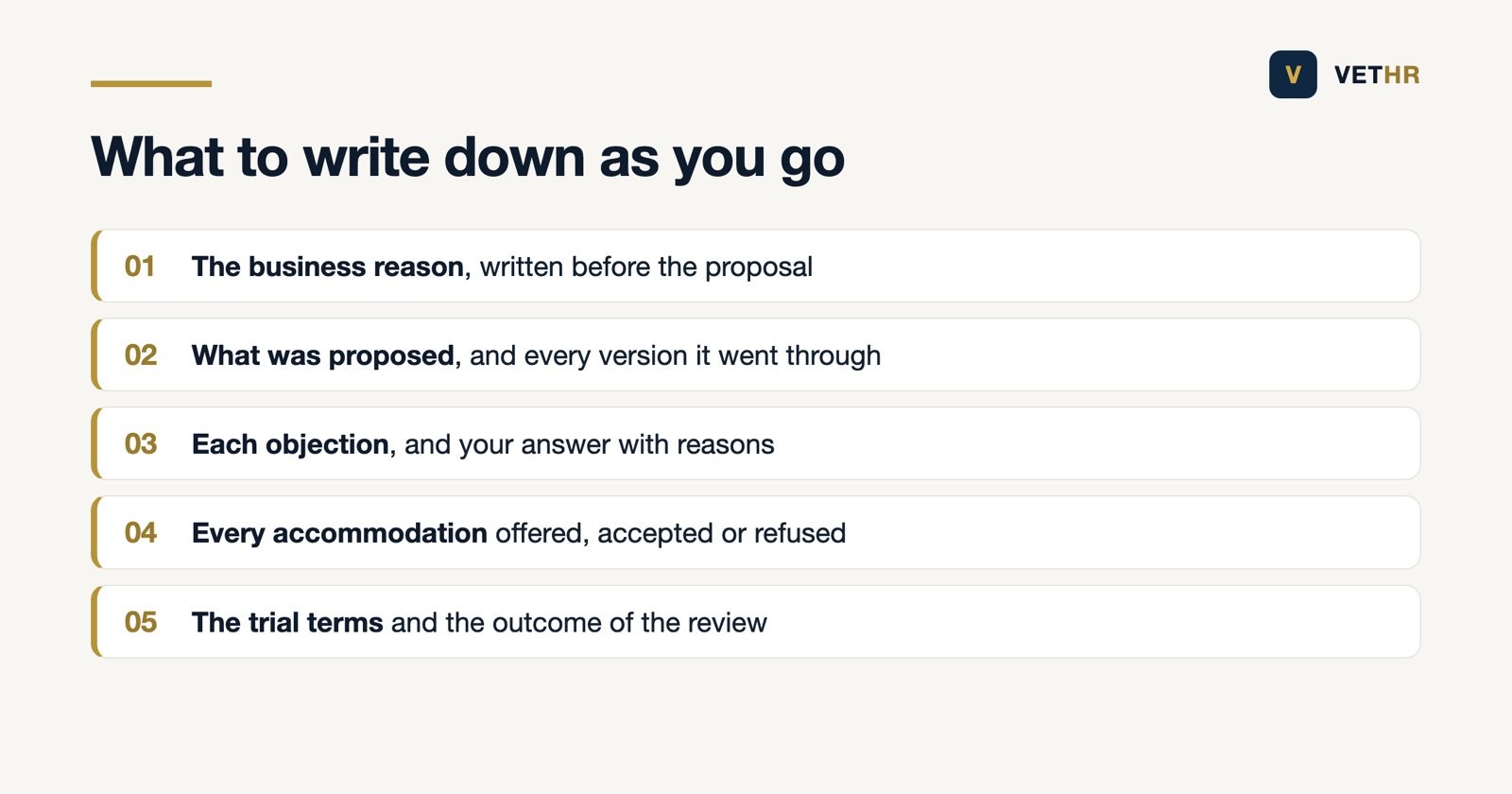
A restructure that is later challenged is judged on the paper trail, and the trail is easy to build while it is happening and impossible afterwards.
That is six documents for a change that will affect the practice for years. It is a good trade, and the consultation record in our pack covers most of it. Where the change also touches how the rota itself is built and published, our guide to the veterinary rota policy is the companion piece.
Sometimes it does, and you need to notice before somebody else does.
If any of those are in play, stop treating it as a restructure and take advice.
Before any restructure begins, work out who is pregnant or within the protected period after maternity, adoption or shared parental leave. Since 6 April 2024 they have priority for suitable alternative employment, and the protection runs for eighteen months from the child’s date of birth where maternity leave was taken.
Also check who has a flexible working arrangement in place, who has adjustments for a disability, and who is on a contract that already says something specific about hours. A restructure that quietly overrides an agreed adjustment is a discrimination claim rather than a rota decision.
It depends entirely on the wording, and flexibility clauses are interpreted narrowly. A clause about varying start times will not support moving somebody from days to nights. Where the change is significant, consult and seek agreement even if you think the clause covers it.
Keep talking to that person specifically. Look for an individual accommodation that preserves the overall change. Do not proceed to dismissal without advice, particularly with the January 2027 changes approaching.
There is no collective consultation duty where nobody is at risk of dismissal, but you still need agreement to change terms, and consultation is how you get it. Skipping it does not save time, it just moves the argument later.
Yes, and a one off payment in exchange for an agreed variation is common and lawful. Document what is being agreed in exchange for what, and apply it consistently, or you create a fairness problem alongside the restructure.
Longer than you want. Weeks rather than days for anything touching hours or pay. A restructure announced on Monday to start the following month will generate more resistance than the same change proposed with a proper consultation and a trial period.
The practices that restructure successfully do two things. They explain the problem rather than announcing the solution, and they offer a trial rather than a permanent change. Both cost time and neither costs money, and together they resolve most of what would otherwise become a dispute.
If a restructure is coming, start earlier than feels necessary, and take advice before you impose anything. Our free HR health check covers contracts and rota design, and you keep the written summary either way. Acas has guidance on changing an employment contract.
Contracts, rotas, holiday, a difficult conversation. Tell us what you are dealing with and we will come back within one working day. Nothing to sign up to.
Got it. We will come back to you within one working day. If you do not see a reply, please check your spam folder.
