Last updated: 24 September 2026
TL;DR: Constructive dismissal is when someone resigns because the employer’s conduct has broken the contract. It can be one serious incident or a series of smaller ones taken together. Unpaid wages, a sudden demotion, forced changes to shifts and ignored bullying are the usual causes. Almost every case in practice was preventable at the grievance stage.
A nurse hands in her notice on a Friday. The letter says she has been left with no choice. Nobody in the practice is surprised, because everyone watched the same six months happen: the rota changed without warning, her grievance about a colleague was never answered, and her on-call pay was quietly dropped in April. That letter is what constructive dismissal looks like before it becomes a claim.
GOV.UK defines it as being forced to leave your job against your will because of your employer’s conduct. The employee resigns, but the law can treat the resignation as a dismissal by the employer, because the employer broke the contract first.
The same page gives examples of the conduct involved: not paying someone or suddenly demoting them for no reason, forcing unreasonable changes such as telling someone to work night shifts when their contract is only for day work, and letting other employees harass or bully them.
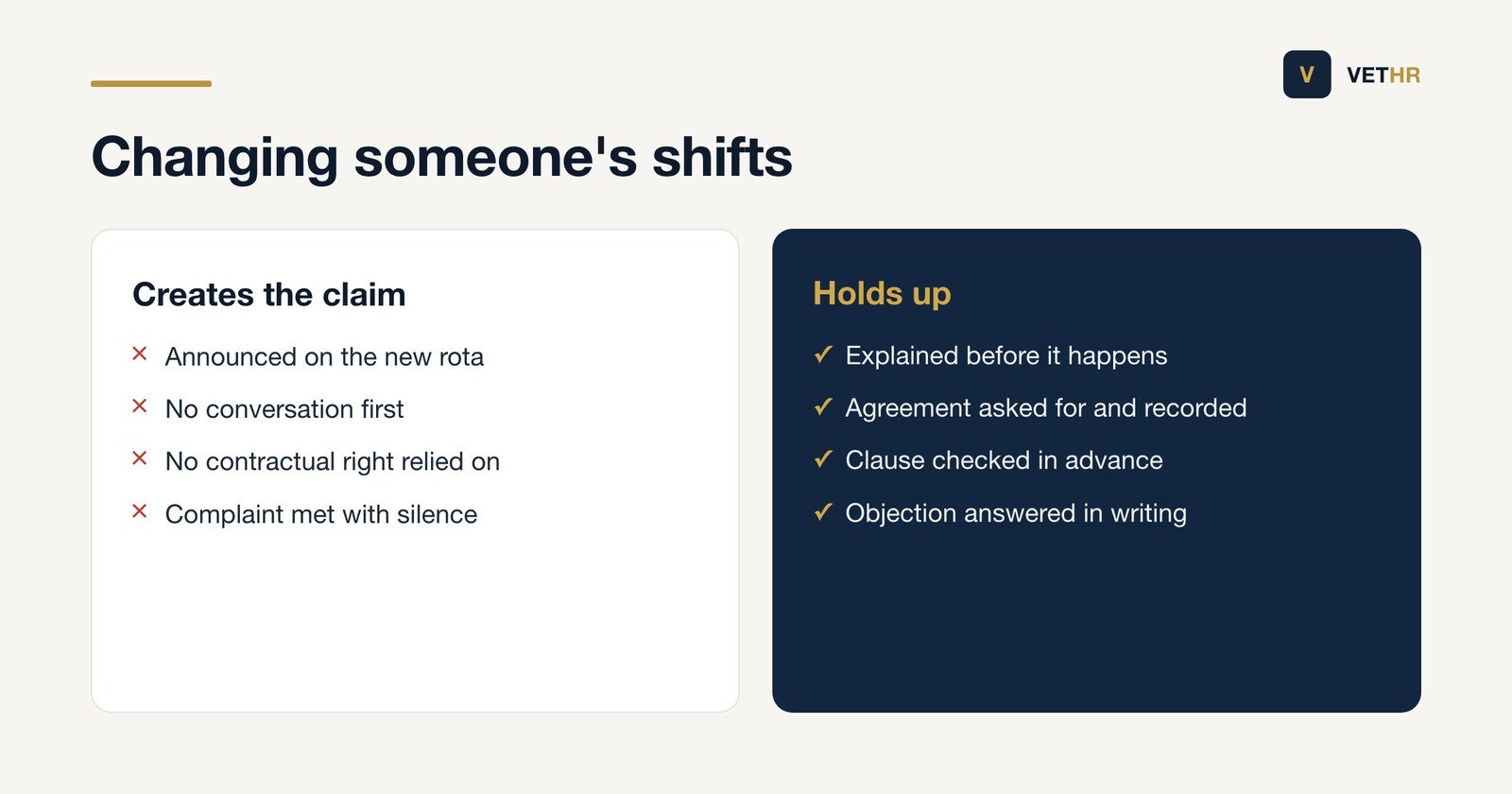
Read that middle example again if you run a rota. Changing when someone works is not a neutral administrative act. It is a change to their contract, and doing it unilaterally is one of the most common routes into a constructive dismissal claim in this profession.
GOV.UK is explicit that the breach of contract may be one serious incident, or a series of incidents that are serious when taken together. That second limb is the one practices underestimate.
No single item on the list in that nurse’s resignation letter would end a career. Together they describe an employer who stopped keeping its side of the bargain. A constructive dismissal case is usually built from small things that were each defensible on their own.
It follows that the fix is early and cheap. Answer the grievance. Reverse the pay change. Have the conversation about the rota. Any one of those, done in week two, removes the pattern before it exists.
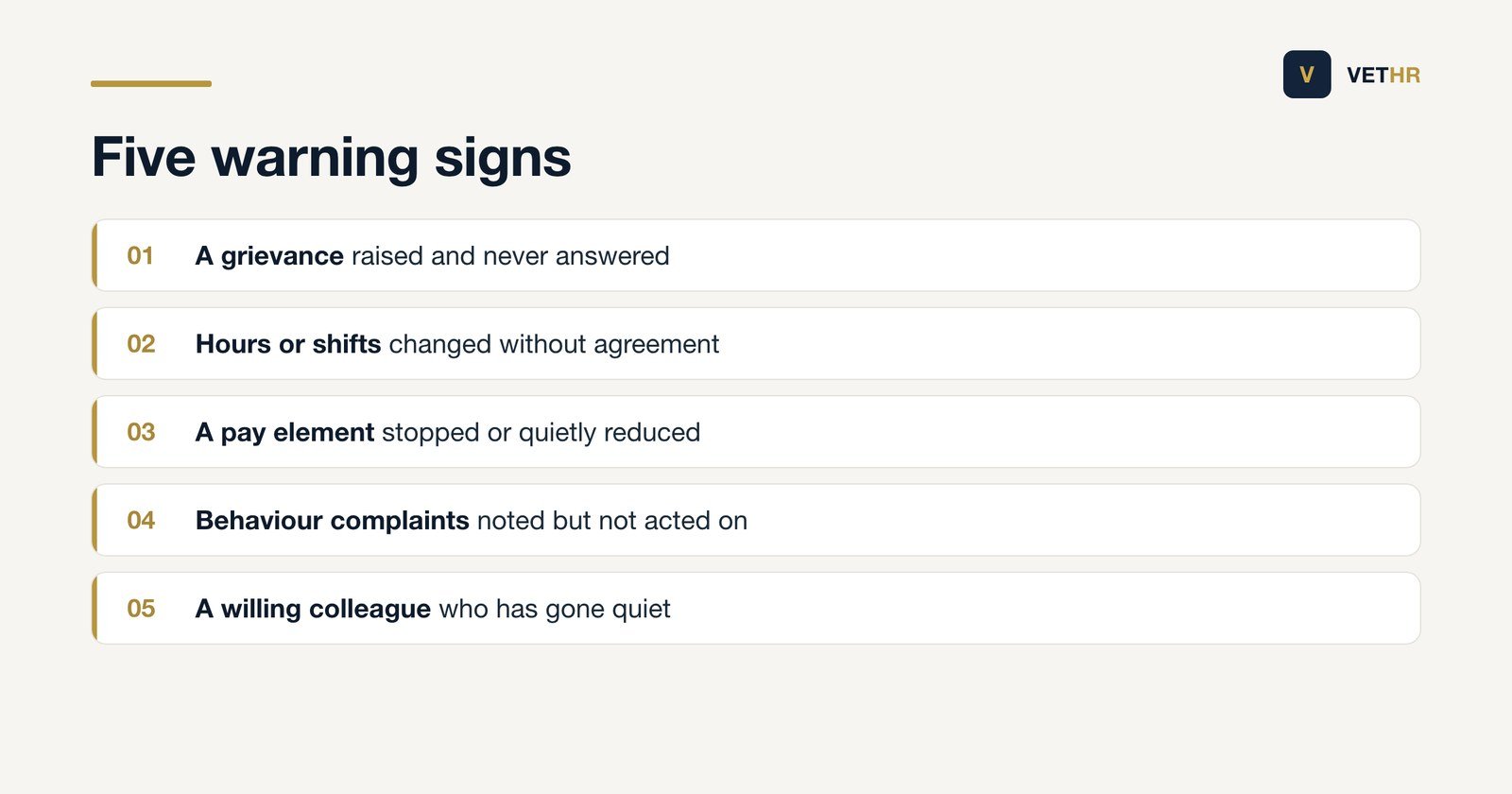
These are the patterns that show up before a constructive dismissal claim does. None of them is proof of anything on its own. All of them are worth a conversation.
Write the date next to each one when you notice it. A constructive dismissal case is argued on a timeline, and the practice that kept its own timeline is in a far stronger position than the practice reconstructing six months from memory after a claim form arrives.
The last one is not legal, it is human, and it is the earliest signal you will get. Our note on exit interviews in a veterinary practice covers how much of this only surfaces once someone has already decided to go.
GOV.UK advises employees to try to sort issues out by speaking to their employer before leaving. That instruction cuts both ways. If a grievance has been raised, the practice has been handed the chance to fix the problem, and ignoring it is the single most damaging thing it can do.
An unanswered grievance is the most common last straw in a constructive dismissal case. It is also the easiest to avoid. Acknowledge in writing within a few days, meet, decide, and reply in writing with a right of appeal.
Our step by step guide to handling a grievance in a veterinary practice sets out the timetable, and workplace mediation is often the better route where the issue is two people rather than a policy.
Most veterinary constructive dismissal risk sits in the rota and the payslip, not in dramatic confrontations. Moving a part-time nurse from three fixed days to a rolling pattern, adding weekends to someone who was recruited on weekdays, or cutting an on-call allowance are all contract changes.
Acas guidance on contract changes is blunt about the requirement: any changes must be agreed by both the worker and the employer, unless there is a clause in the contract that allows the change without agreement. Consult first, explain why, and record the agreement.
If you need to change terms across the team, do it as a proper consultation rather than a rota announcement. Our guide to restructuring a veterinary practice covers how to run that without generating claims.
Do not accept a resignation like that on the spot. Thank them, say you would like to understand what has happened, and offer a meeting within a few days. Many resignations given in a moment of frustration are withdrawn once someone listens.
If the letter alleges a breach, treat it as a grievance even though the person is leaving. Investigate, reply in writing, and keep the file. A practice that can show it investigated is in a much better position than one that can only show it was surprised.
Do not argue about whether it was really a constructive dismissal in the meeting. Gather the facts, take advice, and put your position in writing afterwards.
Watch the clock too. The government’s Employment Rights Act implementation timeline raises the employment tribunal claim time limit from 3 to 6 months on 1 October 2026, and reduces the unfair dismissal qualifying period to 6 months for dismissals from 1 January 2027. Both changes widen the window in which a constructive dismissal claim can reach you.
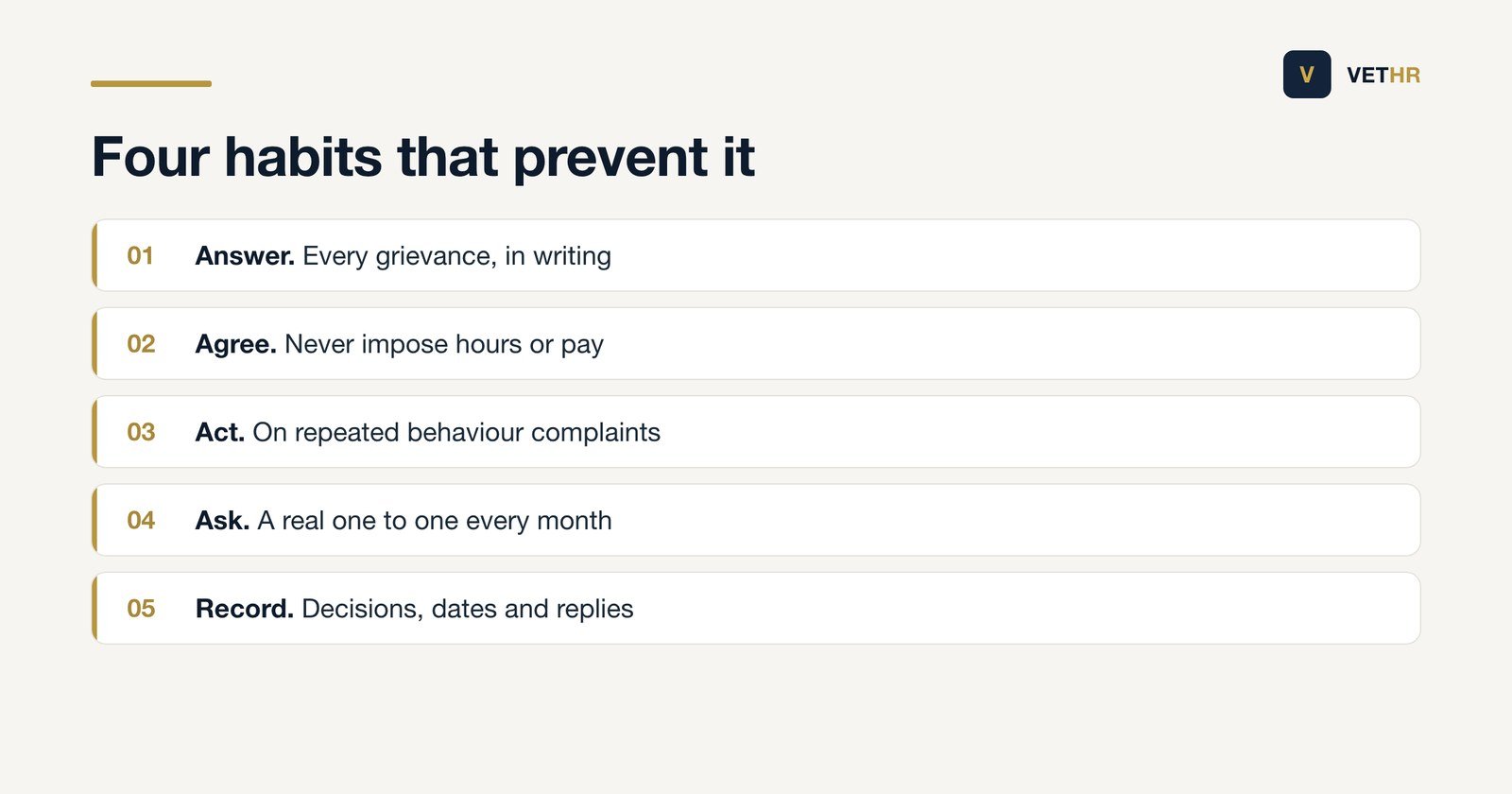
Preventing constructive dismissal comes down to four habits, and none of them needs a solicitor.
Answer every grievance in writing, on a timetable, even the ones you think are unfounded. Never change hours, pay or duties without agreement or a clear contractual right. Act on repeated complaints about behaviour instead of noting them. And hold a real one to one every month, so nothing has six months to build up.
The fourth is the cheapest and the most neglected. Our guide to one to one meetings in a veterinary practice covers a format that takes twenty minutes and surfaces most of this early.
If someone has already raised something serious, book a free 30-minute HR health check and we will talk through the options while they are still options.
Yes. The claim depends on the resignation. GOV.UK guidance warns employees that if they have a case they should leave immediately, because staying on can be argued as accepting the treatment. That is why a resignation following a serious incident needs careful handling.
It can. GOV.UK says the breach may be one serious incident or a series of incidents that are serious when taken together. Not paying someone, or demoting them for no reason, are given as examples of conduct that can amount to a breach on their own.
It can, where it amounts to forcing unreasonable changes to how someone works. GOV.UK uses the example of requiring night shifts when the contract is only for day work. Agree changes, or rely on a genuine contractual flexibility clause.
No. The employee has to show a breach serious enough to go to the root of the contract, that they resigned because of it, and that they did not delay. Practices win these cases, particularly when they can show they investigated and replied.
Yes, and keep the notes. An exit interview that records what was said, and what the practice offered to do, is useful evidence and often the point at which a dispute gets resolved without anyone going near a tribunal.
Every constructive dismissal claim we have seen in veterinary practice had a moment where a written reply, a reversed decision or a proper conversation would have ended it. The cost of that moment is an hour. The cost of missing it runs into months.
If your grievance procedure, contracts or rota change process would not stand up to that test, we fix them through fixed-price HR consultancy for veterinary practices and ongoing HR support on subscription.
The Vet HR Team provides HR consultancy and white-labelled staff systems exclusively to UK veterinary practices.
Contracts, rotas, holiday, a difficult conversation. Tell us what you are dealing with and we will come back within one working day. Nothing to sign up to.
Got it. We will come back to you within one working day. If you do not see a reply, please check your spam folder.
