Last updated: 5 September 2026
TL;DR: The pattern you choose is constrained by three rules: 11 hours of rest between working days, an uninterrupted 24 hours off each week or 48 hours each fortnight, and a 20 minute break for anyone working more than six hours. Within those limits, six patterns cover almost every UK practice, and changing between them is a contractual matter.
Shift patterns in practice tend to be inherited rather than designed. Somebody set the pattern years ago, it has been patched around leavers and new starters ever since, and nobody has asked whether the shape still fits the caseload. That is usually where the burnout and the overtime are hiding.
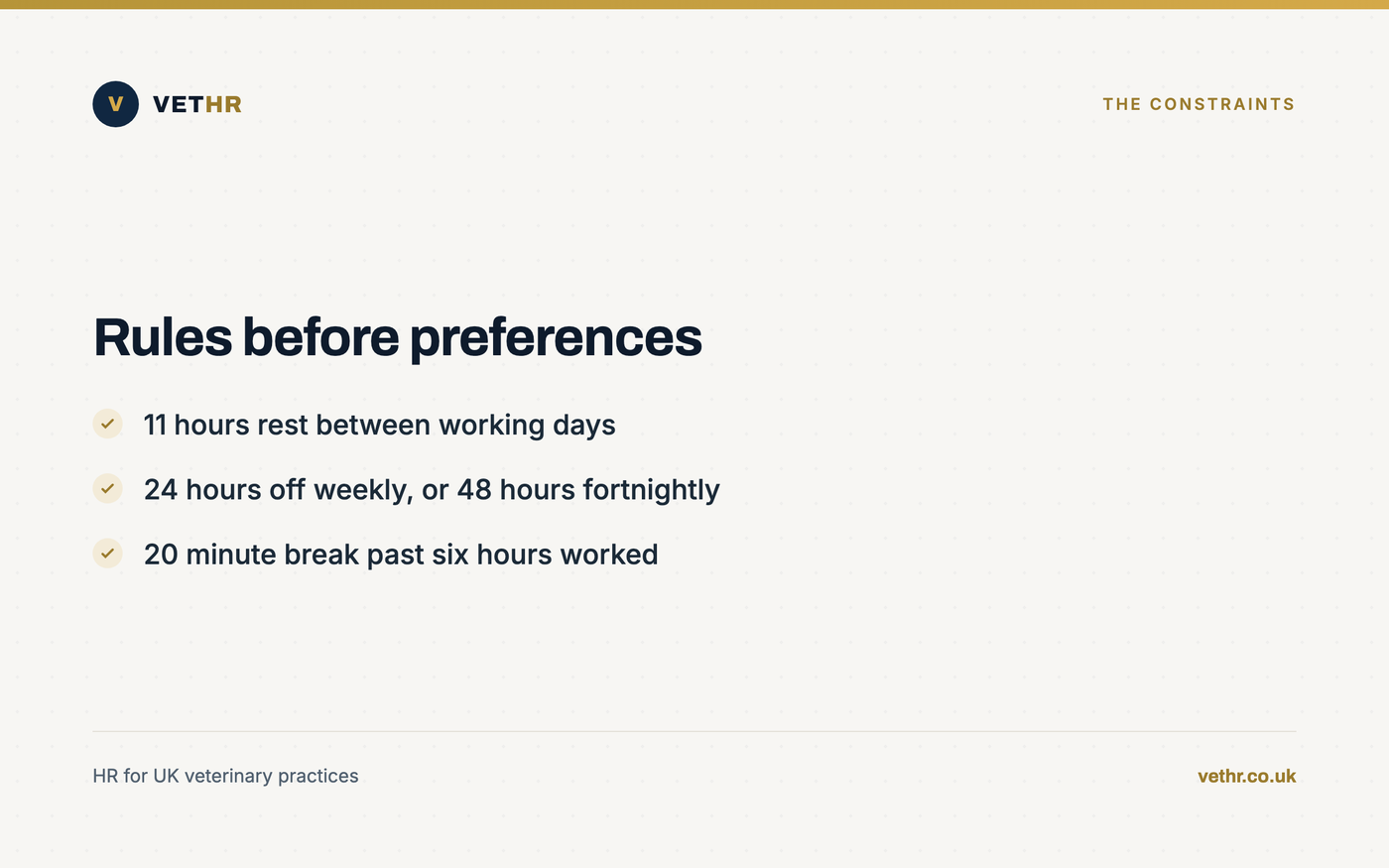
Three rules, and they decide which shift patterns are possible before preference gets a say. GOV.UK sets out that workers get 11 hours rest between working days, either 24 uninterrupted hours off each week or 48 each fortnight, and an uninterrupted 20 minute break when working more than six hours.
The 48 hour weekly average sits over the top. GOV.UK confirms staff cannot work more than 48 hours a week on average, normally averaged over 17 weeks, and individuals can opt out of that particular limit.
Night work is stricter and cannot be opted out of, which our guide to night workers covers. Design the overnight element first, because it constrains everything around it.
The 11 hours is the one that kills clever ideas. A late finish at 9pm means no start before 8am, so the pattern where somebody closes on Tuesday and opens on Wednesday is not available however neatly it fills the gap.
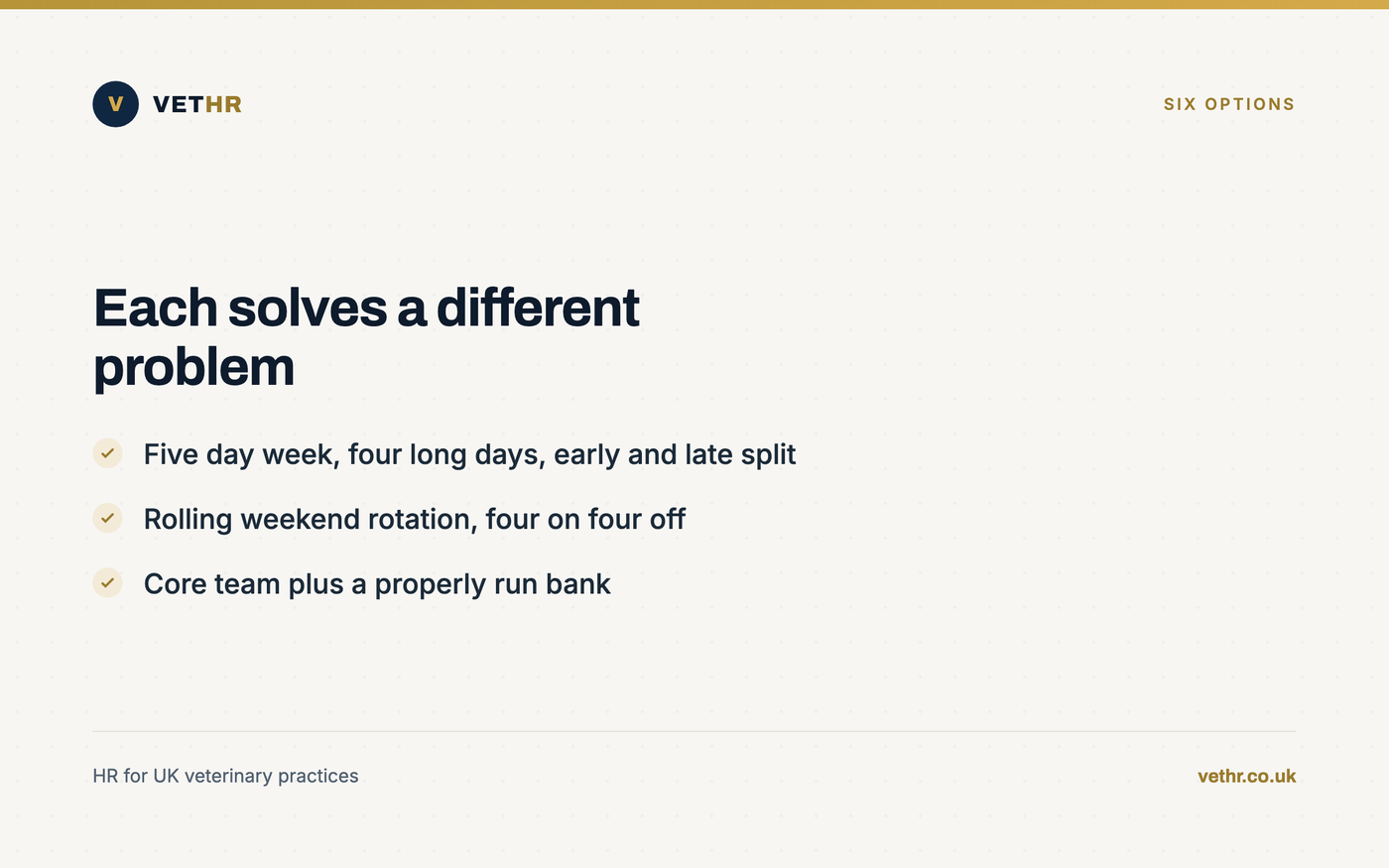
These six shift patterns cover almost every UK small animal and mixed practice. Each solves a different problem and each has a cost that shows up somewhere else.
Pattern two is the most requested and the most oversold. Four long days is genuinely popular with vets and genuinely hard on nurses doing physical work for eleven hours, and the enthusiasm usually fades in the second winter.
Mixing shift patterns within one team is allowed and often sensible. There is no requirement for everyone to work the same shape, and a practice that lets two nurses run long days while three keep a standard week usually fills the rota more easily than one insisting on uniformity.
Pattern six is the realistic answer for most independents. It needs a properly run bank rather than a list of favours, which our guide to casual workers sets out.
Start from the caseload curve, not from the shift patterns you like. Pull twelve months of appointment and admission data and look at where demand actually sits by day and by hour, because most practices are surprised by at least one finding.
Step two prevents the classic error. Coverage is a skill mix question, and a rota that is fully staffed on paper can still be unable to open theatre on a Thursday, as our guide to building a veterinary rota covers.
Step five changes outcomes more than any spreadsheet. Some people want long days for the day off, some want short predictable days for childcare, and pairing shift patterns to preferences costs nothing.
Sometimes, and rarely for everyone in the building. Long days concentrate the same hours into fewer days, which is a genuine benefit for commuting and childcare and a genuine cost in fatigue.
The break is the honest test. If your long day pattern relies on a nurse eating at the prep bench between anaesthetics, you have not designed a shift, you have extended one.
Watch clinical governance data during any trial. Where incident reports cluster in the final two hours of long shifts, the pattern is telling you something, which our See It Report It system is designed to surface.
By consulting properly and getting agreement, because contractual hours cannot simply be reassigned. Where days and hours are written into contracts, changing them is a variation requiring consent rather than a management decision.
Step three is where discrimination risk sits. A new pattern that disadvantages part-time staff, carers or a disabled employee needs looking at carefully, as our guides to part-time workers and reasonable adjustments explain.
Rota inherited rather than designed? A free 30-minute HR health check will look at the shape and the risk. Book your HR health check.
Measure four things before and after a change of shift patterns, rather than asking how people feel about it at a team meeting. Numbers protect you from the loudest voice being mistaken for the majority.
Compare against the same quarter last year rather than against last month. Veterinary demand is seasonal, and a pattern judged in a quiet February will look better than it deserves to.
Ask about sleep during any trial of new shift patterns. It is the earliest indicator you have, it moves weeks before absence figures do, and one honest question at a one to one tells you more than a quarter of data.
Set the review date when you launch the pattern. Trials without an end date become permanent by default, which is how practices end up with the rota nobody chose, as our analysis of the cost of a bad rota sets out.
Eleven hours between working days, plus either 24 uninterrupted hours off each week or 48 hours each fortnight. A shift finishing at 9pm means no start before 8am the next day, which rules out closing one evening and opening the following morning.
Not where hours and days are contractual. Changing them is a variation of contract, so it needs consultation and agreement rather than an announcement. Imposing a change risks breach of contract claims and, where it disadvantages particular groups, discrimination claims.
Usually not below a certain headcount. It gives excellent coverage and genuine recovery, but it needs enough staff to fill every block without constant bank cover. Most independent practices get closer to the same benefit with a stable core team plus a properly run bank.
Workers over 18 are entitled to one uninterrupted 20 minute break when working more than six hours. In practice the issue is not entitlement but whether the rota makes it possible, and a break that only exists in theory is a rota design failure rather than a personal choice.
Four to six weeks is the standard veterinary teams ask for, and it costs nothing. Whatever pattern you run, predictability is consistently rated above the pattern itself, because it is what allows people to plan a life around the work.
There are no best shift patterns. There is the pattern that matches your caseload, respects the rest rules, uses the skill mix you actually have and was chosen with the people working it rather than for them.
Map the demand, eliminate what the rules forbid, trial with a review date and measure overtime and absence before and after. Our rota system and HR consultancy handle the design and the contractual side, and the free HR health check is where to start.
The Vet HR Team provides HR consultancy and white-labelled staff systems exclusively to UK veterinary practices. Contract variations are legal matters; take advice before imposing a change.
Contracts, rotas, holiday, a difficult conversation. Tell us what you are dealing with and we will come back within one working day. Nothing to sign up to.
Got it. We will come back to you within one working day. If you do not see a reply, please check your spam folder.
