TL;DR: A Christmas party is part of work for legal purposes. Acas says employers can be held responsible for discrimination that happens in the course of employment, including at a work party, unless they took all reasonable steps. From 30 October 2026 that extends to harassment by third parties such as clients. Set behaviour standards, plan for on-call cover and inclusion, keep the cost at £150 a head or less for the tax exemption, and handle complaints promptly.
Last updated: 12 November 2026
The Christmas party is the one night of the year when a vet practice closes the doors, lets the team relax and picks up the bill. It is also the night that produces more disciplinary and grievance meetings in January than any other. A comment after the third drink, a lift home that went wrong, a manager who danced too closely, a nurse who stayed on call and missed the whole evening.
This guide explains how to run a Christmas party in a veterinary practice that people enjoy and that does not turn into a claim. It covers employer liability, the harassment duty, inclusion, cover for emergencies and the tax rule. It is general information and not legal advice.
For legal purposes it can be. The Equality Act 2010 makes both the worker and the employer responsible if discrimination happens in the course of employment, and Acas says that means anything linked to work, which can include events outside the workplace, such as a work party. The party is a work event even when it is held in a pub.
The Acas page on vicarious liability explains that an employer can be held responsible for what its workers do, and that the employer might avoid responsibility if a tribunal finds it took all reasonable steps to prevent the discrimination. Its example is a company that provides equality and anti-bullying training, then promptly investigates a complaint and disciplines the worker.
That is the principle to hold on to. You cannot control every conversation, but you can show you took reasonable steps before the party and acted properly after it. Our guide to an equality and diversity policy covers the policy that sits underneath.
Acas says that on 30 October 2026 the law will change so that employers will be liable for harassment from third parties, such as customers and clients, unless they have taken all reasonable steps to prevent it. Acas counts people at conferences or events as third parties, so guests at a party fall within the thinking.
The Acas page on third-party harassment law changes lists the steps it suggests: regular risk assessment, recording incidents and actions, a policy that covers third-party harassment, training, updated client and supplier terms and telling clients the consequences of harassing workers. It also says to record why you decided a step was not reasonable.
For a vet practice the Christmas party often has outsiders: partners, plus-ones, referral contacts, suppliers who have been invited, or a client-facing open evening. Make sure guests know the standards, and make sure your staff know that the practice will act if a guest behaves badly towards them.
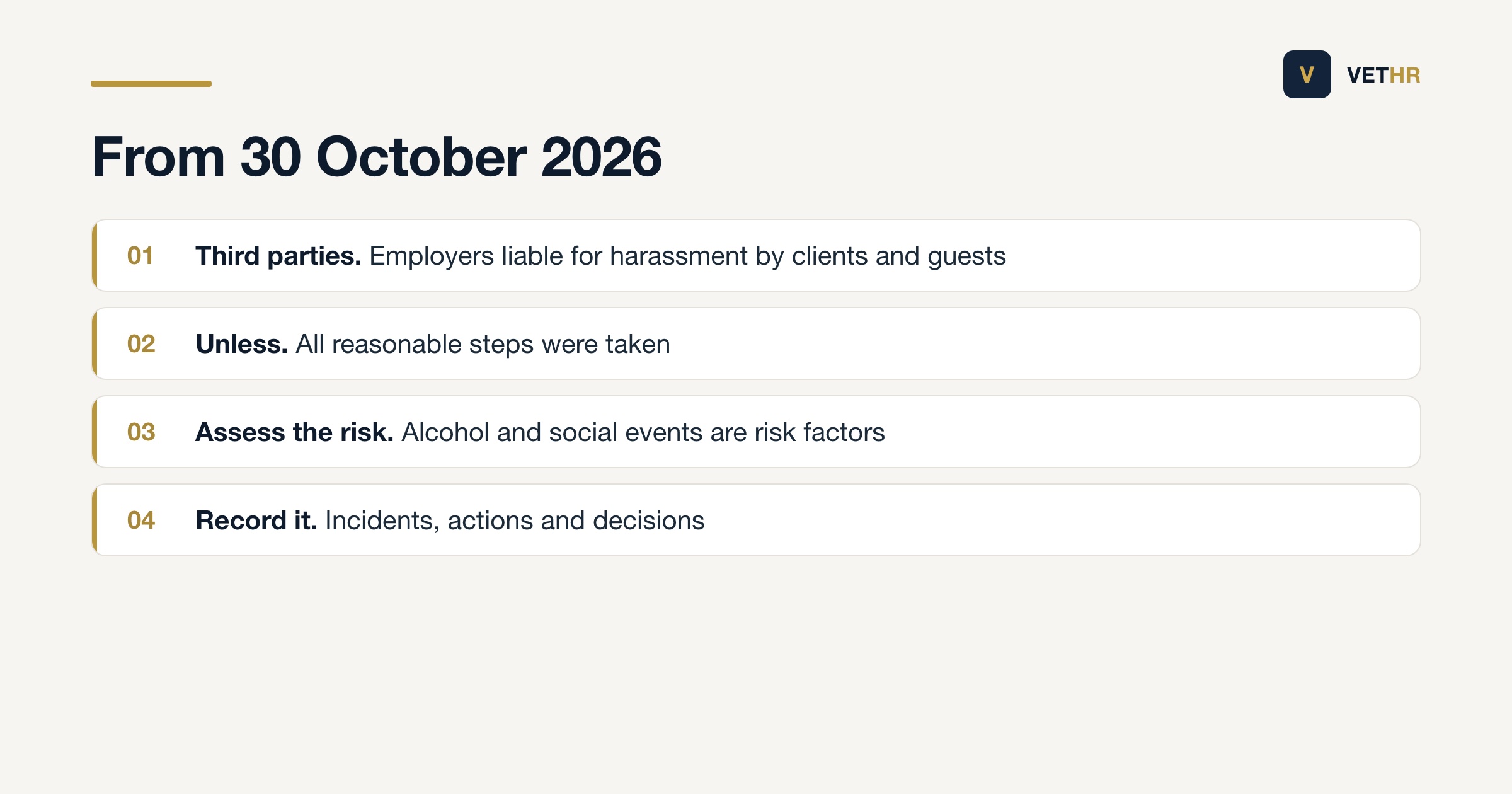
Since 26 October 2024 employers must take reasonable steps to prevent sexual harassment of their employees. Acas lists work-related social events, and an environment where people are drinking alcohol, as risk factors to consider, and suggests setting standards of behaviour for work social events and giving workers ways to get help quickly.
The Acas guide to steps for employers to prevent sexual harassment also suggests encouraging workers to report situations where they felt at risk even if nothing happened, keeping discipline, social media and dress code policies consistent, training everyone to recognise sexual harassment and giving someone senior responsibility for the steps.
Turn that into a short party plan:
Keep it short and plain. The usual rules of the practice apply, including respect, no harassment, no discrimination and no bullying. Staff should look after colleagues, behaviour that would be unacceptable at work is unacceptable at the party, and breaches can lead to disciplinary action. Alcohol is not an excuse.
Acas notes that being unfit for work because of excessive alcohol can be listed in company rules as gross misconduct, and that where an employee’s behaviour in front of clients or other outsiders at a Christmas party reflects badly on the employer, discipline can follow after a proper investigation. Your policy should say that conduct at work events is covered by the disciplinary procedure.
Do not write a rulebook that sounds like a threat. The aim is to set a baseline and show that you thought about it. Our guide to disciplinary procedures covers what happens if a complaint is made, and the guide to managing conflict helps with the awkward conversations that follow.
A veterinary practice cannot close for an evening without a plan. Decide who is on call for emergencies, whether the practice’s out-of-hours provider covers the night, and how the people who stay behind are recognised. Make it fair, rotate it year to year and pay or give time off for it.
If the party coincides with your normal out-of-hours cover, check who is on the rota and whether they can reasonably attend and still be safe for work. Staff who are on call should not be put in a position where they have to choose between drinking and their duty, and it should be clear in advance that on-call staff do not drink.
Pay for the time properly. Our guides to on-call pay, the out-of-hours rota and time off in lieu explain the options. One practical idea is to hold a second small gathering for those who missed the first, so that nobody is left out because they covered the phones.
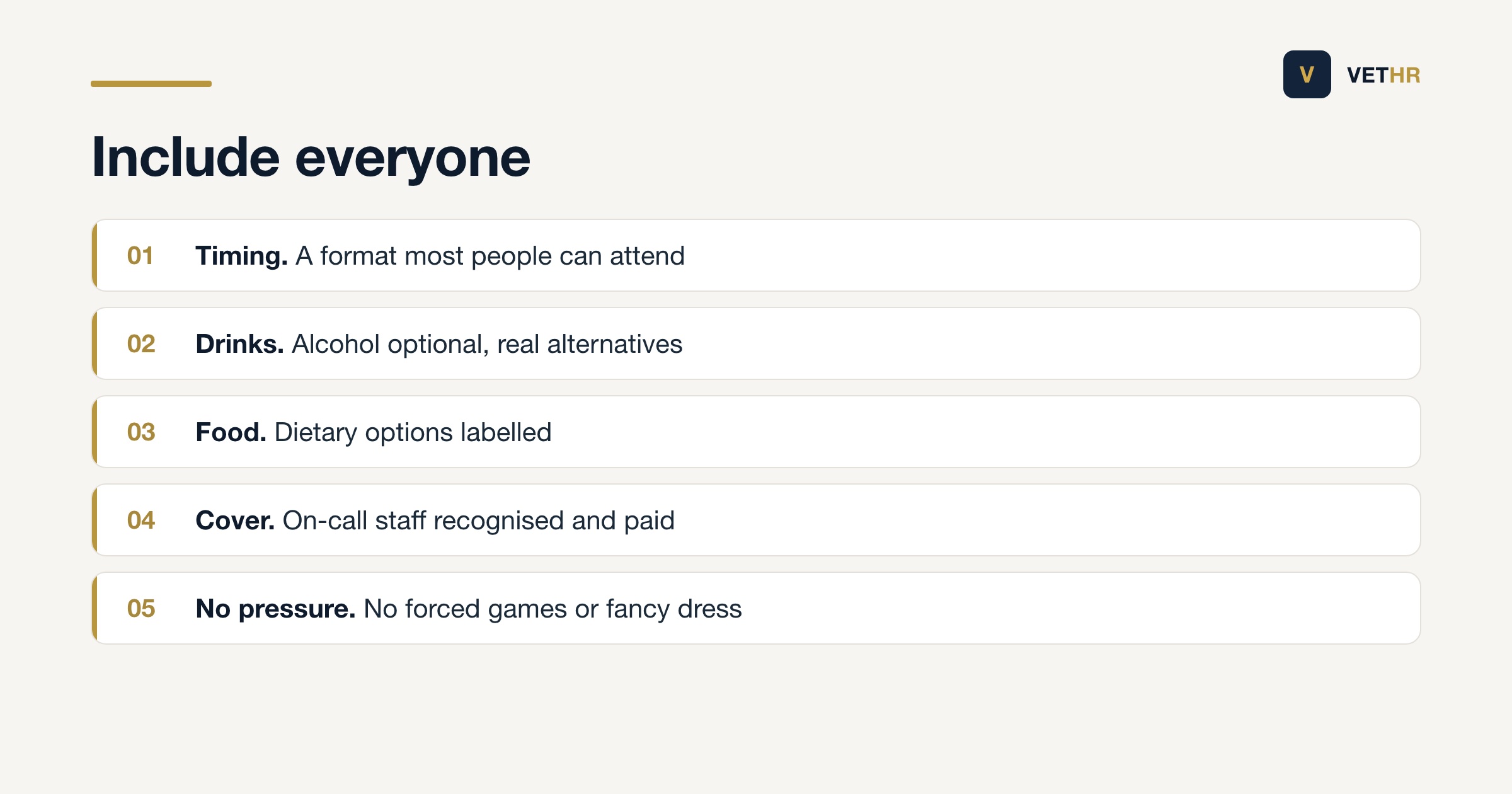
Choose a time, place and format that most people can join, make alcohol optional, offer good non-alcoholic drinks and food that suits different diets, and avoid pressure to drink or to take part. The Equality Act 2010 protects religion or belief, among other characteristics, so a party that quietly excludes people on those grounds carries risk.
Some people do not drink for religious, health, family or personal reasons. Some cannot stay late because of caring duties or travel. Some find large social events hard. A lunch, an afternoon event or an activity can include more of the team than a late evening in a pub. Ask the team what they would like instead of guessing.
Think about the little things as well:
Treat part-timers, nurses on shifts and agency staff fairly where you can. Our guide to agency workers explains why some temporary staff must have access to collective facilities from the first day, and the practice is wise to think about whether invitations to a social event should be handled the same way.
You do not need to ban it, but you do need a plan. Decide whether the practice pays for a limited number of drinks or a tab with a cap, make sure food is served early, offer good soft drinks and let the venue know it should not serve anyone who is clearly drunk. A free bar with no limit raises both risk and cost.
Agree how people get home. Share taxi numbers or book cars, and remind everyone that driving after drinking is a serious offence, so nobody should drive home from the party if they have been drinking. Managers should stay sober enough to notice problems and step in. If someone is unwell or in difficulty, a named person should make sure they get home safely.
Make it clear that the next working day is a working day, and that being unfit for work because of the night before is a conduct matter, not a joke. Say it kindly in the briefing email, with the plan for anyone who needs to swap a shift.
Branch teams, remote staff and people on different shifts can feel the party is for head office. Offer a way for everyone to take part: a party per branch with the same budget, a joint event at a time that works across sites, or a smaller gathering for those who missed the main one.
Keep the budget fair across sites so the tax conditions are met and nobody feels second class. Note who could attend and who could not, and why, so you can show that the event was open to all employees. A simple attendance and invitation record also helps if a question arises about fairness or about the tax exemption.
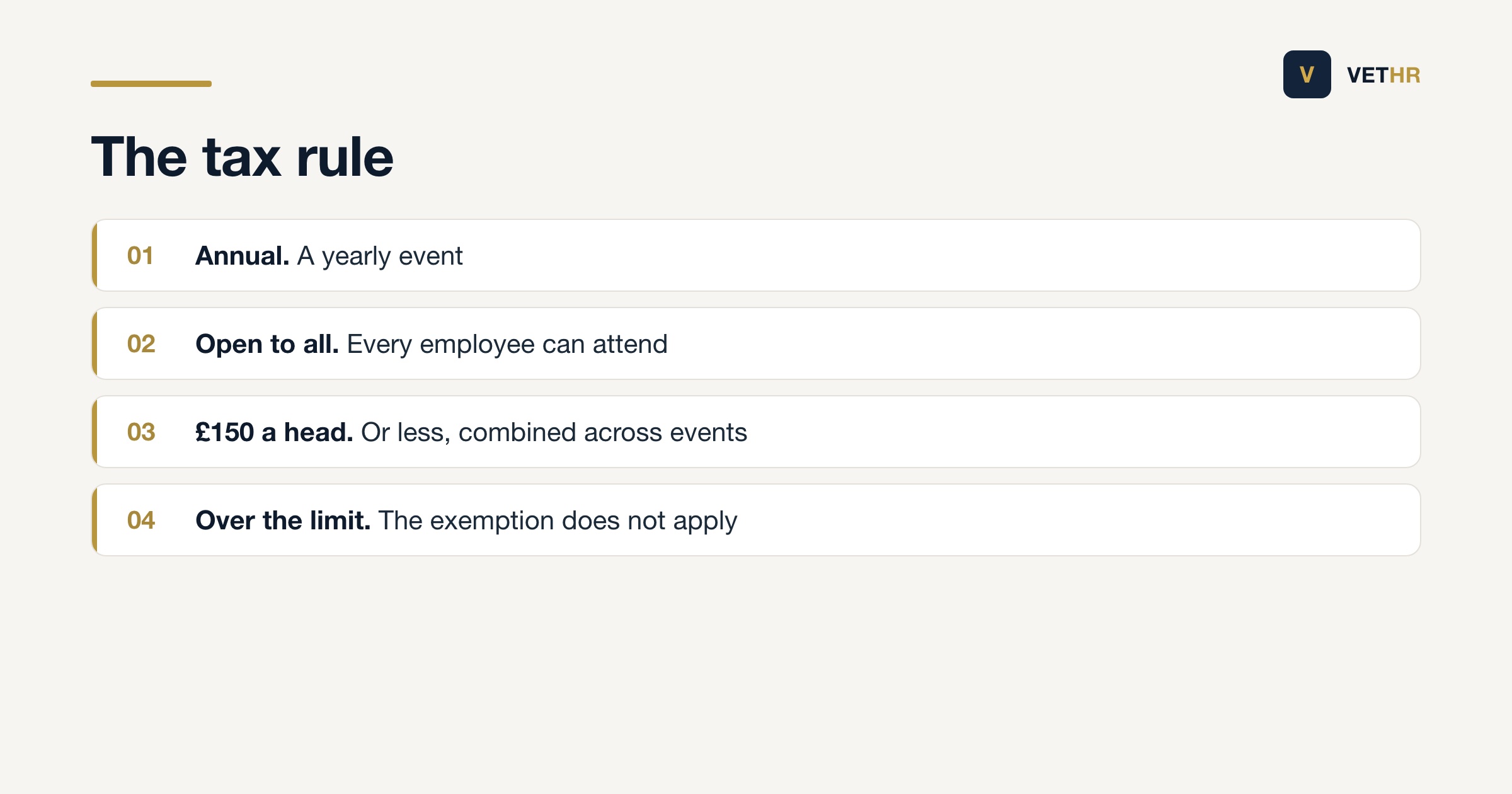
Not if it meets the conditions. GOV.UK says a party is exempt from reporting, tax and National Insurance if it is open to all employees, held annually and costs £150 or less per head. Separate events for different locations or departments are fine if every employee can attend one. Several annual events are exempt if their combined cost is £150 or less per head.
The GOV.UK page on what is exempt says the same rules apply to online parties. The £150 is not an allowance. If the cost per head is above the limit, the exemption does not apply to the party and the full cost per head is reportable rather than just the excess. Check the GOV.UK page and your accountant’s advice on what counts toward the cost, because the overview page does not define it.
For a practice with several branches, the sensible route is one event open to everyone or one per branch with every employee able to attend one. Keep the invoices and the attendance list. If a director or someone with a higher earnings level is involved, the GOV.UK overview says the reporting duties depend on that too, so ask your accountant.
Take it seriously, listen and follow your grievance procedure. Acknowledge the complaint quickly, agree who will investigate, keep the complainant informed and record what you do. A prompt, fair response is part of the all reasonable steps defence, and a slow or dismissive one is a claim in the making.
Do not treat the complainant badly for raising it. That is victimisation. Do not assume that because the event was social the matter is trivial. Do not discipline on rumour. Ask what happened, what was said and who saw it, and give the person complained about a chance to respond. Where there is a risk to anyone, consider interim steps such as changing rotas.
Time off the next day is a related issue. Decide in advance whether the day after the party is a working day, whether people can swap or take leave, and what you expect if someone is unfit for work. Say it before the event, not after. Our guide to managing sickness absence covers the principles.
The usual mistakes are no briefing, leaving managers to set the tone themselves, ignoring on-call staff, assuming everyone drinks, inviting guests without telling them the standards, forgetting the tax conditions and treating Monday’s complaint as a nuisance. All are avoidable with an email and a plan.
Yes, where the conduct breaches your policies, provided you investigate properly and act fairly. Acas notes that behaviour in front of clients or outsiders that reflects badly on the employer can lead to discipline after a thorough investigation.
Acas says the Equality Act 2010 covers discrimination in the course of employment, which can include events outside the workplace such as a work party. The employer might avoid responsibility if it took all reasonable steps.
Acas says employers will be liable for harassment from third parties, such as customers and clients, unless they have taken all reasonable steps to prevent it. Guests at events are within the thinking.
GOV.UK says it is exempt if it is annual, open to all employees and costs £150 or less per head. Above that, the full cost per head is not covered by the exemption. Ask your accountant about the detail.
No. Make alcohol optional, offer good alternatives and avoid pressure to drink. Staff on call should not drink.
If you want a party briefing email, a behaviour note and a complaints route ready before the season, book a free 30-minute HR health check through our contact page. See also our HR consultancy for veterinary practices and the policies and handbook system.
Sources: Acas: vicarious liability, Acas: third-party harassment law changes, Acas: steps to prevent sexual harassment, GOV.UK: social functions and parties, what is exempt.
Contracts, rotas, holiday, a difficult conversation. Tell us what you are dealing with and we will come back within one working day. Nothing to sign up to.
Got it. We will come back to you within one working day. If you do not see a reply, please check your spam folder.
