TL;DR: An equality and diversity policy tells staff what behaviour is expected, what discrimination is and how to complain. The Equality Act 2010 protects nine characteristics, including age, disability, sex and race. Acas says a policy should cover recruitment, pay, discipline, dismissal, redundancy and flexible working, and be backed by training and an action plan. Since 26 October 2024 employers must also take reasonable steps to prevent sexual harassment.
Last updated: 9 November 2026
Most veterinary practices have an equality statement somewhere in a handbook written years ago. Few can say when it was last read, whether managers know what it commits them to, or what the team would do if a client made a racist remark to a nurse at the front desk.
This guide explains how to write an equality and diversity policy that works in a veterinary practice, what the law and Acas say it should cover, and how to turn it from a document into daily habit. It is general information and not legal advice.
An equality and diversity policy is a written statement that a practice treats everyone fairly, with the rules and procedures behind it. Acas says a policy helps everyone to know that the business supports and treats everyone fairly, what behaviour is expected, what discrimination is and is not acceptable, and where to find procedures for resolving problems.
Acas notes that it may also be called an equal opportunities policy, and its equality, diversity and inclusion policy template is a sensible starting structure. The template runs from a statement of commitment, through the purpose of the policy and a list of commitments, to an agreement to follow it and a pointer to grievance and disciplinary procedures.
The policy is not a legal requirement in itself. The legal duties come from the Equality Act 2010. The policy is how you show staff what those duties mean in your building, and how you prove, if you ever need to, that you took them seriously.
The Equality Act 2010 protects people from discrimination because of nine characteristics. GOV.UK lists them as age, gender reassignment, marriage or civil partnership, pregnancy or maternity, disability, race (including colour, nationality and ethnic or national origin), religion or belief, sex and sexual orientation.
The GOV.UK page on types of discrimination adds that you are also protected if you are associated with someone who has a protected characteristic, or if you have complained about discrimination or supported someone else’s claim. In a practice that means a nurse who cares for a disabled partner, or a vet who backs a colleague’s complaint, is covered as well.
Put the list in the policy in plain words, and give a short everyday example of each so that staff can recognise it. A pregnant nurse not given a theatre list because someone assumed she would prefer not to is a recognisable example. So is a receptionist who is asked to take a client call because she is believed to be more patient than her male colleague.
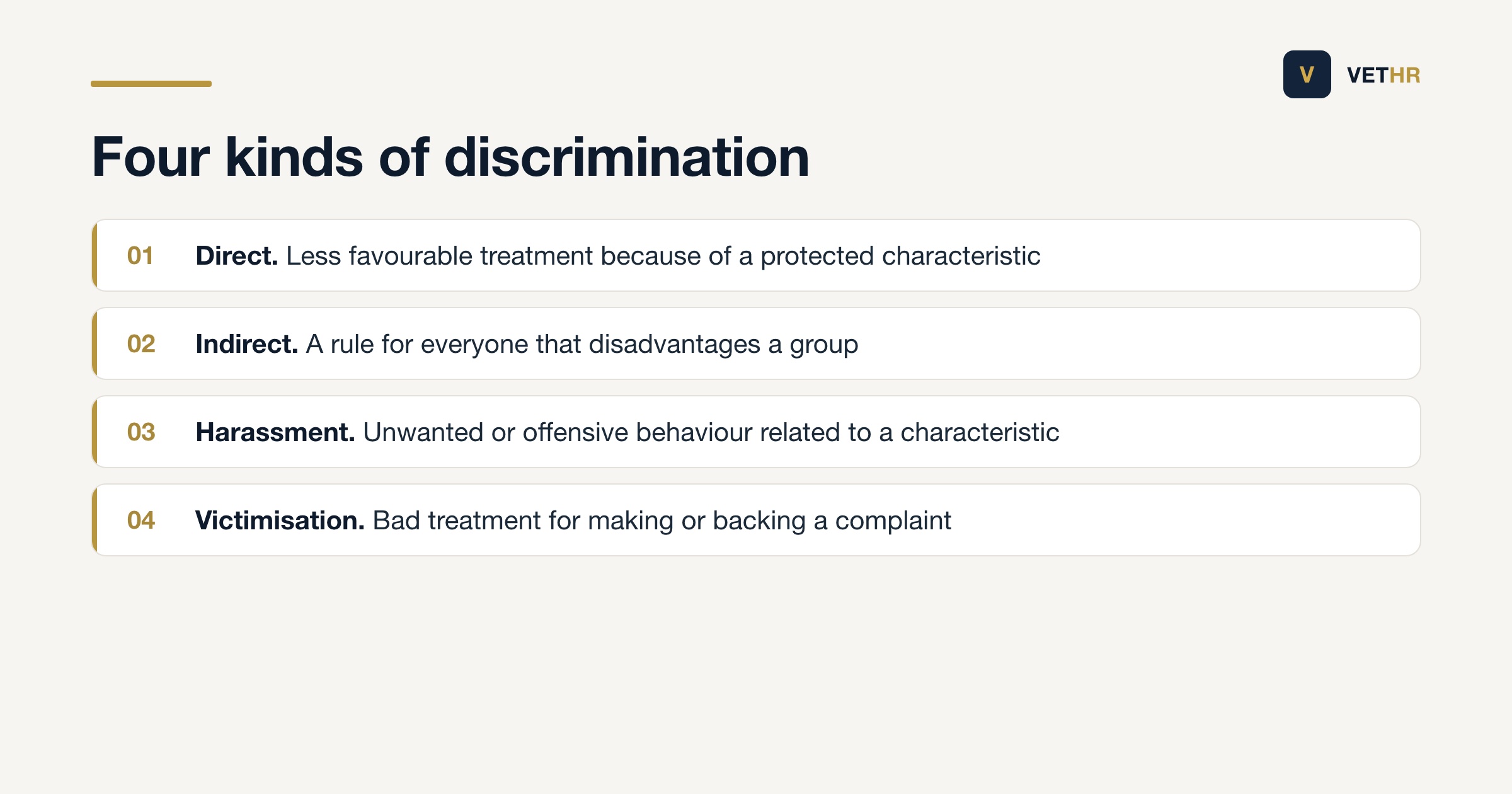
Acas describes four kinds. Direct discrimination is less favourable treatment directly because of a protected characteristic. Indirect discrimination is treating everyone the same way in a way that disadvantages people with a protected characteristic. Harassment is unwanted or offensive behaviour related to a protected characteristic. Victimisation is negative treatment because someone has been involved in a complaint.
Acas sets these out on its page on discrimination and the law, which also says employers have the main responsibility for discrimination at work. They must not discriminate unfairly, must take steps to prevent it and must do all they reasonably can to protect workers from discrimination by others.
A practical illustration of indirect discrimination in a practice: a rule that every vet must be available for out-of-hours calls at short notice, with no flexibility, can disadvantage staff with caring responsibilities or a disability. The rule treats everyone the same, but the effect is uneven. That does not mean you cannot have the rule. It means you should be able to justify it and look for fairer ways to meet the need. Our guide to the out-of-hours rota covers how to do that.
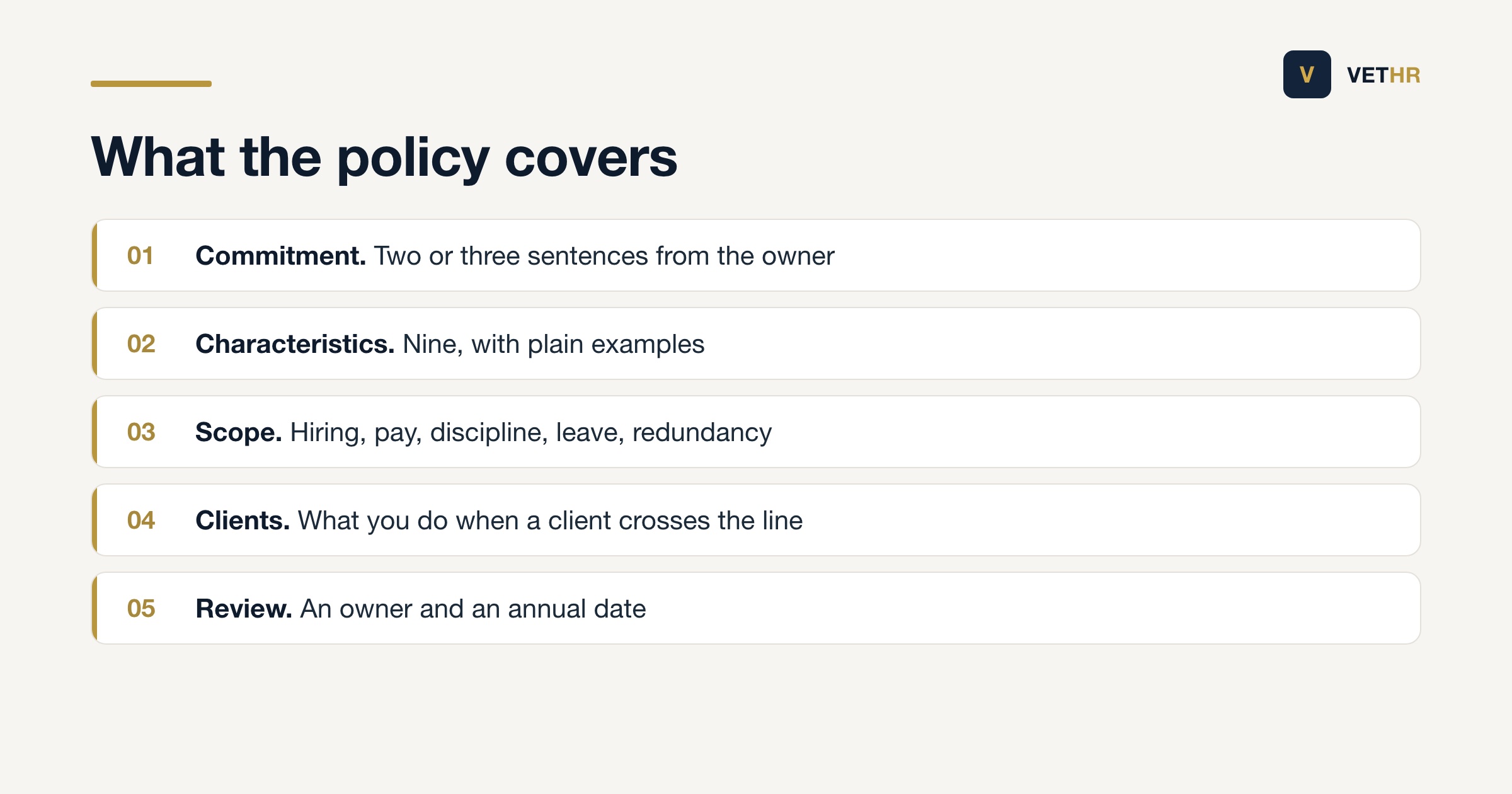
Acas lists recruitment, training and promotion, equal pay, religious belief and practice, dress code, unacceptable behaviour, dismissal, redundancy, parental leave and flexible working. Its template also commits to merit-based decisions, regular review of practices and monitoring of the make-up of the workforce, with an annual review.
Turn that into a practice policy with these parts:
Keep it short enough to read in ten minutes. A two-page policy that people understand beats a twelve-page one that they do not open.
A vet team works face to face with the public, often when people are upset. Clients can make remarks about race, accent, age, sex or religion, and the employer has duties to protect staff. Acas says employers must do all they reasonably can to protect workers from discrimination by others, which includes clients.
Decide in advance how you will respond and write it down. A short script helps: staff calmly state that the comment is not acceptable, a manager steps in, the incident is logged, and in repeated or serious cases the client is warned and, if needed, asked to take their animal elsewhere. Make clear to the team that this is backed by the practice, so a nurse does not feel she must tolerate abuse to keep a client.
The same logic applies to sexual harassment. The next section explains the duty. Our guide to managing conflict in a veterinary practice is useful for the day-to-day handling, and the lone working guide matters where someone is on their own with a client.
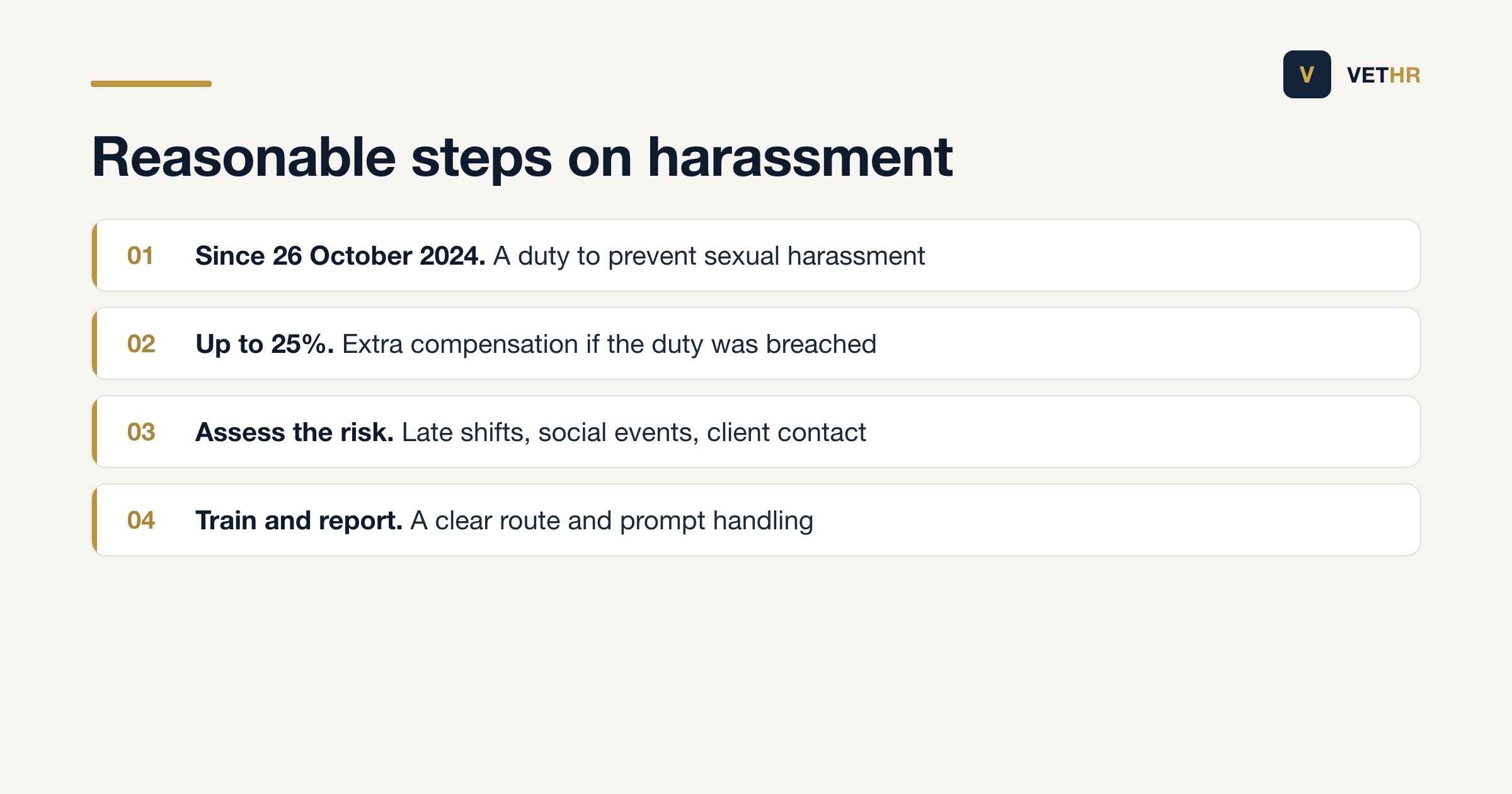
Since 26 October 2024 employers must take reasonable steps to prevent sexual harassment of their employees. GOV.UK says it is meant to encourage workplace culture change. Employees cannot claim for the duty alone, but a tribunal that finds harassment can increase compensation by up to 25% if the employer breached the duty. The EHRC can also enforce it.
GOV.UK’s announcement that new protections from sexual harassment come into force says employers must anticipate where sexual harassment could occur and take preventative action, and act to stop it recurring if it has already happened. It points employers to Acas and EHRC guidance for plans and policies.
The Employment Rights Act 2025 is tightening this. The Acas page on third-party harassment law changes says that on 30 October 2026 the law will change so employers are liable for harassment from third parties, and counts customers and clients among them. The EHRC notes the standard becomes all reasonable steps. Acas suggests regular risk assessment, recording incidents, a policy, training, updated client terms and telling clients the consequences of harassing staff. Our guide to employment law changes for veterinary practices tracks them.
For a practice, reasonable steps usually means a clear anti-harassment section in the policy, a risk assessment of where it could happen, training, a way to report, and prompt, fair handling of complaints. The risk assessment matters. Think about late shifts, out-of-hours work, drug-handling areas, social events, and client contact.
Acas advises employers to understand the law, recognise the benefits of a diverse team, keep policies up to date, train staff and managers, create channels for staff to be heard and make clear how to complain. Pair the policy with an action plan that says who does what and by when, and check whether it is working.
Turn those into a calendar:
Our policies and handbook system includes an equality policy you can adapt, and you can book a free 30-minute HR health check through our contact page if you want someone to read yours and say what is missing.
Acas suggests a separate bullying, discrimination and harassment policy that explains how complaints are handled, and checking other policies such as dress codes so that they do not discriminate. The equality policy sets the principle. The other documents apply it.
Look at the ones that touch protected characteristics most often. A flexible working policy should not penalise carers or disabled staff. A maternity policy must treat pregnancy and return from leave fairly, and our guides to maternity leave and flexible working requests show what to check. Your disciplinary procedure should say that discrimination and harassment are conduct matters.
Dress and uniform rules deserve a look too. A rule about hair, headwear or jewellery can disadvantage people on grounds of religion or belief or race unless there is a good reason, such as infection control or safety, and you can explain it.
Take it seriously, listen, keep it confidential as far as you can, and follow your grievance procedure. The Acas template points staff to the grievance and disciplinary procedures, and notes that using them does not affect the right to bring an employment tribunal claim, and its wording refers to a three month limit. GOV.UK’s implementation timeline lists the increase in tribunal time limits from 3 to 6 months as taking effect on 1 October 2026, so check which limit applies to the claim.
The time limit, whether 3 or 6 months, is a reason to move quickly. A complaint left for weeks can run out of time for internal handling while the tribunal clock runs. Acknowledge it promptly, agree who will investigate, keep the complainant informed and record what you do. Do not treat the person badly for complaining, because that is victimisation, which is a separate form of discrimination.
Consider whether the person needs support while it is looked at, such as a change of rota. Our guide to HR support options explains where to get help.
The common mistakes are a generic policy copied from elsewhere, no training, no plan for client behaviour, treating a complaint as a nuisance, inconsistent treatment between people, and ignoring the harassment duty. Each is simple to fix and each is the first thing a tribunal or the EHRC would ask about.
The law does not require the document itself. The Equality Act 2010 sets the duties, and the policy is how you explain them, train people and show you took reasonable steps. Acas recommends having one.
Age, disability, gender reassignment, marriage and civil partnership, pregnancy and maternity, race, religion or belief, sex and sexual orientation.
Acas says employers must do all they reasonably can to protect workers from discrimination by others. Decide in advance how you will respond to client behaviour and write it into the policy.
Since 26 October 2024 employers must take reasonable steps to prevent sexual harassment of their employees. A tribunal can increase compensation by up to 25% if the duty was breached, and the EHRC can enforce it. Acas says that from 30 October 2026 employers will also be liable for harassment by third parties such as clients, and the standard becomes all reasonable steps.
The Acas template notes that using grievance procedures does not affect the right to bring a tribunal claim, and refers to three months. GOV.UK’s timeline lists an increase to 6 months from 1 October 2026, so check the limit that applies and move quickly.
If your policy is out of date or missing, book a free 30-minute HR health check through our contact page and we will tell you what to change. See also our HR consultancy for veterinary practices.
Sources: Acas: third-party harassment law changes, Acas: equality, diversity and inclusion policy template, Acas: discrimination and the law, Acas: what an employer can do to prevent discrimination, GOV.UK: types of discrimination, GOV.UK: new protections from sexual harassment come into force.
Contracts, rotas, holiday, a difficult conversation. Tell us what you are dealing with and we will come back within one working day. Nothing to sign up to.
Got it. We will come back to you within one working day. If you do not see a reply, please check your spam folder.
