Last updated: 27 June 2026
TL;DR: Managing conflict in a veterinary practice starts long before any formal procedure. A small, high-pressure team will rub along badly sometimes, and the job is to spot it early, have a calm conversation, and resolve it informally where you can. Done well, most friction never reaches a grievance. This guide covers the early signs, the difficult conversation, informal resolution and mediation, fairness and confidentiality, and the point where it tips into a formal process.
Friction is normal in a busy clinic. Long consults, out-of-hours cover and emotional days mean tempers fray and small slights stick. The skill is not avoiding conflict, it is handling it early and calmly, before it hardens into something formal that costs everyone far more.
Managing conflict in a veterinary practice means noticing interpersonal friction early and dealing with it through calm conversation and informal resolution, before it ever needs a formal procedure. It is the everyday work of keeping a small, pressured team running well: clearing the air, settling a clash, and stopping a niggle from becoming a grievance.
This is distinct from the formal routes that sit behind it. A grievance procedure and a disciplinary process are structured, written and serious. Informal conflict management comes first, and it catches most of what arises. Acas describes informal resolution as catching issues early, before they escalate into formal procedures, and notes that it preserves relationships, reduces stress and can cost less than formal procedures, in its commentary on the power of informal conflict resolution at work.
In practical terms it covers a quiet word about a snappy handover, a sit-down between two nurses who keep clashing on shift, or a manager untangling a misunderstanding before it spreads. None of that is a procedure. All of it is conflict management, and it is where a calm practice spends most of its energy.
Conflict hits small veterinary teams hard because there is nowhere to hide. The team is tight, the days are emotionally heavy, and one strained relationship touches everyone on shift. What might be a passing irritation in a large office becomes a daily friction point in a six-person practice where the same people work side by side.
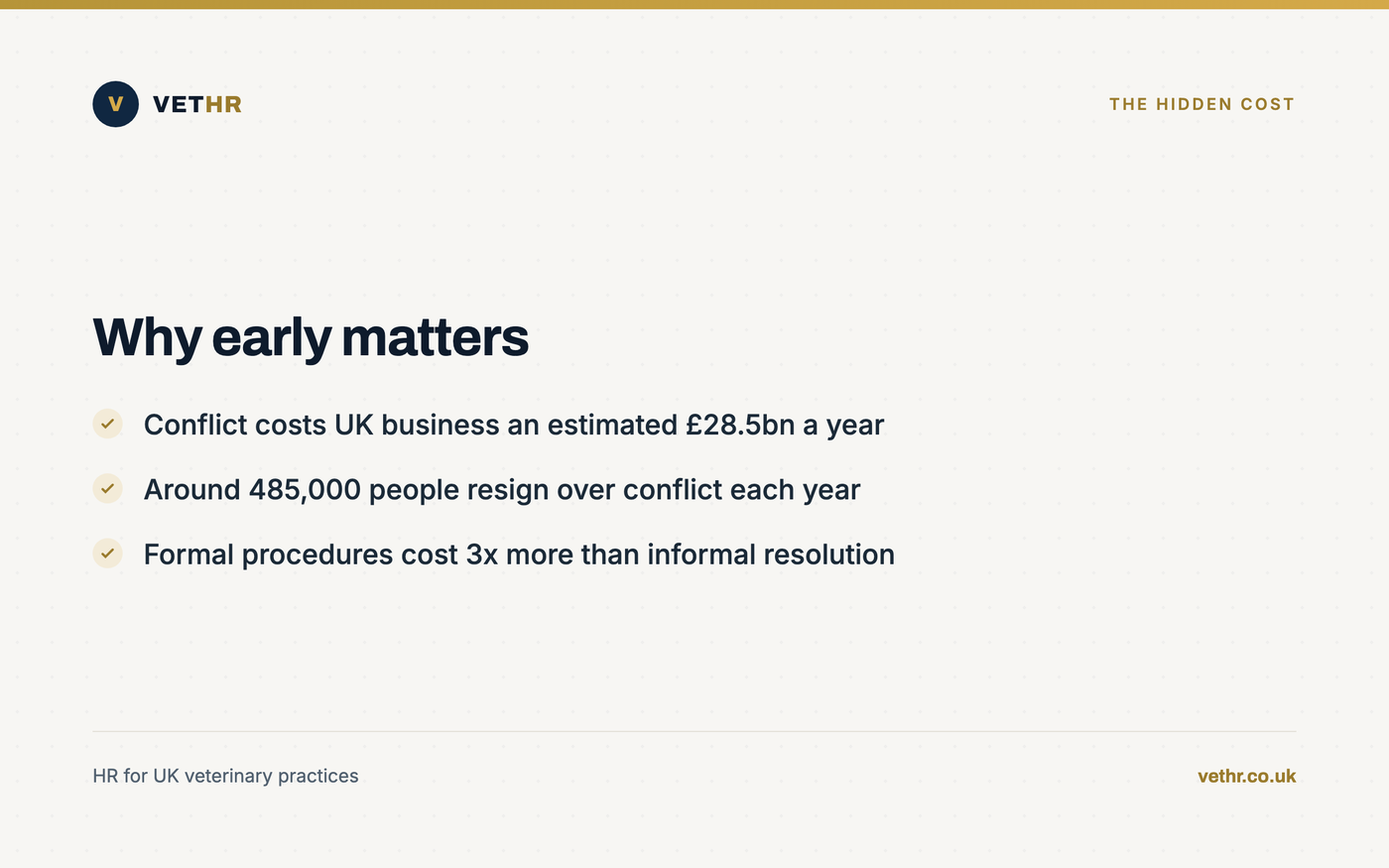
The wider cost is striking. Acas estimates that conflict involving individuals at work costs UK businesses around £28.5 billion a year, and that almost 10 million people experience conflict at work each year, on its page on the business and human cost of conflict at work. In a clinic running on thin margins, even a fraction of that cost lands hard.
It is also a retention problem. The same Acas analysis estimates that around 485,000 people resign each year because of conflict, at a cost to the economy of roughly £11.9 billion, and that about 5 million employees reported stress, anxiety or depression linked to it. Lose one good registered nurse to an unresolved clash and you feel it for months.
You spot team tension early by watching for changes in how people behave, not by waiting for a complaint. Conflict rarely announces itself. It leaks out as cooler handovers, clipped messages and small avoidances, long before anyone says the word “problem”. Catching it here is the whole game, because early friction is far easier to settle.
Timing genuinely matters here. Acas stresses that early intervention prevents conflicts from becoming entrenched positions that are much harder to resolve, in its commentary on informal conflict resolution. The longer two people sit in a cold war on your rota, the more each hardens into being right, and the harder your job becomes.
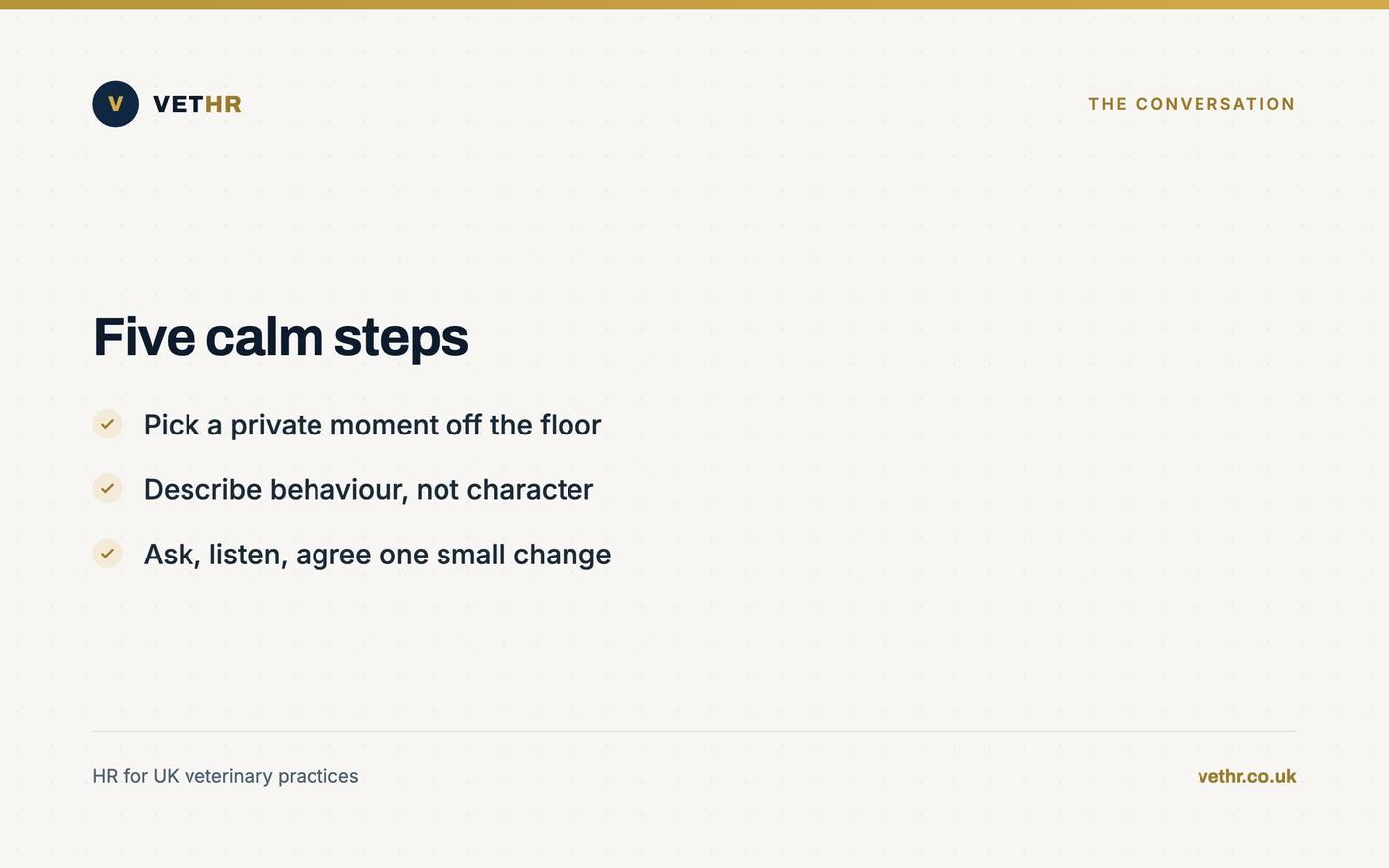
You have the difficult conversation in private, early and calmly, framed as a two-way discussion rather than a telling-off. The aim is to understand what is going on and agree a way forward, not to assign blame. Most workplace problems can be sorted this way, and a clinic is no exception.
Acas advises that many problems at work can be resolved informally, for example through an informal chat, and that if a worker raises a problem informally you should still take it seriously, in its guidance on dealing with a problem raised by an employee. That balance, informal in tone but serious in intent, is exactly right for a practice.
A simple structure keeps these conversations on track:
Language matters more than people think. Acas notes that the wrong phrasing can put people on the defensive, trivialise concerns or make someone feel told off. Lead with curiosity, keep your tone level, and let the other person talk first.
Not sure how to open a conversation that has been brewing for weeks? A short call usually makes the path clear. Book a free HR health check and we will talk through the situation, suggest how to frame it, and tell you honestly whether it is still informal or moving towards something formal. No jargon, no pressure.
Use informal resolution first for almost everything, and bring in mediation when two people are stuck but both genuinely want to work together. Mediation is a structured, voluntary conversation led by an impartial third party, and it suits relationship breakdowns and personality clashes rather than questions of pay or conduct.
Acas describes mediation as a way to mend relationships when there is a disagreement at work, run by a mediator who is impartial and does not take sides, and notes it is voluntary and confidential, on its workplace mediation guidance. Crucially, it adds that mediation is not about judging who was right or wrong in the past, but how to agree on working together in the future.
The same guidance advises trying to resolve the problem informally first, before thinking about mediation. So the order is steady: a quiet word, then a more structured conversation, then mediation if two valued people simply cannot reset on their own. Each step stays out of the formal column.
The financial logic backs this up. Acas figures put the cost of informal resolution through manager conversations at around £250 million, against £12.8 billion for formal internal procedures, on the business and human cost of conflict page. Early, informal handling is not just kinder, it is dramatically cheaper.
You keep it fair by treating both sides even-handedly, listening before you conclude, and keeping the detail confidential to those who need it. In a small practice where everyone talks, discretion is not a nicety, it is what makes people trust the process enough to be honest with you.
Fairness starts with not deciding in advance. Hear both people, separately if needed, and judge behaviour rather than personalities. Acas frames informal resolution as a two-way process and stresses that organisational culture must genuinely support people raising concerns without fear of retaliation. That tone is set by you, every time.
Confidentiality runs alongside it. Acas notes that mediation is confidential and that the mediator agrees with everyone involved what information can be shared and how. Apply the same care to any informal chat: share only what is needed, store your notes securely, and never let a private conversation become corridor gossip. Clear, calm HR policies give everyone the same rules to lean on.
Conflict becomes a formal grievance when informal resolution has not worked, or when the issue is too serious to handle quietly. At that point the calm conversation gives way to a structured, written process, and the tone of this article changes from prevention to procedure.
Acas is clear on the trigger. A worker may raise a grievance formally if they feel raising it informally has not worked, or if it is a serious issue, for example sexual assault or whistleblowing, in its guidance on dealing with a problem raised by an employee. When you reach that line, the informal route has done its job by getting you there cleanly.
The cost gap is the reason to delay this step honestly, not to dodge it. The Acas research found that, where conflict resulted in formal procedures, costs were more than three times those of informal resolution, in its research on estimating the costs of workplace conflict. Going formal too soon is expensive; leaving a serious issue informal is a risk. Knowing the line is the skill.
If you do cross into a formal grievance or disciplinary, follow a fair, consistent procedure from the start. That is exactly where structured support pays off, and where our HR consultancy guides practices step by step so the process is right first time.
You protect culture afterwards by closing the loop, checking the fix held, and quietly modelling the behaviour you want back. Resolving a clash is not the end. A small team watches how it was handled and takes its cue from that, so the days after matter as much as the conversation itself.
Acas advises following up: ask the worker if the problem is now resolved for them, and if it is not, keep the discussion going or remind them they can raise it formally, in its guidance on handling problems raised by staff. A short check-in a fortnight later signals that you meant it and stops old friction quietly returning.
Then look at the conditions that bred the friction. Unfair rotas, vague responsibilities and silent rules cause more clashes than difficult personalities. Fair scheduling, clear expectations and steady, consistent management remove the fuel. Ongoing support through a monthly HR subscription keeps that groundwork in place so the same fire does not keep restarting.
Start informally and early. Have a calm, private conversation with each person, describe the specific behaviour you have seen, listen properly, and agree a small next step with a date to review it. Acas advises that many problems can be resolved through an informal chat. If two valued people are stuck but both want to work together, mediation is the next step before anything formal.
Informal resolution is the early, conversational handling of friction: a quiet word, a sit-down, or mediation, aimed at agreeing a way forward. A formal grievance is a structured, written procedure used when informal steps have not worked or the issue is serious. Acas figures show formal procedures cost more than three times informal resolution, so informal first is usually the right call.
Use mediation when two people have a relationship breakdown or personality clash, both want to keep working together, and an informal chat has not been enough. Acas describes mediation as voluntary, confidential and led by an impartial mediator, focused on how to work together in future rather than who was right. It is not used for pay disputes or conduct matters.
Share only what is needed with only those who need it, store any notes securely, and agree at the outset what can be repeated outside the room. Acas applies this principle to mediation, where the mediator agrees with everyone what information can be shared and how. In a small practice, visible discretion is what makes people trust you enough to be honest.
Yes, and more than most owners expect. Acas estimates workplace conflict costs UK businesses around £28.5 billion a year, with roughly 485,000 resignations and about 5 million people reporting stress, anxiety or depression. For a small practice, losing one experienced nurse or vet to unresolved friction is a real and lasting cost, on top of the daily drag on morale.
Conflict in a practice is not a failure, it is a sign of real people under real pressure. The work is to meet it early and calmly, have the honest conversation, and resolve most of it before any procedure is needed. Done that way, friction becomes a moment you handled well rather than a wound the whole team carries.
If something is brewing on your rota right now, start with the conversation and let it point to the fix. To set the groundwork that prevents repeat clashes, look at clear HR policies, or simply book a free HR health check and we will help you handle it fairly, calmly and well. Nothing escalated that did not need to be.
The Vet HR Team provides HR consultancy and white-labelled staff systems exclusively to UK veterinary practices.
—
Contracts, rotas, holiday, a difficult conversation. Tell us what you are dealing with and we will come back within one working day. Nothing to sign up to.
Got it. We will come back to you within one working day. If you do not see a reply, please check your spam folder.
