Last updated: 27 June 2026
TL;DR: Time off in lieu for veterinary staff, or TOIL, is paid time off given in exchange for extra hours worked, instead of overtime pay. It is contractual, not a statutory right, so a clear written policy is everything. Get the basics right, agree the rate, track every hour, and set an expiry, and TOIL is fair and simple. Get them wrong and you build an “owed time” black hole nobody can account for.
Few things quietly sour a practice like owed time nobody can agree on. A nurse stays two hours late for an emergency, a vet covers a no-show shift, and the hours go into a mental ledger that drifts out of step with everyone else’s. This is a calm guide to running TOIL so it stays fair, traceable and easy to close out.
Time off in lieu for veterinary staff is paid time off given to a team member in return for extra hours they have worked, instead of paying them overtime. A vet who stays late for an emergency banks those hours and takes them back later as paid leave. It is an agreement between practice and employee, not a legal entitlement, so the terms are whatever you write down.
That contractual nature is the single most important thing to grasp. There is no statutory TOIL scheme that sets the rules for you. The hours, the rate, the notice and the expiry all come from your own policy or contract. ACAS is clear that overtime itself is not guaranteed: there is “no automatic legal right” to overtime pay, and an employer “might offer time off instead of overtime pay” as an alternative, as set out in its guidance on pay for working extra hours.
For a busy clinic, TOIL has real appeal. It rewards the people who cover the gaps, it smooths a rota that never quite fits 37.5 hours, and it can be gentler on the wage bill than paid overtime. The catch is that flexibility cuts both ways. Without firm rules, the same scheme that feels generous on a quiet week becomes an unaccountable liability by the end of the quarter.
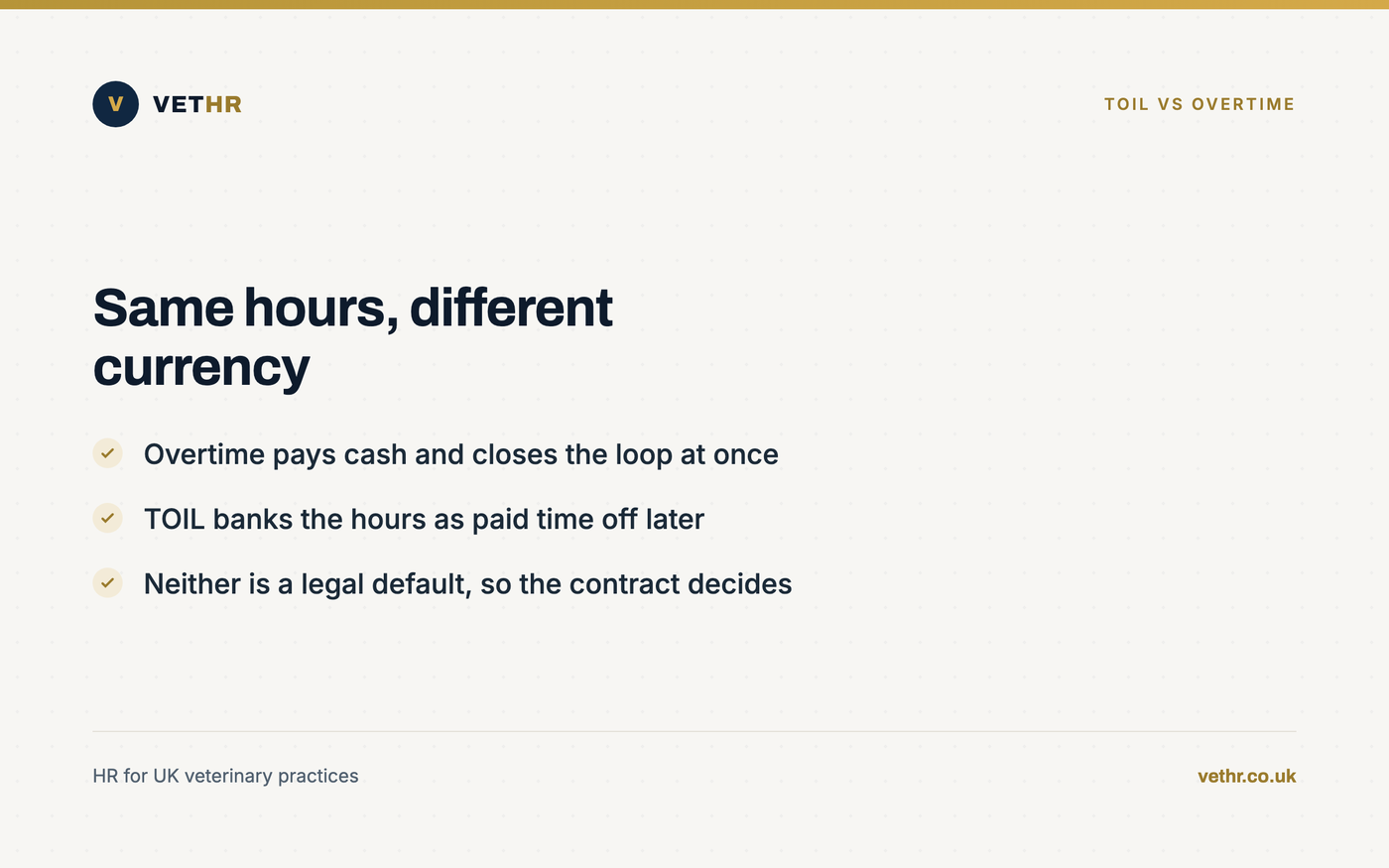
TOIL and overtime pay reward the same thing, extra hours, in different currencies. Overtime pays cash for the hours worked. TOIL pays them back as time off later. Neither is a legal default in the UK, so a practice chooses which to offer and writes it into the contract. Many practices use both, with a clear rule on when each applies.
The legal backdrop is the same for both. GOV.UK confirms that “employers do not have to pay workers for overtime”, while warning that “your average pay for the total hours you work must not fall below the National Minimum Wage”, on its overtime rights page. That minimum wage line matters for TOIL too: if banked hours push someone’s effective hourly pay below the minimum across a pay reference period, the scheme is no longer compliant.
The practical difference is who carries the risk. Overtime closes the loop immediately: the hours are worked, paid and forgotten. TOIL leaves an open balance that someone must remember, honour and eventually settle. That open balance is exactly where the overtime-vs-TOIL decision gets interesting, because the cheaper option on payday can be the more expensive one to administer.
A fair TOIL policy answers the awkward questions before they arise: which hours qualify, at what rate they bank, how time off is requested and approved, when it expires, and what happens to any balance when someone leaves. Put plainly, a fair policy removes the guesswork so two people in the same situation are always treated the same way.
The unsocial-hours question is sharper in veterinary work than in most office settings. ACAS notes that an employer might pay an enhanced rate for overtime worked at “unsocial” times, in its pay for working extra hours guidance. If you bank out-of-hours emergency cover at the flat rate while a colleague is paid time and a half in cash, the people doing the hardest shifts will notice, and fairness is the whole point of getting this right.
Not sure your TOIL rules hold up? A 30-minute conversation usually makes the gaps obvious. Book a free HR health check and we will look at how your practice banks, tracks and settles owed time today, then tell you honestly where the policy is fair and where it leaves you exposed. No jargon, nothing sold for the sake of it.
You track TOIL accurately by recording every banked hour and every hour taken back against a single, shared balance, with a date and a reason. The moment TOIL lives in memory, a text message or a sticky note, it drifts. A real timestamp at the point the hours are worked is the only version everyone can trust.
This is where good record-keeping pays for itself twice. The first payoff is fairness, because nobody argues with a dated log. The second is compliance. ACAS confirms employers must keep working time records and hold them “for 2 years from the date they were made”, in its guidance on the working time rules. TOIL hours are working time, so the underlying record matters whether you pay or bank them.
Pay records reach back even further. GOV.UK guidance on enforcing the minimum wage states that, from 1 April 2021, employers must keep records “for a minimum of 6 years” and be able to “produce the records for an individual pay reference period for an individual worker in a single document on request”. A scattered TOIL ledger fails that test on a bad day. A system that timestamps banked hours and links them to the rota passes it without a thought.
The mechanics are simple once a tool does the counting. Hours worked beyond the planned shift flow from clock in and out into a running TOIL balance, and time taken back draws it down, so the figure is always live. That is the difference between a number you defend and a number you guess.
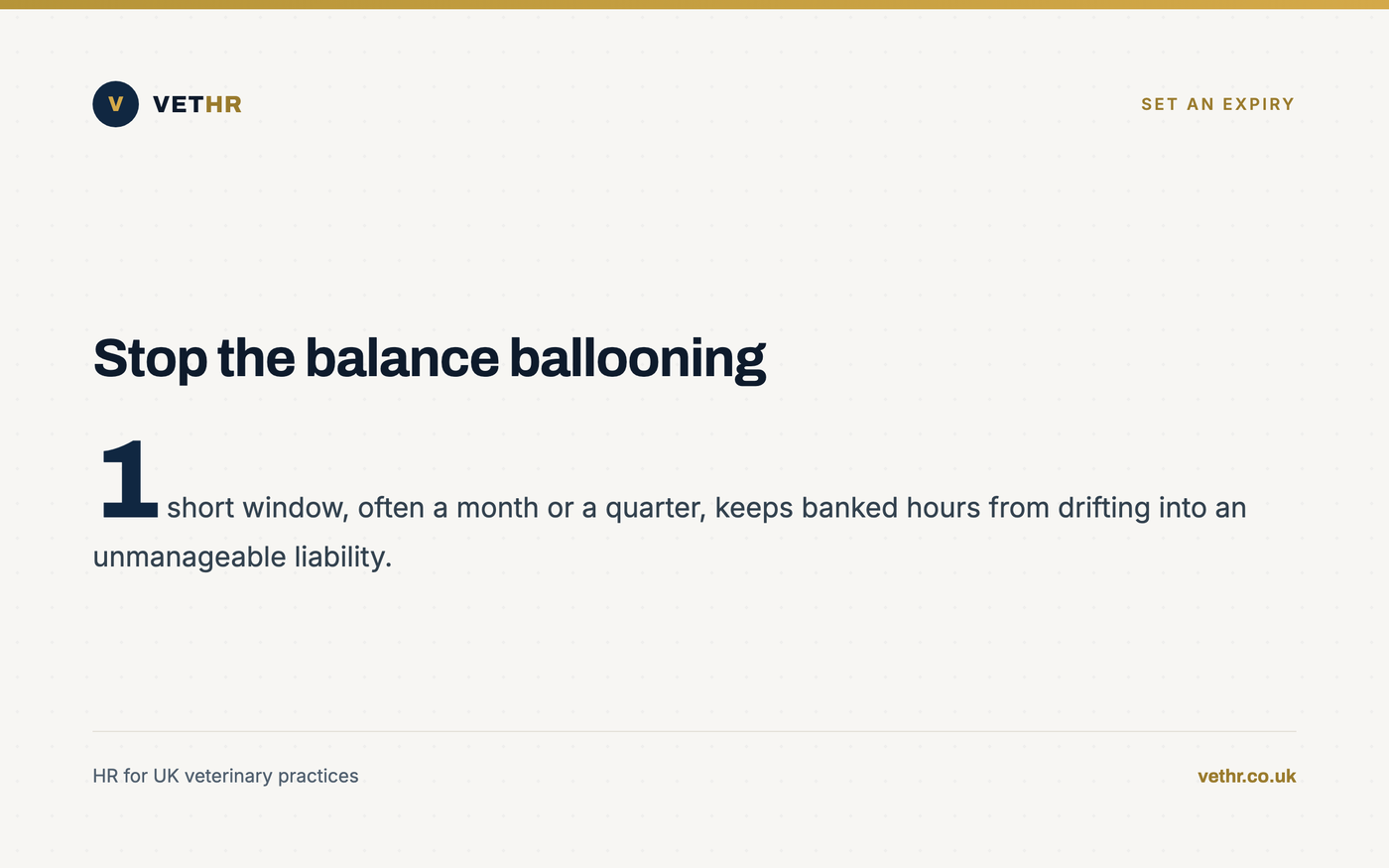
TOIL should usually expire within a set window, commonly the same or the following month, or a quarter at most, because banked hours that linger turn into an unmanageable liability. A short expiry keeps the scheme honest: hours are worked, taken back soon after, and the ledger returns to zero rather than ballooning into the hundreds.
The risk of open-ended carryover is concrete. Hours bank faster in winter and during staff shortages, exactly when nobody can spare the time off to clear them. Twelve months on, a practice can be carrying weeks of owed time it cannot release without leaving the rota dangerously thin. An expiry date forces the conversation early, while a single afternoon still clears the balance.
Whatever you decide, the rule has to be written, applied evenly and communicated up front. Expiring TOIL that an employee was never told about, or never had a fair chance to take, is the kind of decision that breeds resentment and disputes. State the window in the policy, remind people as balances build, and never let a deadline arrive as a surprise. Fairness lives in the warning, not just the rule.
TOIL does not replace statutory holiday, and banking hours does not let a practice sidestep working-time limits. The two sit side by side. Your team still gets their full statutory leave on top of any TOIL, and the hours that earn TOIL still count toward the legal caps on how much someone can work.
Start with holiday. Almost all workers are entitled to “5.6 weeks’ paid holiday a year”, which is 28 days for a five-day week, as set out on the GOV.UK holiday entitlement page. TOIL is extra time off you have agreed to grant, separate from that 5.6 weeks. Banking an hour of TOIL never reduces someone’s statutory leave, and you cannot offer TOIL as a substitute for it. Getting the underlying entitlement right matters first, which is what our holiday calculations are built to handle.
Then the working-time limits. The hours behind TOIL still feed the 48-hour weekly maximum that staff can only exceed with a written opt-out, and rest rules still apply: ACAS sets out “daily rest of 11 hours between working days” and a “20 minute” break where someone works more than six hours, in the working time rules. A vet who banks endless TOIL by working punishing weeks may be banking a compliance problem too. The policy should protect rest, not erode it.
You avoid the owed-time black hole by closing every loop quickly: agree the hours, log them at the time, set a short expiry, and review balances regularly so nothing festers. The black hole forms when hours bank faster than they clear and no single record tells the truth. Three habits keep a practice out of it for good.
None of this needs to be heavy. It needs one shared, dated ledger and the discipline to keep it current, which is far easier when the rota and the hours already talk to each other. Tie banked time to the schedule in a single veterinary rota system, and “how much am I owed” becomes a number you can read off a screen rather than an argument waiting to happen.
No. TOIL is contractual, not statutory. ACAS confirms there is no automatic legal right to overtime pay, and an employer “might offer time off instead”. Because it is an agreement, the rules are whatever you write into your policy or contract, which is exactly why a clear written scheme matters so much.
Yes, as long as the expiry is written into the policy, applied evenly and communicated in advance. A short window, often a month or a quarter, keeps balances from ballooning into an unmanageable liability. The key is fairness: an employee should know the deadline and have a genuine chance to take the time before it lapses.
The hours that earn TOIL still count as working time, so they feed the 48-hour weekly maximum, which staff can only exceed with a written opt-out. Banking hours as time off does not remove them from the legal calculation. A scheme that drives people well over the limit may be storing up a compliance problem as well as fatigue.
No. Statutory holiday is the 5.6 weeks, or 28 days for a five-day week, that almost all workers are entitled to. TOIL is extra paid time off you have agreed to grant for hours worked, separate from and on top of that entitlement. You cannot offer TOIL in place of someone’s statutory leave, and banking it never reduces their holiday.
With a single, dated record that captures hours banked and hours taken back, ideally linked to the rota and clock-in data rather than memory. Working time records must be kept for two years, and pay records for six, so the underlying log matters anyway. A live TOIL balance everyone can see prevents the disputes that scattered notes create.
TOIL is a good idea with a sharp edge. Done well, it rewards the people who cover the hard hours and keeps a stretched rota fair. Done loosely, it becomes an owed-time black hole that nobody can account for and everyone resents. The difference is never goodwill; it is a clear written policy, an honest rate, and a record you can read off a screen.
If your owed-time ledger has drifted, start by tightening the rules and tying them to your hours. See how the pieces fit in our veterinary rota system, read how we work in HR consultancy, or simply book a free HR health check and we will give you a straight recommendation for your practice. Nothing sold that you do not need.
The Vet HR Team provides HR consultancy and white-labelled staff systems exclusively to UK veterinary practices.
Read next: Overtime for Veterinary Staff and Holiday Booking System for Veterinary Practices.
Contracts, rotas, holiday, a difficult conversation. Tell us what you are dealing with and we will come back within one working day. Nothing to sign up to.
Got it. We will come back to you within one working day. If you do not see a reply, please check your spam folder.
