TL;DR: Acas says that if an employer dismisses an employee they should tell them why, when the contract will end, their notice period and their right to appeal, and it is a good idea to put it in writing. Regardless of length of service, the reasons must be put in writing for pregnant employees and employees on maternity or adoption leave. Other employees with employee status and two years’ service can ask for a written statement and the employer must give it within 14 days. A fair dismissal needs a valid reason and a full and fair procedure, usually following the Acas Code of Practice.
Last updated: 24 November 2026

A practice dismisses a receptionist after a disciplinary hearing. The practice manager tells her in the office and she leaves in tears. A week later she asks for the reasons in writing, because she wants to understand what to say to a new employer. Nobody responds. Three weeks after that the practice receives a letter from a solicitor. The practice has no letter, no record of what was said at the end of the hearing and no copy of the appeal rights it should have explained.
The reasons for dismissal are more than paperwork. They show the employee what happened, they show the practice has a valid reason and a fair process and they are the first document a tribunal will ask to see. This guide explains what Acas says about giving reasons, when it must be in writing, what to include, how to describe the reason, what to do about appeals and confidentiality, and what the law is expected to change. It is general information, not legal advice.
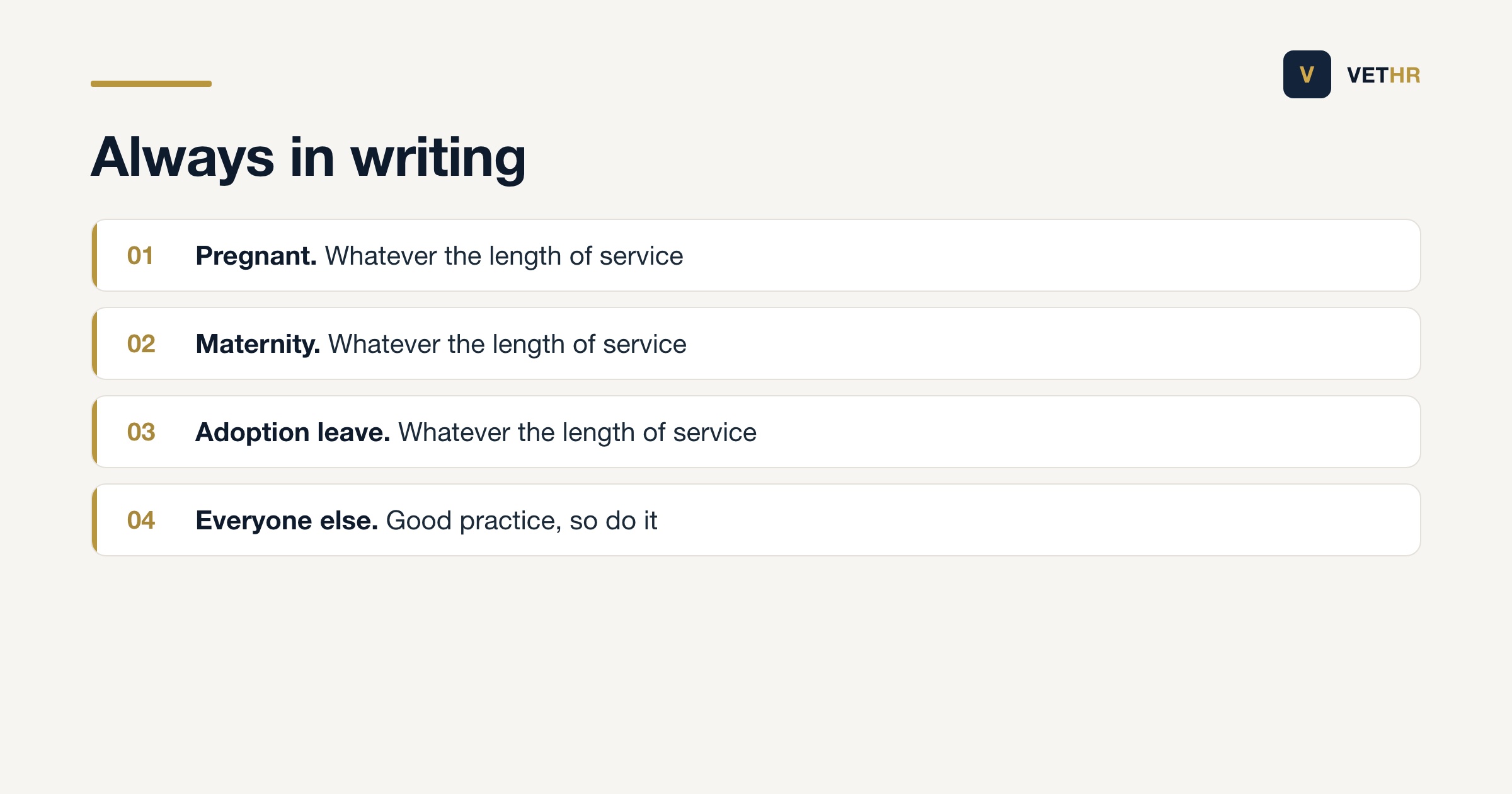
Sometimes. Acas says that regardless of how long someone has been employed, an employer must put the reasons in writing for pregnant employees and employees on maternity or adoption leave. For others, an employee with employee status and two years’ service can ask for a written statement, and the employer must provide it within 14 days.
The Acas page on what dismissal is sets this out. It says that if an employer dismisses an employee, they should tell them why they have been dismissed, when their employment contract will end, their notice period, if there is one, and their right to appeal the decision. It is a good idea to put it in writing, for example in a letter or email.
In practice, treat every dismissal as one where reasons will be put in writing. A letter on the day, or within a day or two, avoids a dispute about what was said, deals with the 14-day rule before it is triggered and is the starting point for the appeal. It also prevents a gap when the person who made the decision is not available.
Agency workers and casual workers on zero-hours contracts are not likely to be employees, and the Acas Code of Practice mainly applies to those with employee status. Acas says it is good practice for employers to follow the same fair procedure for anyone with worker status, so a practice that dismisses a freelance or bank worker from its list should still say why and when.
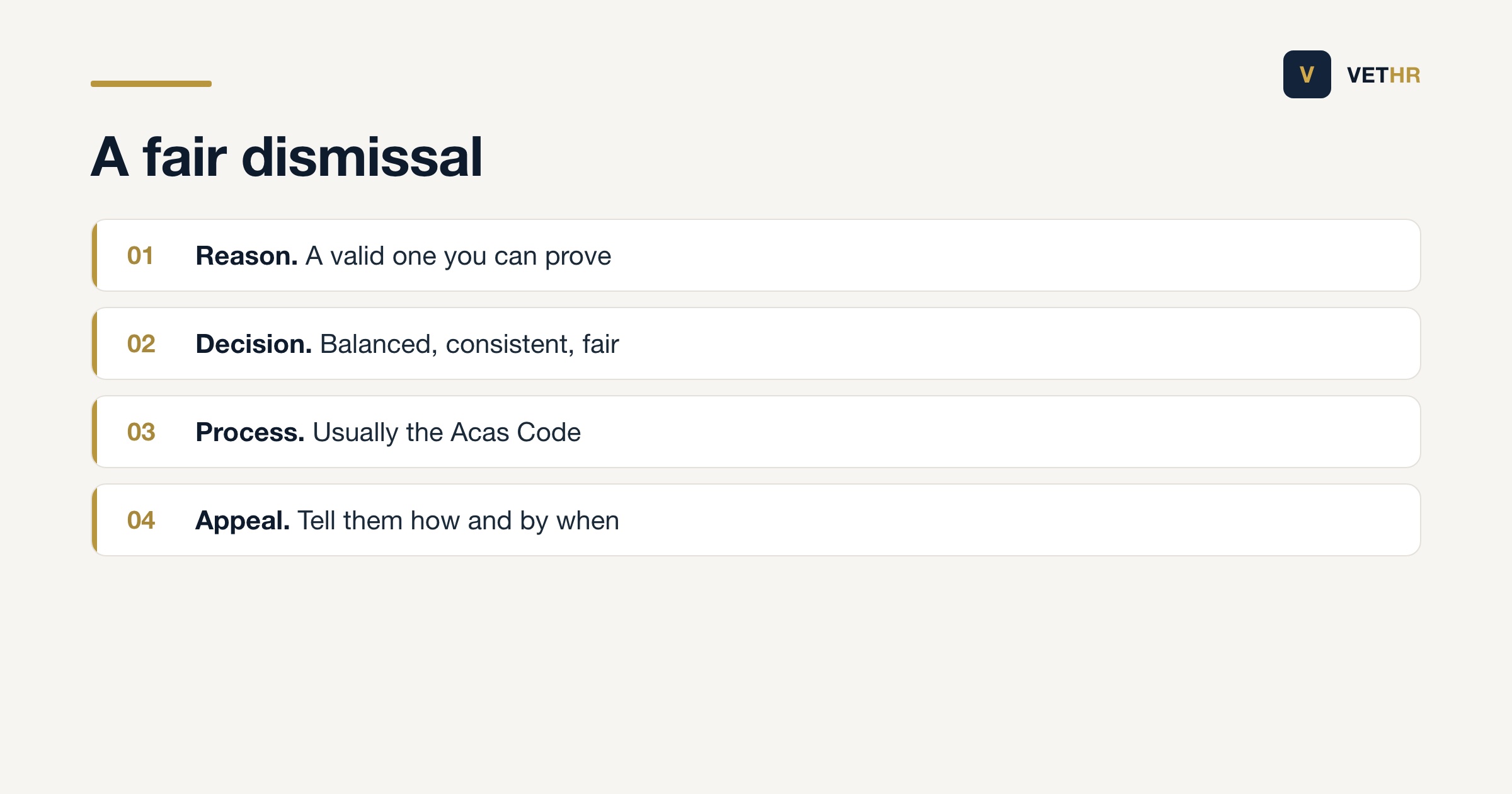
Acas says the employer must have a valid reason and make a decision that is balanced, consistent and as fair as possible, following a full and fair procedure, usually in line with the Acas Code of Practice. The procedure followed will be taken into account if an employee claims unfair dismissal and the case reaches an employment tribunal.
The Acas page on unfair dismissal says it might be unfair dismissal if the employee worked for the employer for at least two years and there was no fair reason, the reason was not enough to justify dismissing them or the employer did not follow a fair procedure. The procedure should follow the Acas Code if it concerns misconduct or capability, and for other reasons the employer should still follow a fair procedure.
The reasons you give should therefore match the reason you can prove, and the procedure you followed. Our guides to disciplinary procedures, gross misconduct and managing underperformance set out the steps for the two most common routes.
Other reasons include redundancy, which has its own process, long-term illness and some other substantial reasons. Acas says that where a worker has a long-term illness, dismissal should be a last resort, and the employer should support the worker and help them return to work, including reasonable adjustments if they have a disability. Dismissing someone because they have a disability could be discrimination. Our guides to long-term sickness and reasonable adjustments cover those routes.
Acas says to tell the employee why they have been dismissed, when the contract ends, their notice period if there is one and their right to appeal. A good letter also states the decision clearly, summarises the evidence and the process, confirms final pay and holiday and tells the employee how to appeal and by when.
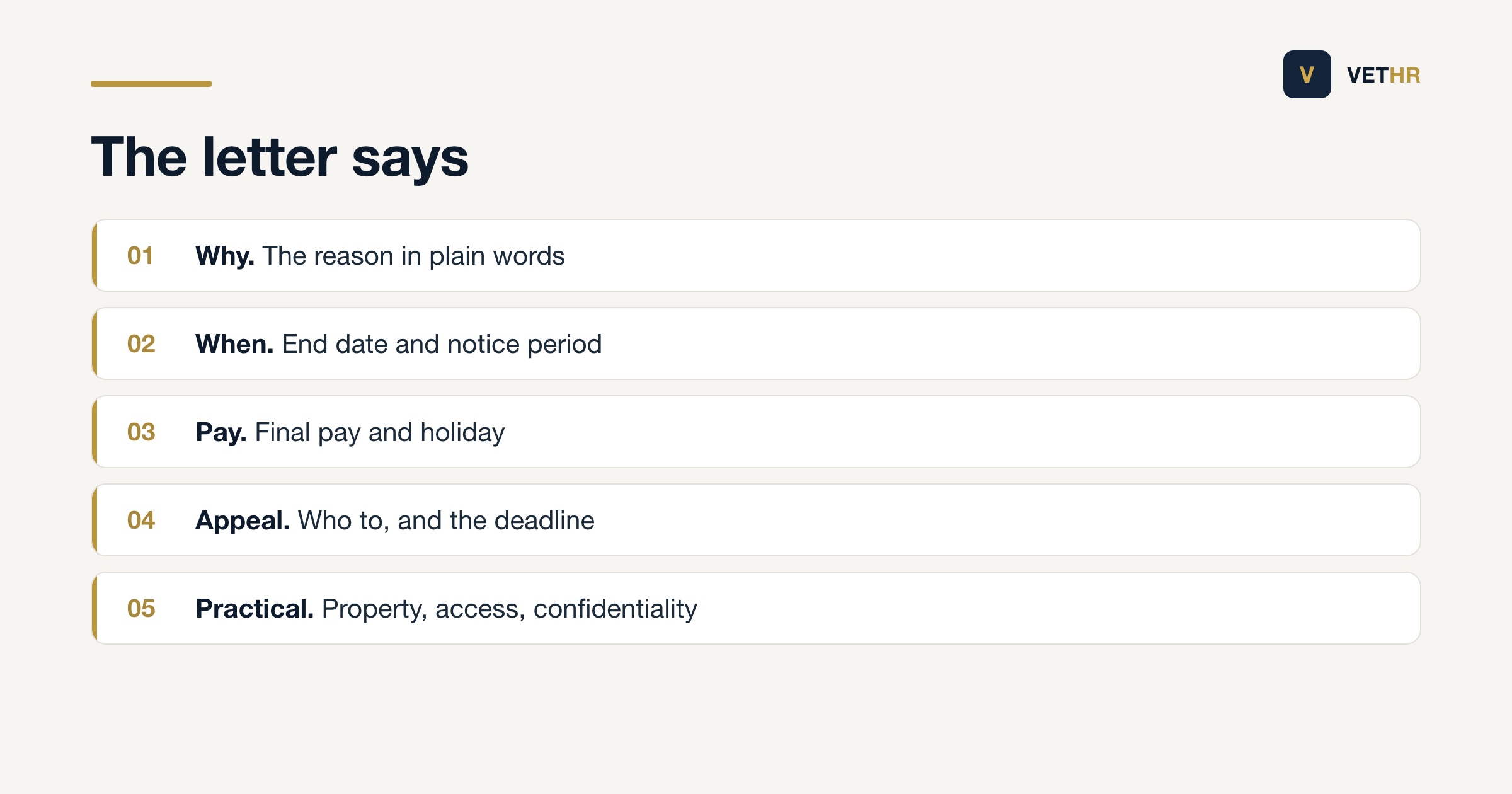
A practical structure for a dismissal letter:
If the dismissal is without notice for gross misconduct, say so and explain why. Our guide to PILON explains the difference between payment in lieu and other forms of notice, and the guide to notice periods covers the basics.
Write it in neutral, factual language. Avoid opinion, exaggeration and anything that cannot be supported by the evidence. The letter may be read by a tribunal, so assume it will be.
Acas says that if an employee with employee status and two years’ service asks, the employer must give the reasons in writing within 14 days. Diarise the date as soon as a request arrives, check the service and status, and reply in time with the same reasons as were given at the end of the procedure.
If the reasons are already in your dismissal letter, send a copy. If not, write a statement that sets out the real reason. It should be consistent with what you said at the hearing, in your notes and in the outcome. Inconsistency between the reason given and the reason relied on later is damaging.
Do not use the request as an invitation to argue. A short, factual statement is enough. Keep a copy of the request and the response. If you are unsure whether the employee qualifies, give the reasons anyway, because it costs nothing and shows fair treatment.
For pregnant employees and those on maternity or adoption leave, the written reasons are required regardless of service and without needing a request. Our guide to redundancy protection covers the extra duties to offer suitable alternative vacancies in a redundancy.
Keep a short decision record alongside the letter: the allegation or reason, the evidence considered, the employee’s response, the conclusion on each point, the sanction and why it was chosen, and the date and time the decision was communicated. It helps the writer of the letter and anyone who reviews the case later.
If more than one person was involved, record who decided. Where the decision was reached after a break, note the time and who was present. If the employee was accompanied, record who accompanied them. These facts are easy to forget and hard to reconstruct.
The record should be factual and complete enough for a manager who was not there to understand why the decision was taken. Our guide to the right to be accompanied explains what to note about the companion, and the workplace investigation guide covers the evidence trail that comes before.
Store the letter, the decision record and the supporting documents in the personnel file, and keep them for as long as your retention policy requires. If a claim is brought, the file is what you will rely on.
Acas says an employee can appeal against a dismissal, and the employer must follow a fair and reasonable procedure, otherwise the employee might be able to claim unfair dismissal even if the reason was valid. The employer should tell the employee how to appeal. Being able to appeal is also part of the Acas Code.
If an employee gets their job back after appealing, Acas notes this is known as a vanishing dismissal, and they cannot claim unfair dismissal to an employment tribunal. Use a different manager for the appeal where possible, and in a small practice consider an external person. Our guide to disciplinary appeals covers how to run one.
Make the appeal route clear in the letter, with a named person and a deadline. Keep the notes of the appeal and write the outcome to the employee. A fair appeal can correct a flawed process and show that the practice acted reasonably.
Acas lists reasons that are automatically unfair if they are the main reason for dismissal, including making a flexible working request, being pregnant or on maternity leave, wanting to take family leave, taking time off for dependants, trade union membership, asking for a legal right such as the minimum wage, jury service, whistleblowing and taking action on a health and safety issue. No qualifying period is needed.
Check that the reason you give is the real reason and that none of these lies behind it. Our guides to flexible working requests, time off for dependants and whistleblowing cover three of them. If an employee has recently asked for a legal right or raised a concern, take advice before you act.
Acas says the Employment Rights Act 2025 will give protection from unfair dismissal after six months in a job, with the change expected in January 2027 and not yet law, and will make fire and rehire an automatically unfair dismissal in most cases. The government has not given an exact date, so check the current position before you rely on it.
Our guide to the unfair dismissal qualifying period explains the planned change and what to do now. The practical lesson is that practices should already treat every dismissal as one that might be challenged, with a documented reason and a fair process, whatever the length of service.
Acas says employers should respect the confidentiality of the person who has been dismissed, for example when telling colleagues and clients that the employee has left. Any outcome of a disciplinary procedure should remain confidential. Say that the person has left and thank them for their work, without giving reasons.
Prepare a short message for the team and for clients where it is needed, and brief anyone who may be asked. Do not post about it on the practice’s group chat or social media. Our guide to the staff WhatsApp group covers the risk of discussing staff matters in informal channels.
The usual mistakes with reasons for dismissal are telling the employee verbally only, giving a different reason in the letter from the one in the hearing, forgetting appeal rights, missing the 14-day deadline, not giving written reasons to pregnant staff and discussing the dismissal with colleagues.
For pregnant employees and those on maternity or adoption leave, yes, regardless of length of service. For others with employee status and two years’ service, within 14 days if they ask. Acas says it is a good idea to put reasons in writing for everyone.
Why they have been dismissed, when the contract ends, the notice period if any and their right to appeal. A good letter also covers the process, final pay and holiday and the practical points.
They do not have the right to ask for a written statement under the two-year rule, but Acas says to give reasons and put it in writing as good practice, and automatically unfair reasons do not need two years’ service.
Yes. Acas says an employee can appeal and the employer should tell them how. Being able to appeal is part of the Acas Code.
Acas says it is planned to become six months in January 2027 under the Employment Rights Act 2025 and is not yet law. Check the current position.
If you want a dismissal letter template, an appeal checklist and a process map for your practice, book a free 30-minute HR health check through our contact page. See also our HR consultancy for veterinary practices and the policies and handbook system.
Sources: Acas: what dismissal is, Acas: following a fair procedure, Acas: unfair dismissal.
Contracts, rotas, holiday, a difficult conversation. Tell us what you are dealing with and we will come back within one working day. Nothing to sign up to.
Got it. We will come back to you within one working day. If you do not see a reply, please check your spam folder.
