Last updated: 24 September 2026
TL;DR: Every disciplinary outcome should come with a right of appeal. Acas recommends 5 working days for the employee to appeal in writing, and the appeal should be heard by a manager who was not involved in the original decision and who has authority to make the final call. In a small practice that usually means bringing someone in.
A practice with nine staff issues a final written warning. The owner investigated it, the owner chaired the hearing, and the owner signed the letter. The nurse appeals. There is nobody left in the building who has not already formed a view, and the appeal is scheduled with the same person who made the original decision. That is the moment a defensible process becomes an indefensible one.
A disciplinary appeal is the safety valve. It is the stage where a decision made in the heat of a difficult month gets looked at again, and where a genuine mistake can be corrected without anyone going near a tribunal.
It is also the stage a tribunal looks at hardest when it considers whether a dismissal was fair or unfair. A sound investigation and a fair hearing can be undone by an appeal that was refused, ignored or heard by the wrong person. The disciplinary appeal is the cheapest insurance in the whole process.
Treat it as a chance to be right rather than a formality to survive. Practices that approach it that way change outcomes surprisingly often, and the change is almost always cheaper than defending the original.
Set the disciplinary appeal out in the outcome letter, in plain words. Name the person the appeal should be sent to, give the deadline, and say what the letter needs to contain. An employee who has to work out how to appeal is an employee who will later say the right was never really offered.
Acas guidance says the appeal should be set out in a letter or email explaining why the employee thinks the outcome was wrong or unfair, and what they would like to happen next. Quote that back to them in your letter so the grounds arrive in a usable form.
Include the same right in every outcome letter, from a first written warning to a dismissal. A practice that only offers an appeal when the decision is serious is applying its procedure inconsistently, and that is the pattern a tribunal notices.
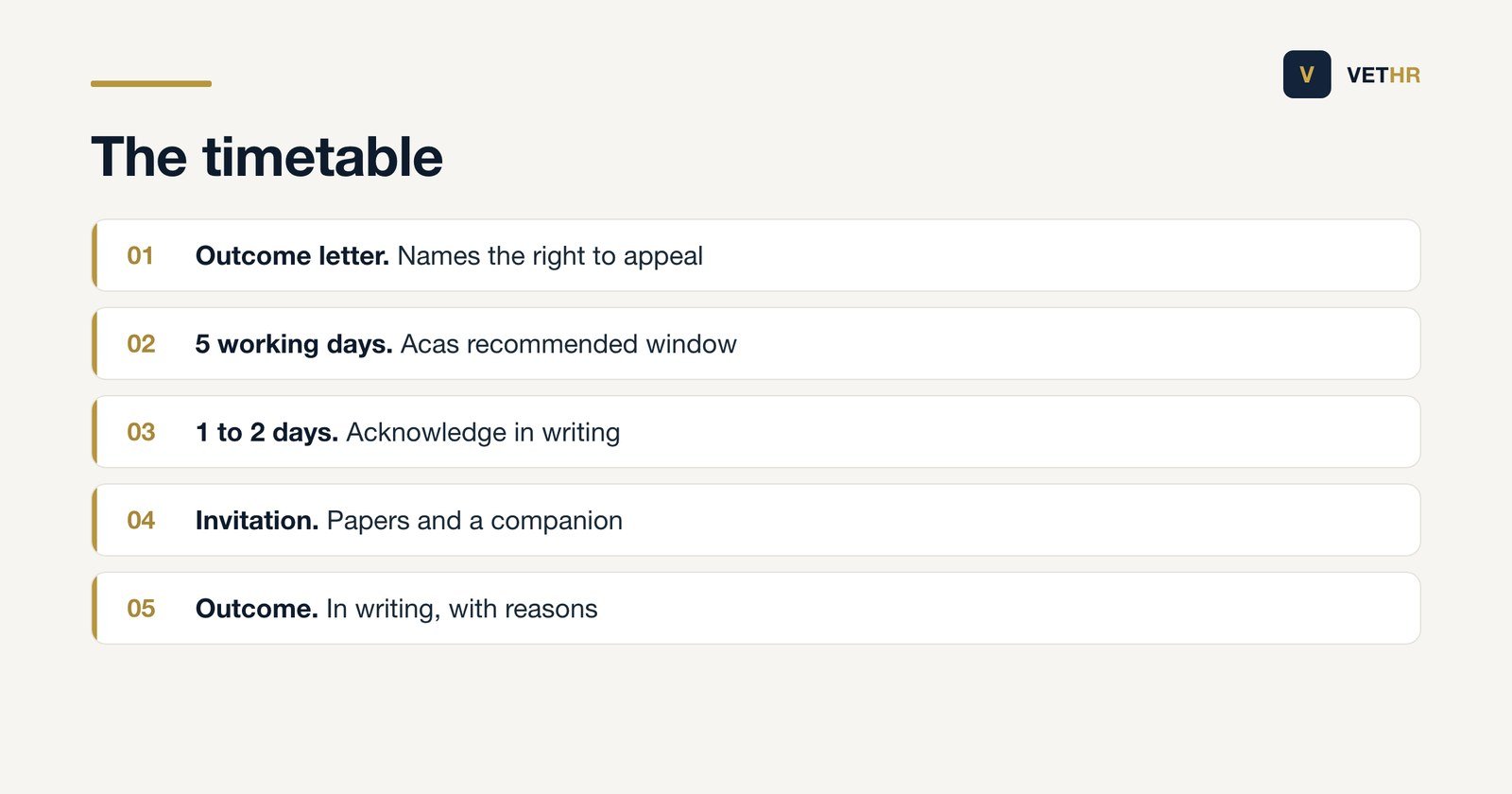
Acas recommends 5 working days from receiving the outcome as an appropriate amount of time. If your policy already sets a period, use that, and if it does not, five working days is a sensible standard to adopt.
Be flexible where there is a reason. Someone on nights, on annual leave or signed off sick has not had five working days in any meaningful sense. Extending a deadline costs nothing. Refusing a late disciplinary appeal on a technicality is exactly the sort of decision that looks poor in hindsight.
Acknowledge the disciplinary appeal in writing within a day or two, and give a target date for the hearing. Silence at this stage is read as hostility, whether or not it was meant that way.
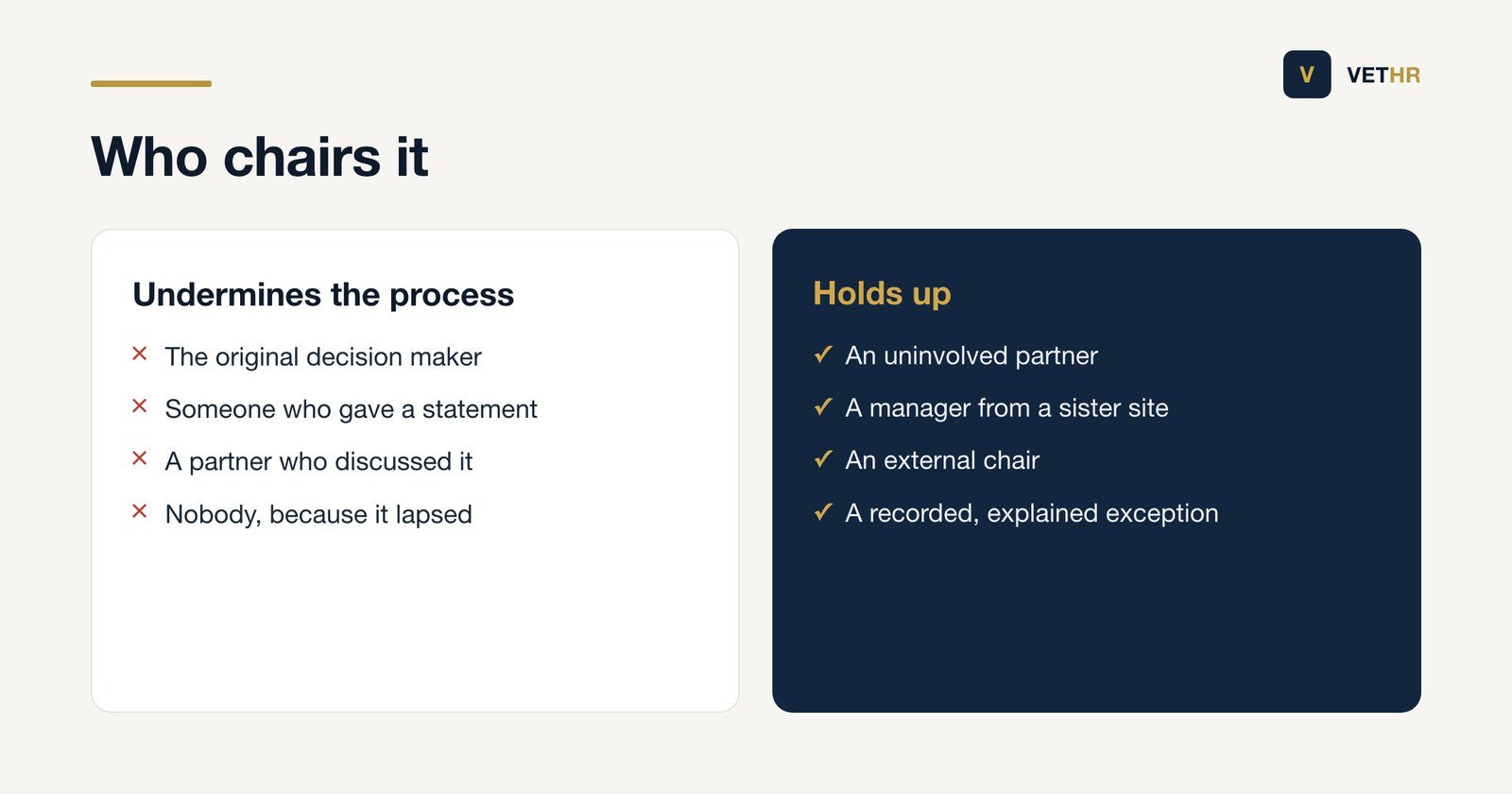
Acas is clear on the principle: the appeal should be handled by a manager who was not previously involved in deciding the outcome, and who has the authority to make the final decision. In a practice with fifty staff that is straightforward. In a practice with nine, it is the hardest question in this article.
There are four workable answers, in rough order of preference.
The fourth is a last resort, not a default. If you use it, say so openly in the letter, explain why, and be scrupulous about reconsidering the evidence rather than defending the first decision. We chair appeals for independent practices as part of HR consultancy for veterinary practices precisely because of this problem.
Give reasonable notice of the disciplinary appeal hearing, send the papers in advance, and tell the employee they can be accompanied. The statutory right to be accompanied applies to appeal hearings, and the companion can be a colleague or a trade union representative.
Start by asking the employee to take you through their grounds. Deal with the points they actually raised rather than rerunning the whole case, unless the grounds are that the whole case was wrong, in which case rerun it properly.
Take notes, or have someone take them. Adjourn to consider rather than deciding in the room. A disciplinary appeal decided on the spot never looks like it was decided with an open mind, even when it was.
If new evidence appears, investigate it before deciding. Our guide to running a workplace investigation in a veterinary practice covers how to do that without starting again from scratch.
Put the disciplinary appeal outcome in writing without unreasonable delay, giving reasons that engage with the grounds raised. Three outcomes are available: uphold the original decision, reduce it, or overturn it entirely.
Increasing a sanction on appeal is a different matter and should not be done unless your policy expressly allows it. An employee who fears a worse outcome will not appeal, which defeats the purpose of having the stage at all.
Say whether the decision is final. In most practices the disciplinary appeal is the end of the internal process, and the letter should say so, along with a line pointing the employee to Acas if they remain unhappy.
Where the original decision was dismissal and the appeal succeeds, reinstate with continuity of employment and sort out back pay. Our note on gross misconduct in a veterinary practice covers the decisions that most often get revisited this way.
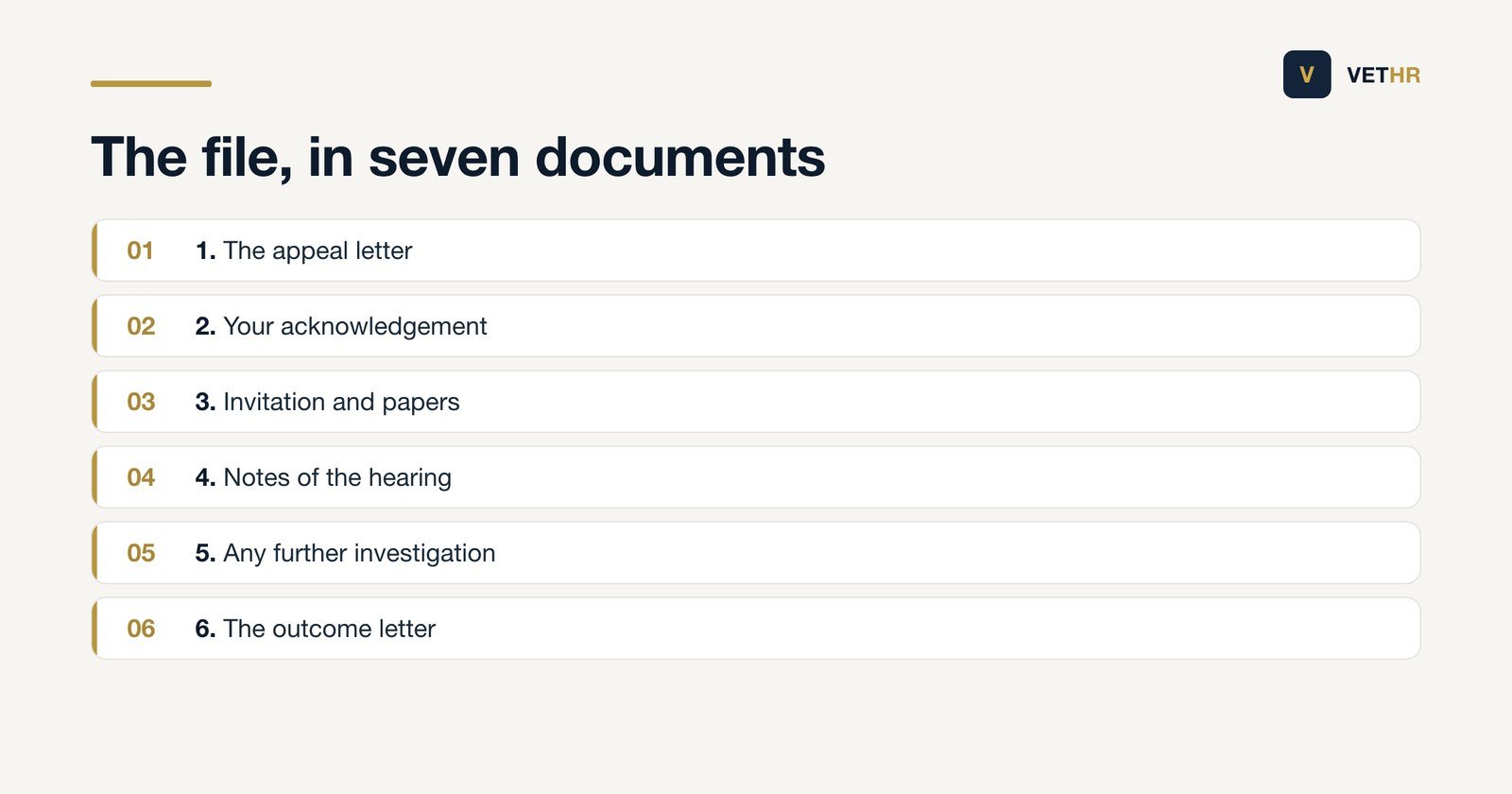
Keep the appeal letter, the acknowledgement, the invitation with the right to be accompanied, the papers sent, the notes of the hearing, any further investigation, and the outcome letter. That is seven documents and it is the whole file.
Store it with the disciplinary record rather than in a manager’s email. Our note on digital staff records for veterinary practices covers where this belongs and who should be able to see it.
If your procedure does not currently describe the appeal stage, that is the gap to fix first. Book a free 30-minute HR health check and we will look at what you have.
Offer one in every case. Acas guidance treats the appeal as a standard part of a fair procedure, and a tribunal considering whether a dismissal was fair will look closely at whether the employee had a real opportunity to challenge the decision.
Only as a last resort. Acas says the appeal should be handled by a manager not previously involved who has authority to make the final decision. Where a small practice genuinely has nobody, record why, or appoint an external chair instead.
Yes. The right to be accompanied applies at appeal hearings as well as the original hearing, and the companion can be a work colleague or a trade union representative. Say so in the invitation letter rather than waiting to be asked.
Consider the reason before refusing. Five working days is a recommendation, not a statutory cut off, and someone on nights or signed off sick may have a fair explanation. Hearing a late appeal costs an afternoon and removes an obvious criticism.
Not automatically. The employment usually ends on the dismissal date, and a successful appeal reinstates it with continuity. Say in the outcome letter what happens to pay and continuity if the appeal succeeds, so nobody is guessing.
Offer the disciplinary appeal in the outcome letter. Give five working days. Acknowledge it in writing. Appoint someone uninvolved. Hear it properly with a companion present. Reply in writing with reasons. Do those six things in that order and the disciplinary appeal stops being the weak point in your process.
If you need an independent chair at short notice, or a procedure that describes all of this properly, we help independent practices with both through policy documents and ongoing HR support on subscription.
The Vet HR Team provides HR consultancy and white-labelled staff systems exclusively to UK veterinary practices.
Contracts, rotas, holiday, a difficult conversation. Tell us what you are dealing with and we will come back within one working day. Nothing to sign up to.
Got it. We will come back to you within one working day. If you do not see a reply, please check your spam folder.
