Last updated: 5 November 2026
TL;DR: A staff discount is only a taxable benefit if what the employee pays is less than the cost of providing the treatment. HMRC says that where the amount paid exceeds the expense of provision, the cash equivalent is nil. Free treatment is different. Write down what is offered, to whom, and who authorises it.
A nurse’s dog needs a dental. The practice has always done staff pets for the cost of the drugs and consumables, nobody writes it down, and the invoice is closed off with a note saying staff. It works until a new bookkeeper asks what the policy is, and nobody can answer without guessing.
A staff discount is taxable less often than practices fear. HMRC guidance states that if the discounted amount the employee pays exceeds the expense incurred by the employer in providing the goods or services, the cash equivalent of the benefit will be nil.
Read that in practice terms. The comparison is not against the price a client would pay, it is against what it cost the practice to provide. A treatment charged at above cost but well below the client price creates no taxable benefit.
Where the expense of provision exceeds the discounted price paid, a charge can arise, and the calculation follows HMRC’s own guidance rather than a rule of thumb.
The cost behind a staff discount is more than the drug bottle. HMRC says the expense of provision includes the cost to the employer of the production or acquisition of the goods or services concerned, together with a proportion of any overhead expenses directly related to that production or acquisition, and any taxes or duties paid.
So a sensible staff discount rate is drugs and consumables plus a fair share of the directly related overhead, rather than the bare cost of the materials.
Most practices that charge cost plus a margin for staff are comfortably clear of a benefit charge. The ones at risk are those charging materials only, or nothing at all.
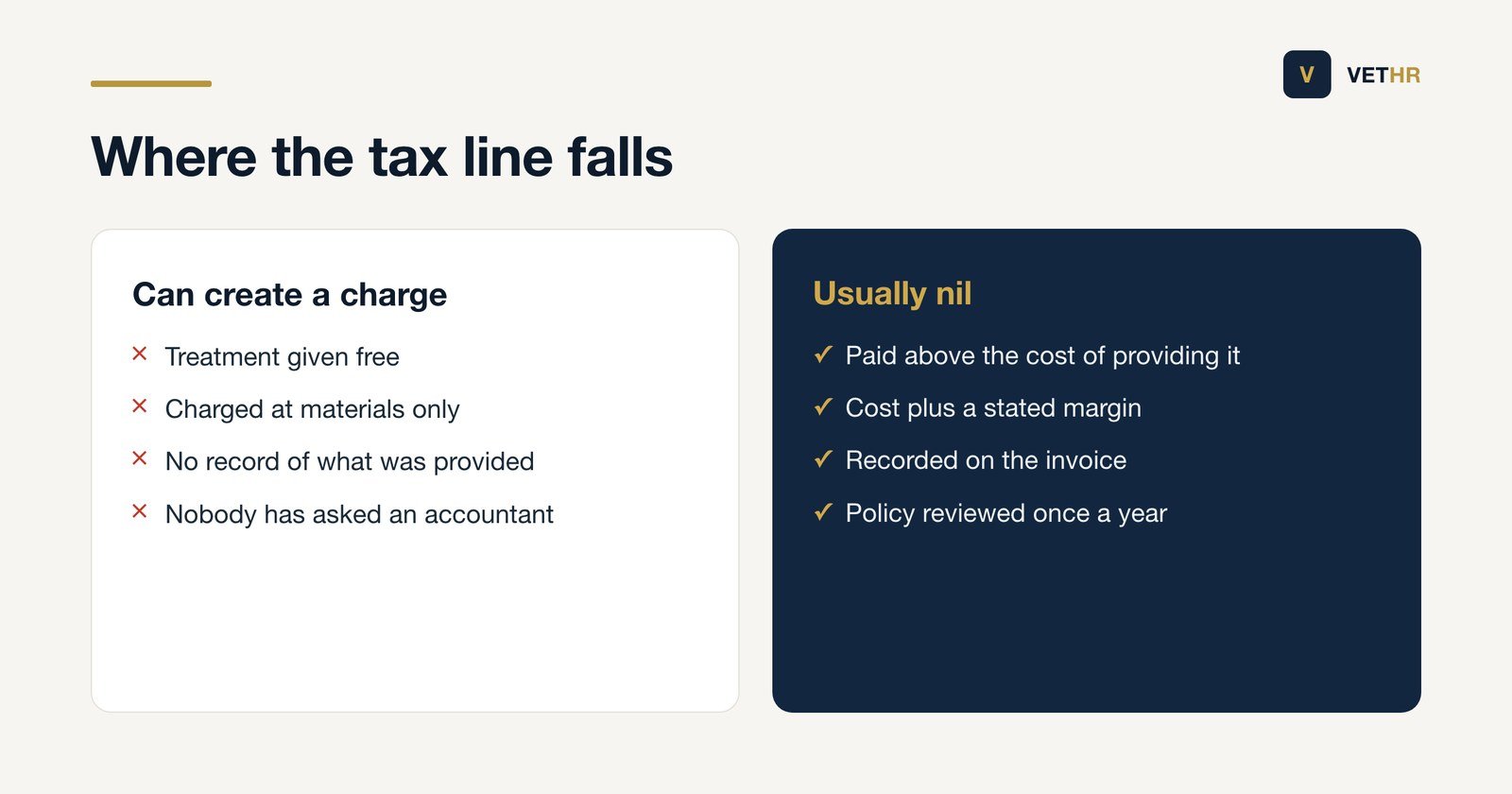
If the employee pays nothing, there is no discounted amount to exceed the expense of provision, so the nil outcome above does not apply and a benefit arises.
That does not mean you should stop doing it. It means the practice should know it is providing a benefit, decide deliberately whether to do so, and handle the reporting rather than discovering the position at year end.
Take advice from your accountant on the reporting route for anything you provide free or heavily subsidised, and do it before the tax year ends rather than during the rush afterwards. A staff discount policy that has never been shown to an accountant is the most common version of this problem.
Keep the staff discount consistent across the team. A rate that quietly differs between a long serving vet and a weekend receptionist is the kind of thing people compare, and there is no tax or clinical reason for the gap. If seniority is going to change the benefit, say so openly rather than leaving it to who asks.
Watch the volume too. A staff discount that covers unlimited treatment for an unlimited number of animals becomes expensive quietly, and the practices that get caught are usually the ones that never set a boundary because it felt ungenerous to do so.
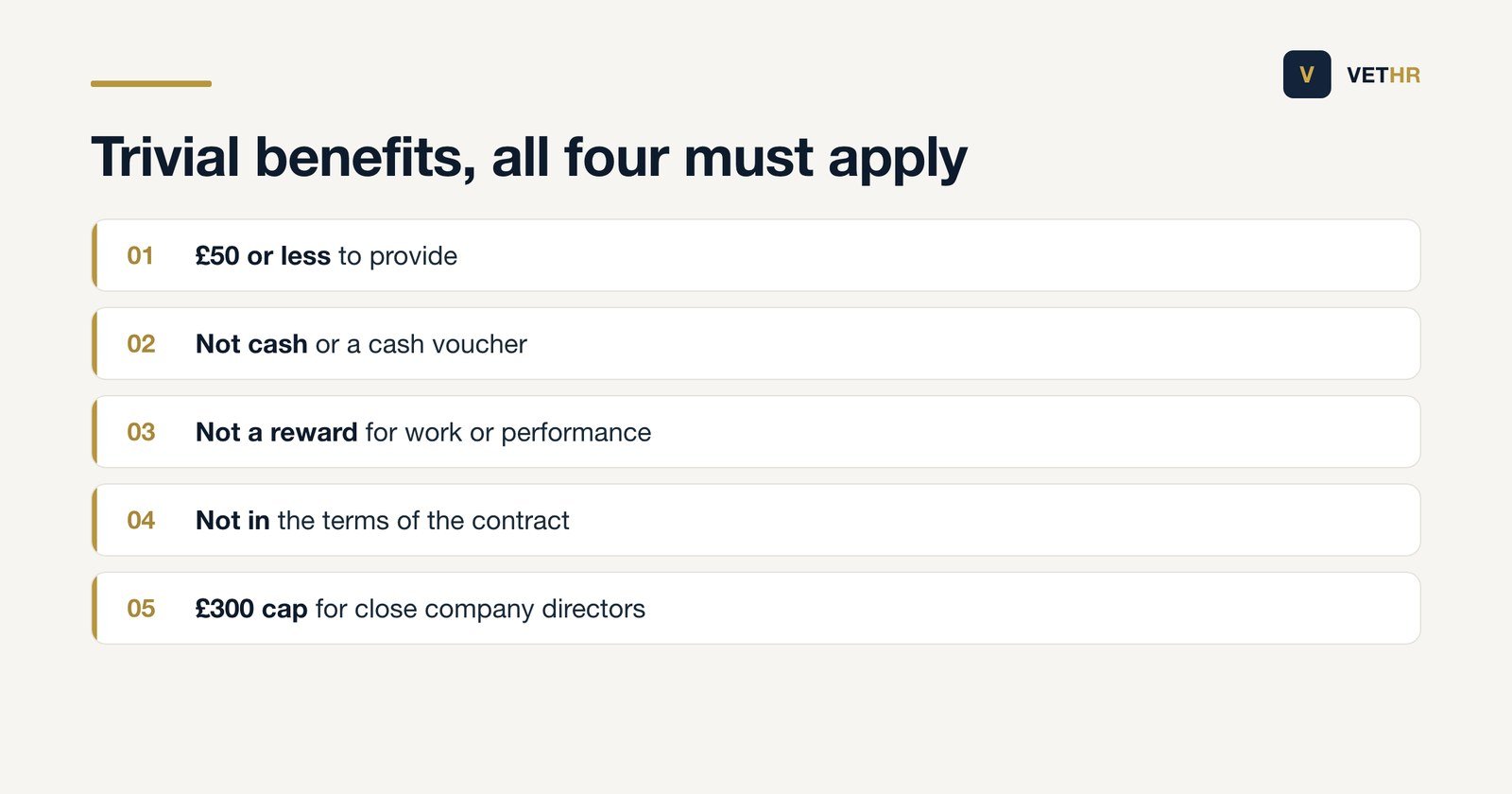
Separate rule, and a useful one. GOV.UK sets out a trivial benefits exemption where the benefit cost £50 or less to provide, it is not cash or a cash voucher, it is not a reward for work or performance, and it is not in the terms of the contract. All four conditions must be met.
Directors of close companies have an annual cap of £300 in a tax year, which catches a lot of owner managed practices.
That covers the Christmas gift, the birthday flowers and the thank you after a brutal weekend. What it does not cover is anything promised in advance or given as a reward, because those fail the conditions. Our note on staff recognition covers the difference between a gift and a reward.
A staff pet is a patient like any other, and the clinical record has to say so. Full history, consent, and notes written as though somebody else will read them, because one day somebody will.
Be careful with controlled drugs. Anything used on a staff animal goes through the register exactly as it would for a client, and a discount does not change the recording obligation. Our guide to the controlled drugs register covers it.
Name who authorises a staff discount. Without that, it drifts to whoever is on the desk, and the answer ends up depending on who asked and how busy the afternoon was.
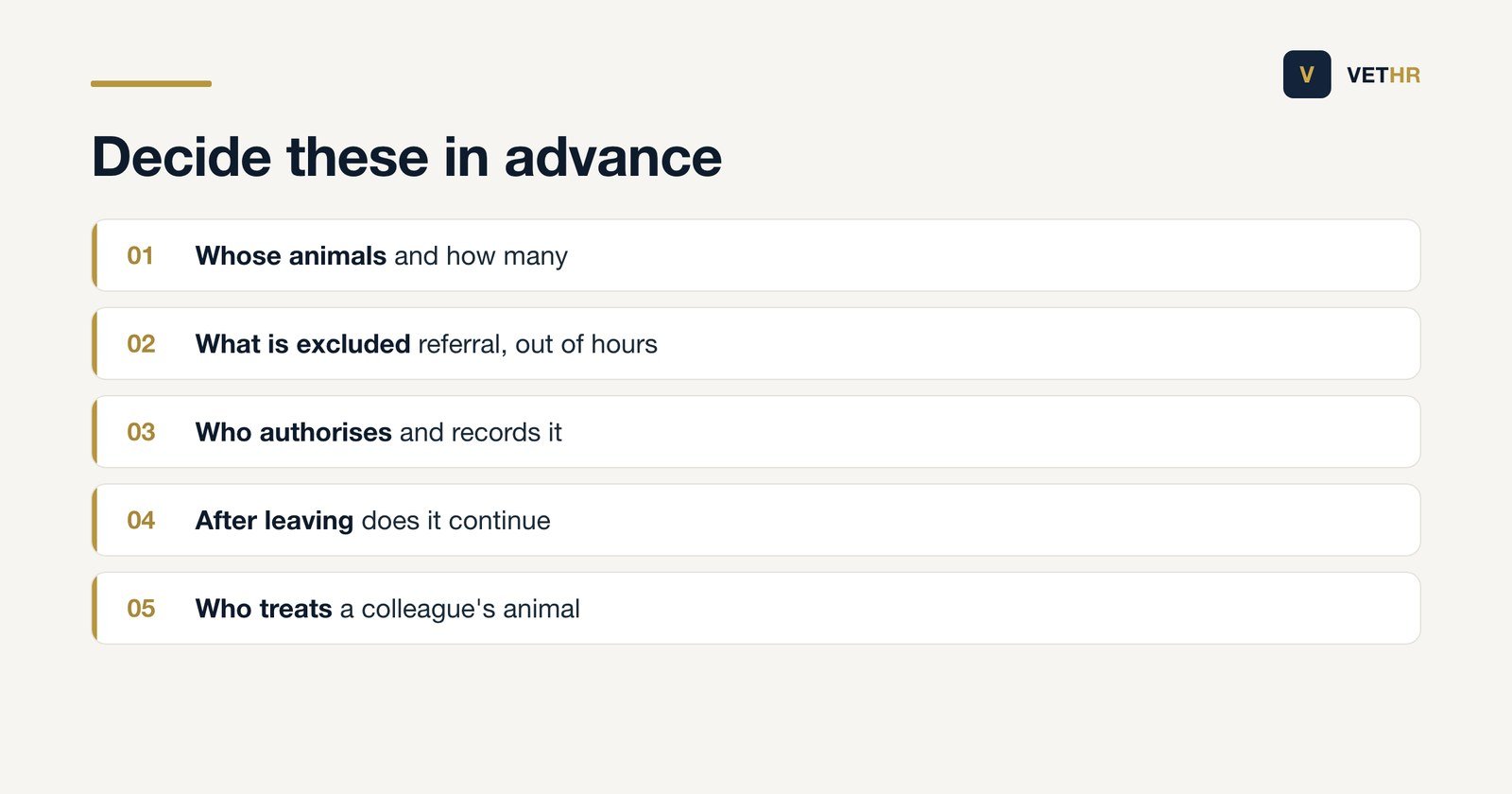
Four come up in almost every practice, and all four are easier decided in advance than in the moment.
That last one deserves real thought. A euthanasia for a colleague’s dog is one of the hardest things a vet does, and nobody should be volunteered for it by a rota. Say clearly that anyone can decline, without explaining. Our note on compassion fatigue covers the cost of these cases.
Five lines on the staff discount in the benefits section, and one conversation with your accountant.
Put it in the handbook rather than leaving it as custom. An undocumented benefit that has run unchanged for years becomes very difficult to alter later, because people reasonably treat it as part of what they were promised. Our notes on staff benefits and the staff handbook cover where it sits.
Never take the cost of treatment out of a payslip without the proper clause and agreement, which is a separate legal question covered in our guide to deductions from wages. Book a free 30-minute HR health check if yours has never been written down.
Only where what the employee pays is below the expense of provision. HMRC states that if the discounted amount paid exceeds the expense incurred by the employer, the cash equivalent of the benefit is nil. The comparison is with cost, not the client price.
HMRC includes the cost of acquiring or producing the goods or services, a proportion of overhead expenses directly related to that, and any taxes or duties paid. So it is more than the drugs and consumables alone.
Where nothing is paid there is no discounted amount to exceed the cost, so a benefit arises. Many practices still choose to offer it. Decide deliberately, and talk to your accountant about the reporting rather than finding out at year end.
Often yes, under the trivial benefits exemption, provided it cost £50 or less, is not cash or a cash voucher, is not a reward for work or performance, and is not in the contract. Directors of close companies have a £300 annual cap.
Only if you say so. Decide in advance whose animals are included and how many, because the question always arrives as a favour for a parent or a partner and is very hard to refuse on the spot.
Almost no practice needs to change its staff discount. What most need is to write down the arrangement they already have, express it as cost plus a margin, and show it to an accountant once.
Then decide the awkward cases in daylight, especially who is expected to treat a colleague’s animal. We write benefits sections for independent practices through HR consultancy for veterinary practices and ongoing HR support on subscription.
The Vet HR Team provides HR consultancy and white-labelled staff systems exclusively to UK veterinary practices.
Contracts, rotas, holiday, a difficult conversation. Tell us what you are dealing with and we will come back within one working day. Nothing to sign up to.
Got it. We will come back to you within one working day. If you do not see a reply, please check your spam folder.
