Last updated: 7 October 2026
TL;DR: Compassion fatigue is the gradual erosion of the ability to engage with distress, and in veterinary work it is an occupational risk rather than a personal failing. Employers have a legal duty to assess the risk of work related stress and act on it. Vetlife runs a free, confidential helpline on 0303 040 2551, 24 hours a day, 365 days a year.
A nurse who cried at a difficult euthanasia in her first year now handles four in a morning without noticing. She has stopped offering to sit with owners. She takes her breaks alone, off site. She is not less kind than she was; she has been protecting herself for three years because nothing in the working day gave her anywhere to put it.
Compassion fatigue is the gradual reduction in someone’s capacity to engage with other people’s distress, caused by repeated exposure to it. It is related to burnout but not identical: burnout is largely about workload and exhaustion, while compassion fatigue is about the emotional demand of the work itself.
Compassion fatigue matters in veterinary practice because the emotional demand is unusually concentrated. Euthanasia, financial limits on treatment, distressed owners, cruelty cases and clinical outcomes that could not be changed all arrive in the same shift as routine vaccinations.
Treating compassion fatigue as a personal resilience problem is both unfair and ineffective. It is a feature of the work, which means it is something a practice can design around.
Rarely a conversation. Usually a pattern, and usually in someone who used to volunteer for everything.
None of those is diagnostic on its own, and none of them is a reason to raise a performance concern. They are a reason to ask a question in a one to one. Our note on one to one meetings in a veterinary practice covers a format that gets there without an interrogation.
This is not only a kindness question. The HSE states that employers have a legal duty to protect workers from stress at work by doing a risk assessment and acting on it, and defines stress as the adverse reaction people have to excessive pressures or other types of demand placed on them.
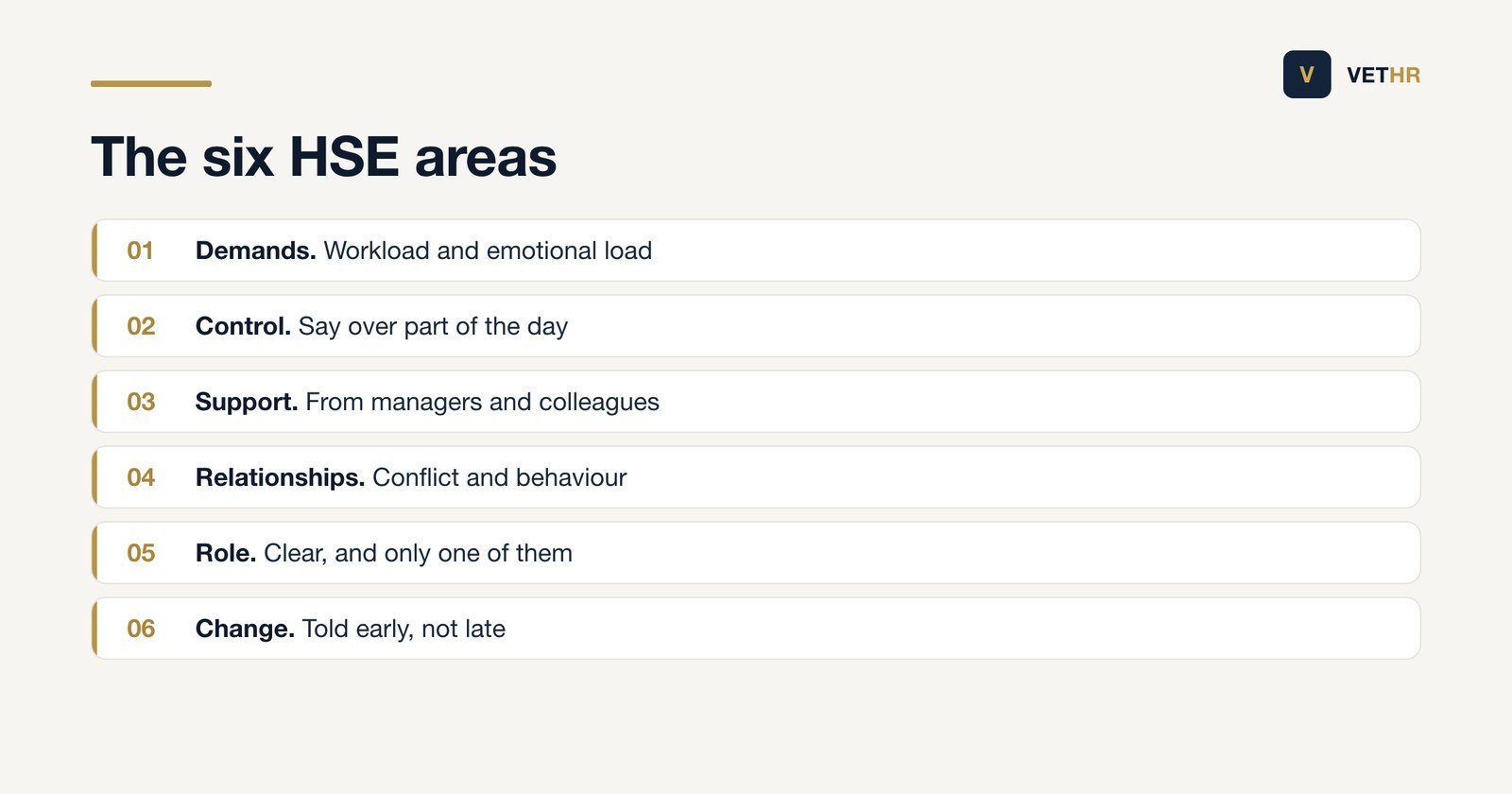
HSE structures the assessment around six areas of work design: demands, control, support, relationships, role and change. Read those six against a veterinary rota and the relevance is obvious, particularly demands, control and support.
It also notes that the earlier a problem is tackled, the less impact it will have. Our guide to the stress risk assessment a veterinary practice is required to have covers how to run it properly.
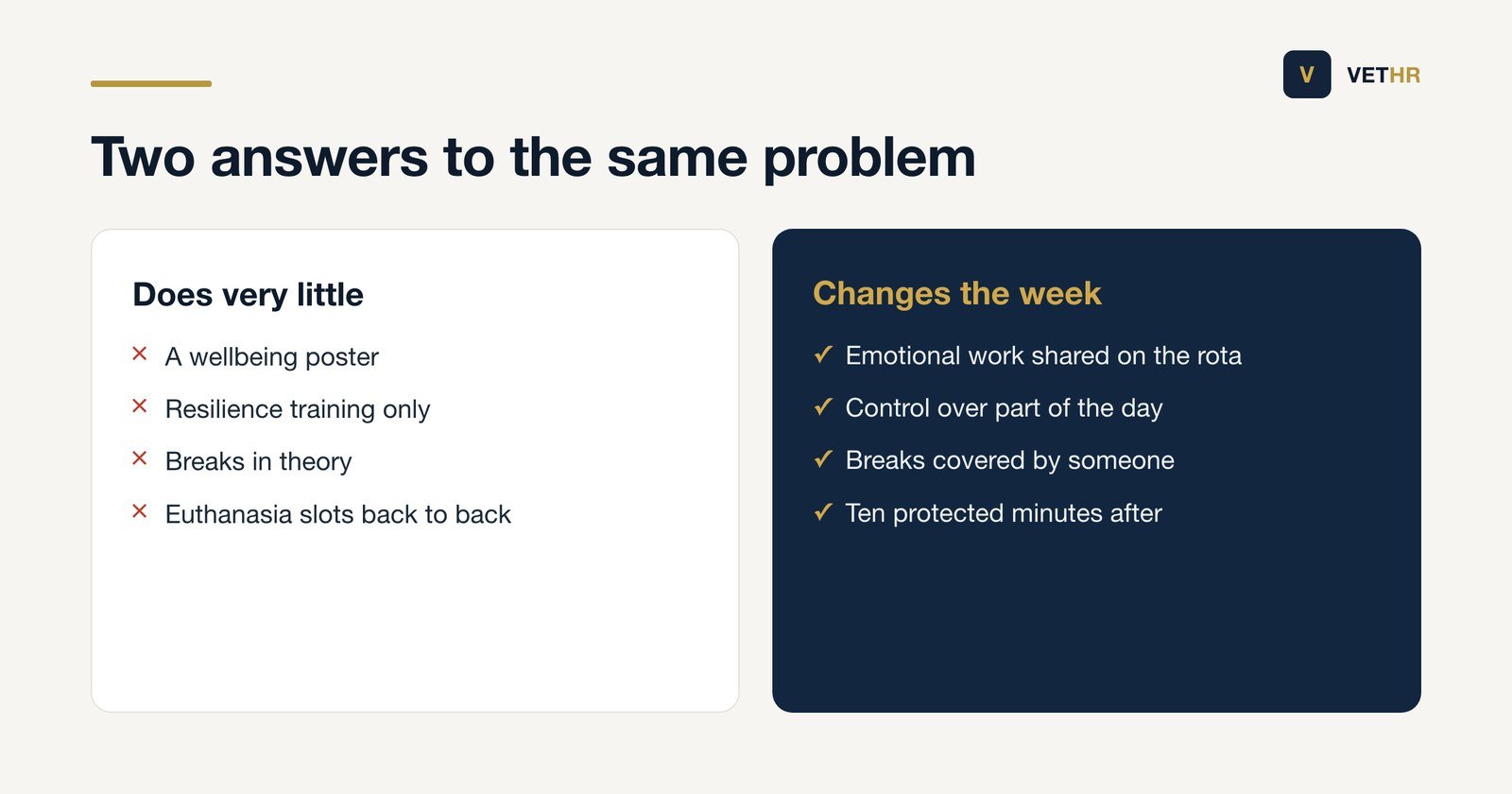
These are the changes that come out of the six HSE areas and that independent practices can actually make.
Notice that five of the six are rota and management decisions. Compassion fatigue is reduced far more by how the week is built than by a wellbeing poster in the staff room. Our rota system is where most of this gets implemented.
The single most effective change we see practices make is protecting ten minutes after a difficult euthanasia. Not a formal debrief, not a meeting. Ten minutes where the next appointment is not already waiting.
It costs an appointment slot. It is also the difference between processing something and stacking it, and stacking is what produces compassion fatigue over three years.
Build it into the appointment structure rather than leaving it to goodwill. If the booking system allows a longer slot for end of life appointments, use it, and brief reception on why it exists.
Watch the new graduates carefully. The first year in practice brings the first euthanasia the person has performed themselves, the first case that could not be saved, and the first angry owner, often in the same fortnight. Compassion fatigue that starts in year one is the kind that ends a career in year five, and a structured first year with a named mentor is the most effective thing a practice can offer.
Watch the long servers too. Someone who has been in the same practice for fifteen years has absorbed more of this than anybody, and is usually the least likely to mention it. A direct question, asked privately by someone they trust, is worth more than any survey.
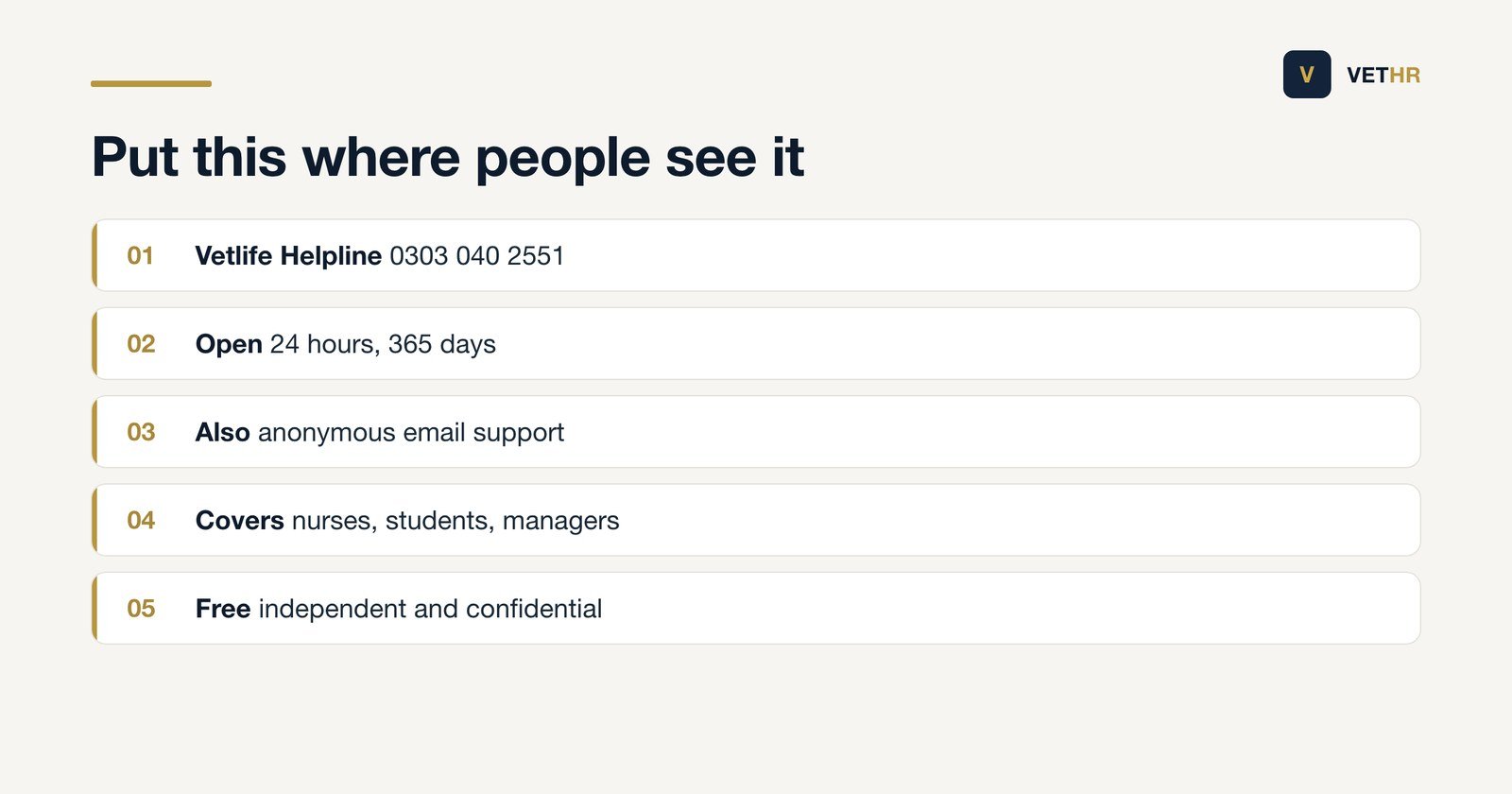
Vetlife describes itself as offering independent, confidential and free help for everyone in the veterinary community including veterinary nurses, students and non-clinical staff. The Vetlife Helpline number is 0303 040 2551, and it operates 24 hours a day, 365 days a year.
There is also an anonymous email service, with replies within 24 hours, and support covers practice managers and non-clinical staff as well as clinicians, students, recent graduates and families.
Put that number somewhere permanent: the staff room wall, the back of the ID badge, the induction pack and the staff handbook. Nobody looks up a helpline at the point they need one, so it has to already be in front of them.
Alongside that, know your own referral route. Our note on occupational health in a veterinary practice covers setting that up before it is urgent.
Owners and practice managers absorb the client complaints, the staffing crises and the financial pressure, and they usually have nobody in the building to talk to about any of it. Compassion fatigue does not stop at the clinical team.
Vetlife support explicitly covers practice managers and non-clinical staff. A peer group outside the practice helps too, because the specific isolation of running a practice is hard to explain to anyone who has not.
If the honest answer is that the practice is short staffed and everybody is absorbing the gap, that is a staffing problem wearing a wellbeing costume. Our notes on staffing levels and managing burnout in a veterinary practice deal with the cause.
If you want an outside view on how your rota is distributing emotional load, book a free 30-minute HR health check.
They overlap but they are not identical. Burnout is largely driven by workload and exhaustion. Compassion fatigue comes from repeated exposure to distress and shows up as a reduced capacity to engage with it. The same person often has both.
Yes. HSE states that employers have a legal duty to protect workers from stress at work by doing a risk assessment and acting on it, structured around six areas: demands, control, support, relationships, role and change.
Something specific and unhurried. Name what you have noticed, say why you are asking, and ask an open question. Avoid framing it as a performance conversation, and do not promise confidentiality you cannot keep.
Vetlife offers independent, confidential and free support to everyone in the veterinary community, including nurses, students and non-clinical staff. Its helpline is 0303 040 2551, open 24 hours a day, 365 days a year, and there is an anonymous email service.
They help far less than changes to the work itself. Five of the six HSE areas are about how work is designed and managed, so rota decisions, appointment lengths and protected breaks do more than any single initiative.
The nurse who stopped sitting with owners did not need to be more resilient. She needed ten minutes after a euthanasia, a share of the emotional work that was not permanently hers, and one person to ask her a real question.
All three of those are management decisions. We help independent practices make them through fixed-price HR consultancy for veterinary practices and ongoing HR support on subscription.
The Vet HR Team provides HR consultancy and white-labelled staff systems exclusively to UK veterinary practices.
Contracts, rotas, holiday, a difficult conversation. Tell us what you are dealing with and we will come back within one working day. Nothing to sign up to.
Got it. We will come back to you within one working day. If you do not see a reply, please check your spam folder.
