Last updated: 27 June 2026
TL;DR: Staff recognition in a veterinary practice is the everyday habit of noticing and naming good work, from a quick thank you to a structured scheme. It matters because feeling unvalued is one of the main reasons vets and nurses leave. The recognition that lands is specific, frequent, fair across the whole team and free of tokenism. This guide covers why it drives retention, low-cost ideas, how to include nurses and reception, peer recognition and how to build it into the routine.
Recognition is the cheapest retention tool a practice owns, and the easiest to do badly. Done well it is specific and constant. Done badly it is a tired “team of the month” board nobody reads. This is a calm, practical guide to the version that actually keeps people, not the version that ticks a box.
Staff recognition in a veterinary practice matters for retention because feeling unvalued is one of the top reasons clinical staff walk. People rarely leave a practice over a single bad day. They leave when good work goes unnoticed for months and the obvious read is that nobody cares. Recognition is the daily signal that the opposite is true.
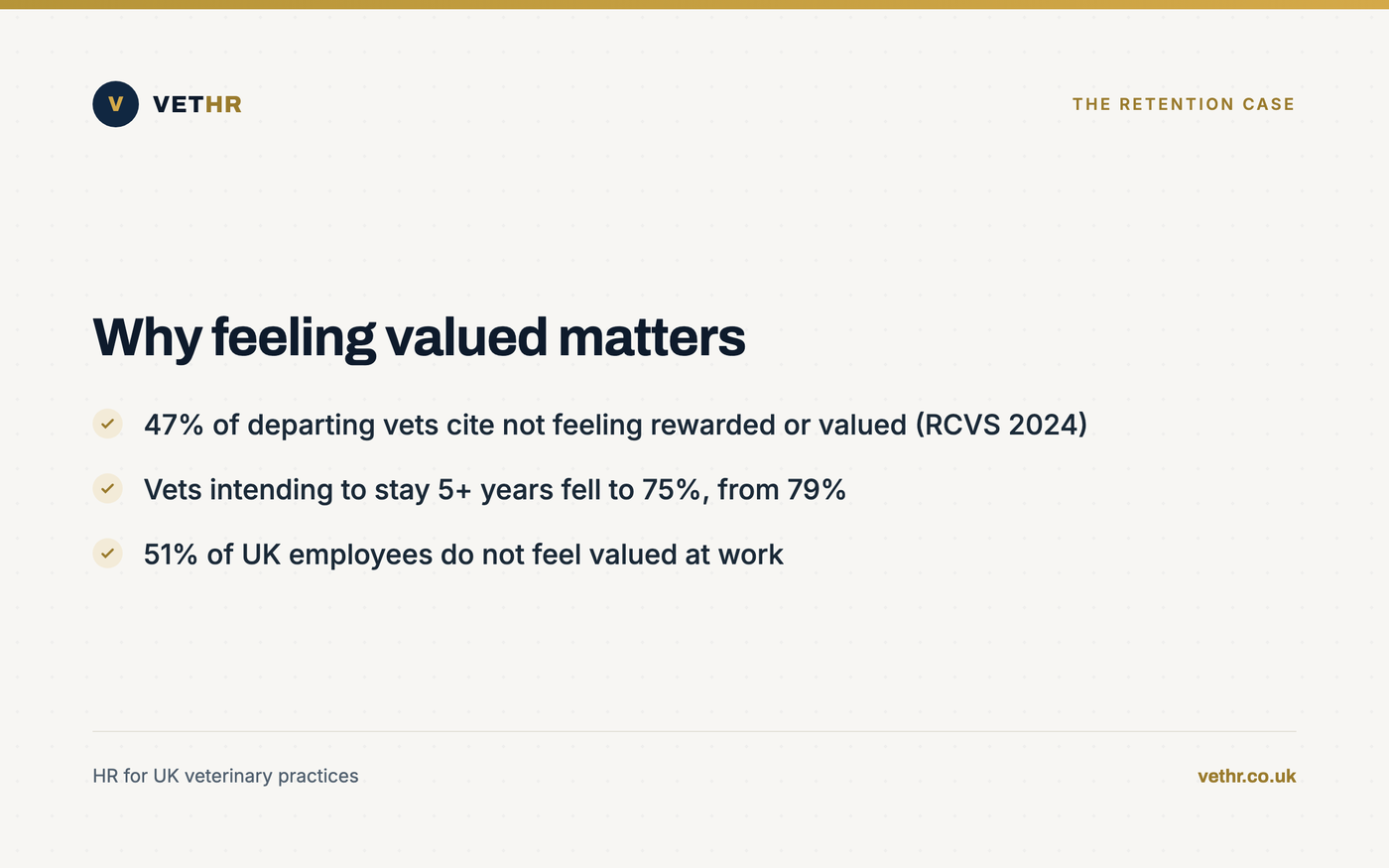
The profession’s own data makes the case plainly. In the RCVS Surveys of the Professions 2024, among vets intending to leave, “not feeling rewarded or valued in a non-financial sense” was named by 47 percent, sitting just behind poor work-life balance at 56 percent and chronic stress at 54 percent, according to the RCVS. Pay was not the headline. Feeling unseen was.
The same survey shows the stakes. The share of vets intending to stay in the profession for five or more years fell to 75 percent in 2024, down from 79 percent in 2019. Across a sector already under recruitment pressure, that drift toward the door is exactly the gap that genuine recognition helps to close.
It is not unique to vets. A wider UK study reported by People Management found 51 percent of employees do not feel valued at work and 53 percent say a lack of recognition harms their motivation. For a clinic running on goodwill through a hard shift, that is morale you cannot afford to leak.
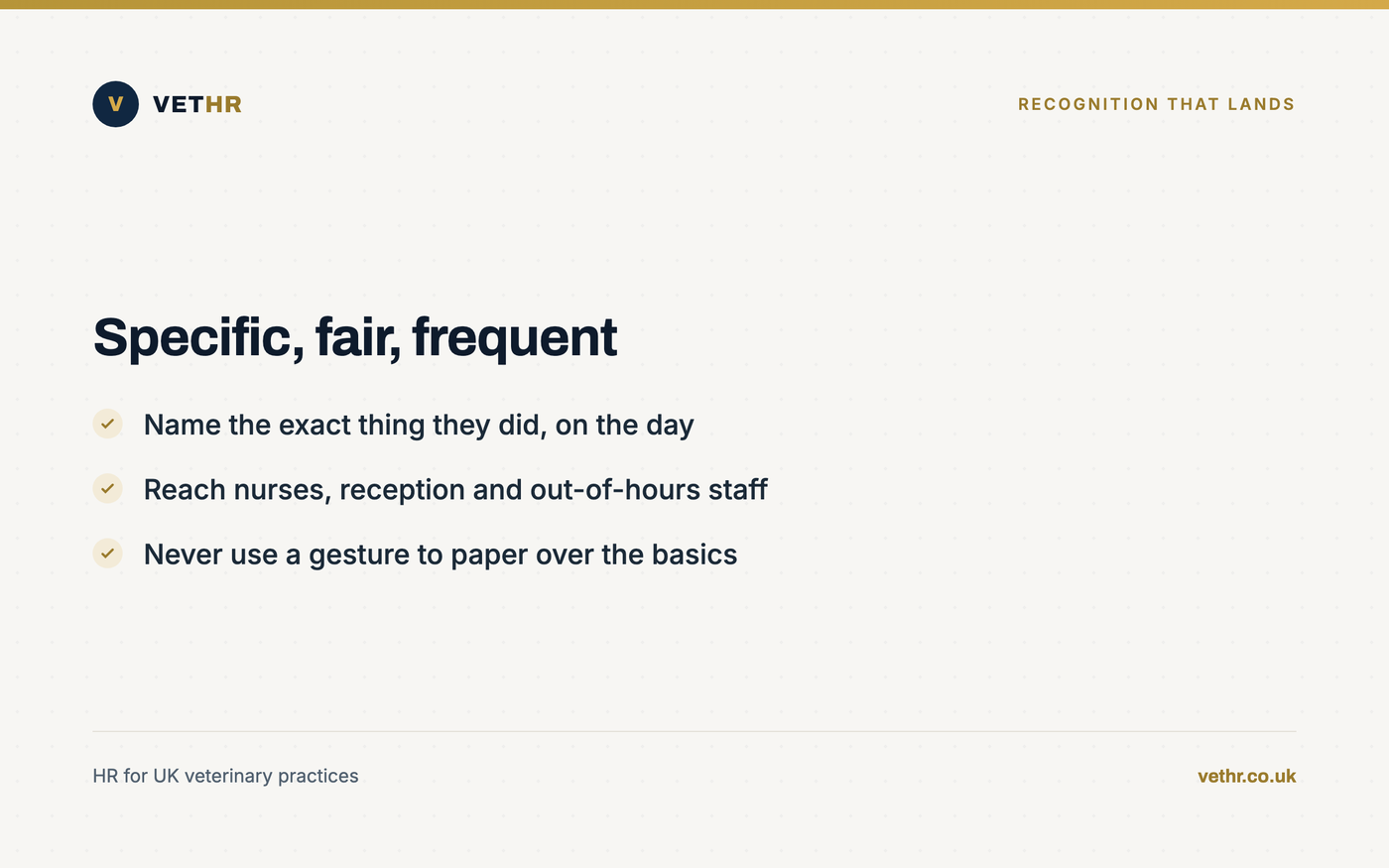
Everyday recognition is the small, specific, frequent acknowledgement that costs nothing but attention. It is naming what someone did and why it mattered, close to when they did it. The research is consistent that frequency beats grandeur: a quick, sincere thank you on the day outperforms an annual award nobody remembers winning.
None of this needs a budget line. The barrier is never cost; it is remembering to do it when the waiting room is full. That is why the practices that get recognition right do not rely on goodwill alone. They build a small prompt into the day so it happens whether the week is calm or chaotic.
Formal schemes and everyday thanks do different jobs, and the best practices run both. A scheme adds visible, fair structure: long-service acknowledgement, a small reward budget, a values-based nomination. Everyday thanks carries the day-to-day warmth. Lean only on the scheme and recognition becomes an occasional event rather than a culture.
The risk with formal schemes is that they drift into tokenism. A “team of the month” picked by the same manager, for the same visible roles, soon reads as a popularity contest. With over half of UK employees already saying a lack of recognition dents their motivation, a scheme seen as unfair can do more harm than none at all.
Used well, structure protects fairness. Clear criteria, rotating nominators and a deliberate effort to surface quiet contributors stop the same three names appearing every time. Some low-cost reward ideas that practices use: a paid early finish, a contribution toward CPD, a voucher, or simply time. None of these substitutes for being noticed in the moment, but they make the noticing tangible.
Not sure whether your recognition is landing or quietly missing half the team? A 30-minute conversation usually makes it clear. Book a free HR health check and we will look at how your practice notices good work today, where it stalls, and which small changes would do the most for retention. No jargon, nothing sold for the sake of it.
You recognise the whole team by widening your definition of good work beyond the consult room. Vets get thanked because their wins are visible. Nurses, reception and support staff hold the practice together in ways that are easy to take for granted, which is precisely why their recognition needs deliberate attention.
This is not a minor group. Veterinary nurses carry their own retention strain: the RCVS 2024 survey found health conditions affected 29 percent of vet nurses compared with 17 percent of vets, and 16 percent of nurses did on-call hours. A team under that much pressure notices very quickly when recognition only flows in one direction.
Fair recognition starts with fair foundations: an accurate rota, holiday worked out correctly, and hours recorded properly so nobody’s effort goes literally uncounted. Recognition rings hollow if the same person feels short-changed on the basics, which is why our staff systems sit underneath the culture rather than apart from it.
Peer recognition is colleagues acknowledging each other directly, rather than praise only flowing from the top down. It often lands harder because it is closer to the work. The nurse who saw exactly how hard a shift was carries more weight than a manager who heard about it second-hand the next morning.
Peer recognition also spreads the load. An owner or practice manager cannot witness every good moment in a busy clinic, and waiting for them to is how quiet contributions get missed. When the whole team is encouraged to call out good work, far more of it gets seen, and the culture stops depending on one person’s attention.
Making it easy is the whole trick. A standing slot in the team huddle for “who do you want to thank this week”, a shared channel for shout-outs, or a simple board where anyone can post a note. The format matters less than the permission: people need to know that noticing each other out loud is welcomed, not awkward.
You avoid tokenism by making recognition specific, fair and consistent rather than performative. Tokenism is the empty gesture: a generic “great team” email, an award given out of obligation, a pizza after a month of short staffing. Your team can tell the difference instantly, and hollow recognition reads as worse than silence.
The honest test is simple. Does this make the person feel genuinely seen, or does it make management feel they have ticked the box? With 47 percent of departing vets citing not feeling valued, getting this wrong is not a soft failure. It quietly feeds the very reason people are already leaving the profession.
You build recognition into the routine by attaching it to things that already happen, so it survives a busy week. Goodwill alone fails the moment the clinic gets slammed, which is exactly when people most need to feel seen. A small, repeatable habit beats a grand intention every time.
Built this way, recognition stops being a campaign and becomes simply how the practice runs. That is the version that shows up in retention, because the team feels valued on an ordinary Tuesday, not just on awards night. If you want help embedding it alongside fair rotas and clear policies, our HR consultancy and monthly support are built for exactly that.
Because feeling unvalued is one of the leading reasons clinical staff leave. In the RCVS 2024 survey, 47 percent of vets intending to leave cited not feeling rewarded or valued in a non-financial sense. Recognition is the daily signal that good work is seen, which is one of the cheapest and most effective retention tools a practice has.
Specific verbal thanks on the day, a quick shout-out in the team huddle, a handwritten note after a hard shift, a paid early finish, or a contribution toward CPD. The best recognition ideas cost attention rather than money. Frequency and sincerity matter far more than the size of any gesture.
Widen your definition of good work beyond the consult room and name role-specific wins, such as a nurse’s calm in recovery or a receptionist defusing a complaint. Check your patterns: if a month of recognition only mentions vets, the rest of the team has already noticed. Fair foundations like an accurate rota matter too.
It is strongly linked. Feeling unvalued is a top driver of people leaving, both in the veterinary profession and the wider UK workforce, where 51 percent of employees report not feeling valued at work. Recognition will not fix pay or workload on its own, but as part of a fair workplace it measurably reduces the reasons people quit.
Keep it specific, fair and consistent, and never use it to paper over poor pay, an unfair rota or unpaid overtime. A generic email or a one-off pizza after a rough month reads as hollow. The test is whether the person feels genuinely seen, not whether management feels it has ticked a box.
Recognition is not a perk or a poster. It is the everyday signal that the people holding your practice together are seen, and it is one of the few retention levers that costs nothing but intent. The version that works is specific, frequent, fair across the whole team and free of empty gestures.
If you want to make it stick rather than start and fade, build it on solid ground. Explore our staff systems for the fair rotas and records recognition rests on, see how we work in HR consultancy, or simply book a free HR health check for a straight read on where your practice stands. Nothing sold that you do not need.
The Vet HR Team provides HR consultancy and white-labelled staff systems exclusively to UK veterinary practices.
—
Contracts, rotas, holiday, a difficult conversation. Tell us what you are dealing with and we will come back within one working day. Nothing to sign up to.
Got it. We will come back to you within one working day. If you do not see a reply, please check your spam folder.
