Last updated: 5 September 2026
TL;DR: The only benefit you must provide is a workplace pension, at a minimum total contribution of 8 per cent of qualifying earnings with at least 3 per cent from the employer. Everything else is a choice. In veterinary practice the benefits that change retention are time, training and predictability rather than vouchers and gym memberships.
Practices spend real money on benefits nobody mentions in an exit interview. Meanwhile the things people actually leave for, a rota published too late to plan around and CPD that keeps getting cancelled, cost nothing to fix and never appear on the benefits list at all.
Essentially one staff benefit, plus the statutory rights that are not really benefits at all. A workplace pension is the obligation, and everything else in a package is a decision the practice makes.
Automatic enrolment applies to workers aged between 22 and State Pension age who earn at least £10,000 per year, and the minimum total contribution is 8 per cent of qualifying earnings, with at least 3 per cent from the employer.
Qualifying earnings run between £6,240 and £50,270 a year. Assess every pay period rather than annually, because bank staff and part-timers can cross the threshold in a busy month and need enrolling at that point.
The rest, statutory holiday, sick pay and family leave, are entitlements rather than staff benefits. Presenting them as generosity is a small deception that experienced nurses spot immediately.
These ten staff benefits come up repeatedly when veterinary teams describe what would keep them, and most are cheaper than the turnover they prevent.
Number one is the outlier. It costs nothing and it outranks almost everything else, because a rota published late makes every other benefit harder to use, as our guide to building a veterinary rota sets out.
Number ten is the fastest growing request. Compressed hours and shorter weeks now appear in interviews as routinely as salary does, and a practice that can genuinely offer one has an advantage that costs less than raising every rate in the building.
CPD is second because it is contractual and professional at once. Vets must complete 35 hours a year and RVNs 15 hours a year under the RCVS requirements, so a practice that cancels study days is interfering with a registration obligation. The RCVS sets out the annual CPD requirement and the plan, do, record, reflect model in full.

The staff benefits that require energy the job has already used up. This is where practice budgets most often go to die, politely and without complaint.
An employee assistance programme is worth keeping despite the low usage, because it costs little per head and matters enormously on the day someone needs it. Name it in every team meeting and after every difficult case.
Before adding new staff benefits, ask five people what they would choose instead. The answer in veterinary practice is usually time, and our guide to veterinary staff retention covers why.
A package of staff benefits costs less than one avoidable resignation, in most cases. That is the comparison worth making, because a benefits budget assessed on its own always looks like a cost and never like a return.
Do the arithmetic against replacement. Recruiting and settling a new RVN absorbs advertising, freelance vet cover, management time and months of reduced capacity, which our analysis of what staff turnover costs a practice works through.
Start at the top of the staff benefits list and work down. A practice that has not yet published its rota a month ahead should fix that before buying anything.
The handbook, in almost every case, marked clearly as non-contractual. Put a benefit in the contract and you have promised it permanently, which is a decision worth making deliberately rather than by accident.
Enhanced sick pay is the classic example. Written into a contract it becomes a term you cannot withdraw when circumstances change; written into a policy it can be reviewed, and the difference only becomes visible in a difficult year.
Say what each of the staff benefits is, who qualifies, from when, and how it is claimed. Vagueness produces inconsistency, and inconsistency in a small team looks exactly like favouritism, as our guide to the staff handbook explains.
Paying for benefits nobody uses? A free 30-minute HR health check will tell you what your team would choose instead. Book your HR health check.
By naming the staff benefits repeatedly and removing the friction. A benefit nobody remembers is money spent on nothing, and take-up is almost always a communication problem rather than a design problem.
Benchmark the package every couple of years against what practices near you advertise. Staff benefits are compared at interview whether or not you compare them yourself, and finding out from a resignation letter is the most expensive form of market research available.
Point four decides whether your CPD budget is real. Study days that live only in an allowance, never in the rota, get cancelled by the first busy fortnight, and the message that sends outlasts the training that was missed.
A workplace pension through automatic enrolment is the main one. It applies to workers aged 22 to State Pension age earning at least £10,000 a year, with minimum total contributions of 8 per cent of qualifying earnings and at least 3 per cent from the employer. Holiday, sick pay and family leave are statutory rights rather than benefits.
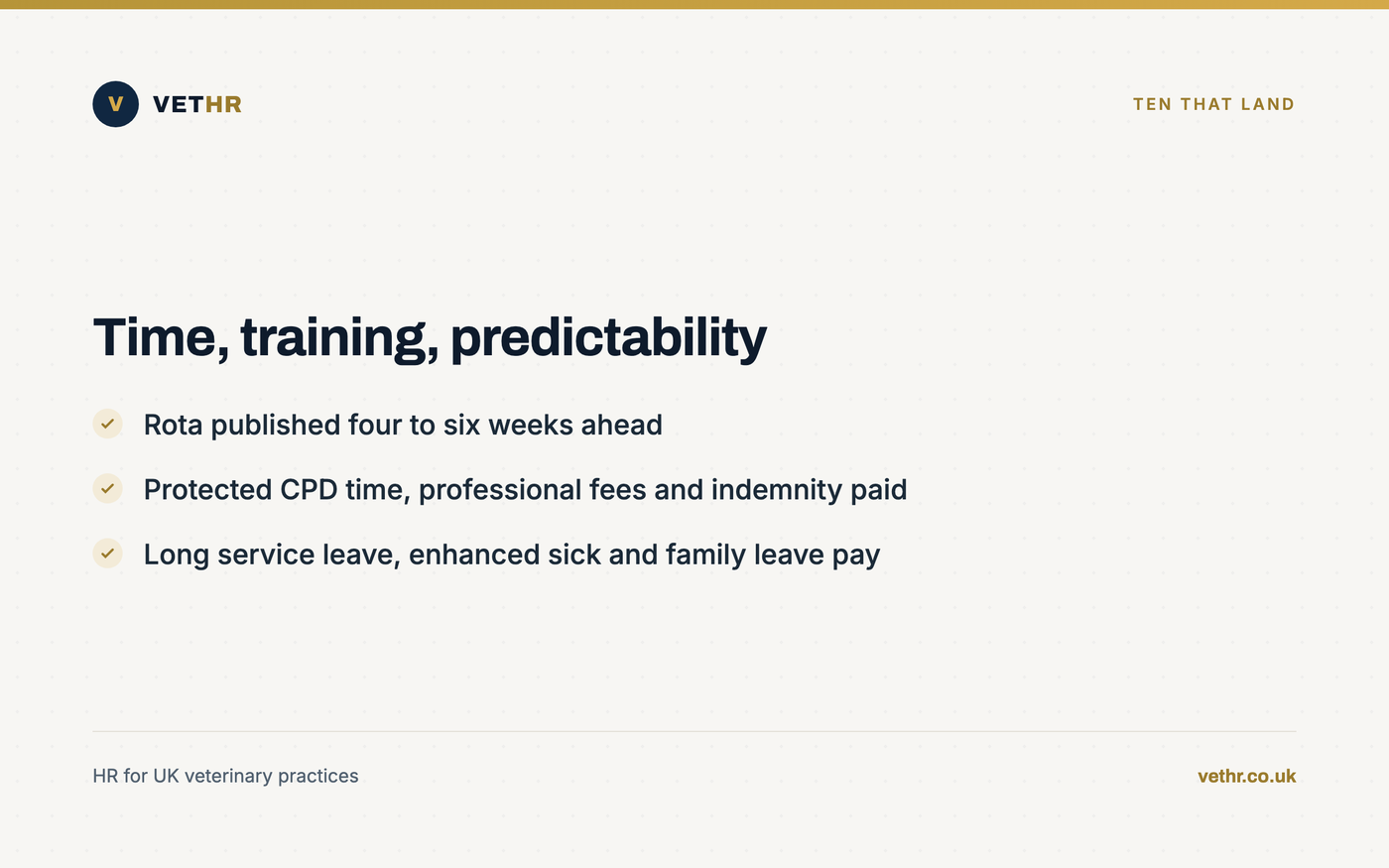
There is no legal obligation to pay professional fees, but it is common and expected in the profession. CPD is a registration requirement for both vets and nurses, so practices that do not fund it are competing for staff with those that do, and the difference is very visible at interview.
It depends on whether it has become contractual. A benefit stated as non-contractual in the handbook is easier to change than one written into contracts or one applied so consistently over years that it may have become an implied term. Take advice before withdrawing anything long-standing.
Part-time workers should generally receive benefits on a pro rata basis, and less favourable treatment because someone works part-time is risky. For bank staff, define eligibility clearly in writing rather than leaving it to be worked out case by case at the point someone asks.
A rota published four to six weeks in advance, consistently. It costs nothing, it is the single most requested change across veterinary teams, and it makes every other benefit usable because people can plan their lives around a schedule they can actually see.
Staff benefits in veterinary practice are judged by whether they survive a busy fortnight. A CPD budget that is cancelled in October, a break that is skipped every day and a rota that arrives ten days ahead all tell the team what the practice actually values.
Get the pension right, fund the professional obligations, protect the time, and write the rules down. Our rota system and HR consultancy handle the mechanics, and the free HR health check will show you which benefits your team would actually choose.
The Vet HR Team provides HR consultancy and white-labelled staff systems exclusively to UK veterinary practices. Pension thresholds change, so check current GOV.UK figures each year.
Contracts, rotas, holiday, a difficult conversation. Tell us what you are dealing with and we will come back within one working day. Nothing to sign up to.
Got it. We will come back to you within one working day. If you do not see a reply, please check your spam folder.
