Last updated: 5 September 2026
TL;DR: Absence trigger points are thresholds that prompt a review conversation, usually based on the number of separate absences in a period or the length of a single absence. Acas is explicit that an employer should not use review points to automatically trigger disciplinary action, and that absence related to disability or pregnancy may need to be adjusted or excluded.
Every practice manager has the same conversation eventually. One nurse has had five single days off since April, another had one three week absence, and nobody is sure whether either of those is a problem or simply a year. A trigger point is what turns that guesswork into a consistent process.
Absence trigger points are thresholds that prompt a review. Acas describes how some organisations have absence policies that set automatic triggers to review absence, activating on either the number of absences in a timeframe or the length of an individual absence.
Note the word review. The trigger starts a conversation about what is happening and what would help; it is not a finding, a warning or a stage of any process.
Two different measures are needed because two different problems exist. Frequent short absences and one long absence require entirely different responses, and a policy with only one threshold will handle one of them badly.
Absence trigger points also protect managers. Without them, one practice manager reviews after three episodes and another after eight, and the inconsistency is what an employee points at when a decision is later challenged as unfair.
Acas expects the points to be documented. The policy should state clearly what the trigger points are and how the review process works, so the same answer applies whoever is managing the person.
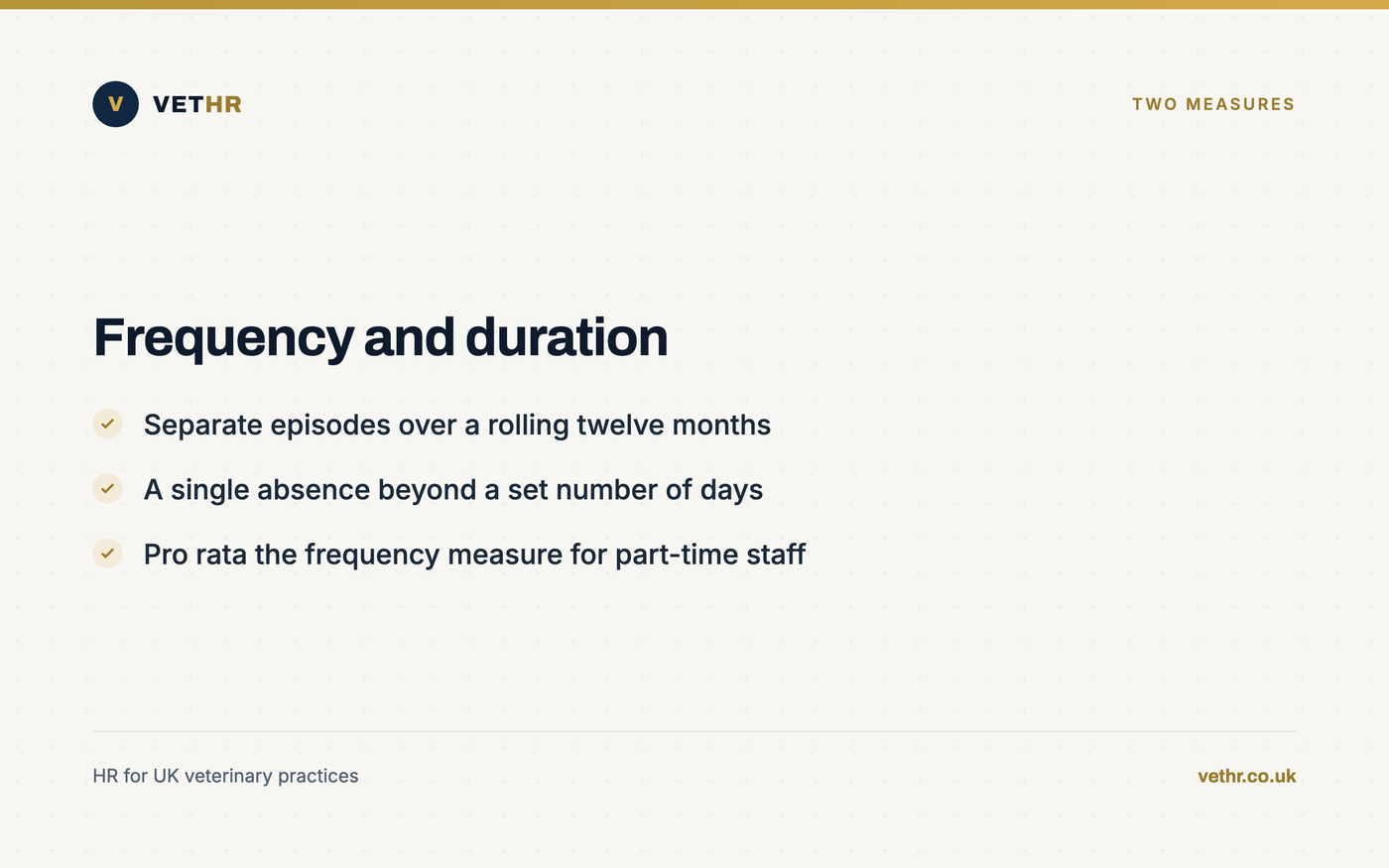
Set absence trigger points at a level that catches a pattern without catching a bad winter. There is no statutory figure, so the number is yours to choose and to justify.
Count episodes rather than days for the frequency measure. Ten separate single days and one ten day absence are the same number of days and completely different situations, and only the episode count distinguishes them.
Use a rolling twelve months rather than a calendar year. A leave year boundary creates an artificial reset in January, and it means an absence in December and one in February look unrelated when they are not.
Pro rata the frequency trigger for part-time staff, or you will systematically review them more often. Our guide to part-time workers covers why that matters legally as well as practically.
Automatic disciplinary action. Acas states plainly that an employer should not use review points to automatically trigger disciplinary action for absence, because that discourages people from taking time off when they are genuinely unwell.
That warning is particularly relevant in veterinary work. A nurse who comes in with a stomach bug because she has hit a threshold puts patients, colleagues and herself at risk, and the practice has engineered that outcome itself.
Nor should absence trigger points be used to compare colleagues in a team meeting. Absence is health information, and discussing one person’s record in front of others turns a management tool into a data protection problem and a morale problem at the same time.
They should also never be applied mechanically without looking at the reason. Hitting a trigger is the moment to ask what is going on, not the moment to reach for a template letter.
And they should not be used as a performance measure. Absence and performance are different questions, and mixing them produces a conversation nobody can answer honestly, as our guide to managing sickness absence covers.
Where counting it against the absence trigger points would discriminate. Acas notes that disabled employees might accumulate review points faster because of medical appointments, and suggests employers could adjust review points or decide that absence related to disability or pregnancy will not count towards them.
Acas frames the adjustment duty itself in its guidance on reasonable adjustments, which confirms employers must make them by law and that the employer bears the cost.
Write the exclusions into the policy rather than applying them case by case. An undisclosed rule is invisible to the person it protects, and it looks like favouritism to everyone else, as our guide to reasonable adjustments explains.
The same logic covers menopause related absence in many practices, which our guide to the menopause policy discusses.

A supportive, structured conversation with an outcome written down. Acas asks employers to explore reasonable adjustments and to consider whether the absence relates to disability, pregnancy or mental health.
Step four surfaces more than practices expect. A cluster of Monday absences after a run of weekends is a rota problem wearing an absence costume, and no amount of review meetings will fix it.
Refer early where a condition may be involved rather than waiting for a third trigger, as our guide to occupational health referrals sets out.
Absence policy with no defined thresholds? A free 30-minute HR health check will set them properly. Book your HR health check.
The cover consequences are immediate and visible to everyone, which changes how absence trigger points land. In an office an absence is absorbed; in a practice it means a colleague loses a break, a list gets rearranged or someone pays for freelance vet cover at short notice.
That visibility creates pressure to attend when unwell, which is precisely what Acas warns trigger points can worsen. In clinical work presenteeism carries infection control and error risks that an office never faces.
There are also occupational causes worth watching. Back injuries from restraint, needlestick incidents, zoonotic exposure and stress after difficult cases all appear as sickness absence, and only some of those are about the individual.
Review your absence trigger points annually against what actually happened. If nobody reached them all year they are set too high to be useful, and if half the team reached them they are measuring the practice rather than the individuals.
Read absence data alongside your other numbers rather than alone. A rising absence frequency next to rising overtime usually describes a staffing problem, as our guide to HR metrics covers.
Not automatically. Acas is explicit that an employer should not use review points to automatically trigger disciplinary action for absence, because it discourages people from taking time off when genuinely unwell. The trigger starts a review conversation, and any further step needs its own justification.
Often it should not. Acas notes disabled employees may accumulate review points faster because of medical appointments, and suggests employers could adjust the points or decide that disability related absence will not count. Adjusting a trigger may itself be a reasonable adjustment.
There is no statutory figure, so choose a level you can justify and apply consistently. Set a frequency trigger based on separate episodes over a rolling twelve months, a separate duration trigger for a single long absence, and pro rata the frequency measure for part-time staff.
A short return to work conversation after every absence is good practice regardless of triggers. It confirms the person is fit to be back, updates records accurately and catches patterns early, which is far more useful than discovering a trend six months later.
No. Scoring systems that weight frequency over duration are one approach among several, and Acas guidance does not require any particular method. Whatever you use, the output should prompt a review conversation rather than an automatic consequence.
Absence trigger points exist so that the same situation gets the same response whoever is on duty. Used that way they are fair and genuinely useful. Used as a countdown to a warning, they teach a clinical team to come in while infectious.
Set two thresholds, count episodes on a rolling year, write the exclusions down and treat every trigger as a conversation. Our policy library and HR consultancy will set them at the right level, and the free HR health check is where to start.
The Vet HR Team provides HR consultancy and white-labelled staff systems exclusively to UK veterinary practices. Discrimination questions are legal matters; take advice where a case is contested.
Read next: Long Term Sickness in a Veterinary Practice.
Contracts, rotas, holiday, a difficult conversation. Tell us what you are dealing with and we will come back within one working day. Nothing to sign up to.
Got it. We will come back to you within one working day. If you do not see a reply, please check your spam folder.
