Last updated: 5 September 2026
TL;DR: A menopause policy sets out how your practice supports staff experiencing symptoms, who to talk to and what adjustments are available. Acas says managing the effects of menopause at work matters for both employers and workers, and that unfavourable treatment connected to a protected characteristic can be discriminatory. In a nurse-heavy profession this is a retention issue as much as a legal one.
An experienced RVN with fifteen years in the practice starts asking about dropping to three days. She mentions poor sleep. Six months later she resigns, and the exit interview says something vague about work life balance. That sequence is common, expensive and often avoidable, and it is what this policy exists to interrupt.
A menopause policy earns its place because the veterinary nursing workforce is overwhelmingly female and a large part of it is in the affected age range. Losing an experienced nurse for reasons nobody discussed is one of the most expensive things a small practice can do, and it happens quietly.
Acas is direct that managing the effects of menopause at work is important for both employers and workers, and warns that a lack of support can lead to loss of confidence, unnecessary absences, worsening mental health and resignations.
The work itself makes symptoms harder. Long shifts in scrubs, theatre gowns, no easy break, restraint of anxious animals, and a rota that treats bathroom breaks as optional. None of that is unique to menopause, and all of it makes the symptoms more visible at work than at home.
There is a practical reason to write a menopause policy rather than handle each case informally. Informal handling produces different answers from different managers, and in a small team those differences are visible within a week and read as favouritism rather than flexibility.
Acas also notes that menopause affects a broader group than cisgender women, and that men should be included in conversations and training. A policy written only for one group excludes people and leaves managers unprepared.
There is no standalone menopause law, which is exactly why practices misread the risk and why a menopause policy is a choice rather than an obligation. The exposure comes through the Equality Act, because symptoms can engage sex, age and disability at once.
Acas puts it plainly: if an employee or worker is put at a disadvantage or treated less favourably because of their menopause symptoms, this could be discriminatory if connected to a protected characteristic. That is the legal core of the whole subject.
Where symptoms are long term and have a substantial adverse effect on day to day activities, the duty to make reasonable adjustments may apply. Acas confirms that employers must make reasonable adjustments by law, and that the employer is responsible for paying for them.
Practically, this means a manager who dismisses symptoms as something to get on with is creating a legal problem as well as a human one. Our guide to reasonable adjustments in a veterinary practice covers the wider duty.

Eight sections, kept short. The purpose of a menopause policy is to make it easy to ask for help and easy for a manager to respond consistently, not to educate the reader about physiology.
The absence section is the one people read first. If menopause related absence counts towards the same triggers as everything else, staff will not disclose, and you will end up managing an attendance problem you could have solved with a fan and a rota change.
Keep the menopause policy non-contractual and put it in the handbook alongside your other wellbeing policies. Our policy library is structured so a policy like this sits with sickness absence and flexible working rather than in isolation.
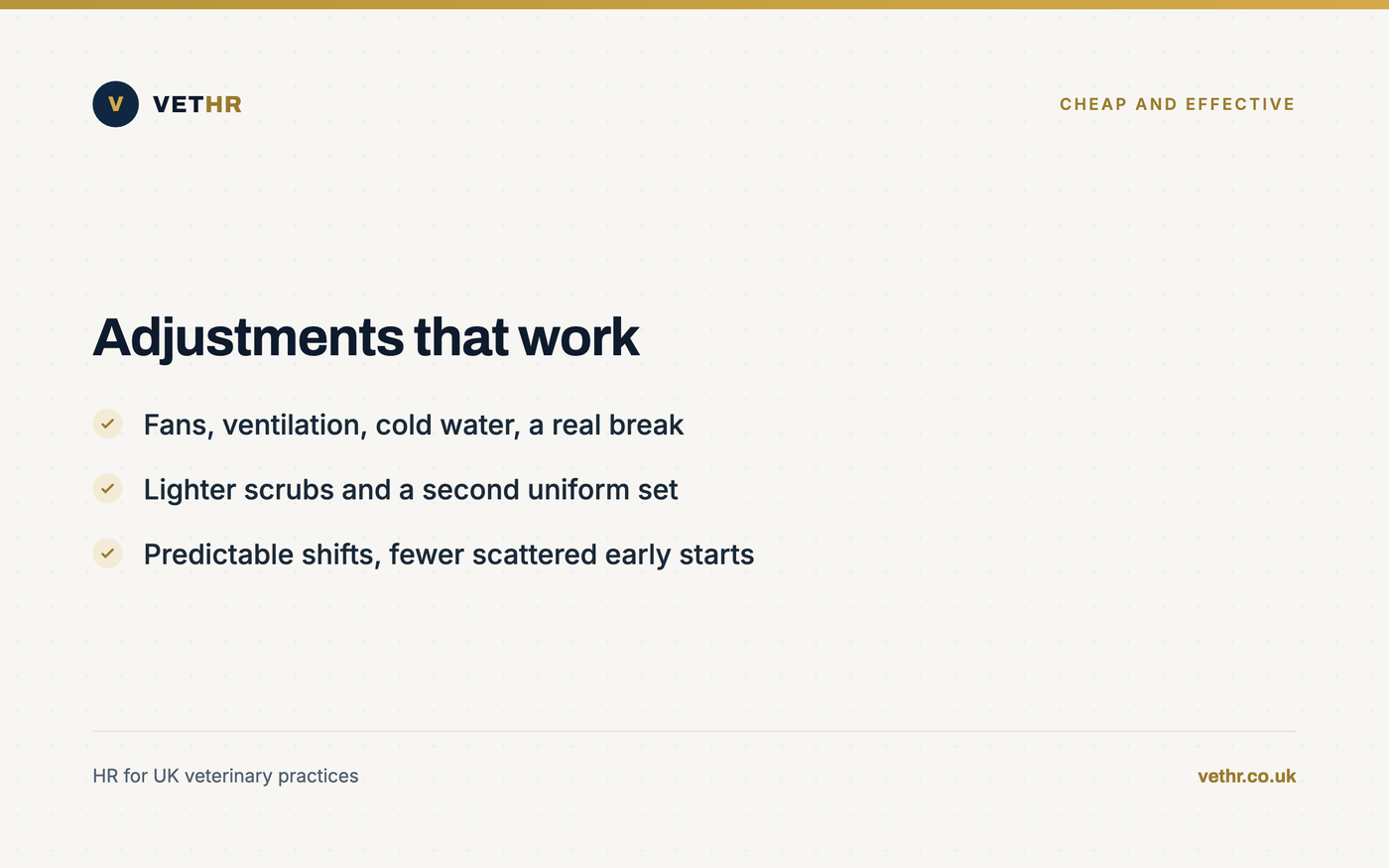
Small, physical and rota based ones, in that order, and every one of them belongs in the menopause policy as a named option. Acas lists workplace modifications such as altered lighting, flexible schedules, phased returns and different working methods among reasonable adjustments generally, and the veterinary versions are usually cheap.
The rota is the powerful one. A nurse sleeping badly will manage a full week of predictable days far better than a scattered pattern with two early starts and a weekend, and that costs nothing to change if it is planned rather than swapped at the last minute.
Where a request goes further, treat it as a formal request rather than a favour. Our guide to flexible working requests covers the process, which is a day one right.
By listening, asking what would help and doing one thing quickly. The menopause policy should say so in as many words. Managers do not need clinical knowledge, and pretending to have it is worse than admitting they do not.
Train managers before you publish the menopause policy. A document that invites disclosure to a manager who then handles it badly does more damage than having no policy at all, because the person has taken a risk and been let down.
Losing experienced nurses and not sure why? A free 30-minute HR health check will look at the whole retention picture. Book your HR health check.
By changing something visible in the first month. Publishing a menopause policy and altering nothing about the building, the uniform or the rota tells the team precisely how seriously to take it.
Pick two physical changes and make them before you circulate the menopause policy. Fans in the consult rooms and an extra uniform allowance are unglamorous, cheap and immediately noticed, and they buy the policy credibility that words cannot.
Then check the retention numbers. If experienced nurses are leaving in their forties and fifties, that pattern is the evidence, and our analysis of what staff turnover costs a practice gives you the figure to put next to it.
Review the menopause policy annually alongside your other wellbeing documents, and after any case where it was used. The person who has just been through it will tell you which sentence was unclear faster than any review meeting will.
Ask about it in exit interviews too, carefully and optionally. You will not always get an honest answer, but the pattern across five leavers tells you more than any single conversation, as our guide to exit interviews explains.
No, there is no standalone legal duty to have one. The obligations come through the Equality Act, because unfavourable treatment connected to a protected characteristic can be discriminatory, and because the duty to make reasonable adjustments may apply where symptoms are long term and substantial.
Not automatically, and it depends on the individual. Where symptoms are long term and have a substantial adverse effect on day to day activities, the disability provisions of the Equality Act may be engaged, which brings the duty to make reasonable adjustments with it. Treat each case individually rather than applying a rule.
Many practices choose to discount it, and say so in the menopause policy. Where symptoms amount to a disability, adjusting absence triggers may itself be a reasonable adjustment. Whatever you decide, write it down, because an undisclosed rule discourages the disclosure the policy is designed to encourage.
Give at least two named options plus an external route. In a small practice the line manager may be the person someone least wants to tell, so naming a second contact, such as the practice manager or a partner, makes the policy usable rather than theoretical.
Acas is clear that men should be included in conversations and training, both as managers who will receive disclosures and as colleagues supporting partners. A policy that is discussed only with part of the team leaves managers unprepared for the conversation when it comes.
This is a retention policy that happens to have a legal dimension. The nurses affected are usually the most experienced people in the building, the ones who train new starters and hold the theatre list together, and they are the hardest and slowest to replace.
Write the menopause policy, train the managers, change two physical things in the first month and review it in a year. Our policy library and HR consultancy can draft it around your rota, and the free HR health check is where to start.
The Vet HR Team provides HR consultancy and white-labelled staff systems exclusively to UK veterinary practices. This is HR guidance, not medical or legal advice.
Read next: A Drugs and Alcohol Policy for Your Veterinary Practice.
Contracts, rotas, holiday, a difficult conversation. Tell us what you are dealing with and we will come back within one working day. Nothing to sign up to.
Got it. We will come back to you within one working day. If you do not see a reply, please check your spam folder.
