Last updated: 24 September 2026
TL;DR: If a worker falls sick during annual leave, they can take statutory sick pay for the days they were ill, if they qualify, and keep that holiday to use another time. Holiday keeps building up while someone is off sick, a worker can ask to take holiday while off sick, and an employer cannot force them to.
Being sick during annual leave is one of the most misunderstood rules in practice management. An RVN comes back from a fortnight in Spain and says she spent five days of it with a chest infection and a course of antibiotics. She would like those five days back. The practice manager has no idea whether that is a legal right, a favour, or a chancer’s request. It is the first of those, and the rules are shorter than most people expect.
Acas guidance is direct. If a worker gets sick while on holiday, they can get statutory sick pay for the time they were sick, as long as they are entitled to it, and keep the time they were sick to use as holiday another time.
So the answer to the nurse is yes, in principle. The five days convert from holiday into sickness absence, and the five days of annual leave go back into her balance.
That is not a loophole and it is not unusual. Being sick during annual leave means the worker did not get the rest the leave was meant to provide, which is the whole purpose of the entitlement.
It applies to a single day as much as to a fortnight. A vet who wakes up with a migraine on the Monday of a week off, and reports it, is sick during annual leave in exactly the same way as someone hospitalised abroad. The test is whether the person was genuinely unfit, not how dramatic the illness was.
What the practice controls is the process around it: how the absence is reported, what evidence is expected, and how quickly the days go back into the balance. Get those three right and this stops being a difficult conversation.
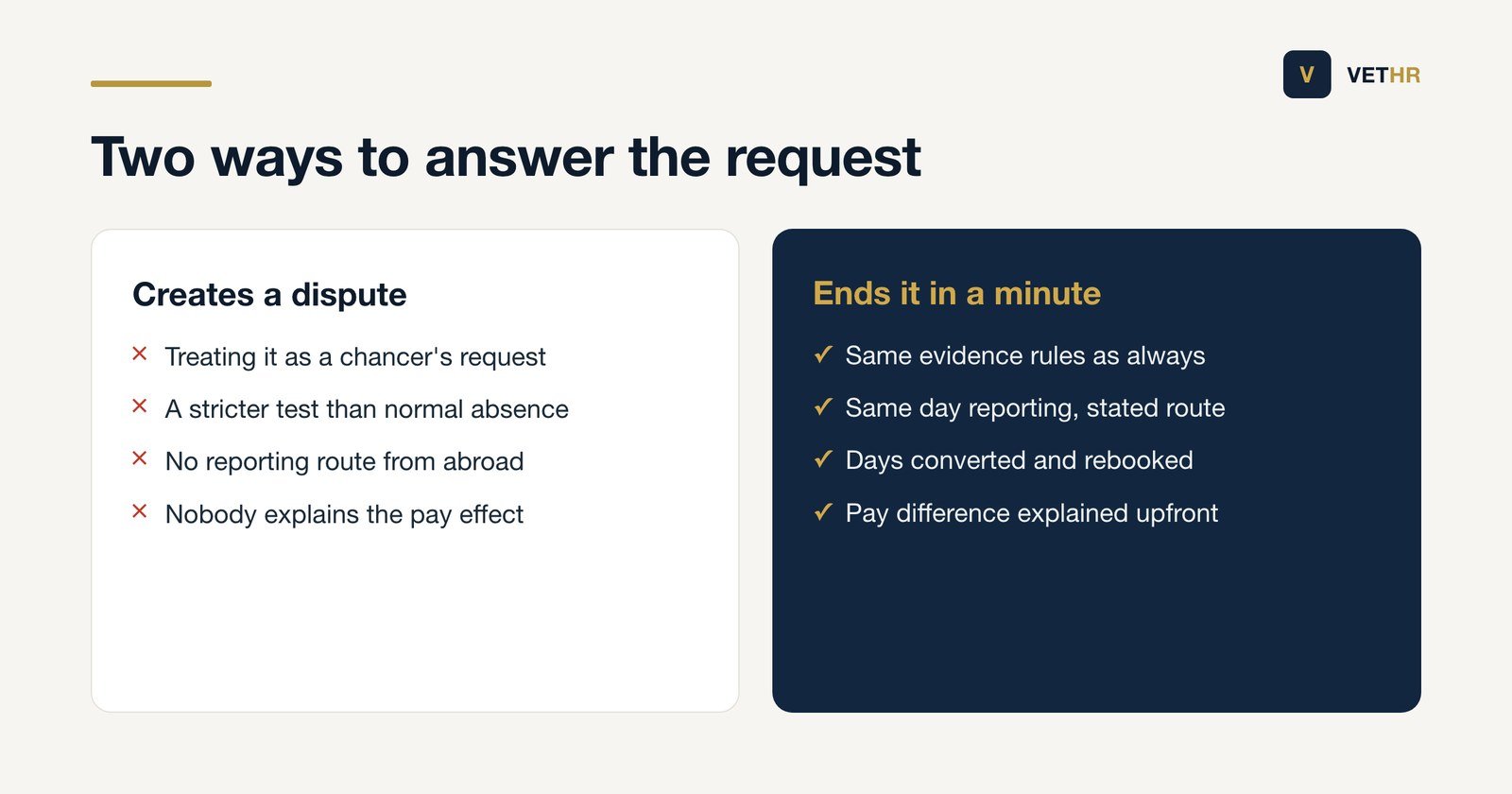
The same rules you apply to any other absence. If your policy requires self certification for the first seven days and a fit note beyond that, apply it here too. What you cannot do is invent a stricter test because the absence happened to fall in a holiday.
Do say in the policy how someone reports being sick during annual leave, because the usual route often does not work. Somebody in another country at 7am is not going to phone the branch line. Give an email address or a number that reaches a manager.
Ask for the report at the time, not on their return. A claim made two weeks later with no contemporaneous notification is much harder for both sides, and stating the requirement in advance avoids that conversation entirely.
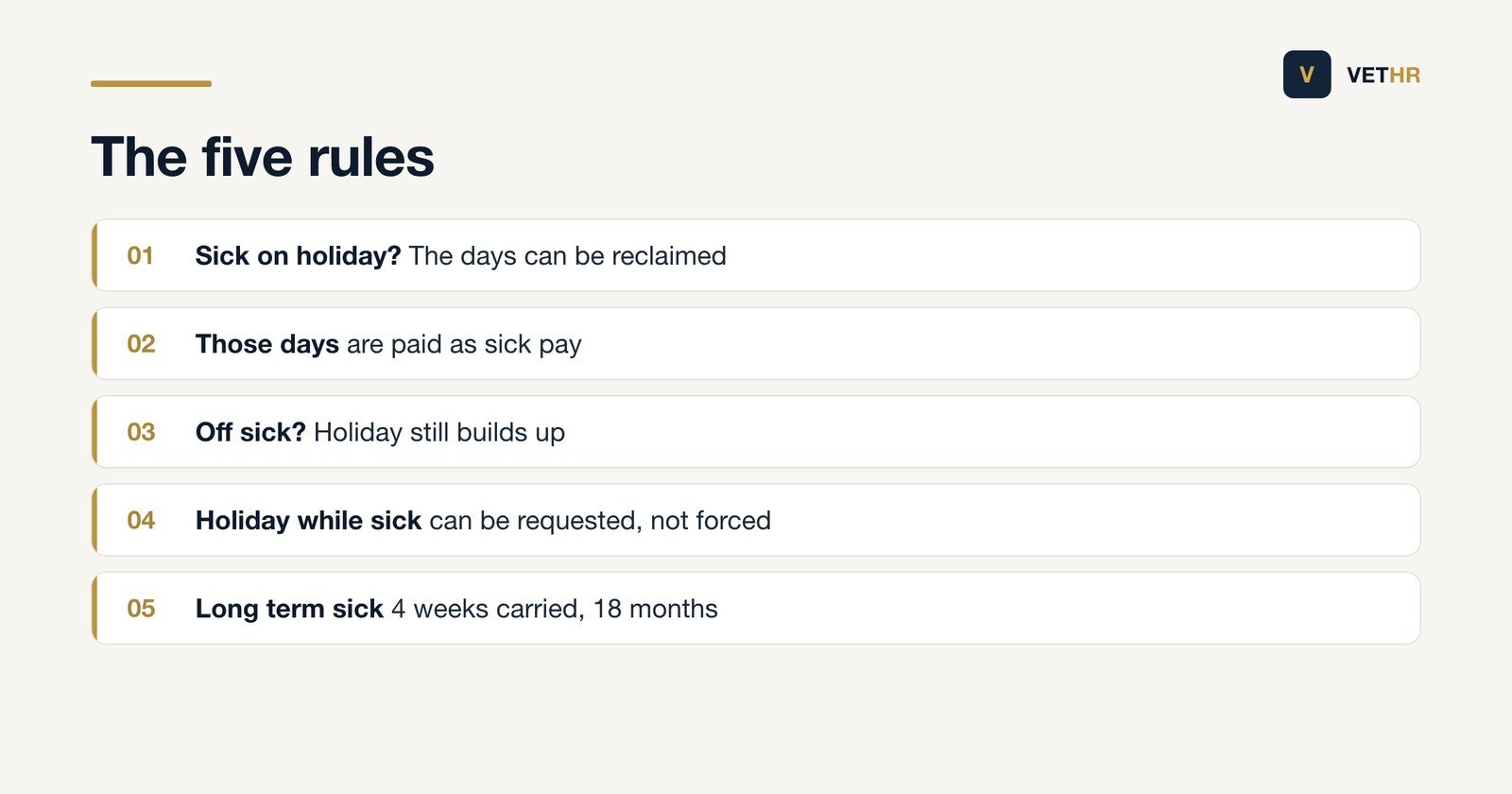
For the converted days, the worker gets sick pay rather than holiday pay. In most veterinary practices that means statutory sick pay unless the contract provides something better, and it will usually be less than a day of holiday pay would have been.
Which is why some staff choose not to reclaim the days at all, and that choice is theirs to make. Tell them what the consequence is, in money, and let them decide. Hiding it produces a grievance later.
One diary note for 2026. The government’s Employment Rights Act timeline removes the lower earnings limit and the waiting period for statutory sick pay from 6 April 2026, which changes the arithmetic for part-time and bank staff who fall sick during annual leave. Our note on statutory sick pay for veterinary staff has the detail.
Yes. GOV.UK confirms that workers build up holiday entitlement while off work sick, and that they have the right to request holiday at the same time as sick leave. Statutory entitlement is 5.6 weeks a year, which is 28 days for someone working a five day week.
Acas puts the same point plainly: workers still accrue holiday when they are off work because of sickness or injury. A vet signed off for three months in the spring comes back with three months of holiday still to take.
Plan for that, because it lands on the rota at the same time as the return to work. A phased return and an accrued holiday balance in the same month is a rota problem you can see coming from a long way off.
They can ask, and you can agree. Acas confirms that a worker can use their paid annual leave while off sick, and that an employer cannot force a worker to take holiday while off sick. The request has to come from them.
This comes up most often when sick pay runs out. Taking a week of holiday at full pay in the middle of a long absence is a reasonable thing for someone to want, and agreeing to it costs the practice nothing it had not already budgeted.
Keep the paperwork clean. The week is holiday, paid as holiday, and deducted from the balance. Our guide to long term sickness in a veterinary practice covers how these conversations usually run.
Acas describes long term sick leave as absence lasting longer than 4 weeks, and says a worker can carry over 4 weeks of unused holiday entitlement, unless the employer allows more. That carried holiday must be used within 18 months from the date it is carried over.
Two numbers to put in the policy, then: four weeks, and eighteen months. Both of them are easy to lose track of in a spreadsheet and easy to hold in a proper system.
Our holiday calculation system tracks carried leave and its expiry alongside the normal balance, and the note on carrying over holiday in a veterinary practice covers the wider rules.
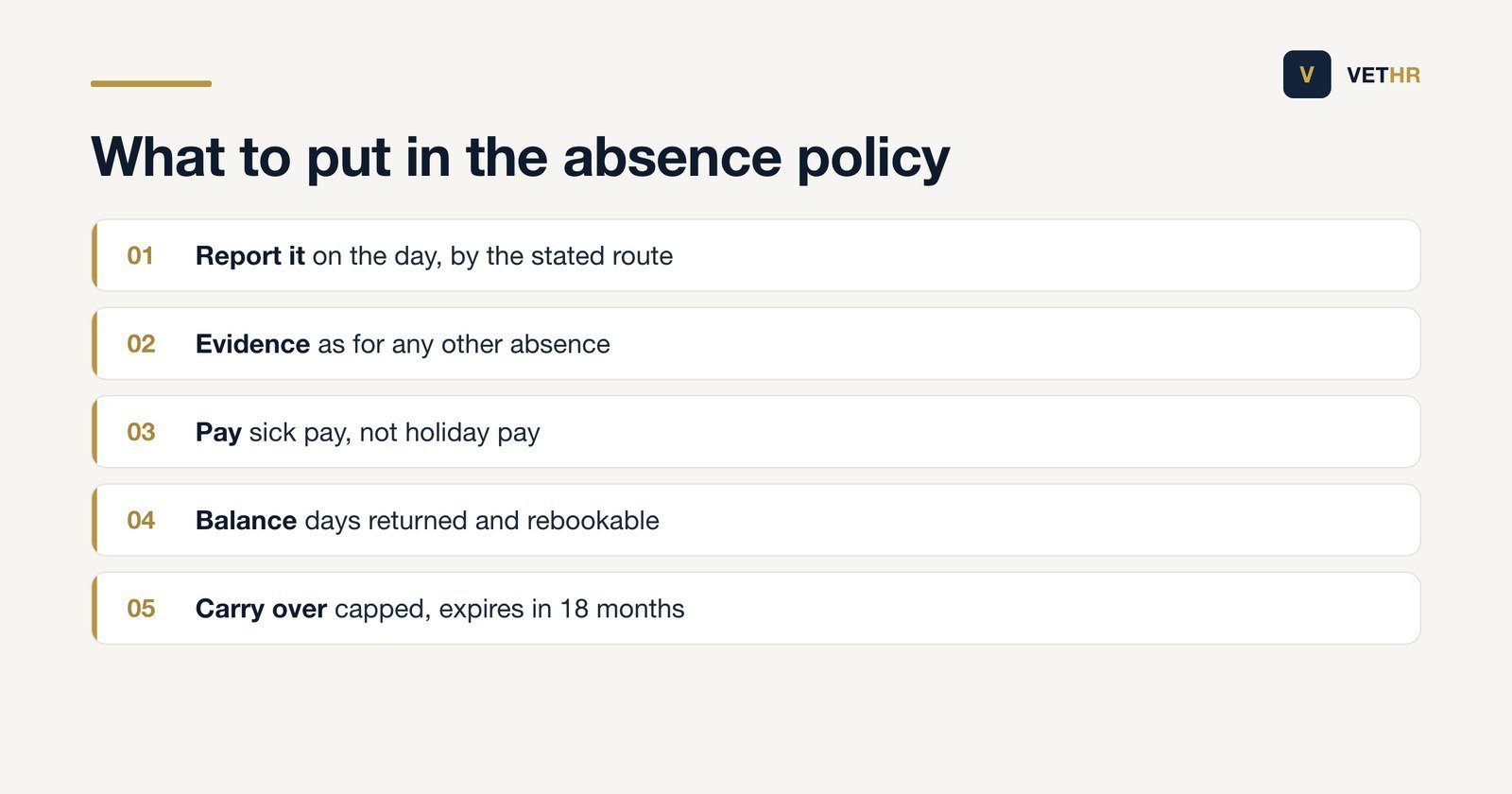
Five lines, sitting in the absence policy rather than the holiday policy, because that is where people look when they are ill.
That is enough. Anything longer reads as suspicion, and suspicion is the thing that turns a five day chest infection into a dispute. Book a free 30-minute HR health check if you want yours reviewed.
Not where the person was genuinely sick during annual leave and has followed your reporting and evidence rules. Acas guidance says they can take sick pay for the time they were ill and keep that time to use as holiday another time.
Your policy can require it, and it should. Set out how to report being sick during annual leave, including a route that works from abroad, and apply it consistently. Requiring same day notification is reasonable; requiring a foreign fit note is not.
Treat them the way your contract treats bank holidays generally. If they form part of the 5.6 weeks entitlement, the same conversion applies. If they are additional contractual days, say in the policy how they are handled.
No. Acas states that an employer cannot force a worker to take holiday while off sick. The worker can request it, and many do when sick pay runs out, but the request has to come from them.
Yes. The entitlement is pro rata but the principle is identical. Bank staff and part-time nurses who are sick during annual leave have the same right to reclaim the days, and the same right to accrue holiday while absent.
Someone who was sick during annual leave is asking for the rest they did not get. Say yes, apply your normal evidence rules, explain what it does to their pay, and put the days back. The whole conversation should take a minute.
If your absence and holiday policies contradict each other, or your spreadsheet cannot track carried leave, we fix both through HR consultancy for veterinary practices and the Vet HR staff systems.
The Vet HR Team provides HR consultancy and white-labelled staff systems exclusively to UK veterinary practices.
Contracts, rotas, holiday, a difficult conversation. Tell us what you are dealing with and we will come back within one working day. Nothing to sign up to.
Got it. We will come back to you within one working day. If you do not see a reply, please check your spam folder.
