Last updated: 5 September 2026
TL;DR: Since 6 April 2026 statutory sick pay is paid from the first day of illness and the lower earnings limit has been removed, so part-time and weekend veterinary staff now qualify. The rate is £123.25 a week or 80% of normal weekly earnings, whichever is lower, for up to 28 weeks. Most practice absence policies still describe the old rules.
Sick pay used to be simple in a small practice: three unpaid waiting days absorbed most short absences, and a lot of part-time staff never qualified at all. Both of those things stopped being true this April. This guide sets out what statutory sick pay now requires of a veterinary practice, and what to change.
Two things, both significant for small employers. Acas records that from that date statutory sick pay is paid from the first day of illness, instead of the fourth, and the lower earnings limit has been removed.
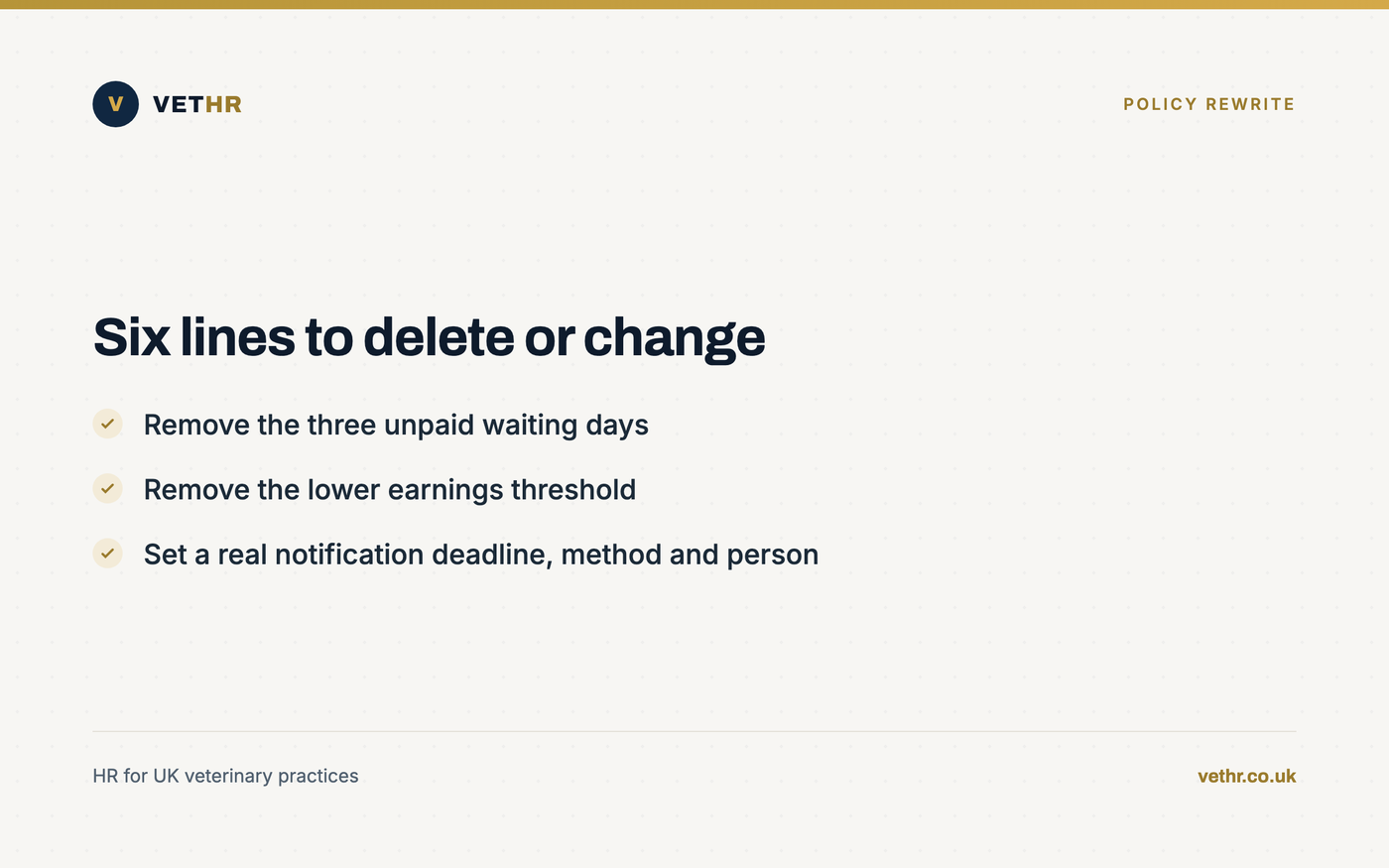
Removing the waiting days changes how statutory sick pay behaves for short absences. A single day off, which previously cost the practice nothing in sick pay, is now payable. Removing the lower earnings limit changes who is in scope: Saturday receptionists, part-time nurses and anyone else previously earning below the threshold now qualifies.
Together those are the most financially visible of the 2026 employment law changes for a practice of 5 to 50 people, and the ones most likely to still be described incorrectly in your handbook.
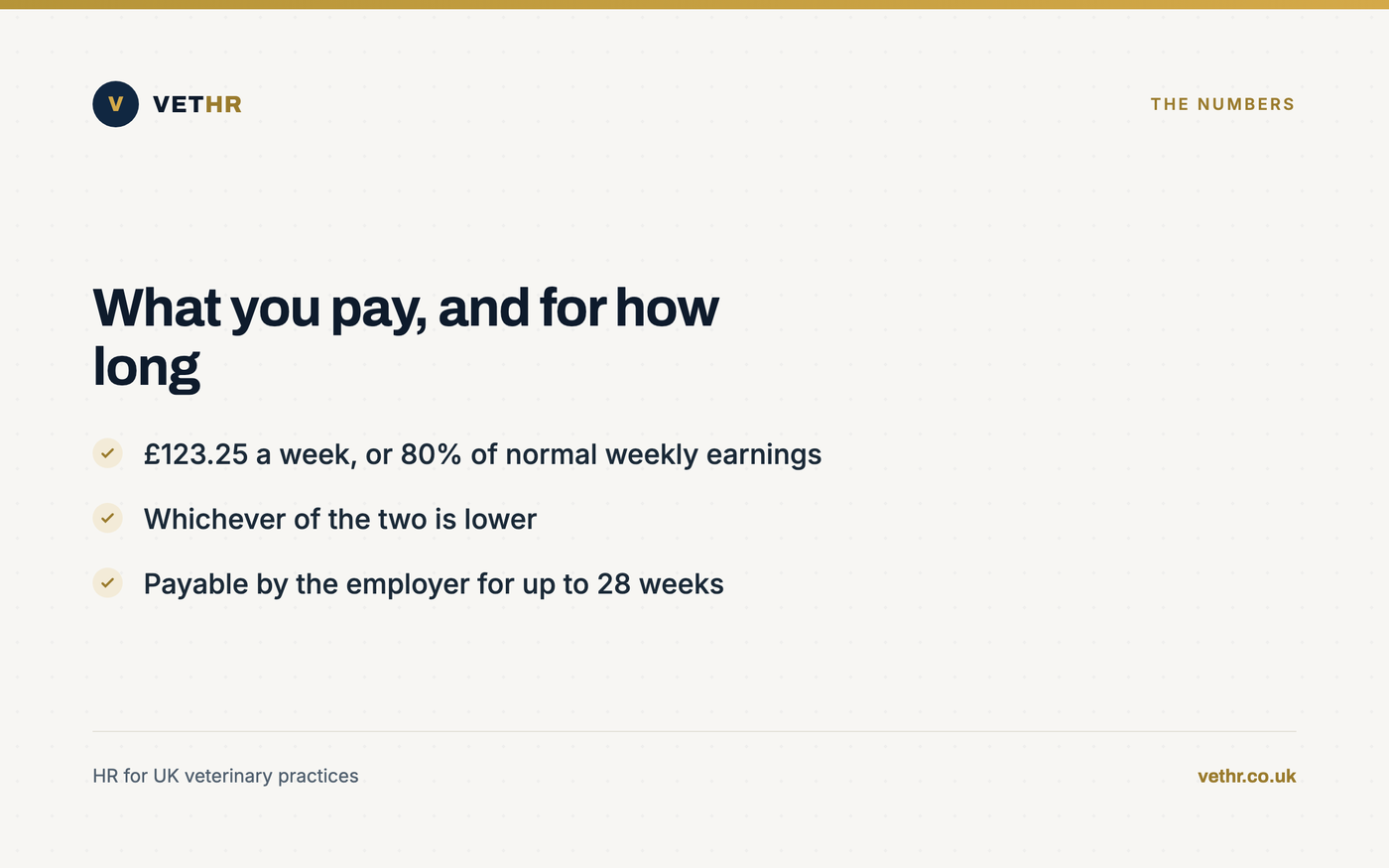
GOV.UK sets it at £123.25 a week or 80% of normal weekly earnings, whichever is lower, paid by the employer for up to 28 weeks. The 80% element is the part practices most often get wrong, because it changes the calculation for lower-paid and part-time staff.
In practice that means two calculations for every absence. Work out 80% of normal weekly earnings, compare it with the flat rate, and pay the lower figure. For a full-time vet the flat rate will almost always be lower. For a part-time receptionist it may well not be.
Twenty-eight weeks is the maximum for any period of sickness, and someone who has already received the full entitlement does not qualify again within the same linked period. Long-term absence therefore needs a plan well before that ceiling arrives.
Far more of your team than before. GOV.UK requires that the person is classed as an employee, has done some work for the employer, and has been ill for at least one full working day. With the lower earnings limit gone, low-hours staff are no longer excluded on pay grounds.
There are still exclusions. Someone who has already had the maximum 28 weeks does not qualify, nor does someone receiving Statutory Maternity Pay, and eligibility ends where there is a continuous series of linked periods lasting more than 3 years.
Check your bank and weekend staff specifically. That is where practices find people who were previously outside the scheme and are now inside it, and where payroll instructions are most likely to be out of date.
Unchanged, and still yours to set. GOV.UK states the employee must tell the employer before the deadline the employer sets, or within 7 days if none has been set, and that a fit note is required if someone is off for more than 7 days in a row including non-working days.
Set the deadline explicitly and make it workable for a practice. For a team where a missing nurse at 8am means a theatre list is in trouble, “by 7:30am, by phone, to the duty manager” is reasonable. A text at 9:15am to a colleague is not a notification system.
Self-certification covers the first 7 days. Keep the form short, and use it as the prompt for a return to work conversation rather than as a piece of paperwork that goes into a drawer. Our guide to return to work interviews covers that conversation.
Many practices do, and it is a genuine recruitment differentiator in a tight market. The important thing is that a company scheme is contractual, so once it is in the contract or applied consistently it becomes very difficult to withdraw.
If you offer enhanced sick pay, define it precisely: how many weeks at full pay, how many at half, whether it is per rolling 12 months, whether service qualifies someone for more, and whether statutory sick pay is included within it rather than paid on top.
Be consistent. Discretionary enhancement decided case by case is how practices end up with a discrimination argument, because two people with similar absences will inevitably be treated differently and someone will notice.
The direct cost is modest per day and meaningful across a winter. The larger cost, as always in a practice, is cover: a nurse off sick on a theatre morning costs the sick pay plus whatever it takes to keep the list running.
Managing statutory sick pay well is therefore mostly about seeing absence early. Practices that record every absence from day one, hold return to work conversations and look at patterns quarterly tend to pay less overall, because short absences are addressed before they become long ones.
Three patterns are worth watching: absence concentrated on particular shifts, absence following out of hours blocks, and one individual’s absence rising steadily. Each has a different cause and a different fix, and none of them is visible in a paper diary at reception.
Our clock in and out system records absence alongside hours worked, which is what makes those patterns show up. See also managing sickness absence in a veterinary practice.
Deliberately, and from week two rather than week twenty. Statutory sick pay runs for up to 28 weeks, which sounds generous until you realise it is also the period during which a small practice has to hold a role open, keep paying for cover, and stay in contact without appearing to pressure someone who is genuinely unwell.
Agree a contact arrangement early: who calls, how often, and by which method. Silence is usually read as abandonment by the employee and as avoidance by the team, and it makes the eventual return conversation much harder than it needed to be.
Consider occupational health input where the absence is likely to continue, and consider adjustments seriously before considering anything else. Phased returns, temporary changes to out of hours duties and lighter clinical lists are all normal in veterinary practice, and they are also evidence that adjustments were explored.
Keep a written record throughout: contact dates, what was discussed, what was offered, what the employee said. When statutory sick pay approaches its limit, that record is what makes the next conversation a fair one rather than a surprise.
Absence policy written before April? A free 30-minute HR health check will tell you what needs rewriting. Book your HR health check.
Since 6 April 2026, sick pay starts from the first day of illness rather than the fourth, so a qualifying absence is payable from day one. GOV.UK also requires the person to have been ill for at least one full working day, so a partial day sent home early needs care in how it is recorded.
Yes. A fit note is required where someone is off for more than 7 days in a row including non-working days, and self-certification covers the period before that. Your policy can set out the process, provided it is applied consistently across the team.
Where an employee falls ill during booked leave and follows your notification and evidence rules, they can usually ask for the leave to be reclassified as sickness and reinstated for later use. Set out how to request it, because doing it informally is how holiday records become unreliable.
SSP applies to employees, so genuine freelance cover engaged on a self-employed basis is outside it. Employment status is determined by the reality of the arrangement rather than the label on the invoice, so take advice where someone works regular shifts under your direction over a long period.
Only after a fair process, and with real care where a disability or pregnancy may be involved. Absence management is a procedure, not an event: record the absences, hold return to work conversations, set out concerns in writing, consider adjustments and take advice before any dismissal decision.
The change to statutory sick pay is not something to resist. It is a prompt to do the thing that improves absence anyway: record it accurately, notice patterns early, and talk to people when they come back rather than pretending nothing happened.
If your absence policy predates April, it needs rewriting rather than patching. Our policy library and monthly subscription keep documents current as the rules move, and the free HR health check will show you the gaps in 30 minutes.
The Vet HR Team provides HR consultancy and white-labelled staff systems exclusively to UK veterinary practices.
Contracts, rotas, holiday, a difficult conversation. Tell us what you are dealing with and we will come back within one working day. Nothing to sign up to.
Got it. We will come back to you within one working day. If you do not see a reply, please check your spam folder.
