TL;DR: Smoke-free law bans smoking in enclosed workplaces and work vehicles, but vaping is not covered by it, so a practice decides its own vaping rules. HSE advises a specific workplace smoking policy that gives priority to non-smokers and is agreed after consulting staff, and says vaping should be part of your risk assessment. If you ban vaping indoors but allow vaping breaks, make sure vapers are not exposed to tobacco smoke. Put the rules in writing and apply them evenly.
Last updated: 13 November 2026

Somewhere behind most veterinary practices there is a back door and a bin, and next to the bin there is a cigarette end. Some practices have a vaping corner in the car park. Some have a rule on the notice board from 2008. Few have a written policy that deals with vaping, the front step that clients walk past, the anaesthetic store and the nurse who goes out every forty minutes.
This guide explains how to write a smoking and vaping policy for a veterinary practice: what the law says, what HSE advises, what you need to decide for yourself and how to put it in place fairly. It is general information and not legal advice.
The Health Act 2006 prohibits smoking in enclosed public places and workplaces, on public transport and in vehicles used for work. Public Health England describes the legislation as based on the evidence of direct health harm to bystanders from secondhand smoke. Local authorities enforce it. Your practice building, staff room and work vehicles are covered.
The HSE page on advice on smoking at work says HSE does not enforce smoke-free law and that local authorities do. It adds that where premises are exempt, health and safety law still requires employers to reduce employees’ exposure to second-hand smoke to as low a level as is reasonably practicable.
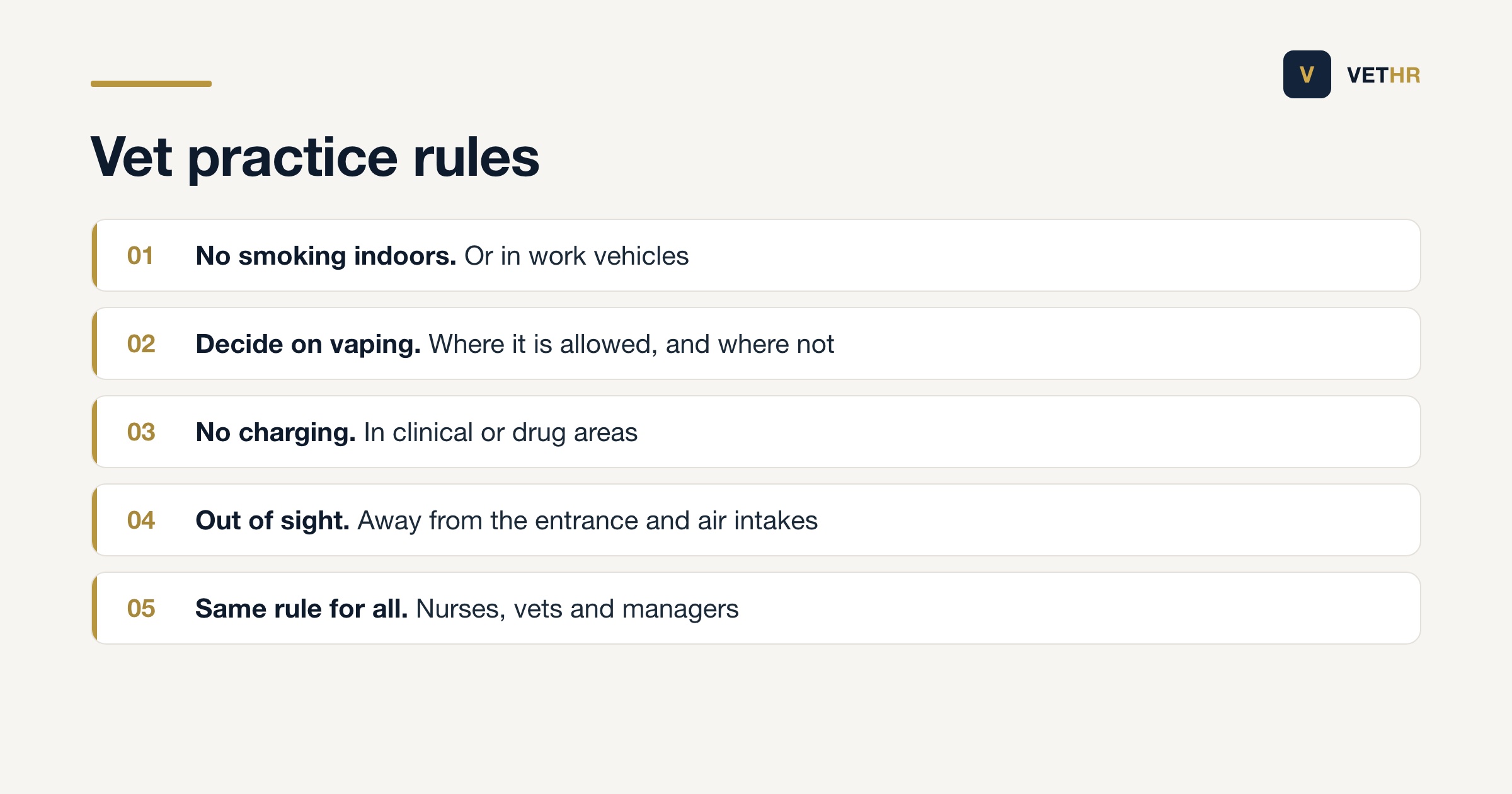
For a veterinary practice that means no smoking inside the building or in a company vehicle, including a vehicle used for visits. It also means that the front step and rear yard deserve thought, because smoke drifts into doorways. The legal minimum is a no-smoking sign and a rule. The better answer is a policy that says where, if anywhere, smoking is allowed outside.
No. Public Health England’s advice on the use of e-cigarettes in public places and workplaces says e-cigarette use, known as vaping, is not covered by smoke-free legislation, because e-cigarettes do not burn tobacco and do not create smoke. The document is from 2016, so treat the evidence in it as dated.
HSE says it does not enforce rules for e-cigarettes, that they are not regulated like tobacco and that general product safety requirements apply. HSE says employers should consider e-cigarettes within their wider workplace risk assessment and that it has not advised on bans, though some organisations have introduced them.
That leaves the decision to you. A practice can ban vaping anywhere on site, allow it in a designated outside area, or allow it in some indoor places. All are lawful. What matters is that the rule is clear, written, communicated and applied evenly. Whichever route you choose, say why, so the rule reads as a considered decision.
HSE recommends a specific workplace smoking policy, giving priority to non-smokers who do not want to breathe tobacco smoke, and consulting employees and their representatives to shape a policy that suits the workplace. If you prohibit e-cigarettes but allow vaping breaks or designated areas, ensure vapers are not exposed to second-hand tobacco smoke.
That last point is easy to miss. If you create a shared outdoor shelter where smokers and vapers stand together, you have put a vaper in tobacco smoke. A bin and a bench for each group, or one area for each, is a simple fix.
The consultation point matters too. A policy imposed without asking is more likely to be ignored. Ask the team what they think, explain the options and take on board practical points such as where the back door opens and who walks past. Our guide to policies and handbooks shows how to document and issue a policy so that everyone has read it.

A short smoking and vaping policy covers scope, the legal position, where smoking is prohibited, where vaping is prohibited or allowed, breaks, fire safety, work vehicles, visitors and clients, support for staff who want to stop, and what happens if the rule is broken. Keep it to a page or two and issue it with the handbook.
A workable structure:

Our guide to disciplinary procedures explains how to deal with breaches fairly, and our equality and diversity policy guide covers how to apply a rule evenly.
A veterinary building has hazards a shop does not: oxygen and other gases, flammable disinfectants and solvents, drugs stores, radiography areas, animals in kennels and clients arriving with upset pets. Each argues for firm rules on where flame, heat and vaping devices are allowed, and for including them in the fire risk assessment.
Vaping devices contain batteries. Charging them in the wrong place is a fire risk, and an e-cigarette used near oxygen or flammable products is an avoidable danger. Many practices ban charging devices anywhere except a clear, non-clinical area. Check your insurer’s requirements, and ask your fire risk assessor to include vaping and smoking arrangements when it is next reviewed.
Think about how it looks. A nurse in scrubs smoking or vaping by the front door is visible to every client and is often at the point where an upset owner is entering or leaving. Many practices choose a spot out of sight of the entrance, away from kennels’ ventilation and away from neighbours. Think also about the animals, and keep smoke and vapour away from air intakes.
There is a health and safety link with lone working too. A person who goes out alone to smoke at night, in an unlit yard, is a lone worker, and our guide to lone working explains how to reduce that risk. A well-lit, visible area is part of the answer.
There is no general legal right to extra breaks to smoke or vape. People are entitled to the rest breaks that apply to everyone, so a sensible policy says smoking and vaping happen during normal breaks and not in addition to them. If you allow extra time for some, expect questions from staff who do not smoke.
Fairness matters in any smoking and vaping policy. Non-smokers sometimes resent the colleague who steps out every hour, and the colleague who is addicted to nicotine may find it hard to wait. A practical middle path is to set out when breaks are taken, accept that a short break in a quiet period is reasonable, and manage the pattern if it affects the work.
Whatever your smoking and vaping policy says, apply it to everyone in the same way, including managers and vets. If it is common knowledge that senior staff slip out when they want to, a rule for others will not stick.
The Tobacco and Vapes Act 2026 received Royal Assent on 29 April 2026. It creates a generational sales ban, with retailers having until 1 January 2027 to comply, and it gives the government powers over vape advertising, packaging and retail licensing. A consultation on extending smoke-free outdoor places and creating heated tobacco and vape-free places closed on 8 May 2026.
The Lewis Silkin summary of the Tobacco and Vapes Act 2026 says the government’s response to the consultation had not been announced, and it contains no workplace-specific provisions. So there is nothing in the sources I checked that changes what a practice must do inside its building today. Watch for the consultation outcome, because vape-free places could change the position on vaping in some settings.
Review your smoking and vaping policy when new regulations are published, and say so in the policy. Our guide to employment law changes for veterinary practices tracks the wider programme.
Consult first, draft second, tell everyone third. That is how a smoking and vaping policy sticks. Ask the team what they think, explain the legal position and the options, write a short policy, give notice of the start date, put it in the handbook and have people confirm they have read it. If it changes contract terms, take advice before imposing it.
If you currently allow something and plan to stop it, give notice and a lead time. Offer support for staff who want to stop smoking or vaping, such as signposting NHS stop smoking services. Make clear that the aim is health and safety, not punishment. For existing staff whose contracts mention a smoking area or break arrangement, check the wording before you change it. Our guide to employment contracts explains how, and our guide to contract changes covers the process if something contractual is affected.
Display no-smoking signs where the law requires them, and add your vaping rules in the staff room and at the entrance for clients. Then check once a quarter that the rule is working: are there cigarette ends by the door, are devices charging in the wrong place, has anyone complained?
Clients arrive stressed, and some smoke or vape on the way in or out. Put a clear sign at the entrance, tell people politely where they may go and have a standard line for staff: we ask everyone not to smoke or vape here, thank you. Do not leave nurses to argue at the door.
Think about the animals too. Smoke and vapour near kennel intakes, recovery areas and the front door are unwelcome for sick pets, and some owners ask about it. A visible rule helps staff say no without making it personal. If a client becomes abusive about the rule, treat it as any other client conflict and log it.
Contractors and delivery drivers should know the rule before they come on site. Add it to your induction for visitors, and include it in contractor paperwork if you use regular suppliers.
Start with a conversation. Remind the person of the rule, ask whether they knew it and explain why it matters. Most breaches are habit or confusion. Record a first conversation briefly, and move to the disciplinary procedure only for repeated or serious breaches, such as smoking in a drug store or near oxygen.
Treat fire and safety breaches seriously. A cigarette near flammable products or a charging device left in a clinical area is not a minor matter, and the policy should say that such breaches can be treated as misconduct. Keep a note of what was said so that you can show the rule was explained.
Be consistent with the practice owner and senior vets. If they break the rule and nothing happens, the policy is finished.
The usual mistakes are no written policy, a smoking shelter that exposes vapers, banning vaping without saying where it is allowed, ignoring fire and charging risks, treating managers differently, forgetting work vehicles and imposing changes without consulting staff. Each is simple to fix with a one-page document.
No. Public Health England’s advice says vaping is not covered by smoke-free legislation. It is up to the employer to decide whether vaping is allowed on their premises.
The Health Act 2006 prohibits smoking in enclosed public places and workplaces and in vehicles used for work. Local authorities enforce it. HSE does not.
Yes, but HSE says you must ensure vapers are not exposed to second-hand tobacco smoke in doing so. Do not put smokers and vapers in the same shelter.
There is no general legal right to extra breaks to smoke or vape. Apply your normal break rules consistently to everyone.
The Tobacco and Vapes Act 2026 received Royal Assent on 29 April 2026. A consultation on extended smoke-free outdoor places and new vape-free places closed on 8 May 2026, and the outcome had not been announced in the sources I checked. Watch for it.
If you want a smoking and vaping policy written for your practice, with a fire safety check and a consultation plan, book a free 30-minute HR health check through our contact page. See also our HR consultancy for veterinary practices.
Sources: HSE: advice on smoking at work, Public Health England: use of e-cigarettes in public places and workplaces, Lewis Silkin: Tobacco and Vapes Act 2026 becomes law.
Contracts, rotas, holiday, a difficult conversation. Tell us what you are dealing with and we will come back within one working day. Nothing to sign up to.
Got it. We will come back to you within one working day. If you do not see a reply, please check your spam folder.
