TL;DR: Natural rubber latex proteins can cause asthma, dermatitis and, more rarely, anaphylaxis, and HSE says they are substances hazardous to health under COSHH. Employers must be able to show they assessed which type of glove, if any, to provide, and that they have an effective glove use policy. If latex is chosen, HSE says single-use latex gloves should be low-protein and powder-free, staff with an existing latex allergy should not use latex gloves, and you must consider health surveillance for occupational asthma and for dermatitis. Give staff information, instruction and training.
Last updated: 17 November 2026

A vet nurse starts to notice red, itchy hands at the end of each shift. A month later she begins to cough in the prep room when the box of powdered gloves is opened. She does not mention it because everyone wears gloves and nobody else has complained. By the time she goes to her GP the practice has no record of which gloves it buys, who selected them or whether anyone has ever checked staff skin.
Single-use gloves are among the most used items in a veterinary practice. HSE treats natural rubber latex as a hazardous substance, so a practice that buys latex gloves has a duty to assess and control the risk. This guide explains what HSE says about latex allergy, how to choose gloves, what a glove policy should cover, when health surveillance is needed and how to look after a member of staff who has a reaction. It is general information, not legal advice.
HSE says natural rubber latex contains proteins to which some people may develop an allergy. The proteins can cause asthma and dermatitis, and more serious reactions such as anaphylaxis are possible. The allergy can develop through skin contact or by breathing in powder from powdered latex gloves, which carries the proteins into the air.
The HSE page on latex allergies explains that in powdered latex gloves the proteins can leach out of the glove material and attach to the powder particles. When the gloves are put on or removed, the powder, with the proteins attached, becomes airborne and can be inhaled. HSE says the risk of inhalation and skin exposure is reduced when non-powdered, low-protein single-use latex gloves are used.
HSE lists the people most at risk: those exposed to latex on a regular basis in jobs where single-use gloves are used often, such as car mechanics, catering, hairdressing and electronics, people who have had multiple surgical procedures, people with a history of certain food allergies such as banana, avocado, kiwi and chestnut, and people with atopic allergic disease, which it says affects some 30 to 40 per cent of the UK population. It adds that around 1 to 6 per cent of the general population is thought to be potentially sensitised, although not all sensitised people develop symptoms.
HSE says the rise in cases among healthcare workers followed the greater use of gloves from the late 1980s and the arrival of high-protein examination gloves on the market, alongside a separate rise in atopic allergy. A veterinary practice uses gloves in many of the same ways as healthcare, so the same principles apply. Nurses, vets, kennel staff and cleaners may all wear gloves for long periods.
HSE says natural rubber latex proteins are substances hazardous to health under COSHH, so the COSHH Regulations and the COSHH Approved Code of Practice apply, including the specific requirements for substances that cause occupational asthma. That means assessing the risk, preventing or controlling exposure, and providing information, instruction, training and health surveillance where appropriate.
For a practice, the COSHH assessment should list the tasks where gloves are used, the type of glove currently supplied, who wears them and for how long, and any reports of skin or breathing problems. If you already have a COSHH assessment, check whether it covers gloves. Our guide to the COSHH assessment explains how to build one.
HSE says employers must be able to demonstrate that they have carried out an assessment to select which type of glove, if any, they should provide, and that they have an effective glove use policy in place. The policy should take account of staff or others, such as clients, who may have a latex allergy.
Where the use of gloves may lead to direct or indirect exposure of members of the public, HSE says the employer must assess the risk of that exposure and adopt suitable controls to protect them. In a practice that includes clients and visitors in areas where powdered latex gloves are used, and sensitive people who touch surfaces or items handled with latex gloves. A latex-free area or process for those cases may be the simplest control.
HSE says first decide whether protective gloves are needed at all, because the law requires other means of preventing exposure to be considered in preference to gloves. If gloves are needed they must be suitable: adequate protection for the hazard and suited to the wearer, the work and the environment. Consider the substances handled, the contact time, comfort, fit, dexterity and sterility.
The HSE page gives the process in order:
HSE explains that low-protein means manufactured to the European standards it refers to, which require extractable latex proteins to meet the limits defined in EN455-3. When you buy, ask the supplier for the standard and the protein figure on the product data sheet, and keep it with the COSHH file.
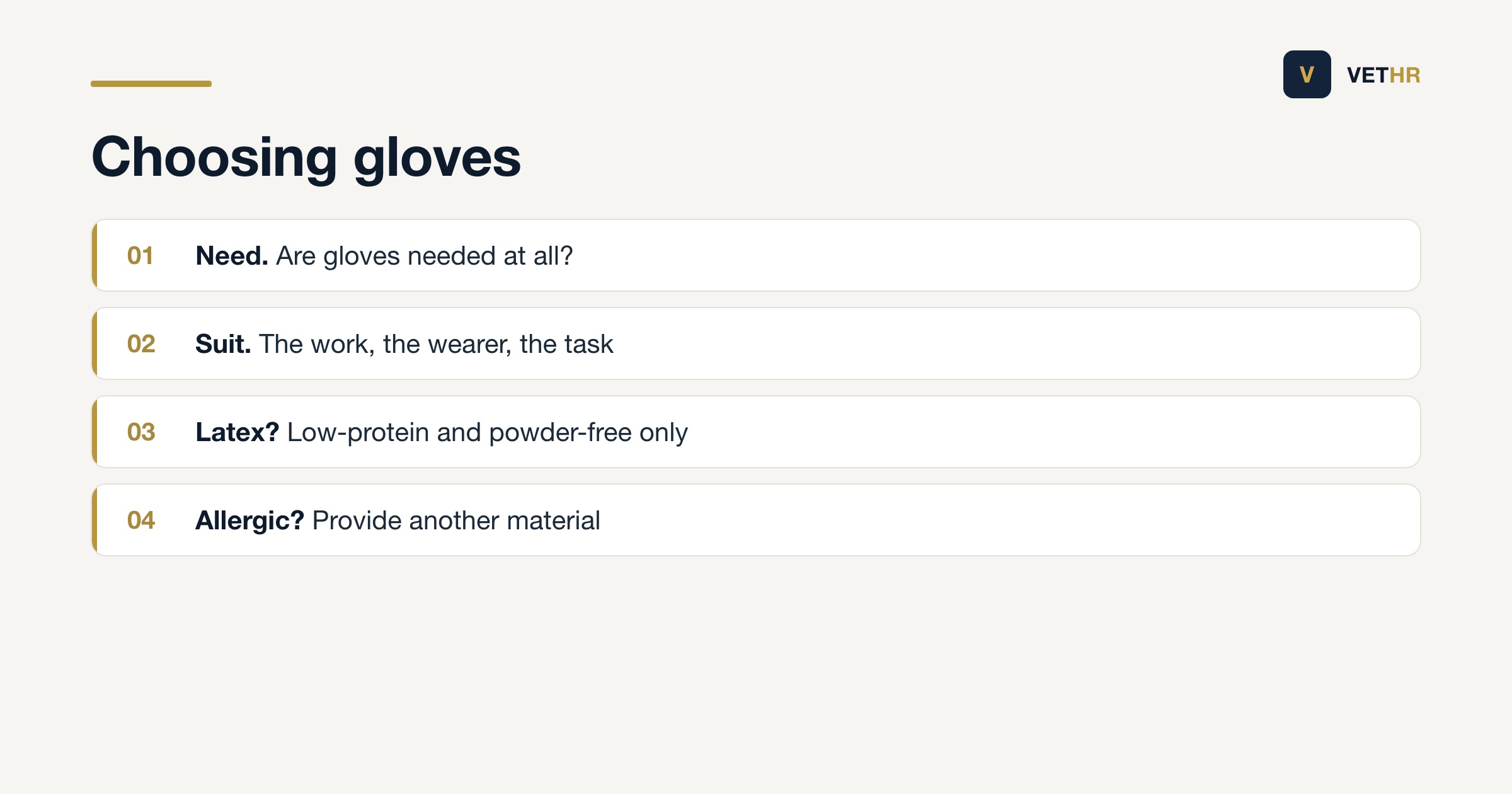
For vet work, think about the tasks: examination and handling, cleaning kennels and equipment, handling chemicals and cytotoxic drugs, surgery and dentistry. HSE says the type of glove depends on the substances handled, so a glove that suits routine examination may not suit cleaning chemicals. Check the manufacturer’s data and your COSHH assessments for each task. Our guide to dermatitis covers skin problems more widely, and the PPE guide covers the general duty.
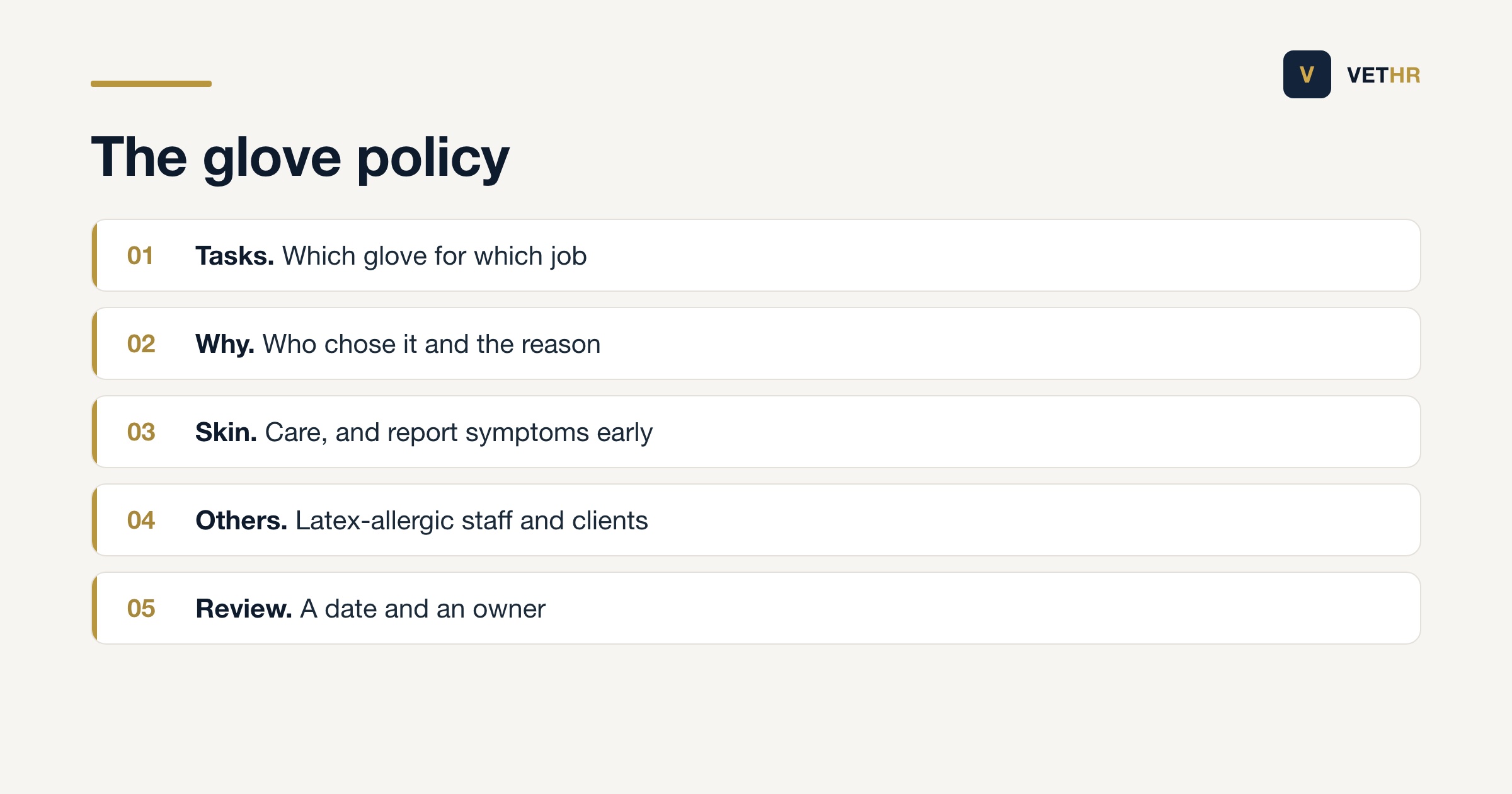
A glove policy states which tasks need gloves, which type is used for each, who has chosen them and why, how to put on and remove them, what to do about skin or breathing symptoms, how latex-allergic staff and clients are protected, and when the policy is reviewed. HSE says you must be able to demonstrate you have an effective policy.
Keep it short. A one-page policy with a table of tasks and gloves is easier to follow than a long document. Add an instruction on hand washing and skin care, because wet work and glove wearing can themselves damage skin. HSE says to consider health surveillance for work-related dermatitis, which means regular skin checks, whenever protective gloves are used, whatever material they are made from.
The policy should say that powdered gloves are not used, if that is your decision, and that low-protein, powder-free gloves are the standard for latex. It should say that staff must tell the manager if they develop symptoms, and that nobody will be penalised for doing so.
If a new starter or an applicant has a known allergy, treat it as a health and safety matter. Our guide to pre-employment health questions explains when you can ask about health, and the guide to reasonable adjustments covers what to do if the person is disabled.
HSE says that where low-protein, powder-free single-use latex gloves are used, the employer must carry out a risk assessment to determine whether health surveillance for occupational asthma should be in place. Because the risk is considered low, a low level of surveillance is likely to be enough. Consider surveillance for work-related dermatitis whenever protective gloves are used.
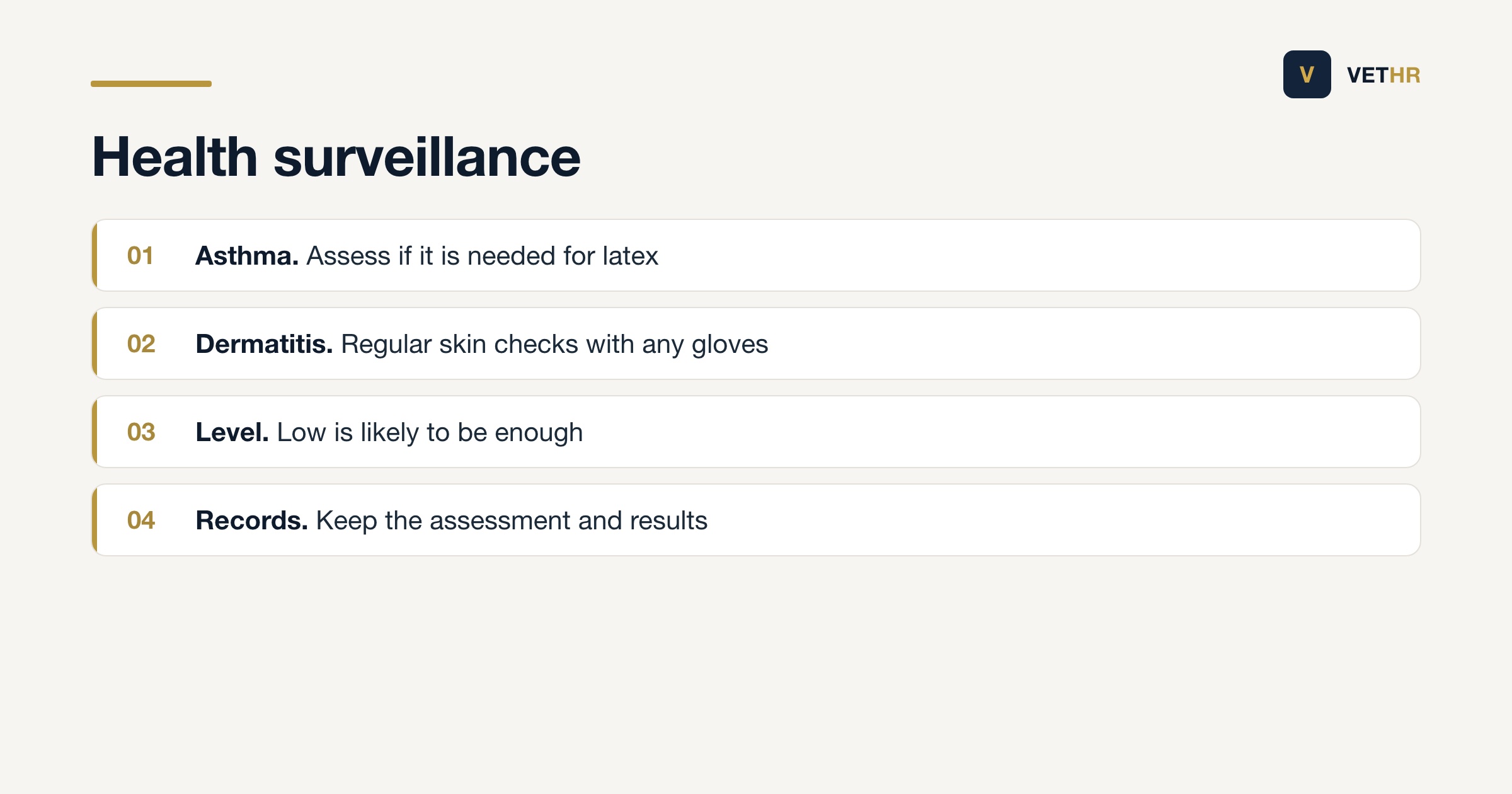
HSE says where health surveillance is appropriate, a low level is likely to be sufficient, and its page points to examples of typical approaches. For skin, HSE describes regular skin checks. For breathing, a simple symptom questionnaire at set intervals is the type of approach commonly used. Decide with your occupational health provider what is proportionate for your team. Our guide to health surveillance and occupational health cover how to set it up.
Make reporting easy and safe. Staff often put up with itchy hands or a cough for months. A short note in the induction and a standing item at team meetings, asking whether anyone has had skin or breathing problems linked to gloves, prompts early reports. HSE’s COSHH approach relies on early identification.
Keep records of the assessment, the glove selection, supplier data sheets, the policy, training and any surveillance results. L8-style record retention does not apply here, but COSHH records and health records have their own retention rules, so ask your occupational health provider how long to keep surveillance records.
Take it seriously. Remove them from exposure, arrange medical advice and record the incident. If someone develops asthma or a serious reaction, review the assessment, consider whether the case is reportable, and think about reasonable adjustments, including alternative gloves, a latex-free workstation and a change of task.
HSE says individuals with an existing allergy to latex proteins should take latex avoidance measures and should not use single-use or reusable latex gloves, so employers may need to provide an alternative material. For a person with a latex allergy, that may also mean controlling latex in the work area, for example making sure powdered latex gloves are not used nearby. If the person is disabled in law, the duty to make reasonable adjustments applies.
Anaphylaxis is a medical emergency. Make sure first aiders know the signs and what to do. Our first aid guide covers first aid arrangements, and the RIDDOR guide covers reporting. If a case may be work-related, ask your occupational health adviser whether it is reportable.
Review the cause. If symptoms started after a change of supplier or a new product, check the product data. If several people report symptoms, look at the glove type, the powder and ventilation. Share what you find with the team.
Buy against a written specification, not a price list. State the material, whether powder-free, the protein standard for latex, the size range and the task, and keep the supplier’s data sheet with the COSHH file. When a supplier changes a product, check the specification again before the new box goes into use.
Store gloves where they will not be exposed to heat, sunlight or chemicals that degrade them, and put each type in a labelled place so that the right glove is used for the right task. Keep latex-free gloves in the same place as latex ones, and make them easy to find, so that nobody uses latex out of convenience.
Include gloves in the induction. Show new starters how to put them on and take them off without contaminating hands or releasing powder, how to wash and dry hands before and after, and where to find alternatives. Ask them whether they have any skin or breathing conditions that affect their work, in terms that comply with the rules on health questions, and tell them how to report symptoms.
The usual mistakes with latex gloves are buying the cheapest gloves, using powdered latex, no assessment of glove choice, no policy, no training, ignoring symptoms and not providing alternatives for people with an allergy.
No. HSE says latex gloves can be used if the assessment shows they are the most suitable, but single-use latex gloves should be low-protein and powder-free, and people with a latex allergy should not use them.
Yes. HSE says natural rubber latex proteins are substances hazardous to health under COSHH, so the Regulations and Approved Code of Practice apply, including the requirements for substances that cause occupational asthma.
HSE says it means manufactured to the European standards it cites, which require extractable latex proteins to meet the limits in EN455-3. Check the supplier’s data sheet.
Where low-protein, powder-free latex gloves are used, HSE says you must assess whether health surveillance for occupational asthma is needed, and a low level is likely to be enough. Consider surveillance for dermatitis whenever gloves are used.
They should avoid latex and not use latex gloves. You may need to provide gloves in another material and control latex use in the area. If the allergy is a disability, reasonable adjustments apply.
If you want a glove selection checklist, a glove policy and a symptom reporting form for your practice, book a free 30-minute HR health check through our contact page. See also our HR consultancy for veterinary practices and the policies and handbook system.
Sources: HSE: latex allergies, HSE: latex allergies in health and social care.
Contracts, rotas, holiday, a difficult conversation. Tell us what you are dealing with and we will come back within one working day. Nothing to sign up to.
Got it. We will come back to you within one working day. If you do not see a reply, please check your spam folder.
