Last updated: 26 October 2026
TL;DR: PPE must be provided free of charge where a risk assessment shows it is needed, and since 6 April 2022 that duty extends to limb (b) workers as well as employees. It comes after engineering controls and safe systems of work, not instead of them, and the employer owns the assessment, the maintenance, the storage and the training.

A student veterinary nurse buys her own safety glasses because the practice pair does not fit over her prescription lenses. A bank nurse is told the lead apron in her size is at the other branch. Both of those are ordinary Monday problems, and both of them are PPE failures that the practice is legally responsible for.
Because it protects one person, badly, if anything goes wrong. HSE frames it as what is needed when some hazards may still remain after engineering controls and safe systems of work have been applied.
That ordering has a practical consequence in a practice. Scavenging on the anaesthetic machine comes before a mask. A hydraulic table comes before a back support. A proper restraint technique and chemical restraint come before thicker gloves.
A practice that answers every hazard with more PPE has skipped the useful part of the assessment. Our note on COSHH assessments in a veterinary practice covers the controls that should come first.
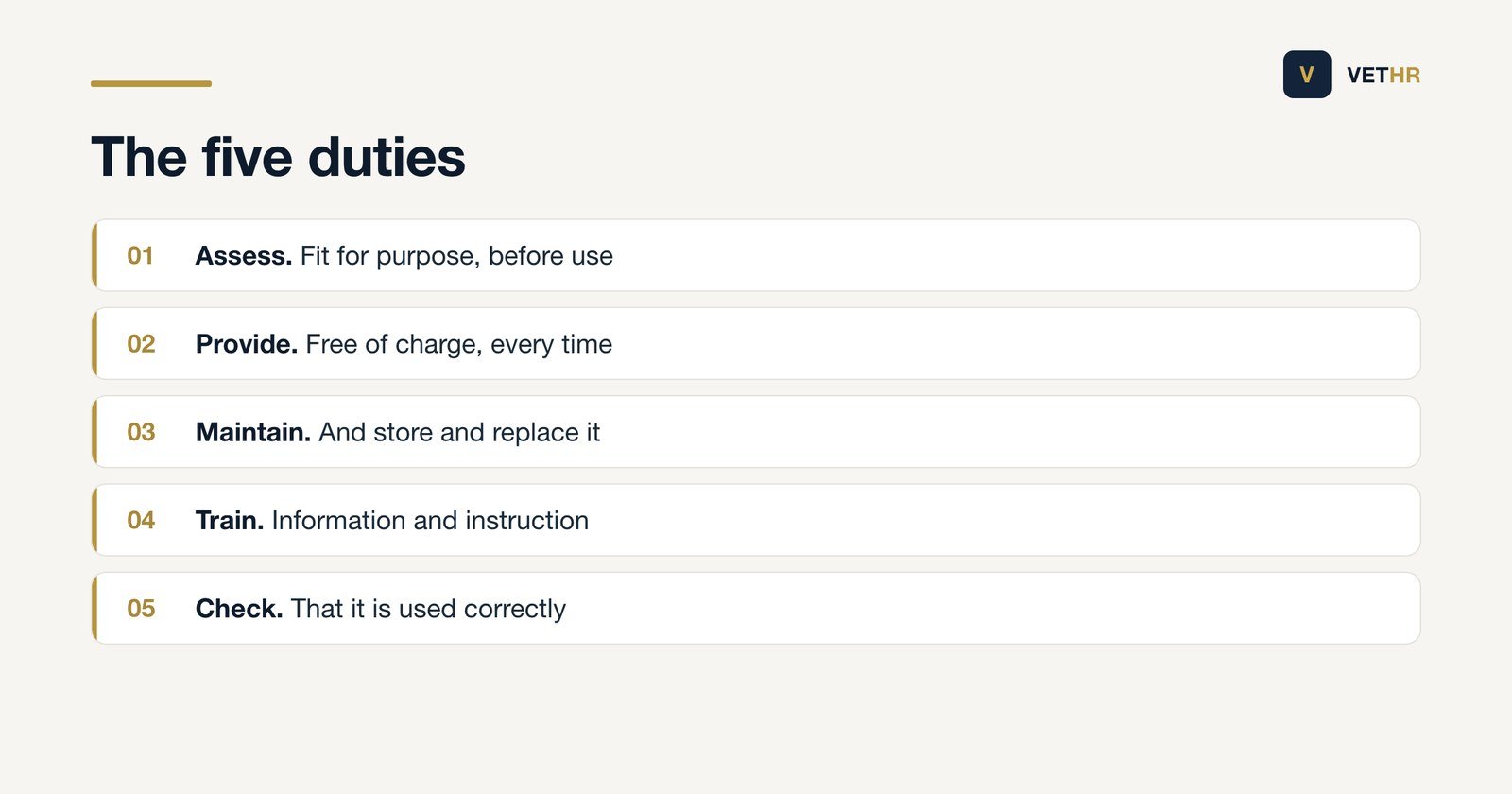
This is the rule with no exceptions. HSE states that employers must provide PPE free of charge if a risk assessment shows it is needed.
Free means free of every associated cost, not just the purchase. The employer carries the cost of the equipment, its storage, its maintenance and replacement, and any training or instruction that goes with it.
So a deposit for a pair of safety glasses is not allowed. Neither is deducting the cost of a lost item from wages, which would also need to clear the separate rules on deductions from wages.
Uniform is a different question. A scrub top that exists so the team looks consistent is workwear; a disposable gown that exists because of a splash risk is PPE. Our guide to the dress code in a veterinary practice covers the first.
Since 6 April 2022 the duties reach further. HSE explains that the amended regulations extended employers’ and employees’ duties regarding personal protective equipment to limb (b) workers, who generally have a more casual employment relationship and work under a contract for service.
HSE puts the obligation plainly: if a risk assessment indicates that a limb (b) worker requires PPE to carry out their work activities, the employer must carry out a PPE suitability assessment and provide the PPE free of charge, as they do for employees.
Read that against a veterinary bank list. The nurse doing four shifts a month, the weekend kennel assistant and the student on placement are exactly the people who tend to get whatever is left in the drawer. Our note on casual workers in a veterinary practice covers the wider status question.
HSE requires PPE to be properly assessed before use to make sure it is fit for purpose. Fit for purpose includes fitting the individual.
Veterinary teams are mostly women, and a lot of protective equipment is still sized and shaped for an average man. Gloves that gape at the wrist, a lead apron that hangs wrong, eye protection that will not sit over prescription glasses and a mask that cannot seal are all failures of suitability, not personal preference.
Buy a range of sizes, involve the people wearing it in the choice, and treat a complaint about fit as a safety report rather than a shopping request.
Work from your own assessments rather than a catalogue. In most small animal practices the list lands in five places.
Our guides to radiation protection and zoonoses cover the two assessments that drive most of this list.

Pregnancy and health conditions change the answer. Someone who is pregnant, immunosuppressed or has a skin condition may need different equipment or a different task altogether, and that is a review of the assessment rather than a favour. Our note on the pregnancy risk assessment covers how that conversation should run.
HSE requires PPE to be maintained and stored properly, and the employer is responsible for maintenance, storage and replacement of anything it provides.
In practice that means a named place for each item, a named person who checks it, and a replacement route that does not depend on someone raising it three times. Lead aprons need checking and storing flat or hung, not folded over a chair in the X-ray room.
Put a line in the weekly checks rather than relying on someone noticing. Our See It Report It system gives staff a route to flag a damaged item without having to chase anybody.
Keep a short record of what was issued to whom and when. It takes one column in a spreadsheet, it answers the question an inspector would ask, and it makes replacement a routine rather than a negotiation each time something wears out.
Add it to induction as well. A new starter who is shown where the equipment lives, in their size, in their first week, is far more likely to use it than one who has to work out the system by watching other people.
HSE requires employers to make sure workers have sufficient information, instruction and training on PPE use, and that it is used correctly by workers.
Used correctly is where practices quietly fail. Aprons left off for a quick radiograph, glasses pushed up during a dental, a mask worn under the nose. None of that is solved by another email.
Two things work. Make the correct behaviour the easy one, by putting the equipment where the task happens. And have senior staff model it, because a team copies what the clinical director does on a busy Friday, not what the folder says.
If you are not sure what your assessments actually require, book a free 30-minute HR health check and we will look at them with you.

No. HSE states that employers must provide it free of charge where a risk assessment shows it is needed, and that extends to storage, maintenance, replacement and any training. A deposit or a deduction is not acceptable.
Since 6 April 2022 the duties extend to limb (b) workers, who generally have a more casual employment relationship. Where a risk assessment shows they need it, the employer must do a suitability assessment and provide it free of charge.
Not usually. A scrub top worn so the team looks consistent is workwear. A disposable gown worn because the risk assessment identifies a splash hazard is PPE, and the free of charge rule applies to the second and not the first.
Ask why before anything else. It is usually fit, comfort or a task that has become impossible with it on, all of which are the employer’s problem to solve. Where the equipment is right and the refusal continues, it becomes a conduct matter.
Where your assessment calls for tight fitting respiratory protection, a mask only works if it seals, so fit testing is how you evidence that it does. Record who was tested, on which model, and when.
The student buying her own glasses and the bank nurse without an apron in her size are not small problems. They are the two most common PPE failures in veterinary practice, and both are fixed with a stock of sizes and a named person who checks it.
Start from the assessments, buy the range, and never let a cost reach a payslip. We build health and safety document sets for independent practices through HR consultancy for veterinary practices and the policy document set.
The Vet HR Team provides HR consultancy and white-labelled staff systems exclusively to UK veterinary practices.
Contracts, rotas, holiday, a difficult conversation. Tell us what you are dealing with and we will come back within one working day. Nothing to sign up to.
Got it. We will come back to you within one working day. If you do not see a reply, please check your spam folder.
