Last updated: 23 September 2026
TL;DR: A veterinary practice can set a dress code, but it must hold men and women to equivalent standards, stay flexible for religion and disability, and rest on safety, hygiene or a genuine image need. Protective equipment must be free. If you require a uniform and staff pay for it, that cost counts against their minimum wage pay.
Every practice has an unwritten dress code: navy scrubs in consults, no rings in theatre, sensible shoes on the ward. The trouble starts when it stays unwritten, and a manager has to tell a new receptionist that her nose ring is a problem, or a nurse is asked to buy her own tunics from her first pay packet.
Yes. A dress code can be a legitimate part of an employer’s terms and conditions. In a veterinary practice it usually has three jobs: keeping staff and patients safe, supporting hygiene in clinical areas, and giving clients a consistent, professional impression. Each rule should trace back to one of those.
The government’s guidance on dress codes and sex discrimination recommends considering the reasoning behind a dress code, consulting staff when setting or changing it, and communicating it to everyone once agreed.
Writing it down protects both sides. A written dress code in the staff handbook means a conversation about appearance starts from the policy rather than from personal taste, and new starters know what to expect before their first shift.
A dress code must not discriminate. Rules for men and women do not have to be identical, but the standards must be equivalent. The government guidance says requirements such as make-up, skirts, manicured nails, particular hairstyles or specific hosiery are likely to be unlawful where there is no equivalent requirement for men.
The same guidance covers three further groups the rules have to work for:
Acas guidance on religion or belief adds that a policy on dress or appearance should be flexible enough to accommodate religious needs, and gives the example of an employer banning loose jewellery where machinery is used for safety, while allowing it in the office where there is no risk.
That example translates neatly to a practice: a safety rule for theatre and the ward, applied only where the risk exists. Our guide to reasonable adjustments covers how to handle individual requests.
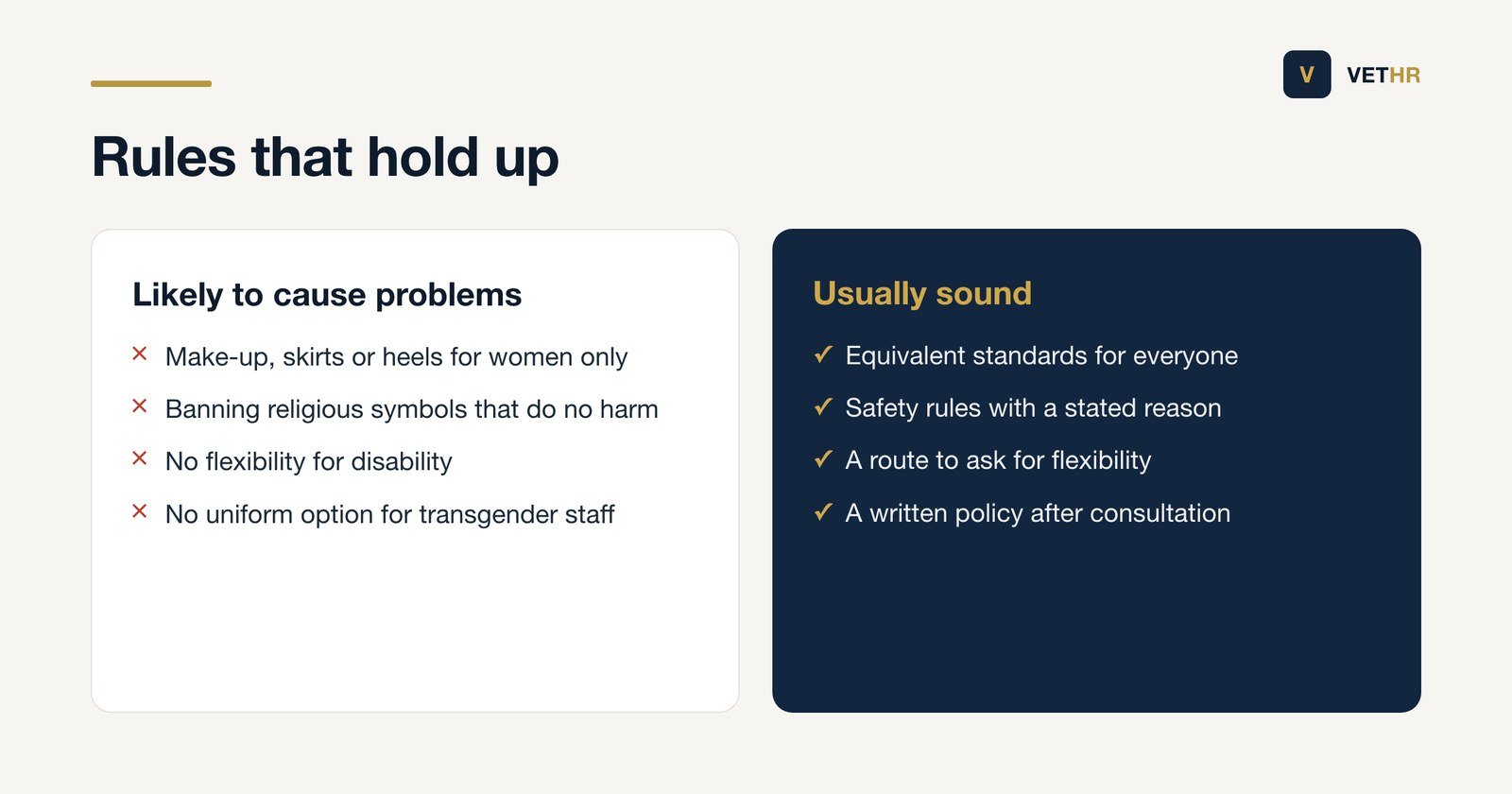
Base the safety rules in your dress code on your risk assessments, and apply them where the risk is. Jewellery, long nails, loose hair and footwear matter most around animals, surgery and wet floors. Protective clothing for radiography, cytotoxic drugs or zoonotic risks belongs in the dress code as well as in the risk assessment.
The government guidance makes a point that applies directly to veterinary work: where a dress code requires particular shoes for appearance rather than protection, the employer should consider whether they make staff more prone to slips, trips or foot injuries.
Link each clinical rule to the assessment behind it, such as your COSHH assessment or pregnancy risk assessment. A rule with a visible reason is followed far more readily than one that reads like taste. Review these rules whenever your work changes, such as a new imaging service or starting to handle cytotoxic drugs, so the policy keeps pace with the risk.
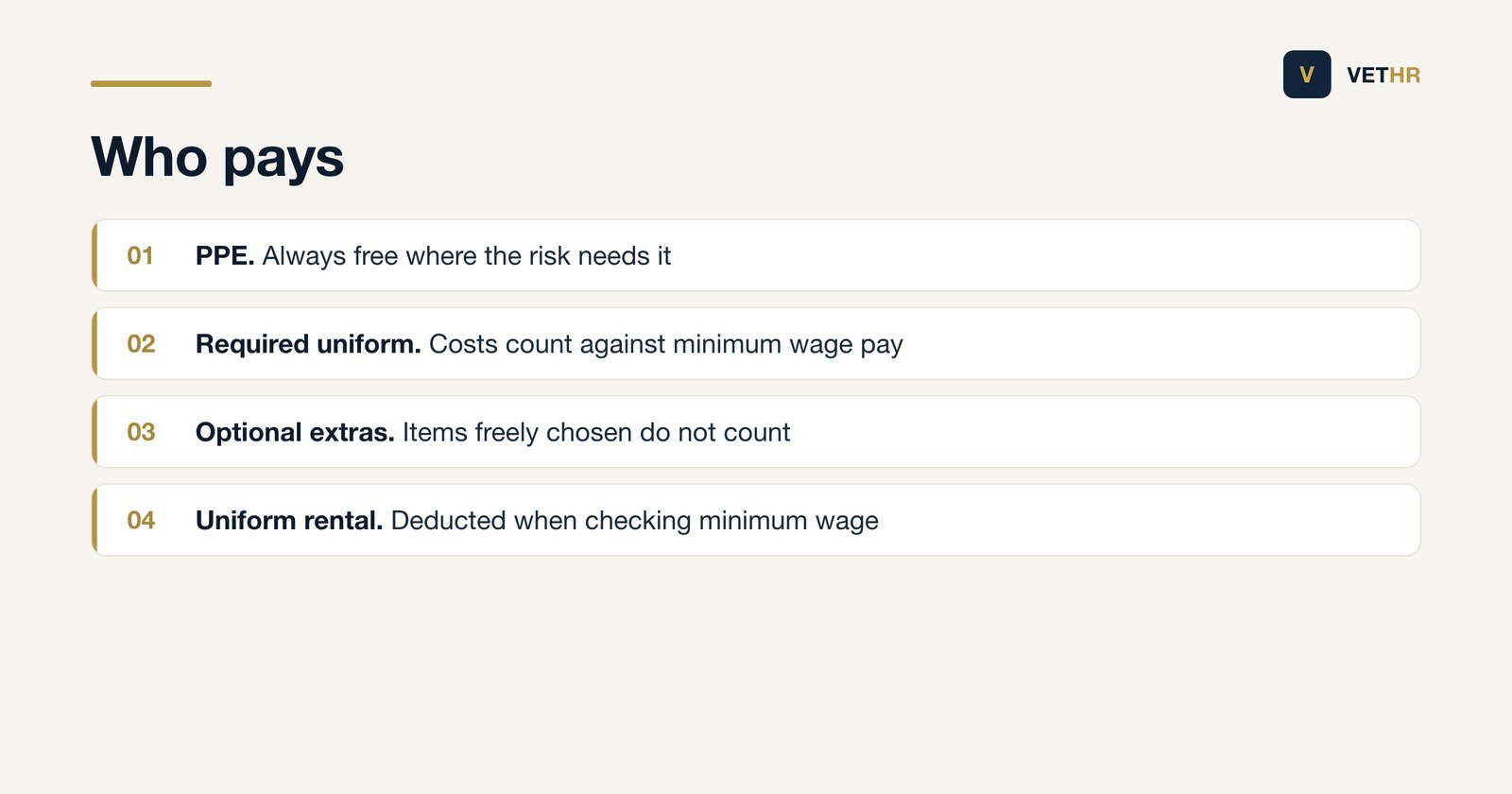
Protective equipment is always free. HSE guidance says no charge can be made to a worker for PPE used only at work. Uniforms are different: a practice can ask staff to contribute, but if a uniform is required, what staff pay for it counts against their minimum wage pay, which can quietly put lower paid staff below the legal rate.
The HSE answer on employers providing PPE explains that employers must provide suitable PPE where a risk is not adequately controlled by other means, that it must be readily available rather than just somewhere on the premises, and that section 9 of the Health and Safety at Work etc Act 1974 prevents charging for it.
On uniforms, HMRC’s minimum wage manual says that where an employer requires workers to buy specific items, those costs always reduce minimum wage pay. That includes a general requirement, such as any black trousers, because it is still imposed by the employer. Optional extra items a worker freely chooses to buy do not count.
This matters most for apprentices, receptionists and kennel staff paid at or near the minimum. GOV.UK is clear that underpaying the minimum wage is a criminal offence, arrears must be repaid immediately, and HMRC can fine and name employers. Our guide to the minimum wage shows how to check.
A practice can set appearance rules, but they need a genuine reason and should be applied consistently. Piercings are a real safety question around animals and in theatre. Visible tattoos rarely are, and a blanket ban can be hard to justify, especially where body art or jewellery has religious or cultural meaning.
The practical approach is to separate safety from preference. A rule that small studs replace hoops in clinical areas has a clear reason a nurse will accept. A rule that tattoos must be covered at reception needs a better reason than habit, and it should apply equally to everyone in that role.
Before enforcing any appearance rule, check whether a religious, cultural or disability reason applies to the individual, and talk about it informally first. If an issue does escalate, handle it through your usual disciplinary procedures, proportionately.
Want a dress code that is clear, fair and easy to enforce? A free 30-minute HR health check is the quickest place to start. Book your HR health check.
Treat it as a conversation about the aim of the rule. Most requests can be met by finding another way to achieve the same safety or hygiene purpose, and the practice only needs to hold firm where there is no workable alternative. Record what was asked, what was agreed and why.
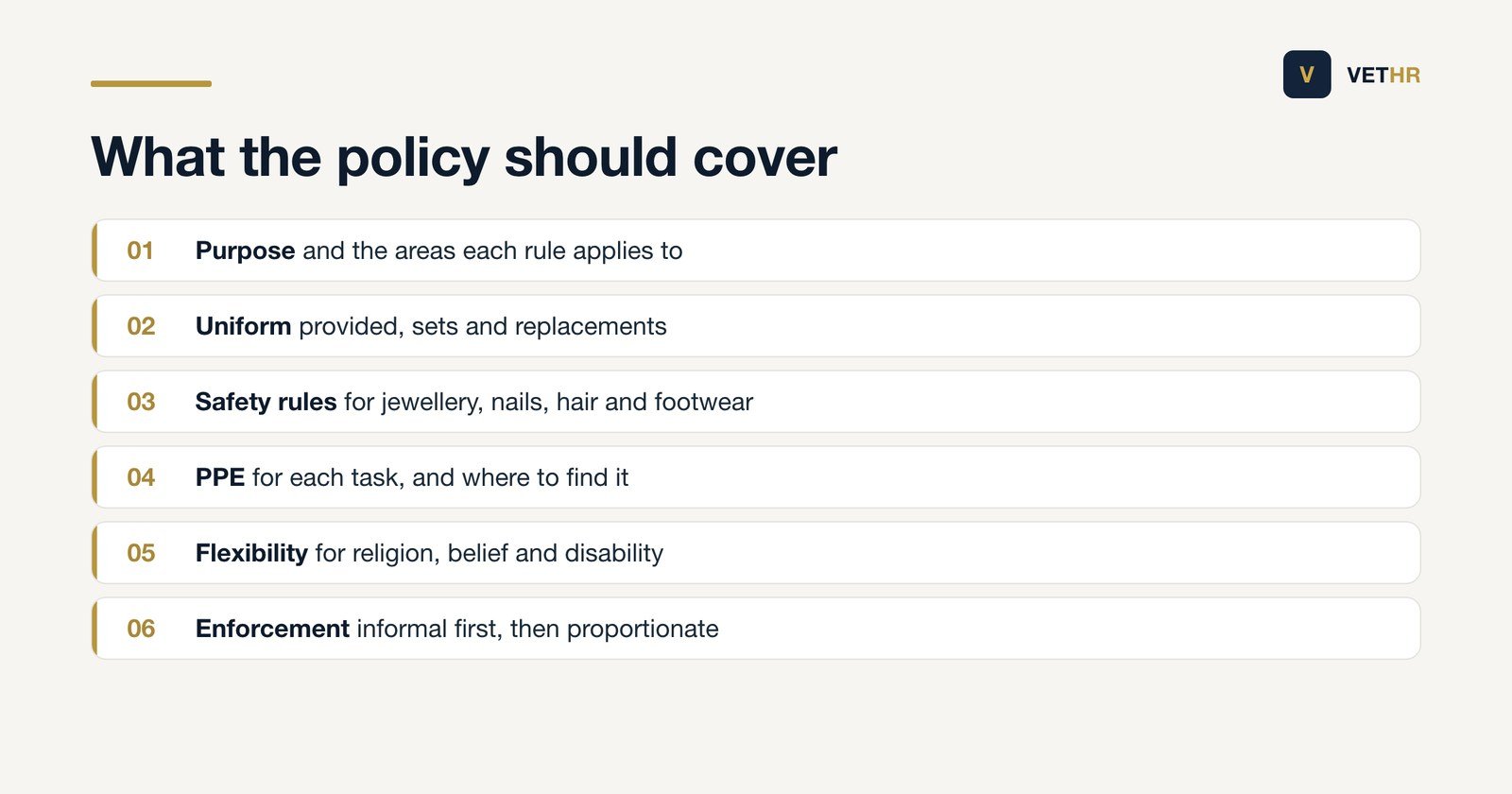
A good dress code is short, explains its reasons and says how people can ask for flexibility. It should cover the areas it applies to, the uniform the practice provides, the safety rules and PPE, religious and disability considerations, and how the practice will deal with problems.
Consult the team before you publish it. People who work in scrubs all day often know which rules are practical and which ones nobody follows, and rules agreed with the team are far easier to uphold. Revisit the policy once a year alongside the rest of your handbook.
You can ask for a contribution, but if the uniform is required, what staff pay counts against their minimum wage pay. For anyone paid at or near the minimum, that can take them below the legal rate, so check before deducting anything.
They do not have to be identical, but they must be equivalent. Government guidance says requirements such as make-up, skirts or particular hairstyles are likely to be unlawful where there is no equivalent requirement for men.
Only with a genuine reason, such as a real safety risk in a particular area. Government guidance says employers should not prohibit religious symbols that do not interfere with the person’s work, and Acas advises keeping dress policies flexible enough to accommodate religious needs.
Yes. HSE guidance says employers must provide suitable PPE where a risk cannot be adequately controlled in other ways, and that no charge can be made to the worker for PPE used only at work.
Yes, where there is a genuine hygiene or safety reason. State the reason in the policy, apply the rule to everyone working in those areas, and allow flexibility elsewhere in the practice where the risk does not exist.
A dress code works when every rule has a reason people can see. Keep safety rules where the risk is, hold everyone to equivalent standards, provide PPE free, check uniform costs against the minimum wage, and leave room for faith and disability.
Our policy system keeps your dress code current and records who has read it, and a free HR health check will flag anything in your current rules that could cause a problem.
The Vet HR Team provides HR consultancy and white-labelled staff systems exclusively to UK veterinary practices. This guide is general information, not legal advice.
Contracts, rotas, holiday, a difficult conversation. Tell us what you are dealing with and we will come back within one working day. Nothing to sign up to.
Got it. We will come back to you within one working day. If you do not see a reply, please check your spam folder.
