TL;DR: Section 60 of the Equality Act 2010 makes it generally unlawful to ask health or disability questions before you make a job offer, whether in a form, at interview or to a referee. There are narrow exceptions, including finding out whether an applicant can take part in an assessment or needs adjustments for it, whether they can carry out an intrinsic part of the job, monitoring and positive action. After a conditional offer you may ask health questions, but you cannot withdraw the offer because of disability. The Equality and Human Rights Commission guidance in this article was last revised in June 2014.
Last updated: 22 October 2026
A practice is recruiting a vet nurse. The application form it has used for years has a box that says Any health problems we should know about? and a field for days off sick in the last two years. The practice manager phones a referee and asks how often the candidate was off. Both questions feel sensible. Both are the kind the law was written to stop.
This guide explains what section 60 of the Equality Act 2010 says about health questions before a job offer, the exceptions that let you ask about the demands of the job, what to do at interview and with referees, what you can do once an offer is made and how to avoid a discrimination claim. It is based on the Equality and Human Rights Commission guidance for employers, which was last revised in June 2014, and is general information, not legal advice. Check the Commission’s current guidance before you rely on it.
The Commission says section 60 makes it generally unlawful to ask questions about disability and health before you make a job offer. It prohibits enquiries by or on behalf of an employer about an applicant’s disability and health up to the point a job offer is made, written or verbal, to applicants and to third parties such as a current or ex-employer.
The Commission’s guidance for employers says the purpose of section 60 is to prevent disability or health information being used to sift out job applicants without first giving them the opportunity to show they have the skills to do the job. It does not stop employers choosing the best candidate. Instead it ensures recruitment decisions are objectively based on each candidate’s true abilities.
It applies to any recruitment process in England, Scotland or Wales involving internal or external applicants, and to selecting a pool of candidates who may be offered work in the future. It covers employers, employment agencies and authorised agents, so a recruitment agency acting for the practice is bound by it too. The Commission suggests instructing agencies not to ask health or disability questions unless an exception applies.
The Commission is responsible for regulating compliance and can take legal enforcement action where proportionate. It adds that an applicant cannot bring a claim just because they were asked a prohibited question, but if an employer asks one and then does not offer the applicant the job, the employer could be liable for unlawful disability discrimination where the applicant was not selected because they are disabled or because the employer thought they were.
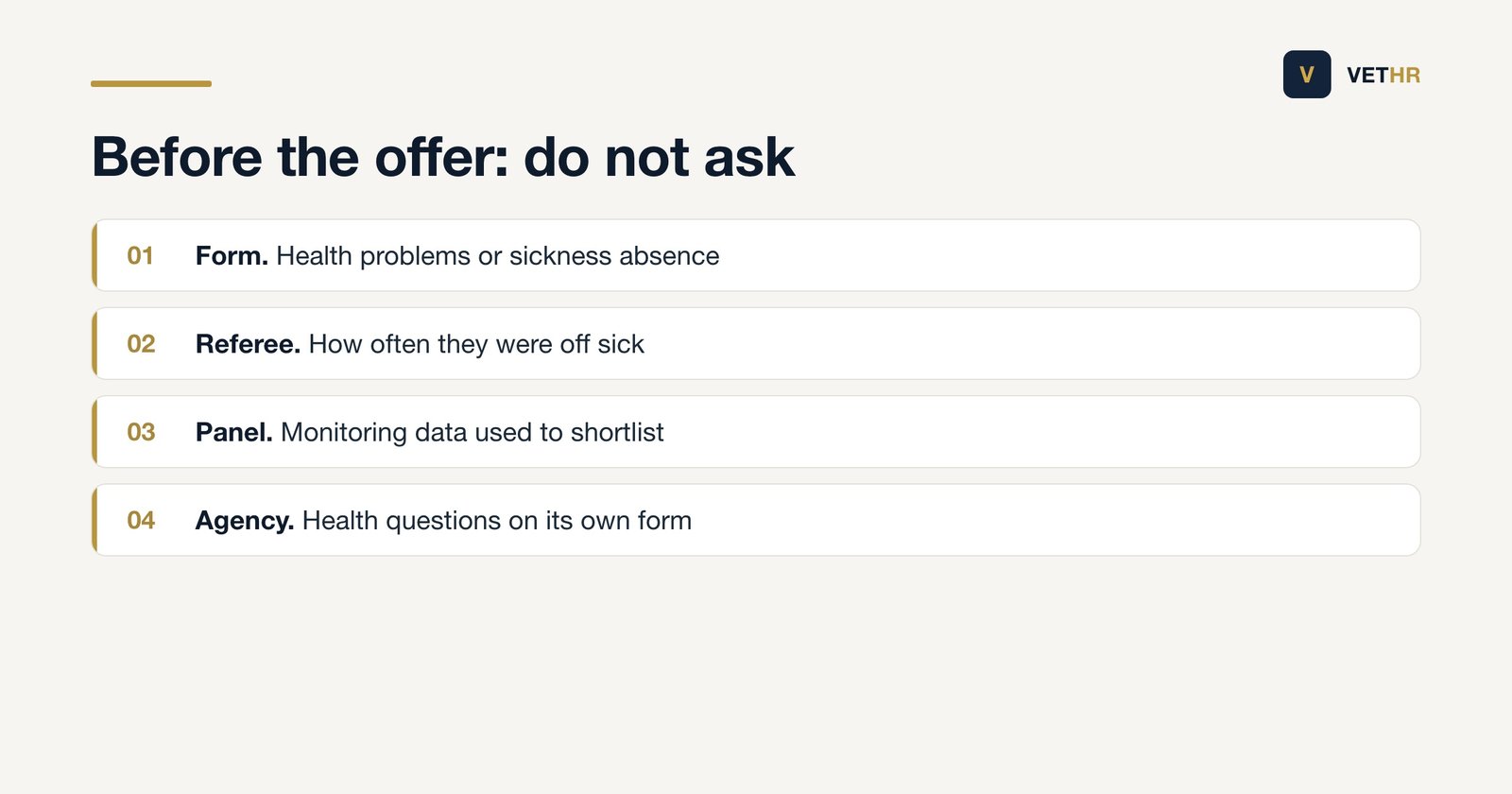
A health question is any enquiry about health or disability, including sickness absence figures, medical history, current conditions, medication or treatment. The Commission’s own example is an application form with a section asking applicants about any health issues and the number of days off because of ill health in the last two years, which it says is in breach.
Sickness absence questions are the commonest slip. The Commission’s checklist says to remove general questions to applicants and third parties that relate to health and disability, such as sickness absence, from recruitment materials, and not to ask for sickness absence information when seeking references before an offer.
Another example involves an agency that shortlisted partly on referee information about sickness absence, which the Commission says is a breach because the agency acted for the employer. A practice that uses a recruiter or an online job board form should check what the form asks and instruct the recruiter in writing.
Monitoring is a special case. The Commission says it is a breach of section 60 to ask for health and disability information in order to shortlist. If information is legitimately sought for monitoring, it should be kept separate from the application form and not seen by the interview panel. A small employer who cannot separate it, because one person handles the whole process, is compliant provided that person disregards it for shortlisting and selection.
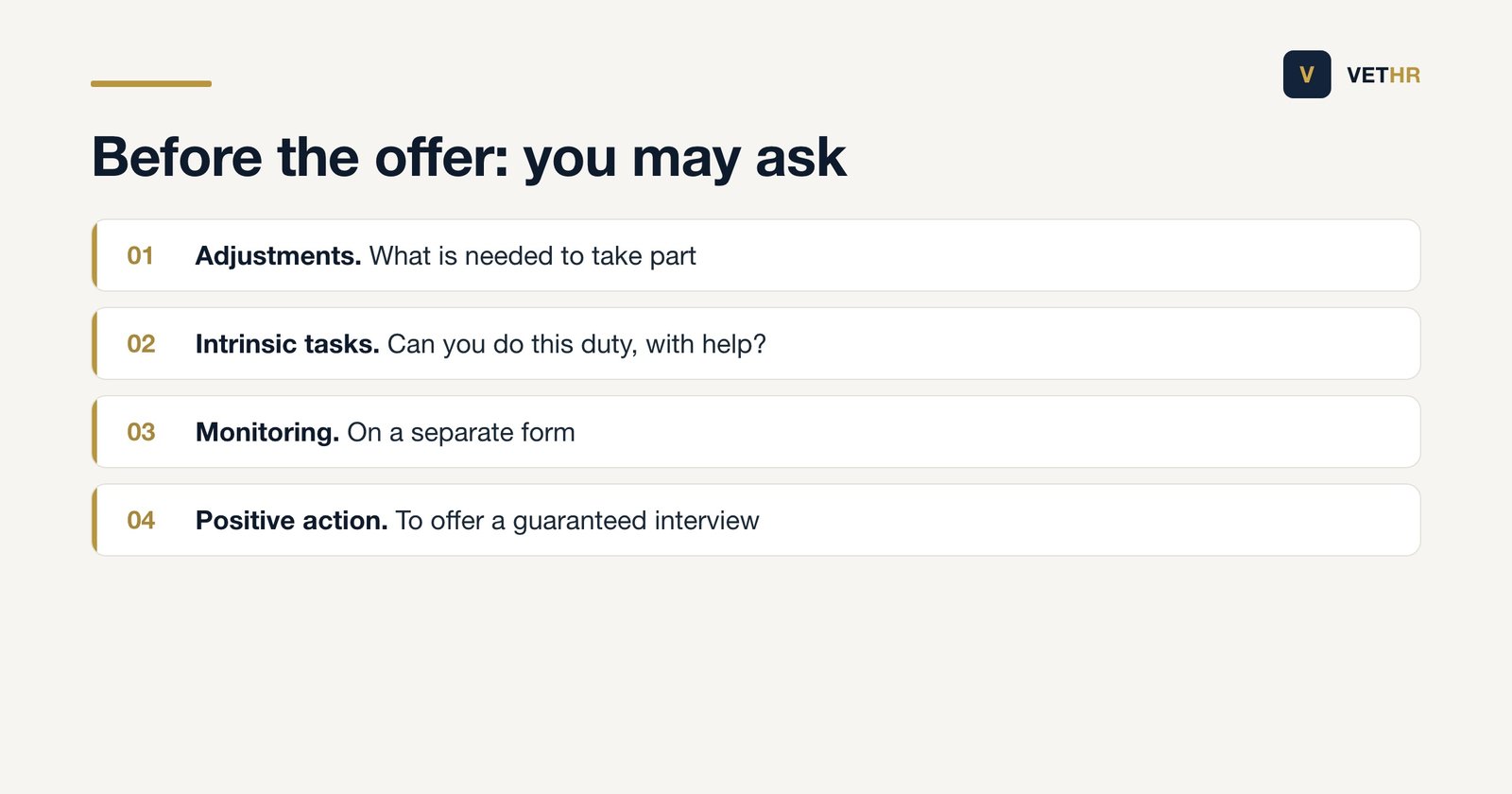
Section 60 allows health questions only within narrow exceptions. The most useful for a practice are asking whether an applicant can take part in an assessment or needs adjustments for it, and asking whether they can carry out an intrinsic part of the job. Both should be put in terms of the job, not the person’s health.
The Commission lists seven exceptions: to find out whether an applicant can take part in an assessment to test their ability to do the job, or whether reasonable adjustments are needed for it, with that information collected separately from the application; to find out whether an applicant will be able to carry out an intrinsic part of the job; to find out whether an applicant has a particular disability where it is an occupational requirement; to monitor the diversity of applicants; to take positive action for disabled people; where another legal requirement means you must ask; and to vet applicants for national security.
The intrinsic function exception matters most for a practice. The Commission’s example is a construction company asking scaffolders whether they have a condition that affects their ability to climb ladders, which is lawful because climbing is an intrinsic function of the job. If the part of the job can be changed or given to someone else, that may count as a reasonable adjustment for a disabled applicant.
In a veterinary practice, the physical demands that may be intrinsic are things like lifting and restraining animals, standing for long periods, working with radiography equipment or assisting in theatre. Define them in the job description and then ask in neutral terms, for example: This role involves lifting animals of up to a stated weight and standing for long periods. Is there anything we should consider to help you do this? Our guide to job descriptions shows how to set out the essential duties, and the guide to reasonable adjustments explains what to do with the answer.
Avoid broad questions such as Do you have any medical conditions that would affect your work? Ask about the task, not the condition. The Commission says the duty to make reasonable adjustments applies to the recruitment process too, so you can and should ask at the right stage what adjustments candidates need for the form, the interview or any test.
The Commission’s checklist says to ask about reasonable adjustments to the recruitment process at an appropriate stage, such as in the job advert in relation to adjustments for completing forms or CVs, or after shortlisting in relation to adjustments for tests, interviews or assessments. Collect the answers separately from the application.
A good job advert includes a line such as: If you need any adjustments to apply or to attend an interview, please tell us. After shortlisting, a short email can ask whether the candidate needs anything to take part in the interview or a practical test.
Section 60 does not affect your duty to make reasonable adjustments for disabled applicants where that duty applies. The Commission says a failure to make reasonable adjustments for a disabled applicant during recruitment is unlawful disability discrimination that cannot be justified. Our guide to interview questions covers what to ask at interview and how to score it.
If a candidate volunteers information about a disability at interview, the Commission says you can ask follow-up questions where the task is an intrinsic part of the job, to find out whether adjustments could be made and whether the person could do the task with them. It is good practice to explain why you are asking. If the information is not relevant to the job, ignore it for decision-making.
Do not ask referees about sickness absence or health before you make an offer. Section 60 applies to questions put to third parties as well as to applicants, and the Commission’s checklist specifically says not to ask for sickness absence information when seeking references in advance of an offer.
Ask for factual references about role, dates, duties and conduct, and about reliability in terms of conduct and performance, not attendance figures. If you want a full reference, make the offer conditional on satisfactory references, and ask then. Our guide to employment references explains the conditional offer route.
If a referee volunteers health information, do not use it to decide whether to make the offer. Make a note that you disregarded it. A short file note is useful evidence if a rejected applicant later alleges that health played a part.
After an offer, which can be conditional or unconditional, you can ask health questions without breaching section 60. The Commission notes an employer can make an offer conditional on medical checks. But if the offer is withdrawn simply because the person is disabled, or the employer thinks they are, the applicant can claim disability discrimination.
The Commission’s example is an employer that sends successful candidates to its occupational health practitioner, who asks a health questionnaire including questions about mental health that were not needed to assess ability to do the job. One applicant disclosed a long-standing, well-controlled condition and the employer withdrew the offer. The Commission says the questions can be asked after the offer, but the withdrawal can found a claim. It adds that a referral to occupational health can be a positive step, because it should open a conversation about reasonable adjustments.
The Commission’s checklist says to refer candidates to occupational health only after an offer is made, and to give practitioners instructions that discourage adverse assumptions about disability and enable proper consideration of reasonable adjustments. Our guide to occupational health covers what to ask for.
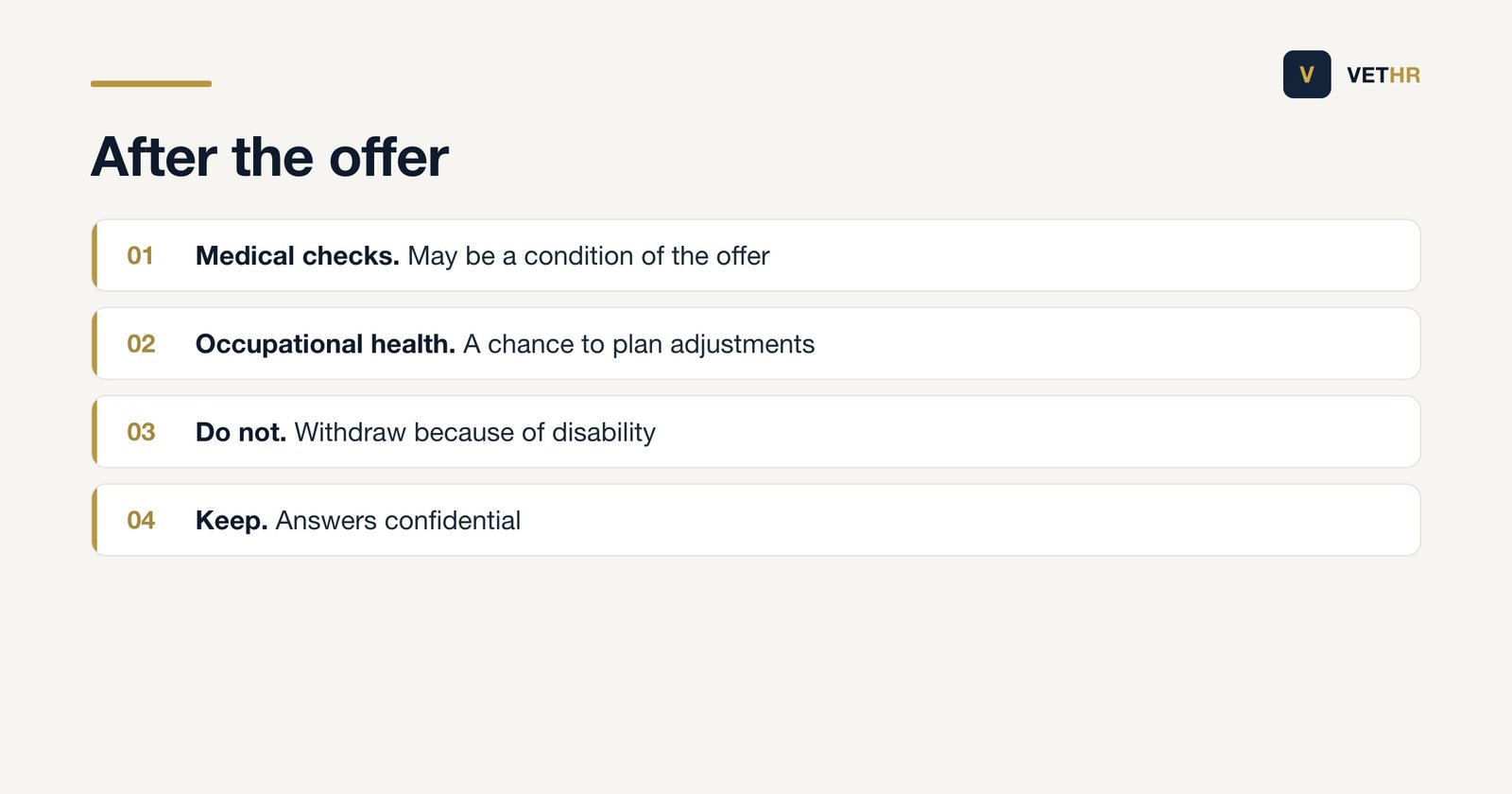
Keep the post-offer questionnaire to what you need: the ability to do the job with adjustments, any adjustments required and any health and safety information needed to protect the person. Do not ask for a full medical history. Treat the answers as confidential and tell the candidate who will see them.
Review the application form, job advert, interview questions, referee request and any recruiter instructions. Remove health and sickness questions, add an adjustments line, move monitoring to a separate form, brief the panel and instruct agencies. The Commission’s checklist gives the structure.
A practical review list:
Our guide to hiring a practice manager and the job advert guide show how to apply the same structure to recruitment more widely.
The usual mistakes are keeping an old application form, asking about sickness absence, asking referees about attendance, letting monitoring forms reach the panel, relying on a recruiter’s own form and withdrawing an offer after a medical check without taking advice.
Generally not before a job offer. The Commission says section 60 makes it generally unlawful, with narrow exceptions such as assessment adjustments and intrinsic parts of the job.
Not before an offer. The Commission’s checklist says not to ask for sickness absence information when seeking references in advance of an offer, and its example of a form asking for days off sick is a breach.
You can ask whether an applicant can carry out an intrinsic part of the job. Put it in terms of the task and ask whether there is anything you should consider to help them do it, not about their health.
Yes. The Commission says you can make an offer conditional on medical checks and ask health-related questions without breaching section 60. You must not withdraw the offer because the person is disabled.
Not just for being asked. The Commission says a claim arises if you ask a prohibited question and then do not offer the job because the person is, or is thought to be, disabled.
If you want a recruitment pack that complies with section 60, with an application form, an adjustments line, an interview scorecard and a post-offer health check set out, book a free 30-minute HR health check through our contact page. See also our HR consultancy for veterinary practices and the policies and handbook system.
Contracts, rotas, holiday, a difficult conversation. Tell us what you are dealing with and we will come back within one working day. Nothing to sign up to.
Got it. We will come back to you within one working day. If you do not see a reply, please check your spam folder.
