Last updated: 5 September 2026
TL;DR: Most practice manager hires fail on authority rather than on capability. Decide what the role genuinely owns before you write the advert, build the job description and person specification first, score candidates against them with two or more interviewers, and agree in advance which decisions stop coming to the owners.

The most common way this hire fails is not a bad appointment. It is a good appointment given a title and no authority, who spends eighteen months asking permission for decisions they were hired to make, and then leaves for a practice that lets them manage.
A practice manager is needed when the administrative load is being absorbed by clinical people at clinical cost. The trigger is rarely headcount alone; it is the point at which a partner is doing rotas at 9pm and the practice is losing consulting time to admin.
Do the arithmetic before deciding. A partner spending eight hours a week on admin is spending it at the value of the consulting they are not doing, and that comparison usually settles the question quickly.
The role also picks up duties that carry legal weight, including health and safety. HSE is clear that employers have a legal duty to protect employees from stress at work by doing a risk assessment and acting on it, and in most practices that duty ends up sitting with this role.
Consider the alternative honestly too. Some practices need better systems rather than another salary, and a rota that publishes itself removes a real slice of the workload, as our guide to HR software for veterinary practices covers.
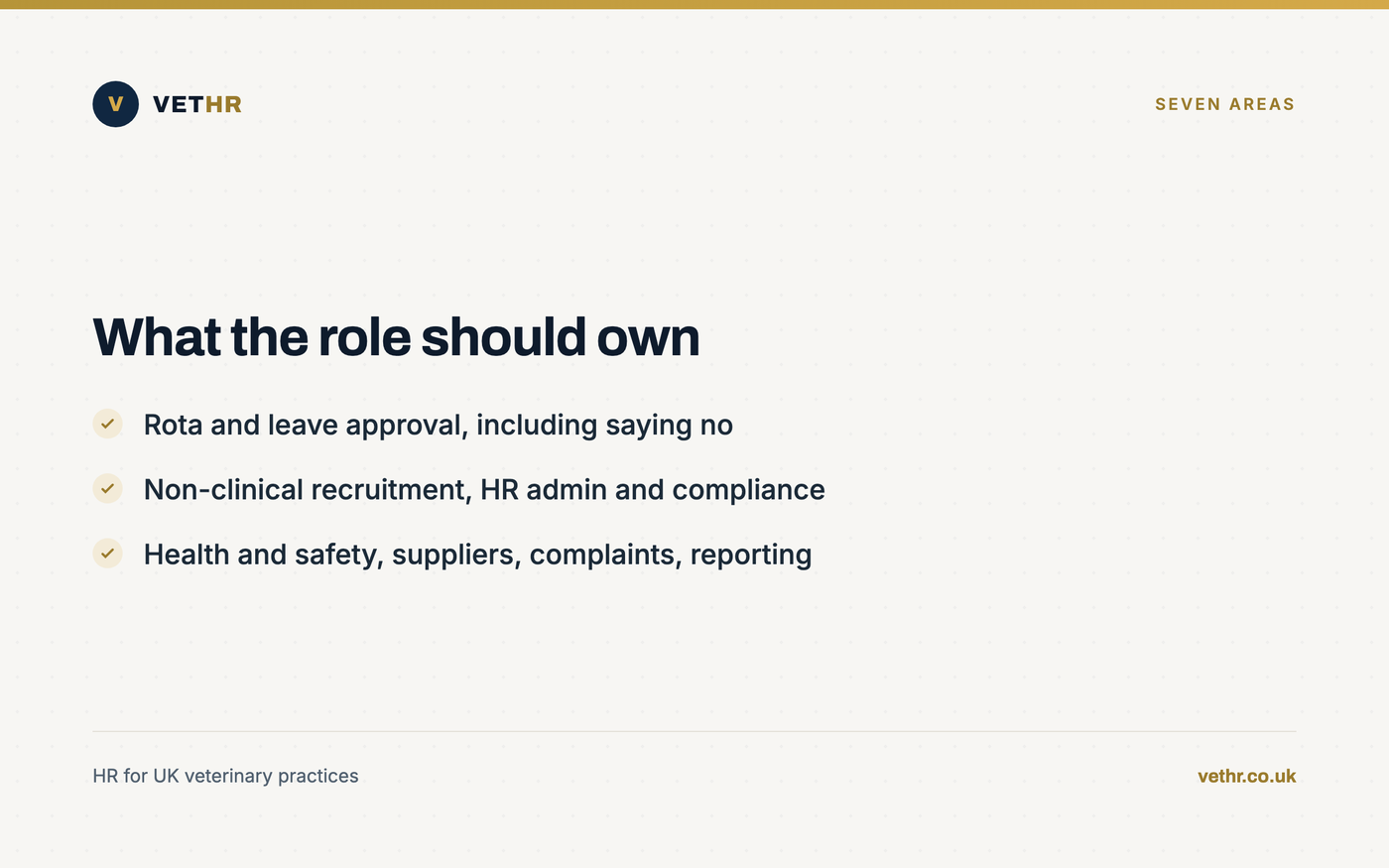
Whatever you are genuinely willing to stop deciding. This is the conversation to have between owners before the advert goes anywhere near a job board.
Number one is the test of whether you mean it. A manager who cannot decline a leave request from a senior vet does not own the rota, and everyone in the building works that out within a month.
Write the boundaries down, including spend limits and which decisions still come to the partners. Ambiguity here is what produces the undermining our guide to bullying at work describes as upward bullying.
A practice manager who can hold a boundary with a clinician and read a profit and loss statement. The clinical knowledge is learnable; the first of those two is not, and it is the one that determines whether the appointment works.
Practices often promote an experienced RVN into the role, which can work well and carries a specific risk. Managing former peers, and losing clinical identity in the process, needs support and an explicit conversation rather than a title change.
Be careful with experience requirements in the advert. Acas warns that terms such as “highly experienced” can discriminate on age and that employers must be able to justify any requirement, as our guide to the job description covers.
Structured, scored and with more than one interviewer. Acas describes turning the job description and person specification into a checklist, scoring applications against it, and involving two or more people to reduce personal bias and unintended discrimination.
Step four separates candidates faster than any conversation. Give them next month’s actual rota problem and see whether they solve it or describe solving it, as our guide to interview questions sets out.
Be explicit in the advert about what the practice manager will decide alone. Acas advises giving applicants a job description and person specification, and that guidance on advertising a job also warns that you must be able to prove a good reason for any requirement you set.
Involve the team in meeting candidates, not in deciding. Their reaction tells you a great deal, and handing them the decision creates a mandate problem on day one.
Against the practice manager scope you have written, not against the last person who did some of it. A role owning HR, health and safety, recruitment, suppliers and two sites is a different job from one keeping the rota tidy.
Check the internal relativities before you advertise. A practice manager earning less than the nurses they manage creates a problem that no amount of goodwill survives, and it becomes visible quickly in a small team.
Decide on any bonus arrangement carefully. Tying a manager’s pay to a metric they do not control produces exactly the behaviour you did not want, as our guide to bonus schemes explains.
Then hold an annual review like everyone else. Managers are routinely forgotten in review cycles because they run them, as our guide to the salary review notes.
Thinking about your first management hire? A free 30-minute HR health check will help you scope it. Book your HR health check.
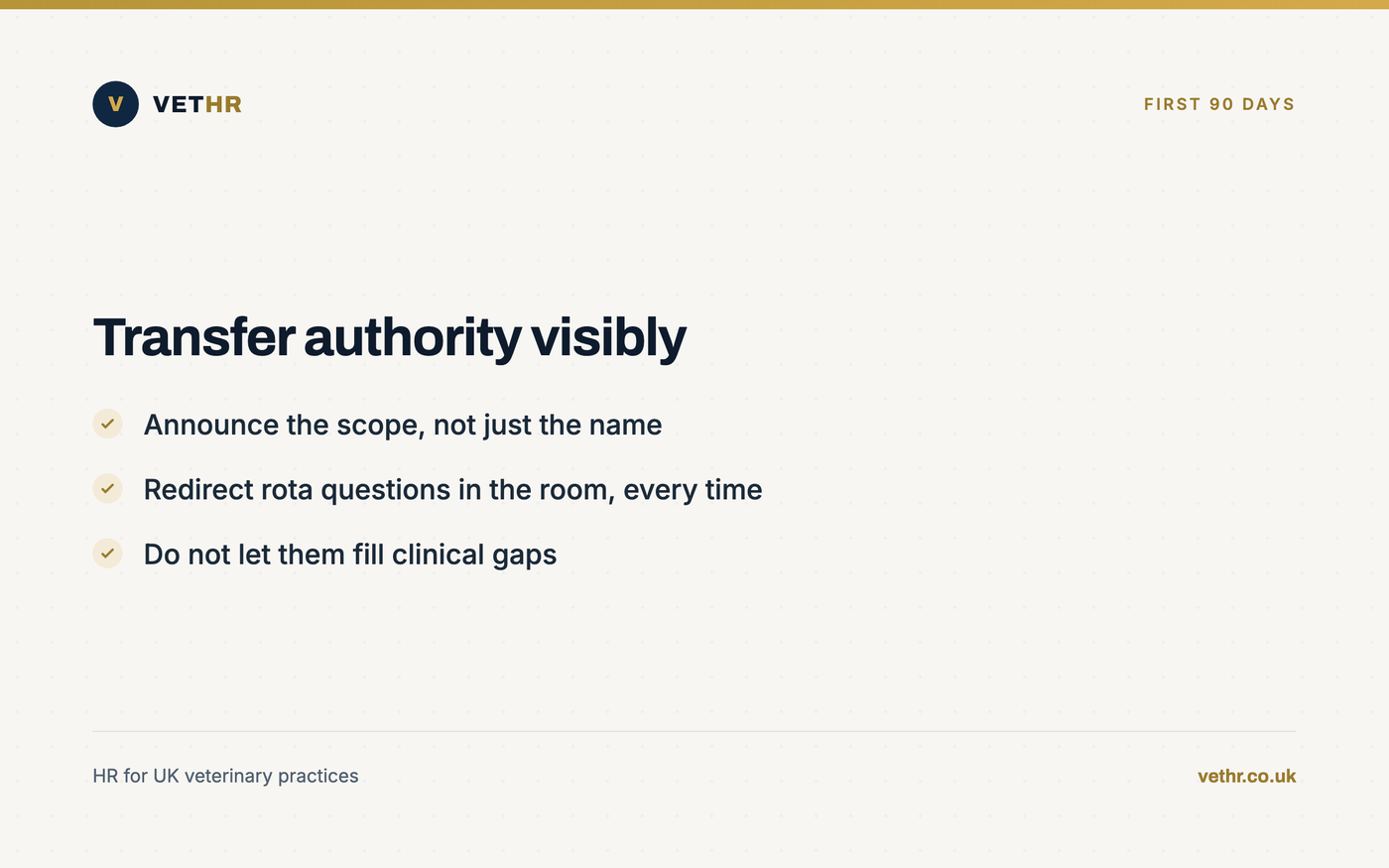
Visible transfer of authority to the practice manager, in front of the team. The single strongest predictor of whether this appointment works is whether the owners publicly stop making the decisions they said they were handing over.
Give the practice manager a budget for their own development from the start. Management is a distinct skill set, and a practice that funds CPD generously for clinicians while offering nothing to the person managing them sends a clear message about where the role sits.
Step two is the whole game. Every redirected question teaches the team where authority actually sits, and every question a partner answers instead teaches them the opposite.
Not necessarily. A clinical background helps with credibility and understanding the work, but the core requirements are people management, financial literacy and comfort with difficult conversations. Only insist on a clinical qualification where the role genuinely includes clinical duties, because requirements must be justifiable.
Often yes, and it needs deliberate support. Managing former peers is genuinely difficult, and so is giving up clinical identity. Be explicit about the change, provide management training, and be clear about how much clinical work, if any, stays in the role.
There is no headcount threshold. The trigger is usually when a partner is spending a day a week or more on non-clinical work, or when a second site opens. Compare the salary against the consulting time being lost, which is the honest way to make the decision.
One named person, not the partnership collectively. Reporting to four owners means four sets of priorities and no way to resolve conflicts between them, which is one of the fastest routes to a resignation in this role.
Authority that was promised and never transferred. A manager who cannot decline a leave request, sign off a spend or make a rota decision without checking has a title rather than a role, and capable people do not stay in that position for long.
A practice manager is one of the highest leverage hires an independent practice makes, and one of the most frequently mishandled. The failure is almost never the person; it is a scope nobody defined and an authority nobody actually released.
Write down what the role owns before advertising, recruit with a scored process and a practical exercise, pay against the real scope and redirect questions visibly for ninety days. Our HR consultancy and contract service handle the scoping and the paperwork, and the free HR health check is where to start.
The Vet HR Team provides HR consultancy and white-labelled staff systems exclusively to UK veterinary practices. Recruitment decisions carry discrimination risk; take advice where a requirement is contested.
Read next: VetGDP: What Your Practice Must Have in Place Before Hiring a New Graduate.
Contracts, rotas, holiday, a difficult conversation. Tell us what you are dealing with and we will come back within one working day. Nothing to sign up to.
Got it. We will come back to you within one working day. If you do not see a reply, please check your spam folder.
