Last updated: 5 September 2026
TL;DR: Acas expects employers to prepare a set of questions that do not discriminate, to ask each applicant the same questions where possible, and to ask candidates what reasonable adjustments they need for the interview itself. Score answers against the job description and person specification, with two or more people involved.
Most veterinary interviews are two people having a nice conversation about a shared profession, followed by a decision made on instinct. That works until the candidate turns out to be wrong for the role, or until a rejected applicant asks how the decision was reached and nobody wrote anything down.
By writing the interview questions before you meet anyone. Acas advises employers to prepare a set of questions to ask at the interview, and that questions must not discriminate.
Acas also advises asking each applicant the same questions where possible, and involving more than one interviewer, with everyone understanding discrimination law before the day.
Build the interview questions from the job description and person specification rather than from what you feel like asking. If a question does not test something on that list, it is conversation rather than assessment, as our guide to the job description sets out.
Decide the scoring before the first candidate arrives too. Criteria invented after you have met three people describe the person you liked most.
Behavioural interview questions that ask for a real example rather than a hypothetical. Adapt the wording to the role, keep the structure, and ask every candidate the same set.
Number four is the most predictive in a clinical setting. A candidate who cannot describe reporting a mistake will not report one for you either, which our See It Report It system depends on.
Ask a practical question too, and watch what they do rather than what they say. A ten minute observed task, a placement of a catheter on a model or a short reception role-play, tells you things no set of interview questions can, provided every candidate gets the same task.
Number ten saves the most money. Someone who says they left their last practice over unpredictable rotas is telling you exactly what will happen if yours is published ten days out.
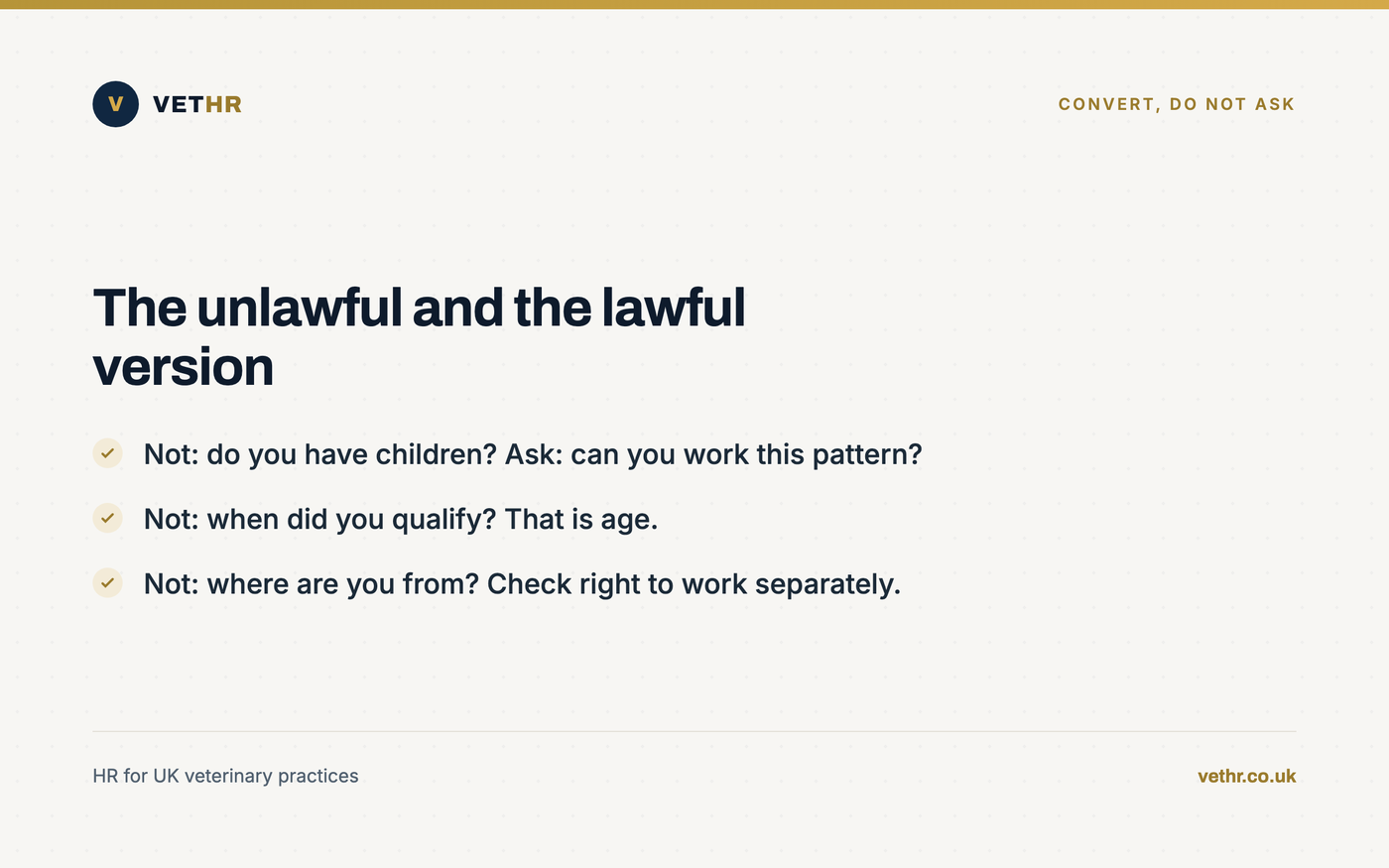
Avoid interview questions that go to a protected characteristic rather than to the job. These come up in veterinary interviews constantly, usually from genuine friendliness rather than intent.
The fix is to convert each into job-related interview questions. You are entitled to ask whether someone can work every third weekend; you are not entitled to ask why they might not be able to.
Acas covers the same ground in its guidance on using protected characteristics in recruitment, which is worth reading by anyone on your interview panel before the day.
Handle right to work as a documented step applied to every hire, not as an interview conversation, as our guide to right to work checks covers.
You must offer adjustments, and health related interview questions are restricted. Acas requires employers to proactively ask candidates about reasonable adjustments needed for the interview, such as accessibility, extra time for tests or a sign language interpreter.
Put that offer in the invitation email rather than asking at the door. By the time someone is sitting in front of you, the adjustment they needed to perform well has already not happened.
Health questions before a job offer are restricted under the Equality Act, with narrow exceptions. The safe route is to describe the role’s requirements accurately and ask whether the person can carry them out with any adjustments they may need.
The duty applies to applicants, not only to employees, which our guide to reasonable adjustments explains in full.
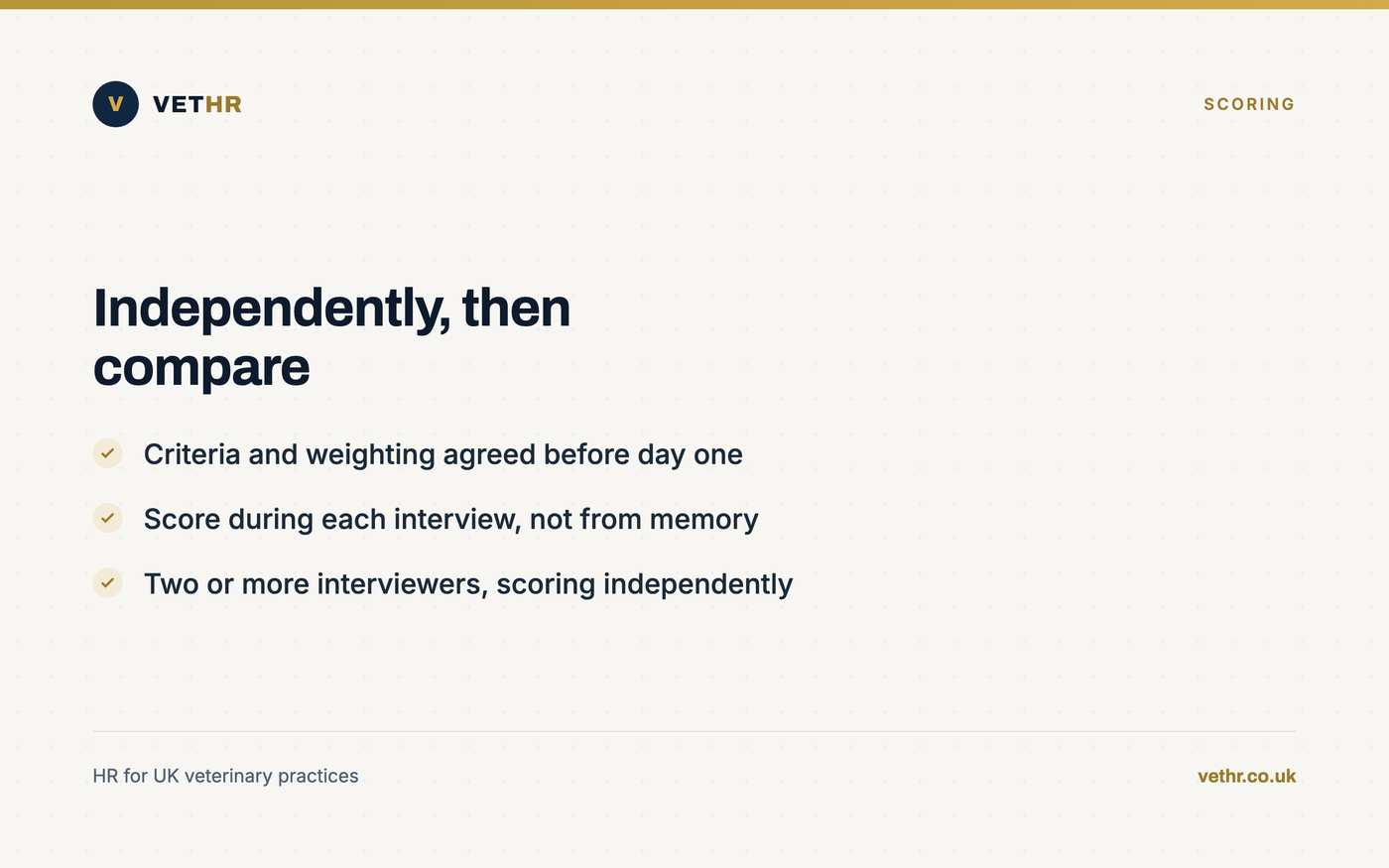
Against a written checklist, independently, before you discuss. Acas describes turning each point in the job description and person specification into a checklist, assessing applications against it and scoring them, with two or more people involved to reduce bias.
Agree in advance what a strong answer looks like for each of your interview questions. Two interviewers scoring the same reply four points apart usually means they were assessing different things, and a one line description of a good answer removes most of that gap.
Step three matters most in a small practice, where one partner’s early opinion tends to settle the room. Independent scores make disagreement visible instead of polite.
Recruiting soon and no structured process? A free 30-minute HR health check will build one with you. Book your HR health check.
The interview questions, the notes, the scores and the reason for the decision. Acas requires interview notes and recordings to be stored securely and confidentially in line with data protection rules, and recordings need the candidate’s permission in advance.
Keep them long enough to answer a challenge and no longer than you can justify. Unsuccessful candidates can make a subject access request too, and the notes will be disclosable, as our guide to the subject access request covers.
Store them somewhere central rather than in a partner’s inbox. Recruitment records scattered across personal mailboxes are the version nobody can produce when a challenge arrives eight months later.
Write notes on the assumption the candidate will read them. That single habit removes almost every problematic comment before it is written.
Acas advises asking each applicant the same questions where possible, to keep the process fair and comparable. Follow-up questions to explore an answer are fine; what causes problems is a different core set for each person, which makes scoring impossible to defend.
No. Ask instead whether the candidate can work the hours and pattern advertised, which is the job-related question you actually need answered. Asking about children or caring responsibilities risks a sex discrimination claim and tells you nothing about capability.
Health questions before a job offer are restricted under the Equality Act, with limited exceptions. Describe the requirements of the role and ask whether the person can carry them out, with any adjustments they need. You must also proactively offer adjustments for the interview itself.
At least two. Acas recommends involving two or more people in selection to reduce the risk of personal bias or unintended discrimination. In a practice that usually means a clinical lead and the practice manager, scoring independently before they compare notes.
It is good practice and it protects you, provided the feedback matches your written scores. In a regional profession where everybody knows everybody, how you treat rejected applicants directly affects who applies next time.
A structured interview is not corporate box-ticking, it is how a small practice avoids hiring the person who interviews well and works badly. The same set of interview questions, scored independently, tells you far more than a pleasant conversation about mutual acquaintances.
Write the questions from the job description, offer adjustments in the invitation, score independently and keep the notes. Our HR consultancy and contract service cover recruitment through to offer, and the free HR health check is where to start.
The Vet HR Team provides HR consultancy and white-labelled staff systems exclusively to UK veterinary practices. Discrimination questions are legal matters; take advice where a decision is challenged.
Contracts, rotas, holiday, a difficult conversation. Tell us what you are dealing with and we will come back within one working day. Nothing to sign up to.
Got it. We will come back to you within one working day. If you do not see a reply, please check your spam folder.
