Last updated: 23 June 2026
TL;DR: HR software for veterinary practices is the system that holds your rota, hours, holiday, staff records and incident logs in one place, so people admin stops living in spreadsheets and inboxes. The honest truth is that not every practice needs it yet. You need it when manual methods start costing you accuracy, compliance or time you do not have. This guide covers what the software does, when it earns its place, the features that matter, what it costs and how to choose without buying for the sake of it.
People admin is the quiet tax on a busy practice. It rarely feels urgent until the month a holiday clash, a missed clock-in or a lost policy becomes a real problem. This is a calm, vendor-neutral look at when a system helps and how to choose the right fit rather than the loudest sales pitch.
HR software for veterinary practices is a single system that manages the people side of the clinic: rotas, working hours, holiday, staff records, policies and incident logs, all in one place instead of across paper, spreadsheets and email. The good ones are built around how a practice actually runs, with out-of-hours cover, registered nurses and freelance vet cover treated as normal, not edge cases.
The word software can mislead, because there are two things on the market. One is a tool you log into and run yourself. The other is HR support, where a specialist handles contracts, advice and tricky cases for you. Many practices want a bit of both, which is why the better offers pair systems with human guidance rather than selling one or the other. The fit matters because a practice rota is not a flat office week: it has consults running late, out-of-hours cover, branch sites and registrations to keep current.
Practices are looking at HR systems because the people problem has got harder, and getting it wrong costs more than it used to. Retention is the headline. Keeping good staff now depends on fair rotas, clear records and a workplace that feels managed, and a manual approach struggles to deliver that consistently across a growing team.
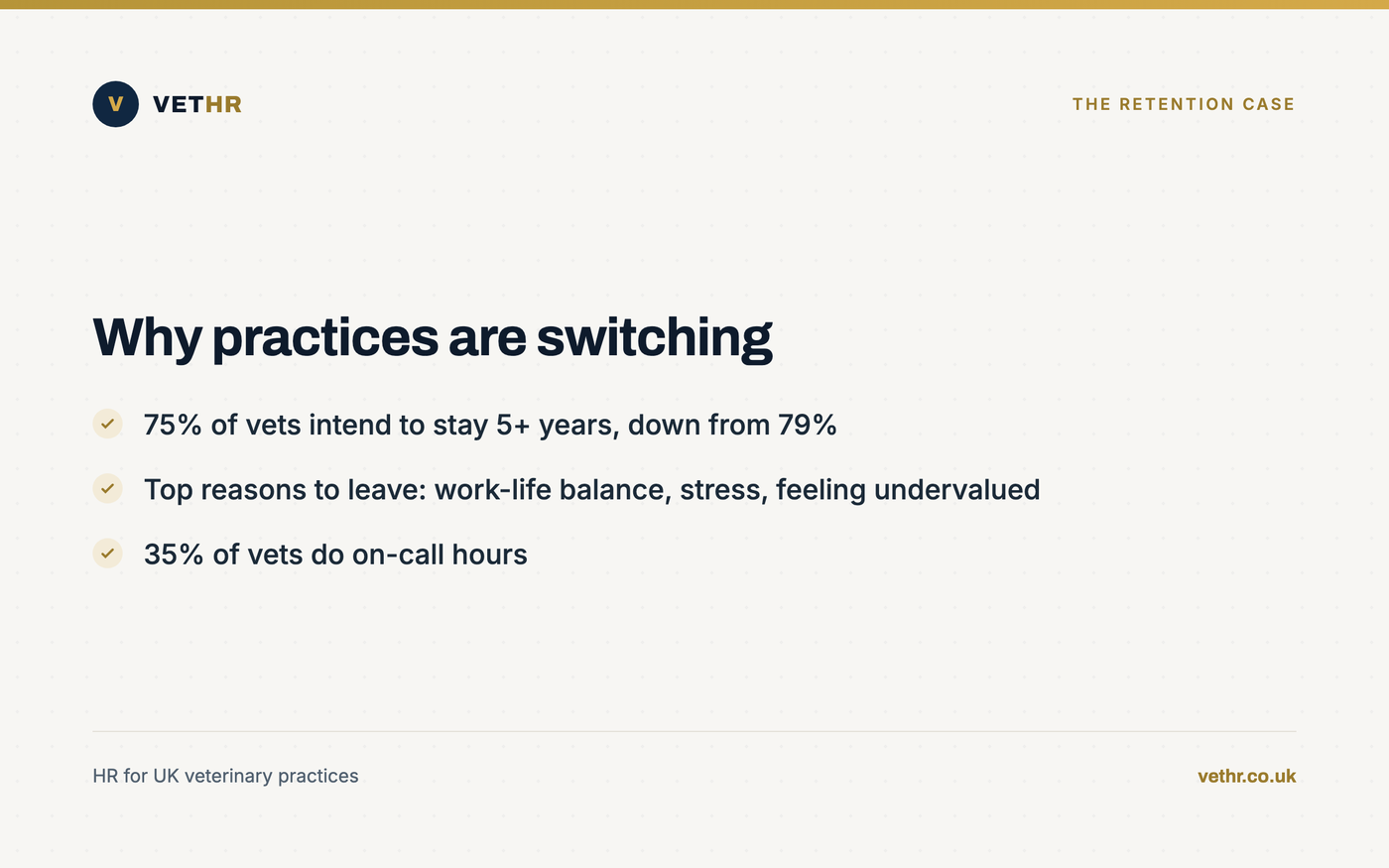
The numbers tell the story plainly. In the RCVS Surveys of the Professions 2024, a smaller share of vets intended to stay in the profession for five or more years, 75 percent, down from 79 percent in 2019, according to the RCVS. A few points may sound small, but across a sector under recruitment pressure it is a meaningful drift toward the door.
Why people leave matters even more than how many. The same RCVS research lists the leading reasons as poor work-life balance at 56 percent, chronic stress at 54 percent, and not feeling rewarded or valued in a non-financial sense at 47 percent. Every one of those is shaped, for better or worse, by how a practice plans hours, shares cover and runs its day to day.
Out-of-hours work sits right in the middle of it. The RCVS found that 35 percent of vets and 16 percent of veterinary nurses did on-call hours. On-call is exactly where rotas turn unfair and records turn vague, so it is no surprise that practices reaching for a system are usually trying to fix the parts of the week that burn people out fastest.
A vet practice needs HR software when manual methods start costing you accuracy, compliance or time, not simply when the team passes a certain size. A calm five-person practice with clean payroll may be fine on a spreadsheet for years. The trigger is friction, the month-end scramble and the dropped detail, not fashion. Below are the honest signs you have outgrown the manual approach.
If two or more of those feel familiar, the manual approach is already charging you, in hours and risk rather than a subscription line. A system turns those recurring scrambles into something that runs quietly in the background, so the practice manager gets their week back and the answer to “can you show me” is a confident yes rather than a wince.
Good HR software for a veterinary practice should cover seven things: rotas, time and attendance, holiday, staff records, policies and contracts, incident reporting, and secure data. The test for each is the same. Does it reflect how a clinic actually works, and does it save more time than it costs to run? Anything that fails both is a feature you are paying to ignore.
Two of those carry hard legal duties worth naming. Acas states that working time records must be kept for two years from the date they were made, and confirms the 48-hour weekly maximum that staff can only exceed with a written opt-out, in its guidance on the working time rules. Software that timestamps and stores those records turns a compliance chore into a non-event.
Pay records go further. GOV.UK guidance on enforcing the minimum wage states that, from 1 April 2021, employers must keep records for a minimum of six years and be able to produce them for a worker in a single document on request. Holiday is the other trap, since rules for irregular-hours and part-year workers changed for leave years from 1 April 2024, as set out on the GOV.UK holiday entitlement guidance. A system should handle both without you doing the maths by hand.
Not sure which of these your practice is missing? A 30-minute conversation usually makes it obvious. Book a free HR health check and we will look at how you run rotas, hours, holiday and records today, then tell you honestly where a system would help and where you are already fine. No jargon, nothing sold for the sake of it.
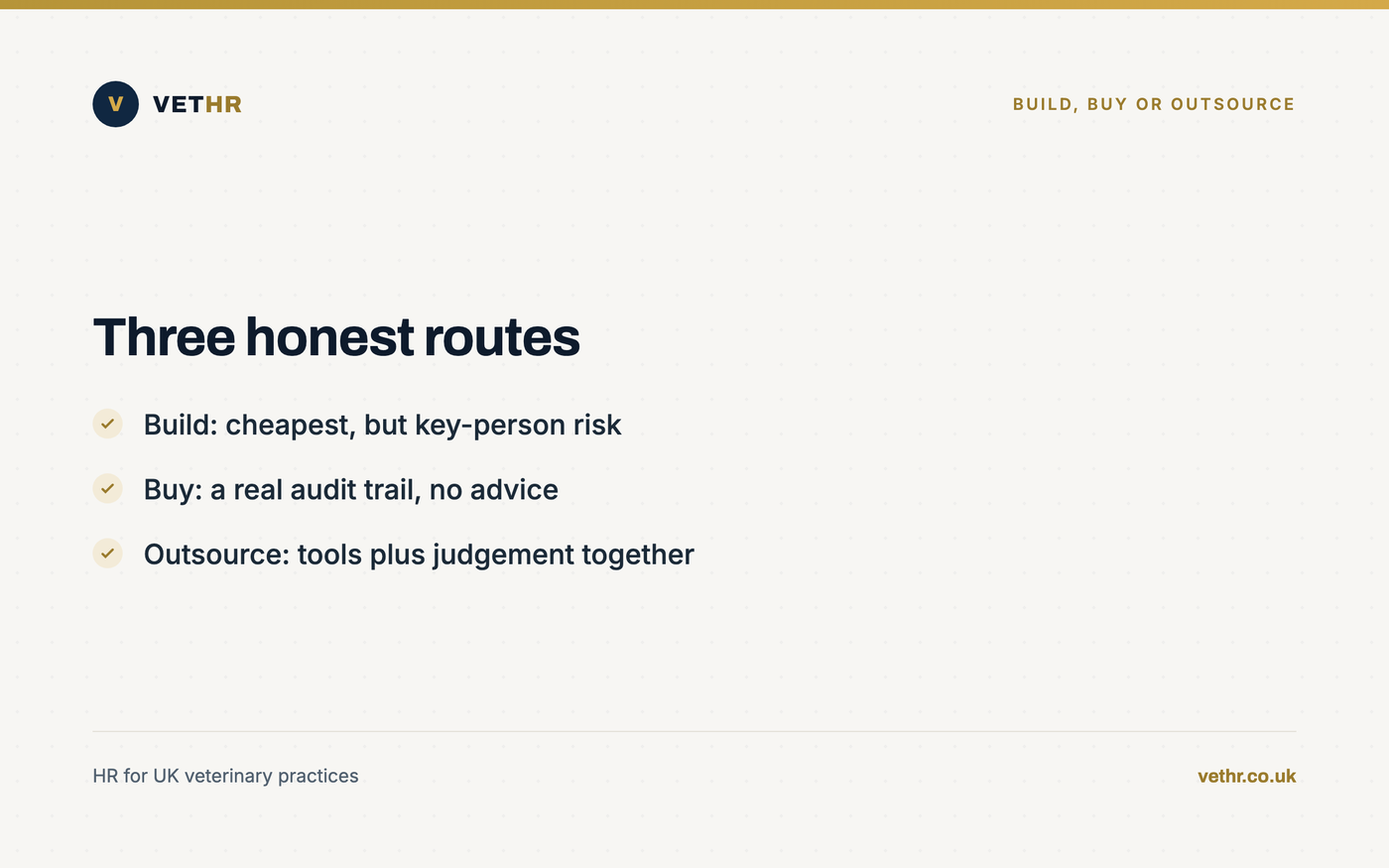
There are three honest routes, and the right one depends on your time and your appetite for risk. Build it yourself from spreadsheets and templates, buy a system you run in-house, or outsource the people work to a specialist who brings the system with them. Most practices are not choosing software so much as choosing how much of this they want to carry.
Building your own is cheapest on paper and works while the team is small and stable. The hidden cost is key-person risk: when the one practice manager who understands the spreadsheets is on leave, or leaves, the system walks out with them. It also leans on you to keep up with changing employment rules.
Buying a system removes the fragility and gives you a proper audit trail, but software alone does not give advice. It will record a grievance neatly, yet it will not tell you how to handle the disciplinary that follows. For a small practice where everyone knows everyone, that judgement is often the part you most need.
Outsourcing folds the tools and the judgement together. A specialist runs the systems and stands behind the decisions, which is why our HR consultancy and monthly support are built around the same systems your team uses day to day. For groups that want their own branding on it, a white-label option puts your practice name on the front. The point is fit, not status.
Honestly, it depends, and any firm number quoted before someone has seen your practice should make you cautious. Cost is driven by team size, how many sites you run, which parts you want and whether you add HR support to the software. A two-person branch and a three-site group are different problems, so a single sticker price fits almost nobody.
The cleaner comparison is value against the manual approach: the practice manager hours lost to people admin each month, the payroll corrections, and the risk carried in records you could not produce on request. For many growing practices, a system is cheaper than the scramble it replaces.
A note on how we price, since people ask. Vet HR quotes per practice in writing after a free health check, rather than publishing a one-size figure that would not fit your setup. You can take systems on their own, or as part of ongoing support, and you will always see the number before you commit. No surprise fees, no pressure, no buying parts you will not use.
Before you sign anything, put the same seven questions to any provider, including us. Honest answers are quick. Evasive ones are a warning. These cut through the demo and show whether a tool was built for a clinic or merely pointed at one.
If a provider answers all seven without flinching, they have done this for practices before. If the answers turn vague around data, compliance or total cost, keep looking. The aim is a system you trust on your worst week, not your calmest one.
A generic tool can work for basic record-keeping, but it rarely fits how a clinic runs. Veterinary practices have out-of-hours cover, registered nurses and freelance vet cover that a flat office system handles awkwardly. Specialist HR software for veterinary practices treats those as normal, which usually means less fighting the tool and fewer workarounds.
It depends on team size, number of sites, the features you want and whether you add HR support. There is no honest single price, which is why we quote per practice in writing after a free health check. The useful comparison is against the manual approach: the admin hours, payroll corrections and compliance risk a system removes.
When the spreadsheet starts costing you accuracy, compliance or time. If payroll week is a hunt, holiday clashes slip through, or you could not produce a clean record on request, the manual method has already failed quietly. Team growth and a second site usually bring that moment forward, because one person can no longer hold it all.
No. Software gives you tools to run rotas, hours and records. Consultancy gives you judgement, the advice on a grievance, a contract or a fair process. Many practices want both, so the better option is to pair systems with human support rather than treating them as a choice between one and the other.
It should be, and that is a feature to check rather than assume. Look for access controls so only the right people see sensitive records, an audit trail of who changed what, and the ability to export and remove data. You remain responsible for the personal data you hold, so the system must make protecting it easier, not harder.
There is no shame in a spreadsheet if your team is small and payroll is calm. HR software for veterinary practices is not a status symbol; it is the answer when people admin starts costing you accuracy, compliance or sleep. That moment usually arrives as the team grows or you add a second site and nobody can hold it all by hand.
If you are weighing it up, start with the friction and let it point to the fix. To see how the pieces fit, browse our staff systems, read how we work in HR consultancy, or simply book a free HR health check and we will give you a straight recommendation for your practice. Nothing sold that you do not need.
The Vet HR Team provides HR consultancy and white-labelled staff systems exclusively to UK veterinary practices.
Related reading: How Vet HR compares with Agilio iTeam · The Crocodile HR alternative
Read next: Why We Built HR for Veterinary Practices, HR Health Check for Veterinary Practices and Outsourced HR for Veterinary Practices.
Contracts, rotas, holiday, a difficult conversation. Tell us what you are dealing with and we will come back within one working day. Nothing to sign up to.
Got it. We will come back to you within one working day. If you do not see a reply, please check your spam folder.
