Last updated: 6 October 2026
TL;DR: Health surveillance is a scheme of repeated health checks used to identify ill health caused by work. Under COSHH it is required where a disease is associated with a substance in use, the disease can be detected early, and workplace conditions make it likely to appear. Health records can need keeping for 40 years.
A nurse mentions that her hands have been cracking since the spring. She has been scrubbing eight times a day for four years and assumed it was winter. Nobody has ever asked the team about their skin, and there is no record of anyone’s condition when they joined. That is the gap health surveillance is designed to close, and it is not an unusual gap.
The HSE describes it as a scheme of repeated health checks used to identify ill health caused by work, and more broadly as any activity which involves obtaining information about employees’ health and which helps protect employees from health risks at work.
It is not a general medical, and it is not a fitness test. It looks for the specific early signs of the specific conditions your work could cause.
It is also not a substitute for controlling the hazard. Health surveillance tells you whether your controls are working; it does not replace them.
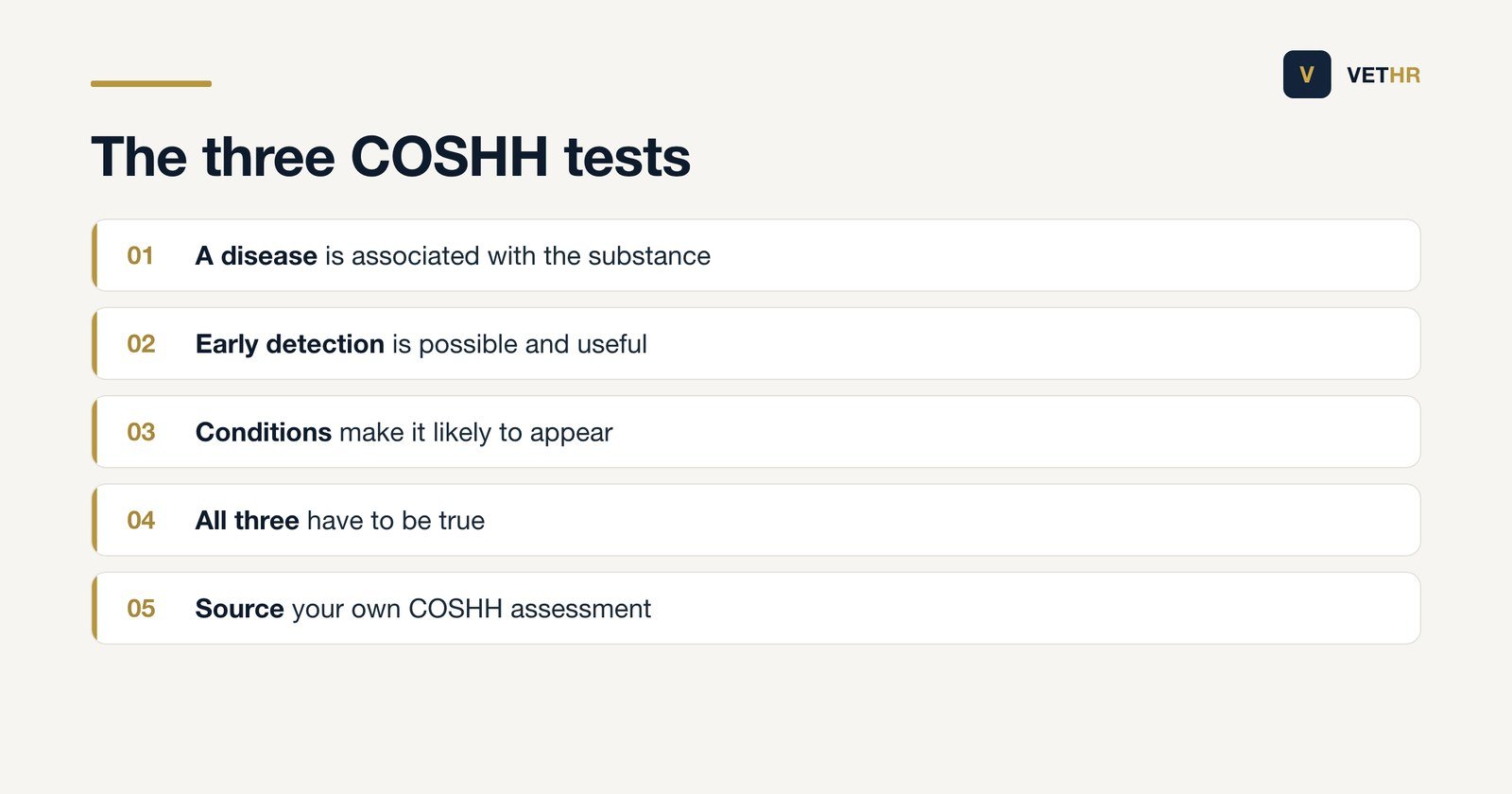
HSE sets three conditions under COSHH. It is needed where there is a disease associated with the substance in use, such as asthma, dermatitis or cancers; where it is possible to detect the disease or adverse change and reduce the risk of further harm; and where the conditions in the workplace make it likely that the disease will appear.
All three have to be true. That is why health surveillance is not required for every hazard a practice controls, and why the decision follows from your COSHH assessment rather than sitting separately from it.
If your COSHH assessment does not name the diseases associated with your substances, that is the work to do first. Our guide to the COSHH assessment in a veterinary practice covers how to get there.
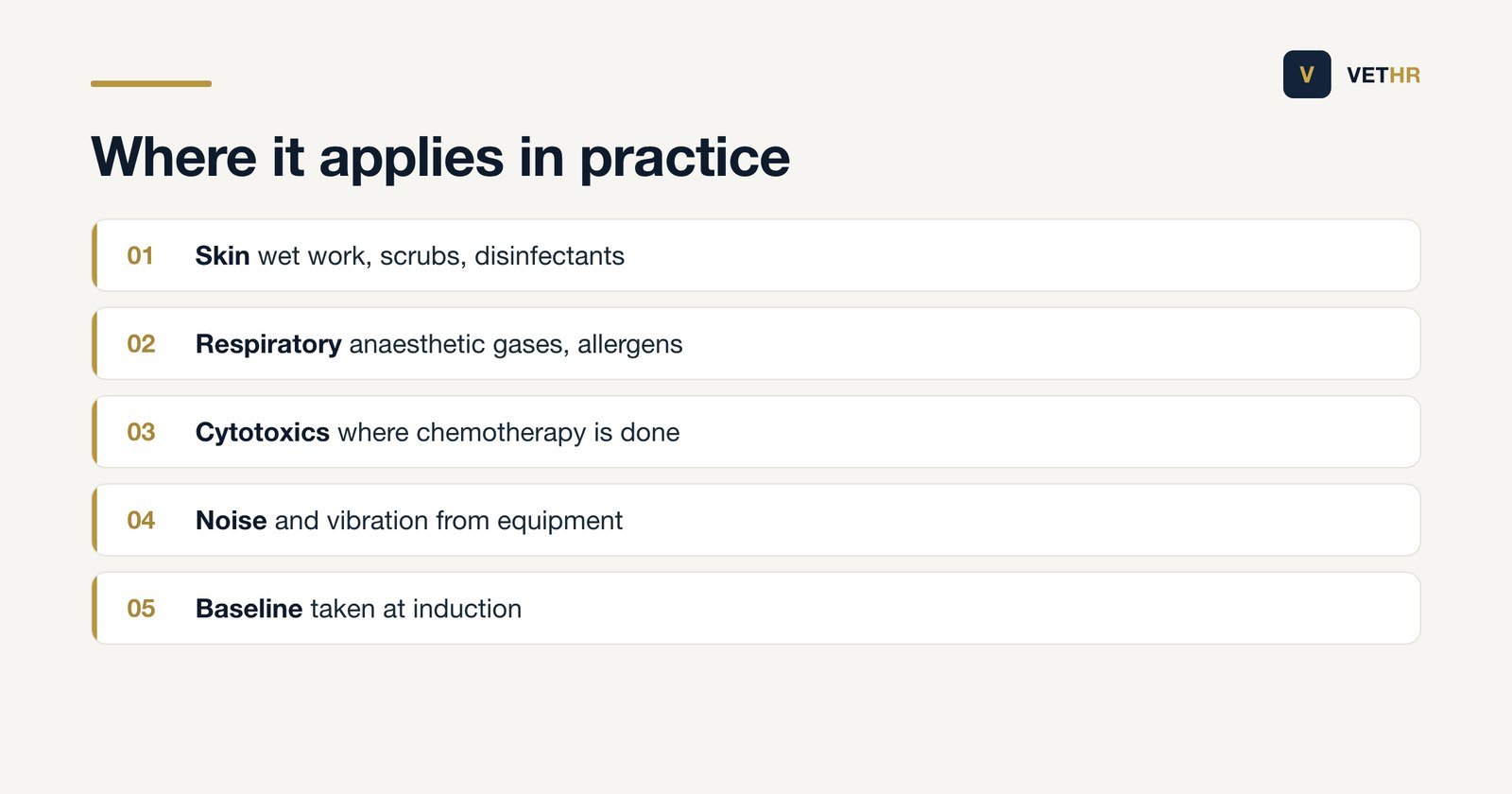
Four areas come up most, and skin is the one nearly every practice has.
Skin checks are the most practical place to start. They are quick, they need no equipment, and dermatitis is both common in this profession and entirely detectable early.
It depends on the level. HSE notes that health surveillance may need to be completed by an occupational health professional, meaning a doctor or nurse, and that the employer must then have the results interpreted and take action to eliminate or further control exposure.
Simpler checks can be run in house by a trained responsible person. A skin checking scheme, for example, is usually a short structured questionnaire and a look at the hands, done by someone trained to know what to escalate.
Name that person, record their training, and give them a route to refer on. Our note on occupational health in a veterinary practice covers how to set up the referral relationship before you need it urgently.
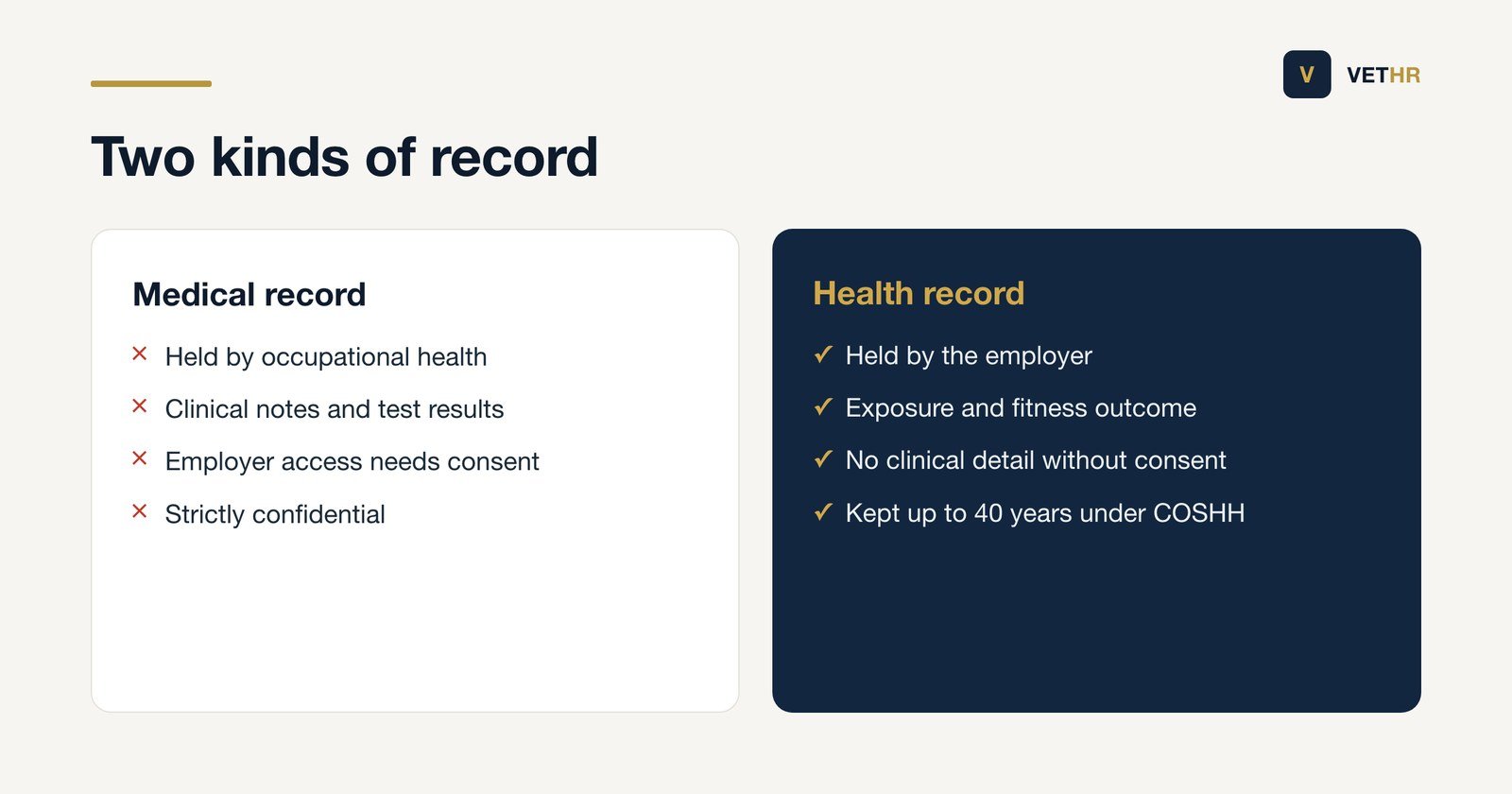
These are two different things, and confusing them is the most common data protection error in this area. HSE describes the health record as a legal record of the outcome of health surveillance, containing the worker’s details, work location, hazard exposure and fitness assessment.
Medical records are separate, held in confidence by the occupational health professional, and HSE states that you can only access medical records with the written consent of the worker. The health record should not contain confidential medical information unless the worker has consented in writing.
Retention is long. HSE gives 40 years under COSHH as an example of the period specified in the relevant regulations, and says that where no period is specified, records should be kept at least while you employ the worker. It also recommends offering workers a copy of their health record when they leave.
Forty years is longer than most practices keep anything. Our note on GDPR and staff records covers where a retention period like that sits alongside everything else you hold.
Tell people what the scheme is for before you start it. Health surveillance asked for without explanation sounds like the practice checking up on individuals, and the first person to decline will set the tone for everyone else. Say plainly that the purpose is to find out whether the controls are working, and that the action it produces lands on the work rather than on the person.
Set the frequency and keep to it. Annually is a reasonable default for a skin scheme in a small animal practice, with an extra check whenever a new product is introduced or someone’s role changes substantially. A scheme that runs twice and then stops produces a record that is worse than no record at all.
Health surveillance that produces a result and no action is worse than none. HSE frames the duty as having the results interpreted and then taking action to eliminate or further control exposure.
In a practice that usually means something practical: different gloves, an emollient regime, a change in disinfectant, better scavenging on the anaesthetic machine, or a change to how one person’s week is organised.
Some results also become reportable. Diagnosed occupational dermatitis and occupational asthma appear on the HSE list of reportable diseases where work is the cause. Our guide to RIDDOR in a veterinary practice covers that decision.
An independent practice does not need a department. It needs five things, and they fit on one page.
The baseline at induction is the step that pays for itself. Without it, a nurse whose hands crack in year four has no record of what her skin was like in year one, and neither do you. Our new starter checklist covers where it fits.
If you would like a view on whether your practice needs health surveillance and for what, book a free 30-minute HR health check.
Not automatically. It is required where a disease is associated with a substance in use, the disease can be detected early enough to reduce further harm, and workplace conditions make it likely to appear. Most practices meet those tests for skin.
Simple checks can be carried out in house by a trained responsible person, with a route to refer on. More complex health surveillance may need an occupational health doctor or nurse, and the employer still has to act on the results.
Health records are kept for at least the period the relevant regulations specify, and HSE gives 40 years under COSHH as an example. Where no period is specified, keep them at least for as long as you employ the worker.
Only with their written consent. Medical records stay with the occupational health professional. What the employer holds is the health record, which should not contain confidential medical detail without consent.
Talk to them about why. Refusal is usually about privacy or worry about the consequences, and both are answerable. Explain what is recorded, who sees it, and that the purpose is to change the work rather than to assess the person.
If your practice does nothing else, add a skin question and a look at the hands to induction and to an annual check, and write down what you find. That single step turns a nurse’s cracked hands from an unexplained problem into a documented one you can act on.
We help independent practices decide what health surveillance they need and build the records around it, through HR consultancy for veterinary practices and the policy document set.
The Vet HR Team provides HR consultancy and white-labelled staff systems exclusively to UK veterinary practices.
Contracts, rotas, holiday, a difficult conversation. Tell us what you are dealing with and we will come back within one working day. Nothing to sign up to.
Got it. We will come back to you within one working day. If you do not see a reply, please check your spam folder.
