Last updated: 5 September 2026
TL;DR: Bank holidays do not have to be given as paid leave, and an employer can choose to include them in the 5.6 weeks of statutory annual leave. What decides whether a Christmas rota damages your team is not the law but the method: publish early, use a transparent rotation, pay properly and never let the same people cover every year.
Every practice has the December conversation. Two nurses want the same three days, a vet worked last Christmas and assumed that meant this year was safe, and somebody discovers on 20 December that nobody has actually confirmed the Boxing Day cover. It is entirely predictable, which is why it is entirely preventable.
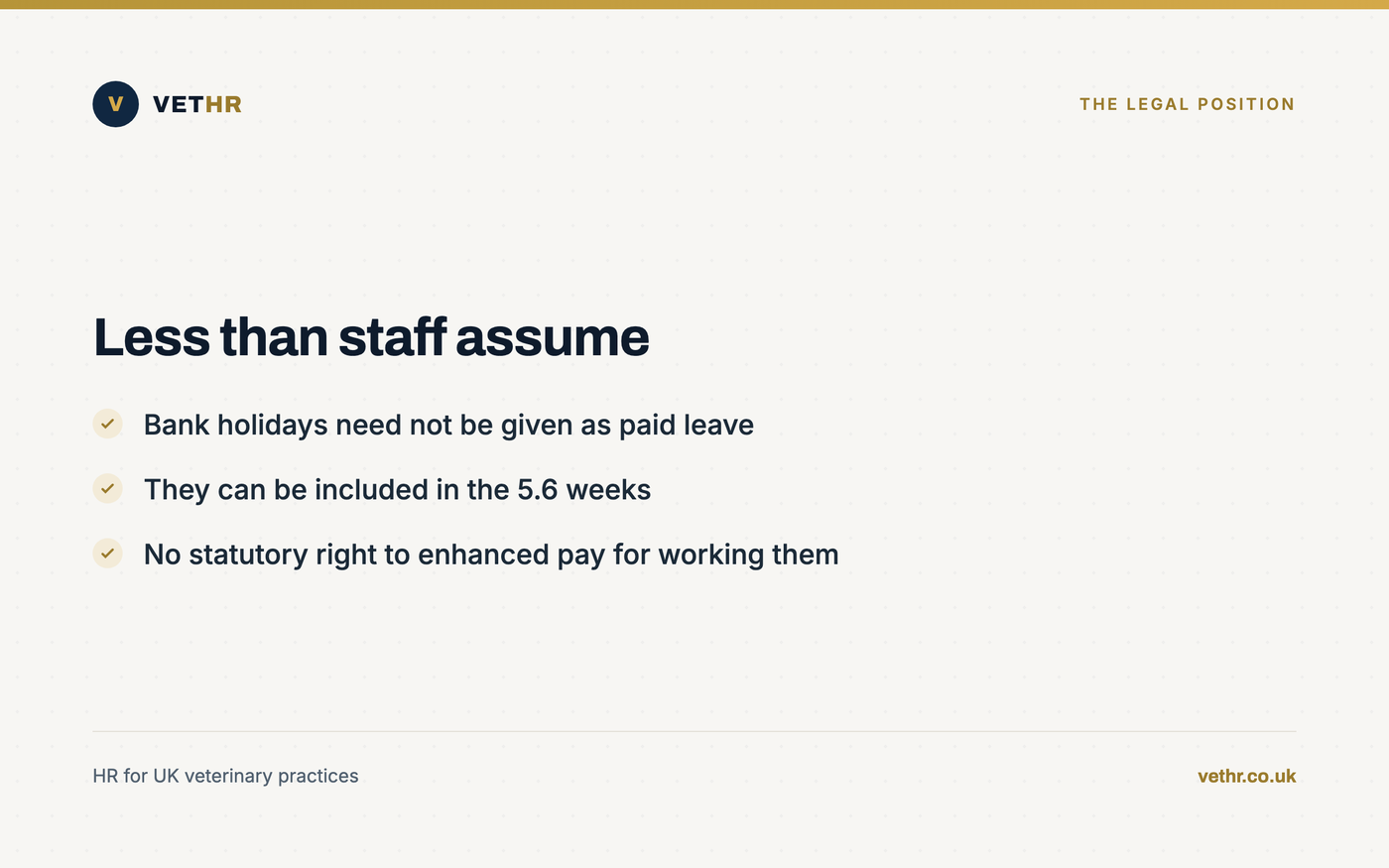
Less than most staff assume. GOV.UK is explicit that bank or public holidays do not have to be given as paid leave, and that an employer can choose to include bank holidays as part of a worker’s statutory annual leave.
The underlying entitlement is 5.6 weeks, which is at least 28 days for someone working five days a week, and statutory paid holiday is limited to 28 days. Whether Christmas Day sits inside or outside that allowance depends on the contract, not on custom.
Working time rules still apply across the period. The 48 hour weekly limit is normally averaged over 17 weeks, so a heavy fortnight is lawful, but daily and weekly rest still have to happen inside it.
So there is no automatic right to Christmas Day off, and no automatic right to enhanced pay for working it. Both are contractual questions, and a practice that has never written the answer down is arguing about it every December.
Check what your contracts actually say before the Christmas rota is drafted. Our guides to bank holiday entitlement for veterinary staff and employment contracts cover how to make that unambiguous.
The Christmas rota should be published by the end of October, and ideally earlier. That is not a legal requirement, it is a practical one: your team is booking family plans, travel and childcare in autumn, and a rota published in December is a rota published after the decisions it affects.
Publishing the Christmas rota early also protects you commercially. Practices that leave it late end up buying freelance vet cover in the most expensive fortnight of the year, having lost the chance to solve it internally for nothing.
Put it in the same system as every other rota rather than in a separate spreadsheet that lives on one laptop. Our rota system exists so the festive period is visible alongside the rest of the year.
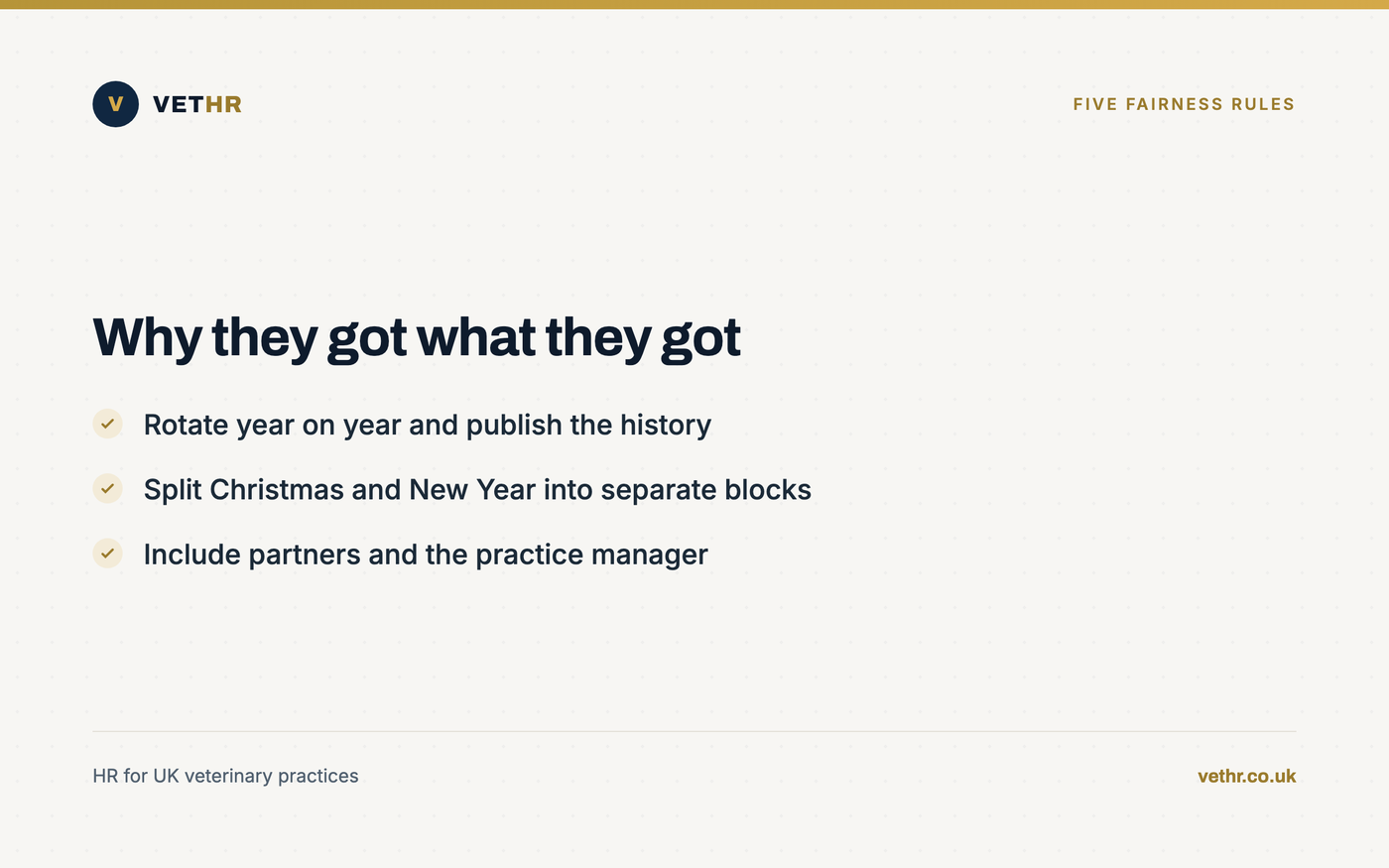
With a written rule applied consistently, not with goodwill. Fairness in a Christmas rota is not everyone getting what they want, it is everyone being able to see why they got what they got.
That last point carries more weight than any policy sentence. A practice where the owners never work the festive period has a Christmas rota problem that no rotation rule will fix, because the team can see the exemption.
Check skill mix as well as headcount when the Christmas rota is drafted. Three people on site means nothing if none of them can run an anaesthetic, and the festive period is exactly when a thin skill mix meets an emergency caseload.
Avoid basing allocation on who has children. It sounds compassionate and it corrodes teams quickly, because staff without children notice that they cover every year and there is no route to a different outcome.
However your contracts say, decided before the Christmas rota is published and applied to everyone. There is no statutory right to enhanced pay for bank holiday working, so this is a business decision that becomes a fairness issue the moment it is made case by case.
Whatever you choose, write down what happens when a day in lieu cannot be taken because the rota is full in January. Unexpired lieu days are a running source of resentment, as our guide to time off in lieu explains.
On-call pay deserves its own line. Being available on Christmas Day is not the same as working it, and both need a rate, which our piece on on-call pay for veterinary staff covers.
With a published deadline and a stated tie-break, agreed before the Christmas rota is drafted. The worst version is first come first served with no deadline, which rewards whoever reads their email fastest in September.
Set the tie-break in advance. Last year’s allocation is the fairest one, followed by a documented rotation, and only then by length of service or a draw. Announce the rule with the request form, not after the requests arrive.
Say no properly when you have to. A short explanation referring to the rotation is respected; silence followed by a published Christmas rota that contains the answer is how a practice loses a nurse in January.
Allow swaps, within rules, recorded in one place. Staff will solve a surprising amount between themselves if you let them, provided skill mix and cover requirements are protected, as our guide to shift swaps sets out.
Dreading the December conversation again? A free 30-minute HR health check will help you build the rules before you build the rota. Book your HR health check.
Plan it alongside the Christmas rota, because the recovery is part of the same problem. A practice that covers the festive period brilliantly and then works everyone flat through January has simply moved the cost rather than removed it.
Book the January debrief while you build the Christmas rota. Fifteen minutes in the first week of January, asking what worked and what did not, gives you next year’s rules for free and shows the team that the fortnight was noticed rather than simply survived.
Two things protect the team.
Ensure whoever worked the most demanding shifts has genuine rest before the January workload arrives, and check that carried-over annual leave has somewhere to go if your leave year ends on 31 December.Watch for the January resignation. Exit conversations often trace back to a festive period that felt unfair, and our analysis of what staff turnover costs a practice puts a number against the fortnight nobody wanted to plan.
No. GOV.UK confirms that bank and public holidays do not have to be given as paid leave, and that an employer can include them within the 5.6 weeks of statutory annual leave. Whether your team gets Christmas Day off is a contractual and operational question, not a statutory right.
There is no statutory requirement to pay an enhanced rate. Many veterinary practices choose to, either as a premium rate or as a day in lieu, and some do both for Christmas Day and New Year’s Day. Whatever you decide, put it in writing and apply it to everyone consistently.
By the end of October. Staff book travel and childcare in autumn, and freelance vet cover is cheapest and most available when arranged months ahead. A rota published in December is published after the decisions it affects have already been made.
Be careful. It feels reasonable and it damages teams, because colleagues without children end up covering every year with no route to a different outcome. A documented rotation based on who worked last year is easier to defend and easier to live with.
Have a named escalation for each day and an agreed callout rate before the period starts. Deciding what a last minute shift is worth at 8am on Boxing Day produces either an unfair outcome or an expensive one, and often both at the same time.
The law gives you almost complete freedom over the festive period, which is precisely why the Christmas rota is a leadership test rather than a compliance one. Everyone can see how the days were shared out, and they remember it for a year.
Publish by the end of October, rotate visibly, pay what you said you would, and include the owners in the rotation. Our rota system and HR consultancy can set the rules up once, and the free HR health check is the place to start.
The Vet HR Team provides HR consultancy and white-labelled staff systems exclusively to UK veterinary practices. Check your contracts and current GOV.UK guidance before changing bank holiday arrangements.
Contracts, rotas, holiday, a difficult conversation. Tell us what you are dealing with and we will come back within one working day. Nothing to sign up to.
Got it. We will come back to you within one working day. If you do not see a reply, please check your spam folder.
