TL;DR: Under the Employment Rights Act 1996 an employer must offer pregnant employees, and employees on maternity, adoption, shared parental, neonatal care or bereaved partner’s paternity leave, any suitable alternative vacancy as a priority over other staff. Since 6 April 2024 the protected period for pregnancy and maternity runs from telling the employer about the pregnancy until 18 months after the birth. Paternity leave is not covered. Reducing existing roles does not create vacancies, but new or combined roles may. Breaching the rules can be automatically unfair dismissal and possibly pregnancy and maternity discrimination.
Last updated: 23 November 2026

A two-site practice decides to close its smaller branch and combine the front desk roles at the main site. One of the receptionists at the smaller branch is on maternity leave, and the head nurse has just told the practice manager she is pregnant. The practice manager has been planning to run an interview for the one new combined role and to select the best candidate. Nobody has asked whether the pregnant nurse and the receptionist on leave have a right to be offered any suitable role before anyone else.
They do, in many cases. This guide explains what Acas says about redundancy protection for pregnancy and new parents, who is covered, how long the protected period lasts, what counts as a suitable alternative vacancy, what to do when roles are reduced and what to put in writing. It is general information, not legal advice, so take advice before any redundancy that involves a protected employee.
Acas says the law applies to employees who are pregnant, or who are taking maternity leave, adoption leave, shared parental leave, neonatal care leave or bereaved partner’s paternity leave. It does not apply to other types of leave, such as paternity leave. Agency workers and casual workers on zero-hours contracts are not likely to be employees.
The Acas page on redundancy protection for pregnancy and new parents, last updated in April 2026, says that by law the employer must offer a suitable alternative vacancy to people in these groups if there is one. The duty comes from the Employment Rights Act 1996.
In a practice that means checking everyone whose role is at risk against the list. Someone on maternity leave is the obvious case. Others are less obvious: an employee who has told you she is pregnant but is still working, a nurse on shared parental leave in blocks, a vet back at work who is on neonatal care leave or a receptionist taking bereaved partner’s paternity leave. Our guides to maternity leave, shared parental leave and neonatal care leave cover the leave itself.
Record who falls into the protected groups before you begin. Do not rely on memory, because someone may have told one manager and not another. Note that Acas says the protection starts when the role is selected for redundancy, which it explains means it is no longer possible for the employee to return to it.
For pregnancy and maternity, the redundancy protected period starts when the employee tells the employer they are pregnant and ends 18 months from the exact date the baby is born, or from the expected week of childbirth if the exact date has not been given. Other leave types have their own start and end rules.
Acas says that from 6 April 2024 the protected period for pregnant employees and those taking maternity leave was extended. Before that they were protected only while on maternity leave. The extended protection applies to employees who notify their employer of pregnancy or start maternity leave after 6 April 2024, and to those who were already on maternity leave on that date.
Acas gives an example: a baby is born in October 2024 and the employee is selected for redundancy in January 2026. That is less than 18 months after the birth, so the person is still in the protected period and any suitable alternative vacancy must be offered as a priority.
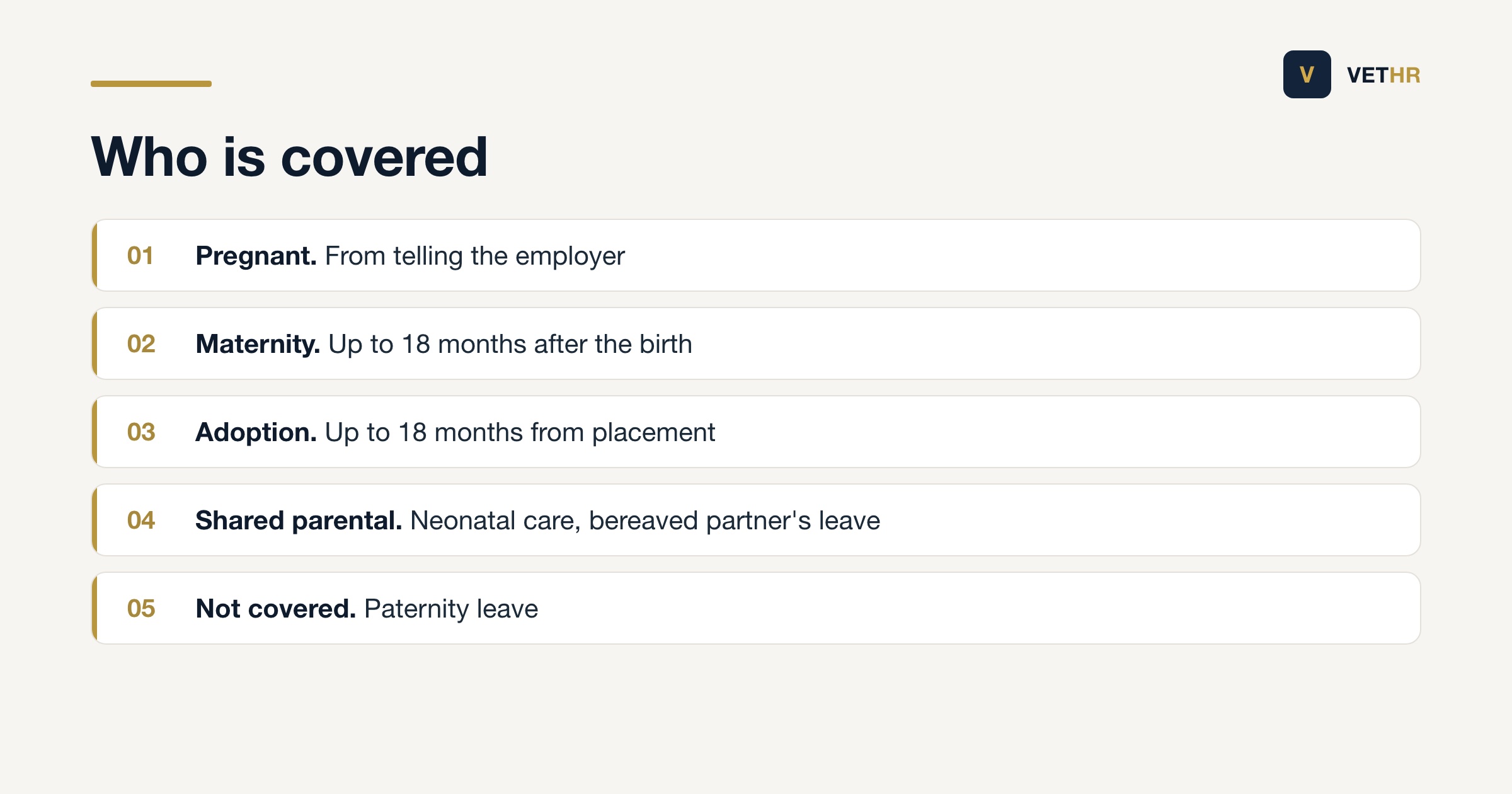
The other leave types follow the same pattern with variations:
If there is a miscarriage within the first 24 weeks of pregnancy, the protected period ends two weeks from the end of the pregnancy. If a child is stillborn after 24 weeks, it ends 18 months from the date of the birth. An employee who has already taken a different type of leave has the protected period for that specific type of leave.
The protection also ends when the employment ends. Acas gives the example of a person on maternity leave whose role is made redundant at 15 months, with no suitable alternative role. Their employment ends and they do not have the further three months’ protection.
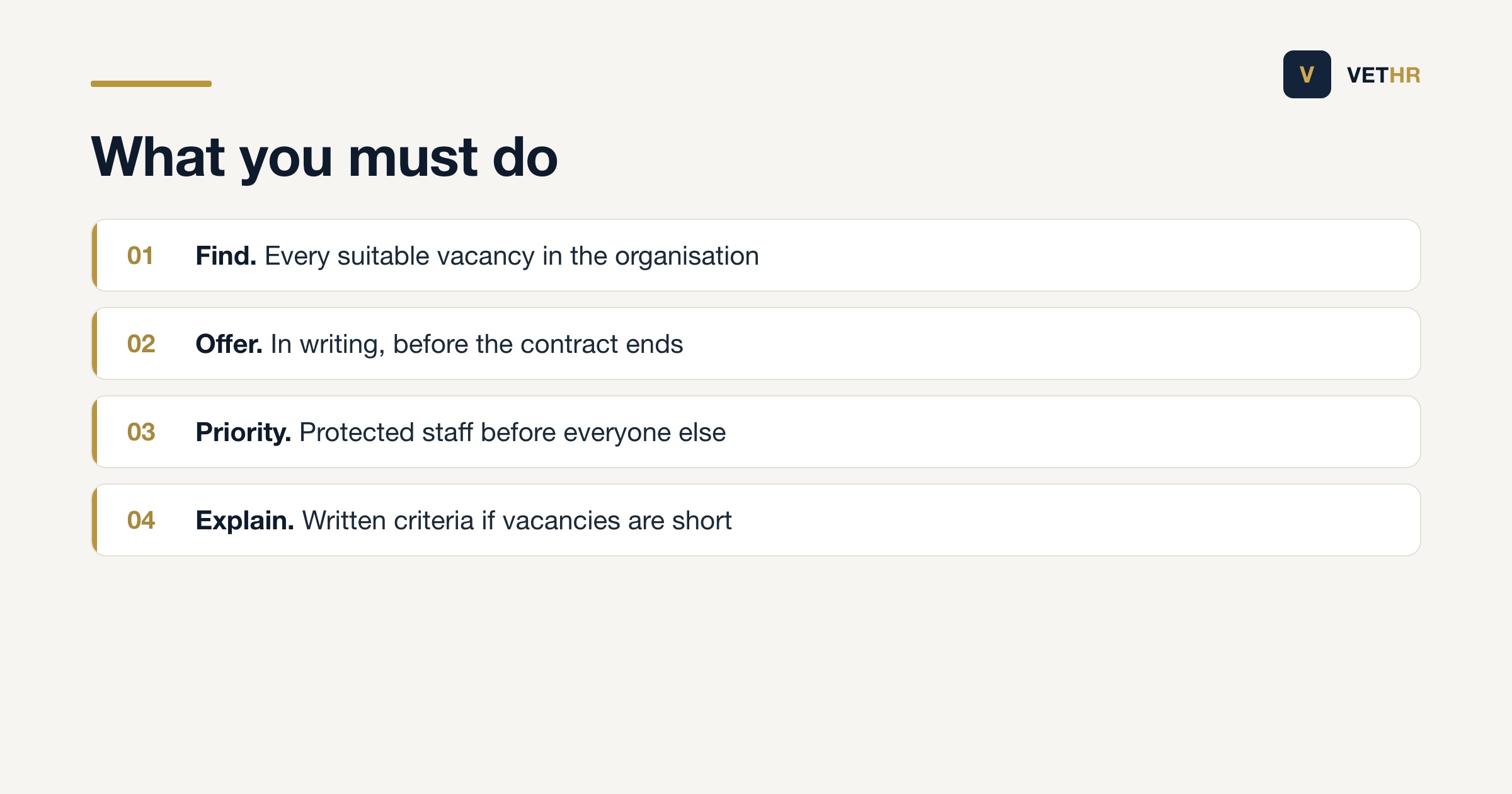
A suitable alternative vacancy is a job that is actually available in your organisation, that the employee could do and that is suitable for them. Acas says to identify available jobs, talk to the employees to see if they agree the job is suitable, and put the offer in writing before the current contract ends, with a start within four weeks.
The Acas page on offering alternative employment says you must try to move anyone selected for redundancy into other jobs in your organisation instead. If a role is suitable, you should offer it instead of redundancy. The employee should not have to apply for it. If you do not, the employee could claim unfair dismissal.
When you offer a role, it must be in writing, offered before the current contract ends, a different role from the current one, with an explanation of how it is different, and start within four weeks of the current role ending. Employees have the right to a four-week trial period if they accept a new role, which can be longer if they need time to train and it is agreed in writing with a clear end date.
If the employee turns down the role, Acas says they need a valid reason why it is not suitable, such as lower pay, health issues that prevent them doing the job or difficulty getting there. Take advice before treating a refusal as unreasonable, particularly where the person is pregnant or on leave.
For a practice, think broadly about vacancies. Nursing, reception, admin, practice management, rota coordination, client care and cover roles may all be possibilities, across all sites in the group. A vacancy that is open at a sister branch still counts if it is within your organisation. Our guide to redundancy covers the wider process.
Yes. Acas says anyone who has this redundancy protection has priority over other employees for any suitable alternative vacancy, even if other employees are also suitable. If there are not enough vacancies for everyone who is protected, the employer decides who is most suitable and should explain its criteria in writing.
The Acas page says the decision might include considering an employee’s skills, job knowledge and experience. The employer should explain in writing what criteria it will use and why, in a letter or email. If an employee is not offered a suitable vacancy, the employer should meet them to discuss the decision.
Acas’s other page adds a rule for competing interest: if more than one employee is interested in the same role, you must offer the role first to employees on maternity leave, shared parental leave or adoption leave, and follow a fair process for everyone else, for example holding interviews. In a practice with several people on leave and one vacancy, set the criteria before you begin, apply them consistently and record the reasons.
Do not make the protected employee apply or interview against others for a suitable alternative vacancy. They should be offered it. If you are unsure whether a vacancy is suitable, discuss it with the employee, and take advice.
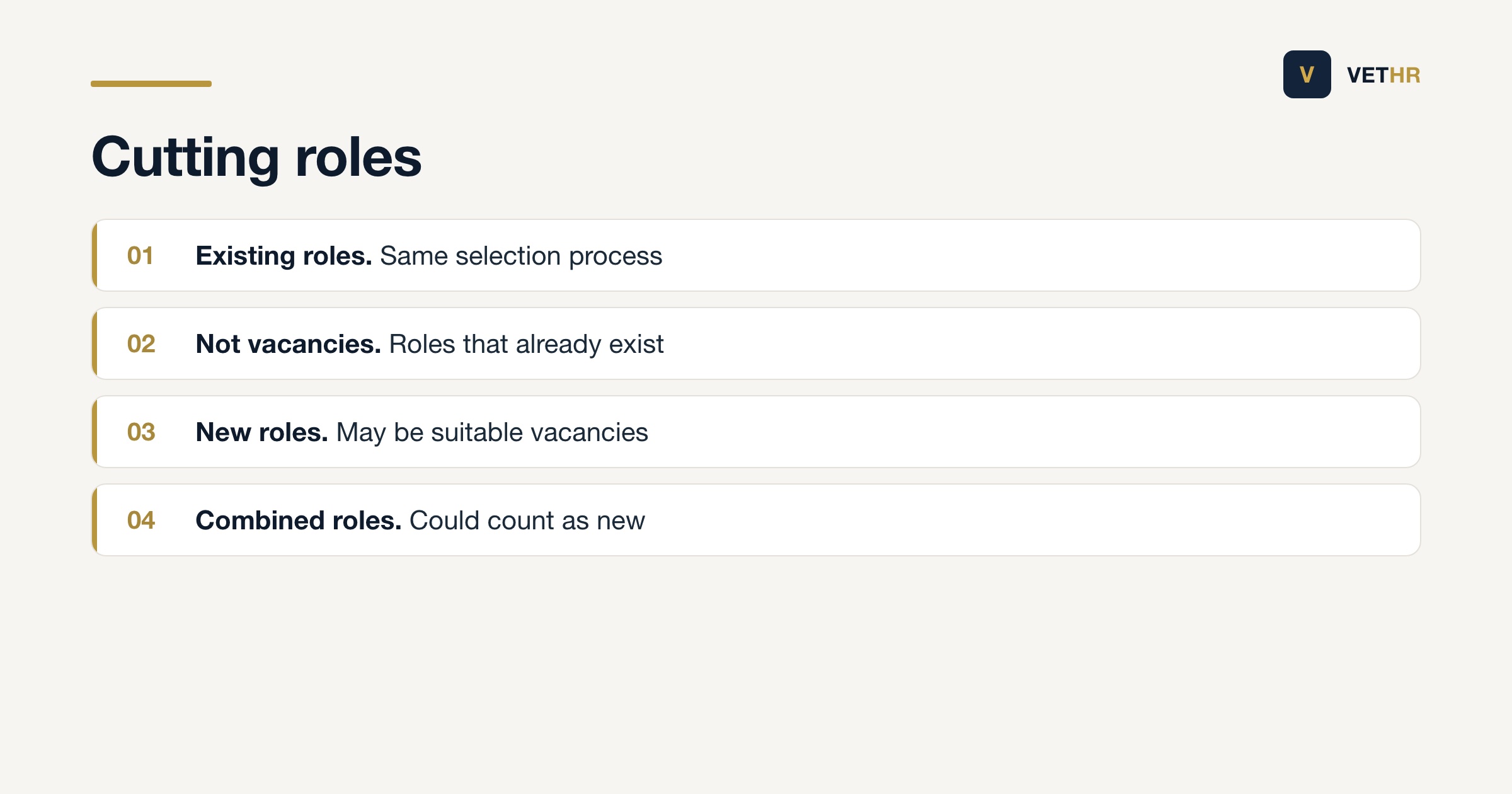
Acas says that when you reduce existing roles and create no new ones, the protected employee goes through the same selection process as everyone else. The reduced number of roles filled in selection are not suitable alternative vacancies, because they already exist and are not vacant. If reducing roles creates new ones, those could be vacancies.
Acas’s example is an employer reducing administration roles from 20 to 10. A fair selection process includes a pregnant employee, the remaining ten jobs are filled and she is not selected because she did not meet the criteria. The employer gives her redundancy notice and explains it will offer a suitable alternative if one becomes available.
If roles are combined, Acas says the new combined role could be a suitable alternative vacancy. In the opening example, the one new combined front desk role at the main site is such a case, because it is a new job. Protected employees should be offered it before anyone else if it is suitable. If you are unsure whether you are reducing roles or creating a new one, take advice, because the answer decides who goes first.
Selection criteria still need to be fair. Our guide to pregnancy risk assessment covers the health and safety side of pregnancy at work, and the unfair dismissal qualifying period guide explains how qualifying periods affect other claims. Do not take pregnancy, maternity or other leave into account in selection scoring.
Acas says that if an employer does not follow the law, it might be automatically unfair dismissal, and if the person is pregnant or on maternity leave it could also be pregnancy and maternity discrimination. Treat any redundancy that involves a protected employee as high risk and take advice before you start.
Automatically unfair dismissal does not require the usual qualifying period, which is why these claims are difficult to defend. Our guide to employment tribunals explains the process and costs, and the settlement agreement guide explains when an agreed exit may be appropriate.
Keep a record of each step: who is protected, the vacancies identified, how suitability was assessed, the offers made and when, the criteria applied when there were more candidates than roles, and the meeting held with anyone not offered a role. That file is your evidence.
Put in writing who is covered, the dates of the protected period, the vacancies identified, the offers made with the date and the start date, the criteria and reasons where there was competition, and the meeting notes. Give protected employees the information in a clear letter or email.
A checklist for a practice:
The usual mistakes with redundancy protection are forgetting that pregnancy counts from the day the employer is told, treating a protected employee like everyone else in an interview, ignoring combined or new roles, not offering in writing, missing the other leave types and assuming paternity leave is covered.
Employees who are pregnant or taking maternity, adoption, shared parental, neonatal care or bereaved partner’s paternity leave. Acas says it does not apply to other leave such as paternity leave.
From when the employee tells the employer she is pregnant until 18 months from the exact date the baby is born, or the expected week if the exact date is not given. It ends sooner if employment ends.
Any suitable alternative vacancy as a priority over other employees, in writing, before the current contract ends. The employee should not have to apply for it.
The employer decides who is most suitable, for example on skills, job knowledge and experience, and should explain the criteria in writing. It should meet anyone who is not offered a role.
Acas says protected employees go through the same selection process, and the remaining roles are not vacancies. New or combined roles may be vacancies.
If you want a redundancy checklist, a protected employee tracker and offer letter templates for your practice, book a free 30-minute HR health check through our contact page. See also our HR consultancy for veterinary practices and the policies and handbook system.
Sources: Acas: redundancy protection for pregnancy and new parents, Acas: step 8, offer alternative employment.
Contracts, rotas, holiday, a difficult conversation. Tell us what you are dealing with and we will come back within one working day. Nothing to sign up to.
Got it. We will come back to you within one working day. If you do not see a reply, please check your spam folder.
