Last updated: 5 September 2026
TL;DR: Shared parental leave lets eligible parents split up to 50 weeks of leave and 37 weeks of pay between them. The mother has to curtail her maternity leave first, both parents have to pass eligibility tests, and each block needs eight weeks’ notice. Take up is low, mostly because employers explain it badly. For a practice the real work is rota planning, and you get months of warning.
A way for two parents to divide the leave that would otherwise all be taken by the mother. She gives up part of her maternity leave, and what she gives up becomes available to be shared.
The headline figures: up to 50 weeks of leave and up to 37 weeks of statutory pay, taken by either parent or both, together or separately, in up to three blocks each. It is not an addition to maternity leave. It is a redistribution of it.
That last point is the one most people misunderstand, including managers. Shared parental leave does not create extra weeks. It moves them.
Both parents have to pass tests, and they are not the same tests. In outline, the parent taking the leave needs sufficient continuous service with their employer, and the other parent needs to have worked and earned enough over a defined period, which can include self employment.
This matters in veterinary practice more than in most sectors, because a genuinely self employed partner doing freelance vet cover may still enable their partner to qualify. The eligibility test looks at work and earnings, not at employment status alone.
Do not work eligibility out by hand. Use the GOV.UK shared parental leave guidance and planner, and confirm in writing only once you have checked. Telling somebody they qualify when they do not is a difficult conversation to have twice.
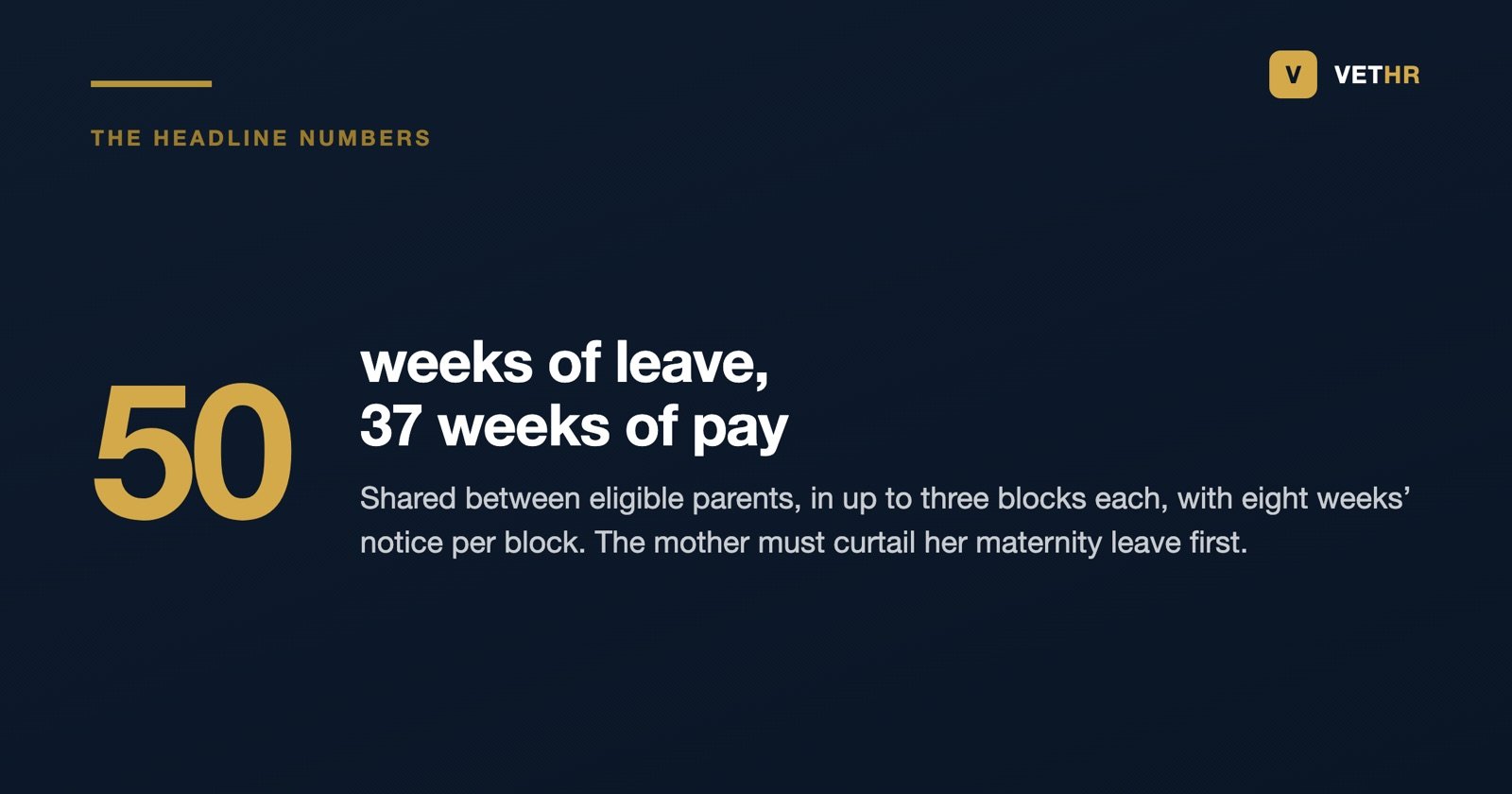
Nothing happens until the mother formally curtails her maternity leave, either by giving notice to end it on a set date or, if she has already returned, by having ended it.
Curtailment is difficult to undo. It can generally only be withdrawn in narrow circumstances and within a short window. So the practical rule for a practice is simple: do not encourage anybody to submit a curtailment notice until the whole plan is worked out and both employers have confirmed eligibility.
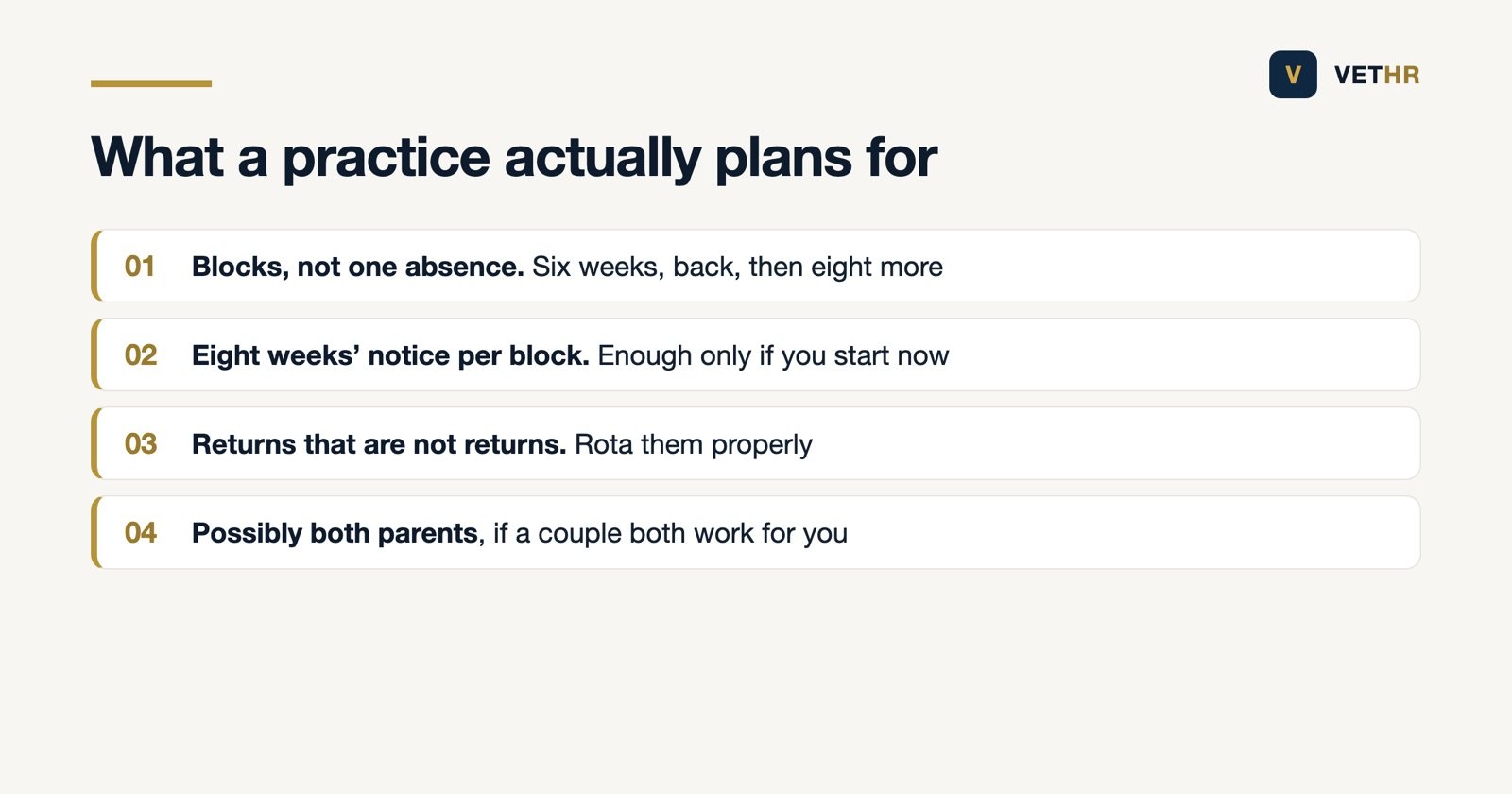
The employee then gives notice of entitlement and intention, followed by a booking notice for each block, with at least eight weeks’ notice each time.
The legal side of shared parental leave is the employee’s to navigate. The operational problem is yours, and it is different from maternity leave in one specific way: it can be discontinuous.
You are entitled to discuss the pattern and to explain what works operationally. A single continuous block must be accepted if properly notified. A discontinuous request can be discussed and, if you cannot accommodate it, there is a process, but refusing outright without a conversation is how a workable plan turns into a grievance.
Most employees hear “shared parental leave” and stop listening, because it sounds like a form. Here is the version that lands, and it is worth having ready before somebody announces a pregnancy.
“If you would both rather split the time off, you can. Mum gives up part of her maternity leave and the rest becomes shared. You can take it in blocks, at the same time or at different times, and you both need to check you qualify. It is not extra time, it is the same time divided differently. Have a look at the government planner and come back to me, and I will work the rota around whatever you decide.”
That is it. No practice needs to be an expert in the notice regime to say that, and saying it early is the single biggest thing an employer can do about shared parental leave take up.
The operational trick with shared parental leave is to treat each block as a separate staffing event with its own plan, rather than as one long absence with gaps.
Where the pattern will not work operationally, say so early and constructively rather than at the end of the notice period. Acas has clear guidance on shared parental leave and pay if you want the process in more detail, and our guide to maternity leave covers the entitlement it is carved out of.
Shared parental leave take up remains low for three reasons, and a practice can influence two of them.
If you enhance maternity pay and not shared parental pay, take advice on how you have structured it. It is a well litigated area and the position is more nuanced than either extreme suggests.
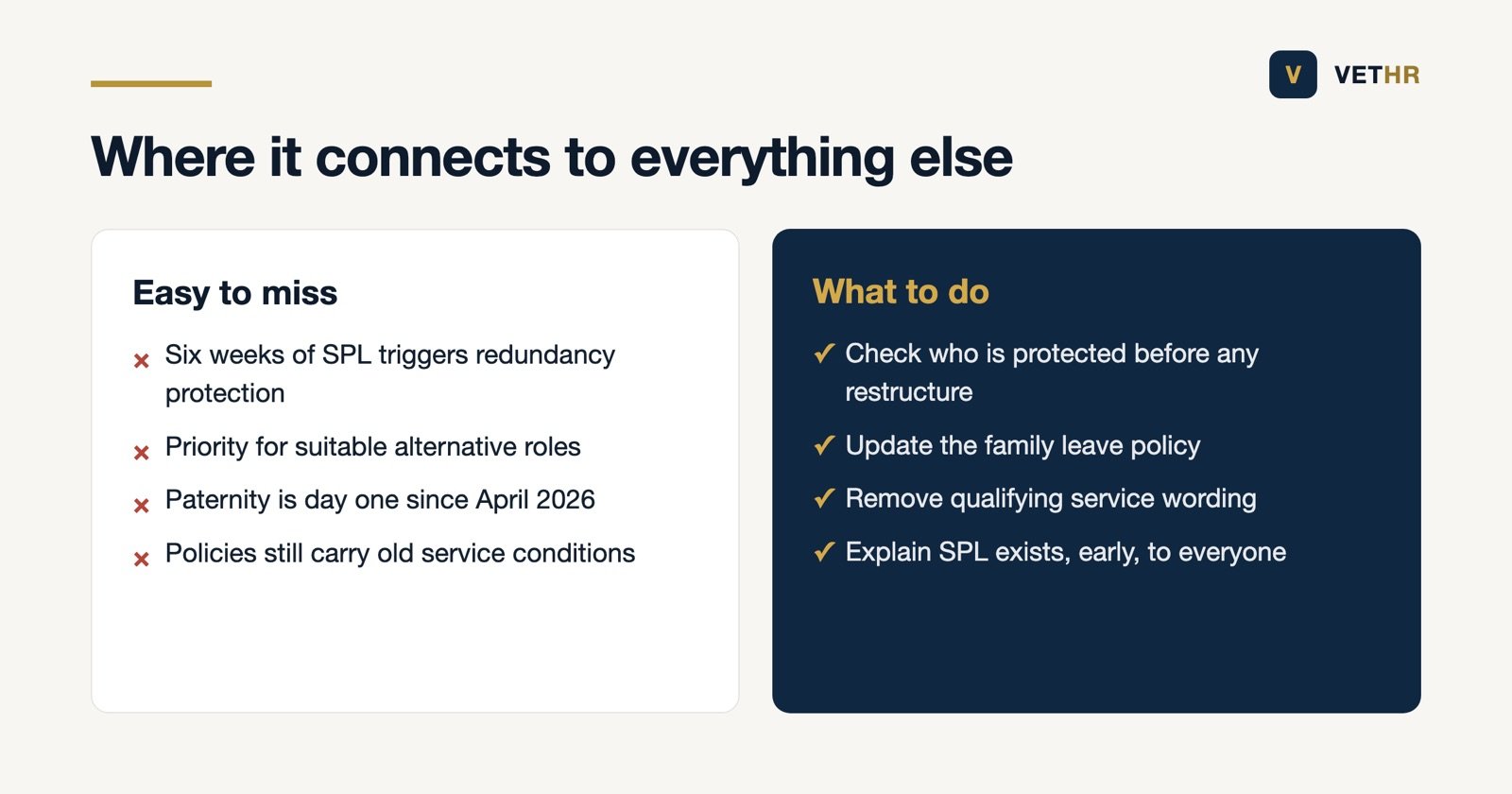
Two connections practices miss.
Redundancy protection. An employee who has taken six or more consecutive weeks of shared parental leave gains the extended redundancy protection introduced on 6 April 2024, giving priority for suitable alternative employment. If a restructure is even being contemplated, identify who is covered first.
Day one paternity leave. Since 6 April 2026 paternity leave and unpaid parental leave are day one rights. Those are separate entitlements from shared parental leave, and a practice policy written before 2026 will almost certainly still contain a qualifying service condition that no longer applies.
Our free family leave pack has the notification form, the acknowledgement letter and a pregnancy risk assessment written for veterinary work rather than an office.
Not where the employee is eligible and has given proper notice for a single continuous block. A request for discontinuous blocks can be discussed and there is a process if you cannot accommodate the pattern, but the underlying entitlement is not something you grant or withhold.
The statutory position and the discrimination position are not identical, and this has been litigated repeatedly. If you enhance maternity pay, take advice on how your shared parental pay is structured rather than assuming either that you must match it or that you need not.
The equivalent of keeping in touch days for shared parental leave, and there are more of them: up to 20 for each parent taking leave. They are optional on both sides and must be agreed in advance, including the pay.
Not legally, but operationally it changes everything. Plan the rota for both absences together, and be careful not to let one person’s arrangement be constrained by the practice’s convenience in a way the other’s is not.
The partner can take theirs while the mother is still on maternity leave, which is a common pattern. What cannot happen is the mother being on both at once, because the maternity leave must be curtailed for the shared entitlement to exist.
Shared parental leave is administratively fiddly and operationally very manageable, which is the opposite of how most practices treat it. You get months of notice, the entitlement is capped, and the blocks are known in advance.
The practices that handle it well do one simple thing: they explain it exists, early, to everybody, rather than waiting to be asked. That costs nothing and it is the difference between an employee who plans with you and one who springs a curtailment notice on you in February. If you want your family leave policy checked against the 2026 position, our free HR health check covers it.
Contracts, rotas, holiday, a difficult conversation. Tell us what you are dealing with and we will come back within one working day. Nothing to sign up to.
Got it. We will come back to you within one working day. If you do not see a reply, please check your spam folder.
