TL;DR: The statutory pay rates for 2026 to 2027 are Statutory Sick Pay of £123.25 a week or 80% of average weekly earnings if lower, and £194.32 a week or 90% of average weekly earnings if lower for paternity, shared parental, adoption, parental bereavement and neonatal care pay. SMP pays 90% of earnings for six weeks, then the same lower figure. The National Living Wage is £12.71 an hour. SSP now has no earnings limit and no waiting days.
Last updated: 3 November 2026

A receptionist rings in sick on a Monday. A nurse starts maternity leave on Friday. A new apprentice joins on Wednesday. Each needs a different statutory figure, and the right one changes every April. A payroll run that uses last year’s rate underpays someone, and underpaying statutory pay is a mistake the practice has to put right.
This guide gives the statutory pay rates for 2026 to 2027, explains how each is worked out, flags what changed on 6 April 2026 and lists the checks a practice manager should make. Every figure comes from GOV.UK pages named below. It is general information, so check your payroll provider’s rates before you pay.
The main weekly rates are £123.25 for Statutory Sick Pay and £194.32 for the family-related payments, each capped at a percentage of earnings. The National Living Wage is £12.71 an hour. The figures below come from GOV.UK’s rates and thresholds for employers page.
| Payment | 2026 to 2027 rate |
|---|---|
| Statutory Sick Pay (SSP) | £123.25 a week, or 80% of average weekly earnings if lower |
| Statutory Maternity Pay (SMP), first 6 weeks | 90% of average weekly earnings |
| SMP, remaining weeks | £194.32 or 90% of average weekly earnings, whichever is lower |
| Statutory Paternity Pay | £194.32 or 90% of average weekly earnings, whichever is lower |
| Statutory Shared Parental Pay | £194.32 or 90% of average weekly earnings, whichever is lower |
| Statutory Adoption Pay, first 6 weeks | 90% of average weekly earnings |
| Statutory Adoption Pay, remaining weeks | £194.32 or 90% of average weekly earnings, whichever is lower |
| Statutory Parental Bereavement Pay | £194.32 or 90% of average weekly earnings, whichever is lower |
| Statutory Neonatal Care Pay | £194.32 or 90% of average weekly earnings, whichever is lower |
GOV.UK’s rates and thresholds for employers 2026 to 2027 states that the SMP rate applies from 5 April 2026 and all other rates from 6 April 2026. The tax year runs from 6 April 2026 to 5 April 2027.
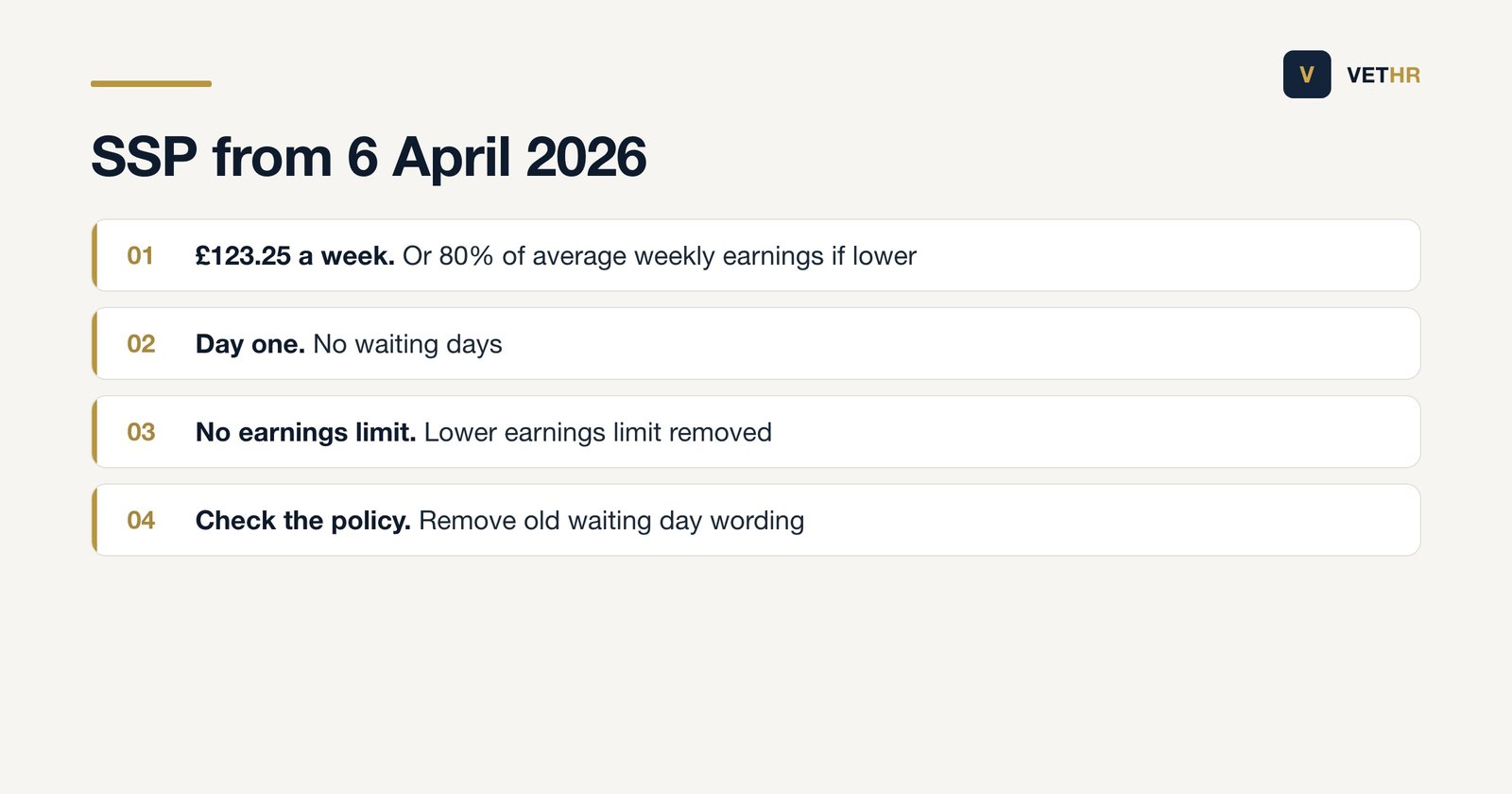
SSP is the lower of £123.25 a week or 80% of the employee’s average weekly earnings. Business.gov.uk says the rate for all employees is calculated at 80% of average weekly earnings or the flat weekly rate, whichever is lower. It starts from the first day of absence.
Two short examples show how it works. They are illustrations, not payroll advice.
Daily rates follow from the weekly rate and the number of qualifying days the employee normally works, so check your payroll provider’s method for part-week working.
Two things. The lower earnings limit has been removed, so SSP is available to all eligible employees regardless of their earnings, and the three-day waiting period has been removed, so SSP is payable from the first day of absence. The changes apply across the whole of the UK.
Business.gov.uk’s page on Statutory Sick Pay changes tells employers to review sickness absence policies, including references to waiting periods or earnings thresholds, to check with their payroll provider how the changes affect the payroll system, and to communicate the changes to managers and staff. It also links to transitional guidance for absences that began before 6 April 2026 and were still running.
The GOV.UK timeline update, updated 22 October 2026, confirms the SSP changes took effect on 6 April 2026, removing the lower earnings limit and the waiting period. For a practice, the people who gain most are part-time and low-hours staff, such as reception cover and bank nurses, who may previously have earned below the limit.
Look for any line that mentions three waiting days, a minimum earnings threshold or the old way of working SSP out. Update the handbook, the contract template and the absence form, then tell managers. The mistake to avoid is a policy that says one thing while payroll does another.
Our guides to statutory sick pay for veterinary staff and managing sickness absence cover the process in more detail.
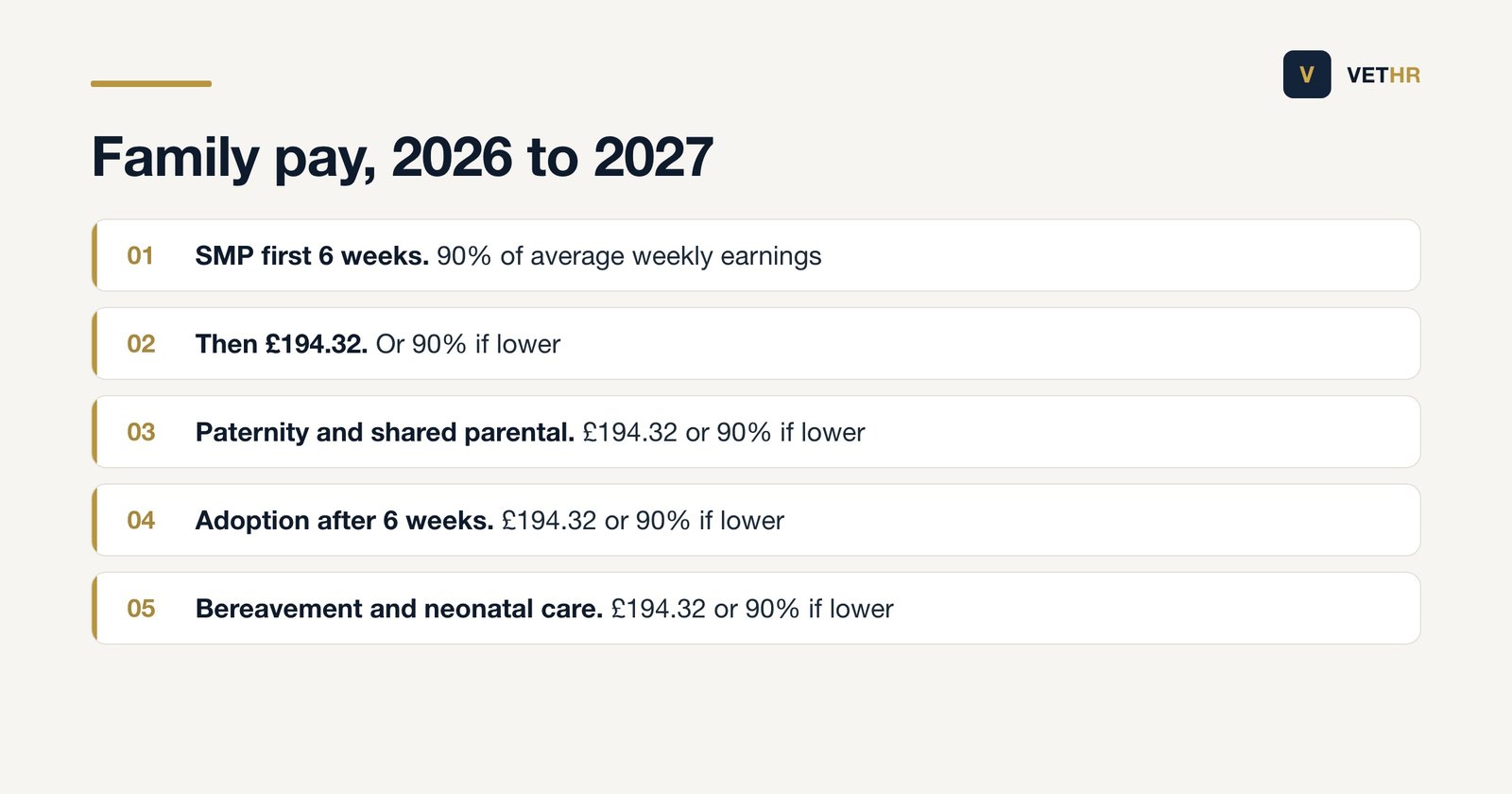
SMP pays 90% of average weekly earnings for the first six weeks, then £194.32 or 90% of average weekly earnings, whichever is lower. Paternity, shared parental, parental bereavement and neonatal care pay each use £194.32 or 90%, whichever is lower. Adoption pay follows the same pattern as maternity pay.
An illustration: an employee with average weekly earnings of £500 would receive 90%, which is £450, for the first six weeks of SMP. After that, 90% is £450 but the flat rate is £194.32, so the lower figure of £194.32 applies. The figures are examples to show the method.
These are statutory minimums. Many practices enhance maternity pay to retain staff, and some pay a full-pay period before dropping to statutory. If yours does, set out clearly what happens after the enhanced period. Our guides to maternity leave, paternity leave and shared parental leave cover entitlement and notice.
The GOV.UK timeline update says day one paternity leave and unpaid parental leave took effect on 6 April 2026. Bereavement leave, including pregnancy loss, takes effect in April 2027. All future dates remain subject to parliamentary processes and may change.
Check your policies against both. A paternity policy that still asks for a qualifying period of service is now out of date, and the same goes for unpaid parental leave. Read the GOV.UK timeline update for the current dates before you finalise changes, and see our guide to employment law changes for veterinary practices.
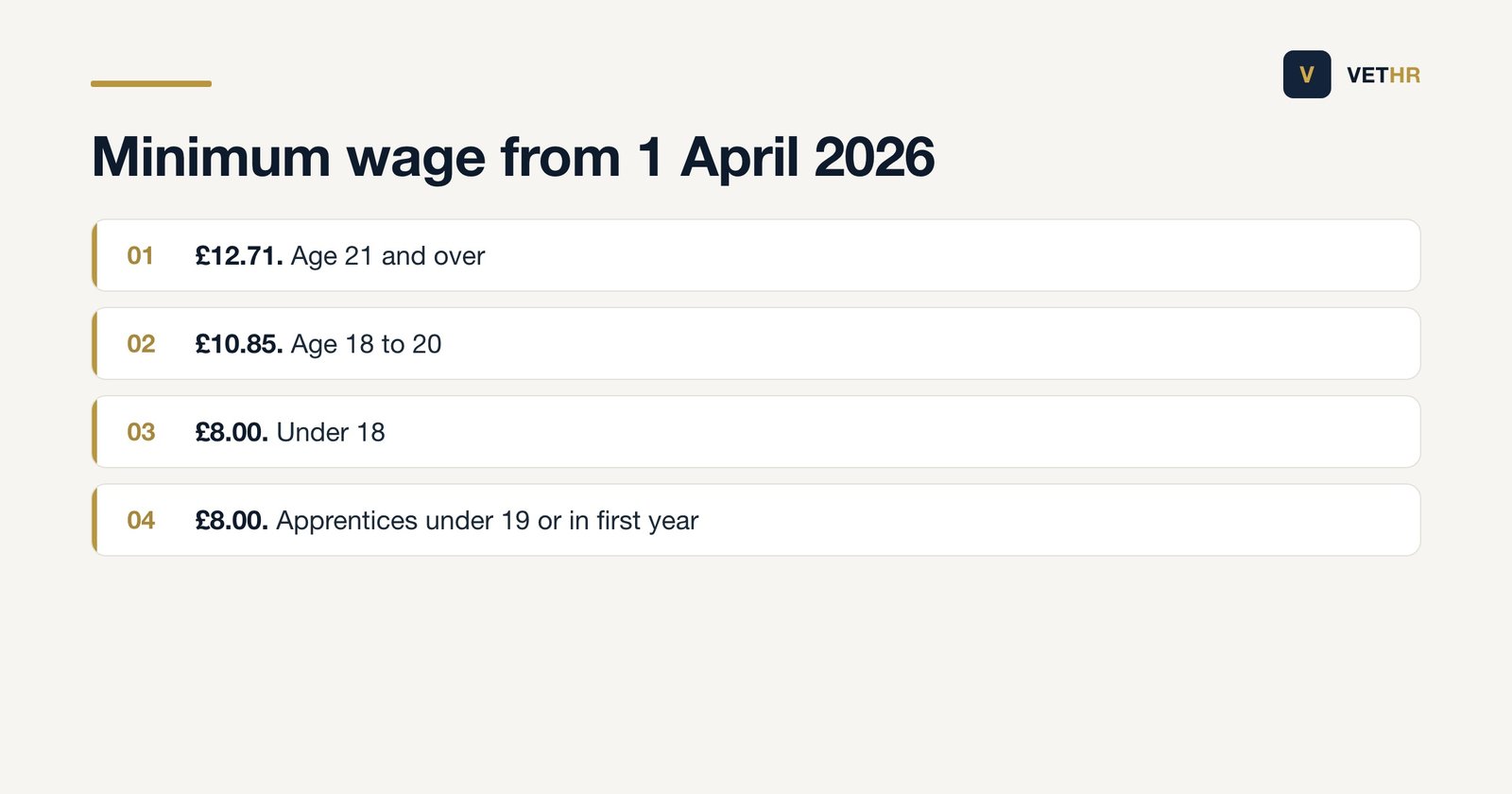
From 1 April 2026 the National Living Wage is £12.71 an hour for those aged 21 and over. The rates are £10.85 for 18 to 20 and £8.00 for under 18. The apprentice rate is £8.00 for apprentices under 19 or aged 19 or over in the first year of their apprenticeship.
These come from GOV.UK’s page on National Minimum Wage and National Living Wage rates. For a veterinary practice the points that catch people out are the age bands for junior reception and kennel staff, the apprentice rate for trainee nurses and the way unpaid on-call time or deductions can bring pay below the minimum. Our guide to the minimum wage in a veterinary practice covers those.
Apprenticeships deserve a note. The apprentice rate applies only while the person is under 19 or in their first year. After that, the rate for their age applies, and it is easy to forget when the first year ends. Put the date in your payroll diary.
Take a practice of fifteen staff in a month with ordinary absences. One part-time receptionist is off sick for three days. One nurse is on maternity leave. One vet starts paternity leave. One apprentice has a birthday and moves to a new age band. Each case uses a different rate from the table, and a payroll run has to get all four right.
The part-time receptionist earns £150 a week on average. Under the current rules there is no waiting period and no earnings limit, so SSP applies from the first day. Eighty per cent of £150 is £120, which is lower than £123.25, so the weekly SSP is £120, paid pro rata for the days off. A year earlier, the same absence might have started unpaid for three days.
The nurse in the later weeks of SMP receives the lower of £194.32 or 90% of average weekly earnings. If the practice enhances maternity pay, payroll must record when the enhanced period ends, because the step down is a frequent source of queries. The new father receives statutory paternity pay at the lower of £194.32 or 90%, and the apprentice’s hourly rate depends on age and on whether they are still in the first year.
None of this is complicated individually. The risk is volume and timing. A short monthly review of who is on which rate, with the date each rate changes, stops the small errors that become formal grievances. Our payroll guide for veterinary practices explains how to set that review up.
GOV.UK lists the secondary threshold at £96 a week and the upper secondary threshold for under 21s, apprentices and veterans at £967 a week, with an upper earnings limit of £967 a week. The lower earnings limit for Class 1 National Insurance is £129 a week.
These affect payroll cost more than statutory pay itself. A payroll provider will normally update them, but check the new tax year’s figures appear on the first payslips. GOV.UK also lists the recovery rates for statutory payments: 92% where total Class 1 National Insurance for the previous tax year is above £45,000, and 109% where it is £45,000 or lower.
Check five things: the statutory rates in payroll, the minimum wage for each employee’s age, the sickness and family leave policies, any enhanced schemes that refer to statutory rates, and payslip wording. Do it in the first week of April and again if rules change mid-year.
If you would like a second pair of eyes on your policies and payroll set-up, book a free 30-minute HR health check at our contact page. Our HR policies and documents set is kept in line with the current rules.
The common mistakes are using last year’s rates, keeping waiting days in the policy, forgetting the lower earnings limit has gone, missing the apprentice cut-off and paying enhanced pay without a clear end.
£123.25 a week, or 80% of the employee’s average weekly earnings if that is lower. It is payable from the first day of absence, with no waiting period and no lower earnings limit.
90% of average weekly earnings for the first six weeks, then £194.32 a week or 90% of average weekly earnings, whichever is lower, for the remaining weeks.
£12.71 an hour for age 21 and over. The rate is £10.85 for 18 to 20, £8.00 for under 18 and £8.00 for apprentices under 19 or in their first year.
Yes. From 6 April 2026 the three-day waiting period has been removed, and SSP is payable from the first day of absence. The lower earnings limit has also been removed.
GOV.UK lists recovery rates of 92% where total Class 1 National Insurance for the previous tax year is above £45,000, and 109% where it is £45,000 or lower. Check the conditions with your payroll provider.
Book a free 30-minute HR health check through our contact page and we will review your sickness and family leave policies against the current rules. See also our HR consultancy for veterinary practices.
Sources: GOV.UK: rates and thresholds for employers 2026 to 2027, Business.gov.uk: Statutory Sick Pay changes, GOV.UK: National Minimum Wage and National Living Wage rates, GOV.UK: Employment Rights Act timeline update.
Contracts, rotas, holiday, a difficult conversation. Tell us what you are dealing with and we will come back within one working day. Nothing to sign up to.
Got it. We will come back to you within one working day. If you do not see a reply, please check your spam folder.
