TL;DR: Fire and rehire means dismissing an employee who will not agree to a new contract, then re-engaging them on the new terms. Today it is lawful if the practice has a sound business reason and acts reasonably, and a statutory code sets the minimum process. The Employment Rights Act 2025 will make it automatically unfair to use it for core changes such as pay, hours, leave, pensions and some shift patterns, unless the practice is in serious financial difficulty. Dates are still moving, so plan now.
Last updated: 2 November 2026
A practice group buys three independent clinics. Their contracts differ: different pay bands, different on-call arrangements, different holiday entitlements. The head office wants one set of terms. Most staff agree. Two senior nurses and one vet do not. Someone says, in a meeting, that they will have to agree or leave.
That sentence is where fire and rehire starts. This guide explains what the law says today, what the Employment Rights Act 2025 changes, what shift pattern changes might be caught, and what a veterinary practice can do instead. It is general information and not legal advice, so take advice before you act on a specific case.
Fire and rehire is where an employer dismisses an employee who will not agree to a contract change and then offers to re-engage them, or engages someone else, in the same or substantially the same role on the new terms. It is a dismissal, so all the usual unfair dismissal rules apply.
The government’s factsheet on the Employment Rights Act 2025 describes it this way: employers may sometimes need to propose changes to contracts, and if employees do not agree, the employer may dismiss them before offering to re-engage them, or other employees, in the same or substantively the same roles, to put the changes in place.
In a veterinary practice the changes that cause trouble are usually the practical ones: pay structures, on-call and out-of-hours rotas, reduced holiday, a bonus scheme that is withdrawn, or harmonised terms after an acquisition. Our guide to contract changes in a veterinary practice covers the ordinary route of agreeing the change first.
Yes, but it is risky. The government factsheet says that under the existing law an employer may be able to fire and rehire if it can show a sound business reason, including responding to economic changes, changing working practices or harmonising terms, and must show it acted reasonably in all the circumstances.
That means a tribunal will ask two questions: was there a sound business reason, and was the dismissal reasonable, including how the practice consulted and what it offered. Acas calls fire and rehire a last resort, to be considered only after you thoroughly explore all other options and fully consult. It is still a dismissal, so you need a fair reason, a fair process, the right notice and a right of appeal.
Imposing a change without agreement is a different risk. Acas says it is a breach of contract, and employees may work under protest, bring claims or resign and claim constructive dismissal. Neither route is free of risk, which is why the safest plan is agreement.
The Code of Practice on dismissal and re-engagement is, in Acas’s words, the minimum procedure you must follow. It sets out employers’ responsibilities when seeking to change terms. A tribunal can increase an employee’s compensation by up to 25% if an employer has unreasonably failed to comply with it.
The factsheet says that until the new measures come into force, the existing Code of Practice sets out employers’ responsibilities when seeking to change contractual terms and conditions of employment, and that an employment tribunal can increase compensation in certain circumstances by up to 25% if an employer has unreasonably failed to comply with the code.
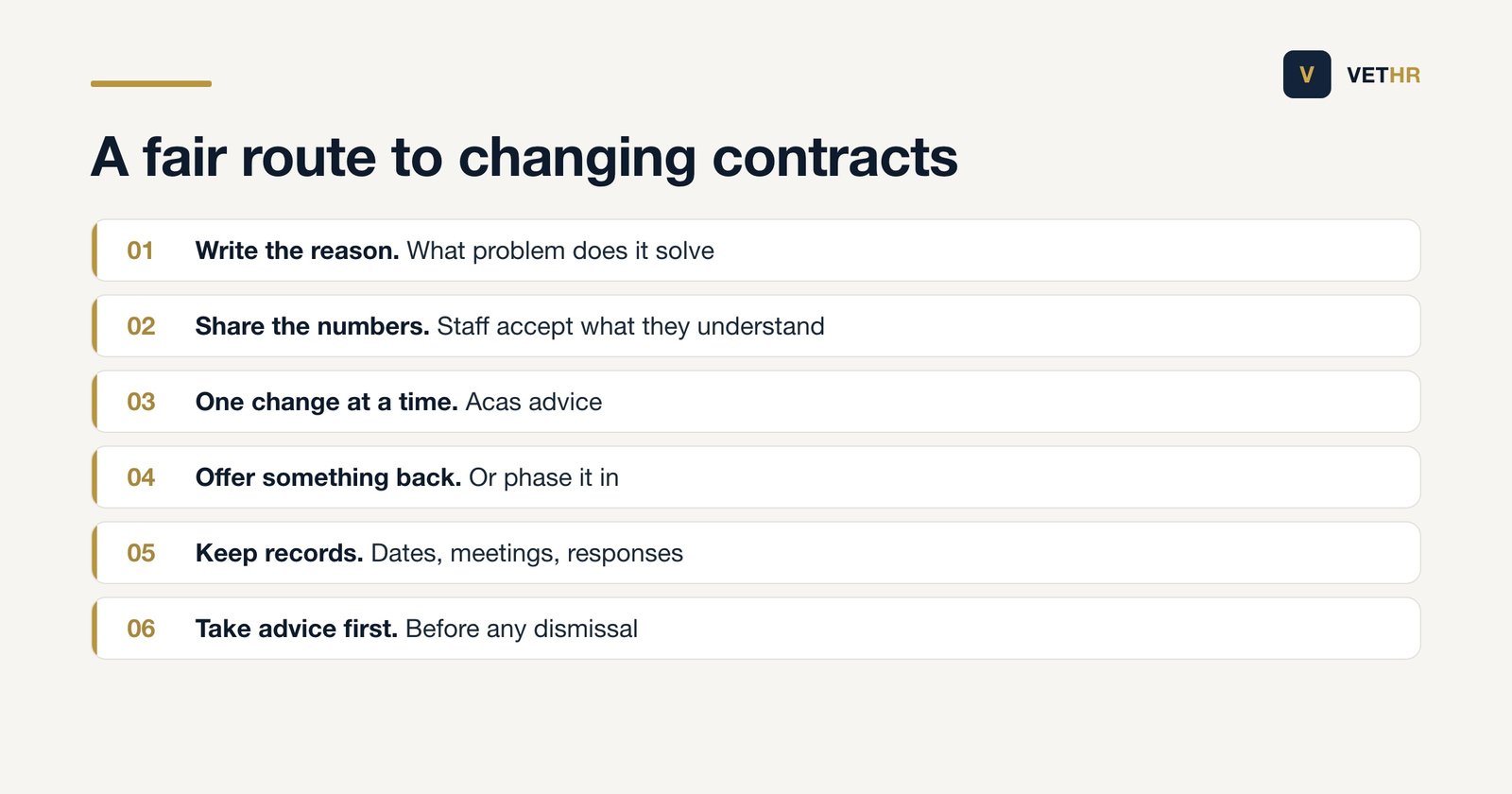
Acas’s practical advice on its page if changes cannot be agreed is to keep negotiating for as long as is reasonably possible, discuss one change at a time, be transparent about your reasons and make proposals easier to accept, for example by offering better terms in exchange for less popular changes, or introducing changes gradually or temporarily. It also says to contact the Acas helpline before raising fire and rehire with employees.
If you propose to dismiss 20 or more employees at one establishment, collective consultation rules apply. Acas says to consult at least 30 days before the first dismissal for 20 to 99 employees, or 45 days for 100 or more. A protective award of up to 180 days’ full pay per employee can apply from 6 April 2026.
For most independent practices this is unlikely to apply to a single practice, but it can matter for a group or a merger affecting many staff. Acas notes that if you fail to consult collectively, a protective award of up to 180 days’ full pay per employee can apply from 6 April 2026, and a tribunal can increase it by up to 25% if you unreasonably failed to follow the code.
If you are anywhere near the number, take advice before you start. The consultation period has to run before the first dismissal, so timing is part of the plan.
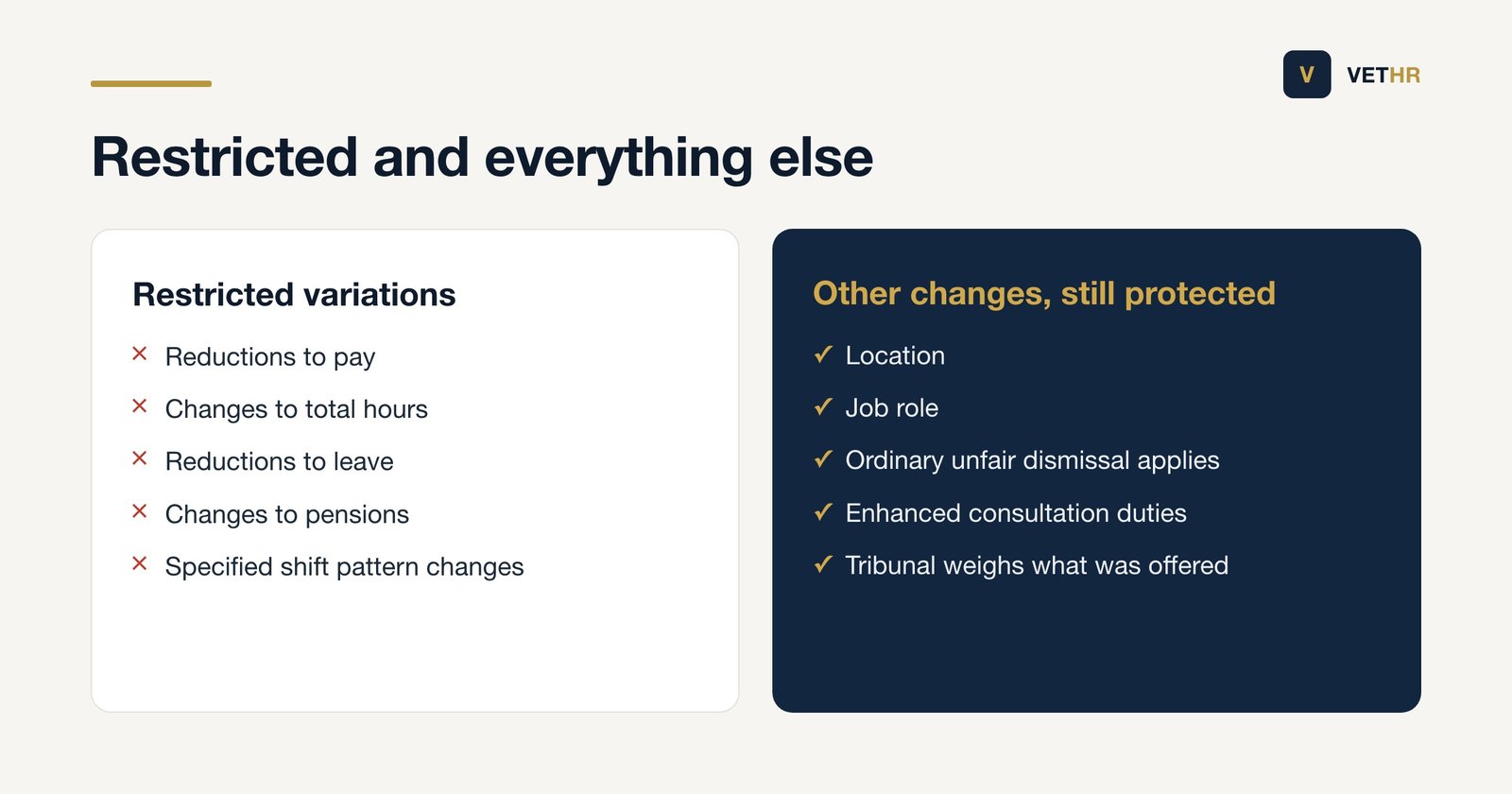
It makes it automatically unfair to dismiss an employee for refusing a restricted variation of their contract, unless the employer meets a narrow exemption for financial difficulty. Restricted variations are reductions to pay, changes to total hours, reductions to leave entitlement, changes to pensions and specified shift pattern changes.
The factsheet explains that it will be an automatic unfair dismissal for employers to use the practice to change these core employment terms unless they meet a narrow exemption for financial difficulties. It also says it will be an automatic unfair dismissal to dismiss employees to replace them with non-employees, for example agency workers, to do substantially the same work, unless the need for the work has ceased or reduced or the financial difficulty exemption applies.
Changes to non-restricted terms, such as location or job role, will not be automatically unfair, but they will be subject to enhanced protections for ordinary unfair dismissal. These aim to make sure employers consult meaningfully and require tribunals to take account of anything offered in exchange for the change.
It is a narrow defence. The employer must show evidence of financial difficulties affecting, or likely in the immediate future to affect, its viability, that the changes were to eliminate, prevent or significantly reduce or mitigate those difficulties, and that it could not reasonably have avoided the need to make them.
All three limbs must be met. The factsheet calls it a high bar that accounts for businesses that need to restructure to remain viable and save jobs. Even where the employer meets it, the tribunal still has to assess whether the dismissal was fair in the circumstances, considering whether the employer consulted and whether it offered the employee anything in return.
For a practice, that means evidence, not an assertion. Management accounts, forecasts, cash flow and the options you considered would all matter. A plan to improve margins, harmonise terms or pay for an acquisition is not on its own the same as financial difficulty affecting viability.
The Act lets the Secretary of State set out in regulations which shift pattern changes are restricted variations. The government consulted on whether changes between day and night and between weekday and weekend working should be included, and on whether to exclude certain expenses and benefits in kind from the pay restriction.
The factsheet says the consultation on the shift pattern and expenses details ran until 1 April 2026, and the regulations will follow. Until they are published, treat rota changes with care. In a veterinary practice, out-of-hours rotas, night cover and weekend working are central to how the business runs, so a change to them may be caught.
Our guides to out-of-hours rotas and on-call pay cover the current rules on those arrangements. Watch the regulations before you plan a rota overhaul that staff may resist.
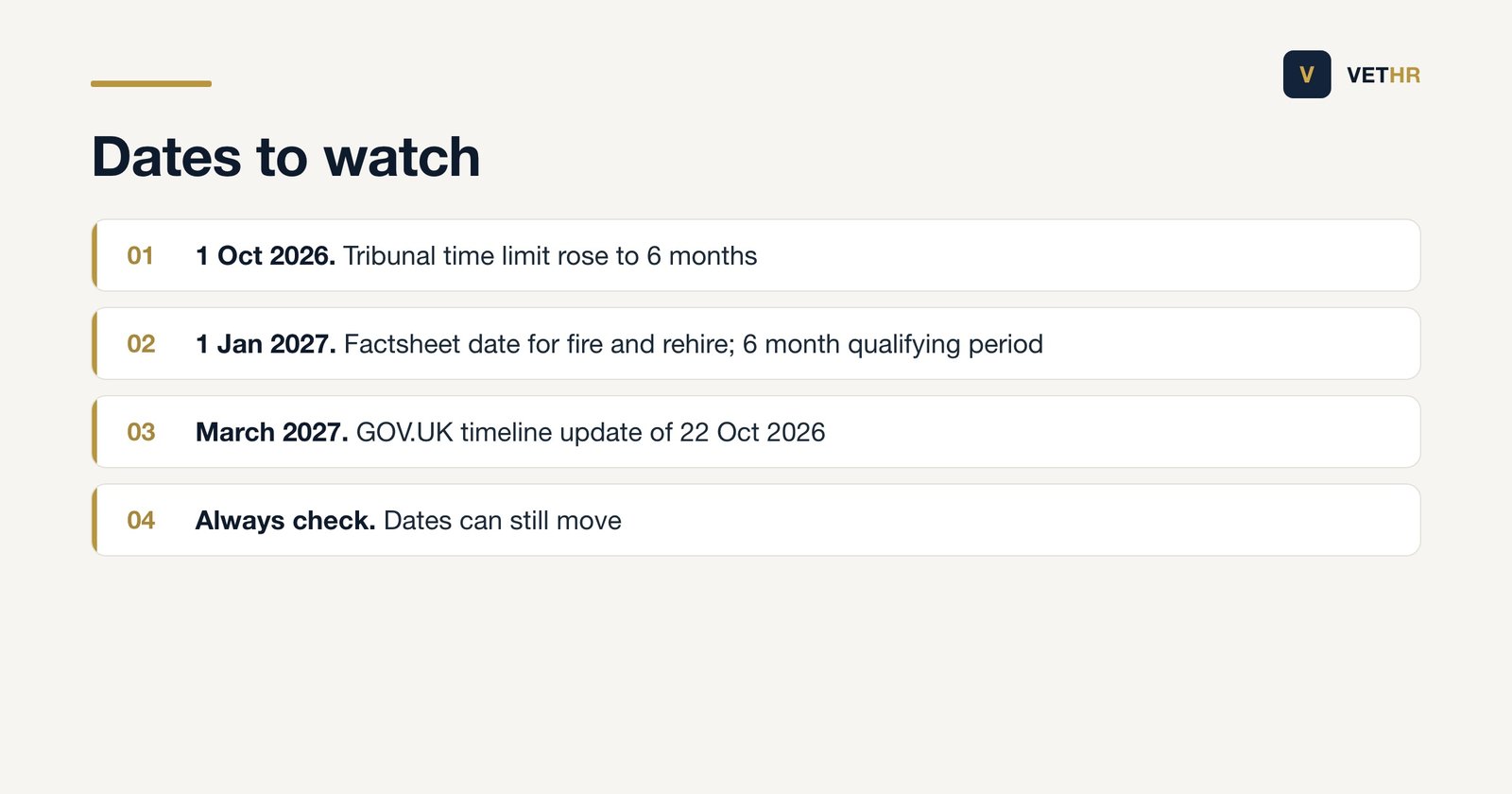
The government factsheet gives an expected commencement of 1 January 2027, and Acas also expects January 2027. The GOV.UK timeline update, updated on 22 October 2026, lists fire and rehire protections under measures taking effect in March 2027. The date has moved before and may move again.
The same timeline update lists other dates that matter to practices: the increase in tribunal time limits from 3 to 6 months took effect on 1 October 2026, and the unfair dismissal qualifying period is reduced to 6 months for dismissals from 1 January 2027. All future dates remain subject to parliamentary processes.
Read the current GOV.UK timeline update before you rely on any date. Our guides to employment law changes for veterinary practices and the unfair dismissal qualifying period track the wider changes.
Rushing is risky. The existing law still requires a sound business reason and a reasonable process, the statutory code still applies, and tribunals can increase compensation by up to 25% for unreasonable failure to follow it. The government estimates that fewer than 1% of employers use fire and rehire in a year.
The factsheet, citing Department for Business and Trade analysis of 2022 survey data, suggests that fewer than 1% of employers might engage in the practice each year, and says most businesses seek mutually beneficial solutions. In a profession short of vets and nurses, the commercial case against it is as strong as the legal one. A threatened dismissal is often the moment a good clinician starts looking elsewhere.
If you think a change is needed, ask whether the same outcome can be reached by agreement, by phasing, by offering something in return or by a voluntary opt-in. Those routes are lawful now and lawful after the change.
Start with the reason, then the options. Explain why the change is needed in plain terms, show the figures, listen to alternatives, offer something in return, phase the change and give people time. Record every step, because a tribunal will want to see the process, not just the outcome.
If you want a second pair of eyes before you start, book a free 30-minute HR health check at our contact page. We can look at the change you have in mind and the likely reaction, and suggest a plan.
It matters whenever terms are harmonised. After an acquisition, the buyer often wants one set of terms across clinics. If staff transfer under TUPE, their terms generally transfer with them, so changing them afterwards needs agreement or a proper process. Pushing changes through fire and rehire will become harder once the new rules apply.
Plan harmonisation as a project, not an announcement. Map the differences, decide which matter, price the cost of levelling up where you can, and consult properly. Our guides to TUPE for veterinary practices and restructuring a veterinary practice explain the surrounding rules.
Where harmonisation is the aim, a transition period with protected terms for current staff is often cheaper than a dispute. New starters join on the new terms, current staff move when they choose or when the old terms naturally end. It takes longer, and it keeps people.
The common mistakes are threatening dismissal early, skipping consultation, presenting a decision as a proposal, rushing before the law changes and failing to keep records. Each makes a later claim easier to bring and harder to defend.
Not today. An employer may be able to fire and rehire with a sound business reason and a reasonable process. The Employment Rights Act 2025 will make it automatically unfair for certain core changes, with a narrow exemption for financial difficulty.
The government factsheet gave 1 January 2027, and Acas expects January 2027. The GOV.UK timeline update of 22 October 2026 lists March 2027. Dates remain subject to parliamentary processes, so check the current update.
Reductions to pay, changes to total hours, reductions to leave entitlement, changes to pensions and specified shift pattern changes. The shift pattern details are set by regulations, following a consultation on day and night and weekday and weekend changes.
It is the minimum procedure an employer must follow when seeking to change terms. A tribunal can increase compensation by up to 25% if an employer unreasonably fails to follow it. Acas advises contacting its helpline before raising fire and rehire with staff.
Not safely. Imposing a change without agreement is a breach of contract, and dismissing someone for refusing is risky now and may be automatically unfair later if it touches restricted terms. Consult, offer something in return and take advice.
If you are planning a contract change, book a free 30-minute HR health check through our contact page and we will talk through the options. See also our HR consultancy for veterinary practices and the policy document set.
Sources: GOV.UK factsheet: fire and rehire, February 2026, Acas: if changes cannot be agreed, GOV.UK: Employment Rights Act timeline update.
Contracts, rotas, holiday, a difficult conversation. Tell us what you are dealing with and we will come back within one working day. Nothing to sign up to.
Got it. We will come back to you within one working day. If you do not see a reply, please check your spam folder.
