Last updated: 14 September 2026
TL;DR: Gross misconduct is conduct serious enough to justify dismissal without notice for a first offence, such as theft, fraud, violence or gross negligence. In a veterinary practice that includes diverting controlled drugs and falsifying clinical records. A fair process still applies every time: investigate, set out the allegations in writing, hold a hearing with a companion, decide, and offer an appeal.
A controlled drugs register that does not balance. A nurse who arrives for an evening shift smelling of alcohol. A client account discounted to almost nothing. These are the moments when an owner wants someone gone by lunchtime, and they are exactly the cases where a dismissal gets lost on process.
Gross misconduct is behaviour so serious that it destroys the trust the working relationship depends on, which can justify dismissal without notice even for a first offence. The Acas Code of Practice gives theft or fraud, physical violence, gross negligence and serious insubordination as examples, and expects your own rules to say more.
There is no fixed legal list. What counts depends on the organisation and the job, which is why the Code accepts that examples will vary with the nature of the work. A practice that stores controlled drugs, holds client data and keeps animals in overnight carries risks an ordinary office does not.
Ordinary misconduct is handled differently. Lateness, a rude exchange with a colleague or a task left undone are dealt with through warnings that escalate. Gross misconduct skips those warning stages, and nothing else.
Write your examples down before you need them. A list in the staff handbook tells people where the line sits before anyone crosses it, and gives whoever hears a case something concrete to measure the facts against.
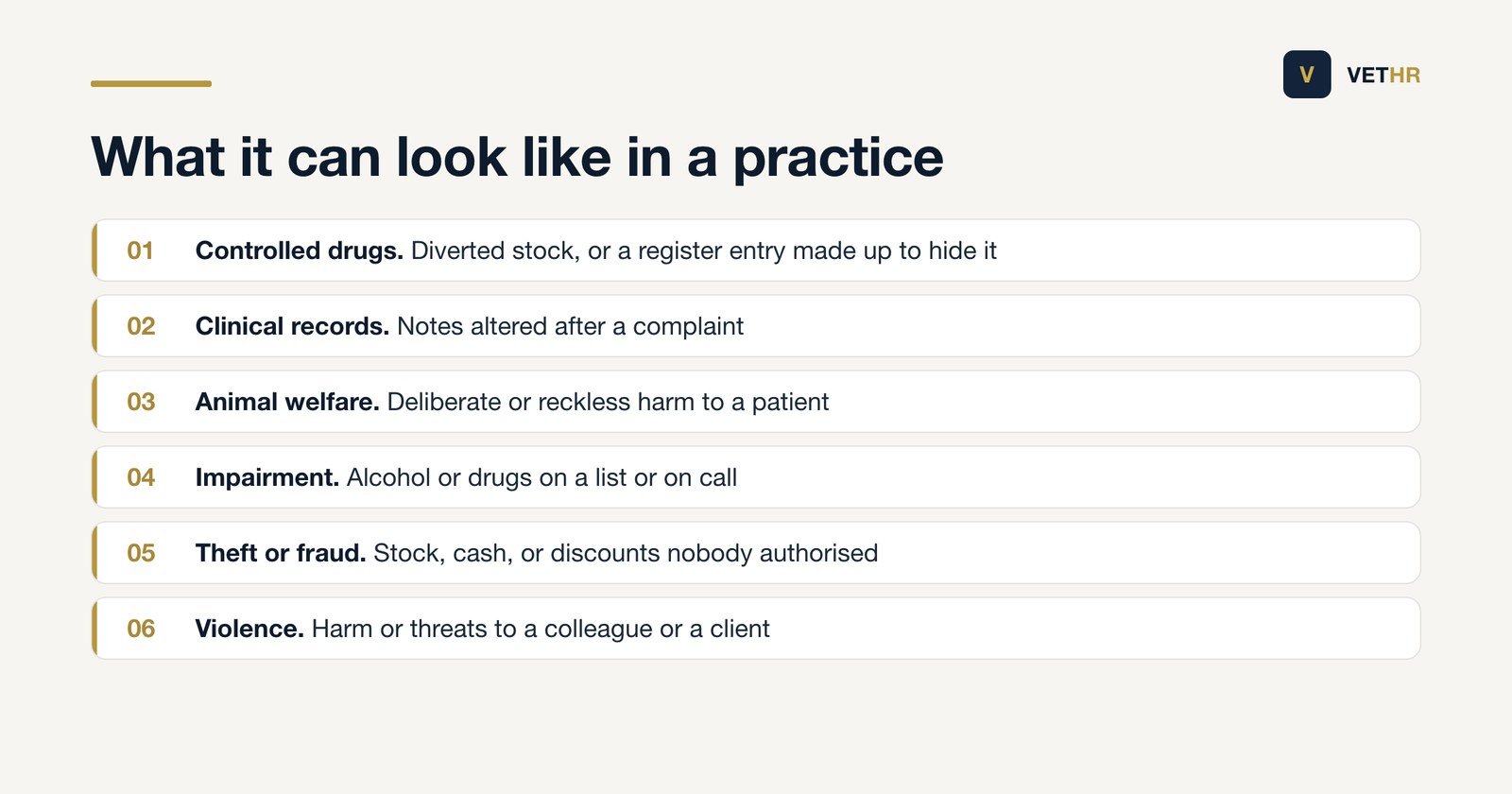
In a veterinary practice, gross misconduct usually involves drugs, records, animals, money or people. The eight examples below are the kind practices put in their disciplinary rules. Every case still turns on its own facts, its evidence and what the person says when they are given the chance to respond.
Impairment needs particular care. Where alcohol or drug use points to a dependency rather than a one-off choice, the practice may be dealing with a health problem as well as a conduct problem. Our guide to a drugs and alcohol policy explains how to handle that line fairly.
Social media sits at the edge of the list. A post that identifies a client or mocks a patient can amount to gross misconduct, and a clear social media policy makes that far easier to show at a hearing.
Yes. Gross misconduct can justify dismissal without notice for a first offence, with no earlier warnings on file. What it never justifies is skipping the process. Acas is clear that a fair disciplinary process should always be followed before anyone is dismissed, however obvious the facts look on the day.
The risk is financial as well as legal. Under the Acas Code of Practice on disciplinary and grievance procedures, an employment tribunal can adjust any award by up to 25 per cent where an employer has unreasonably failed to follow the Code.
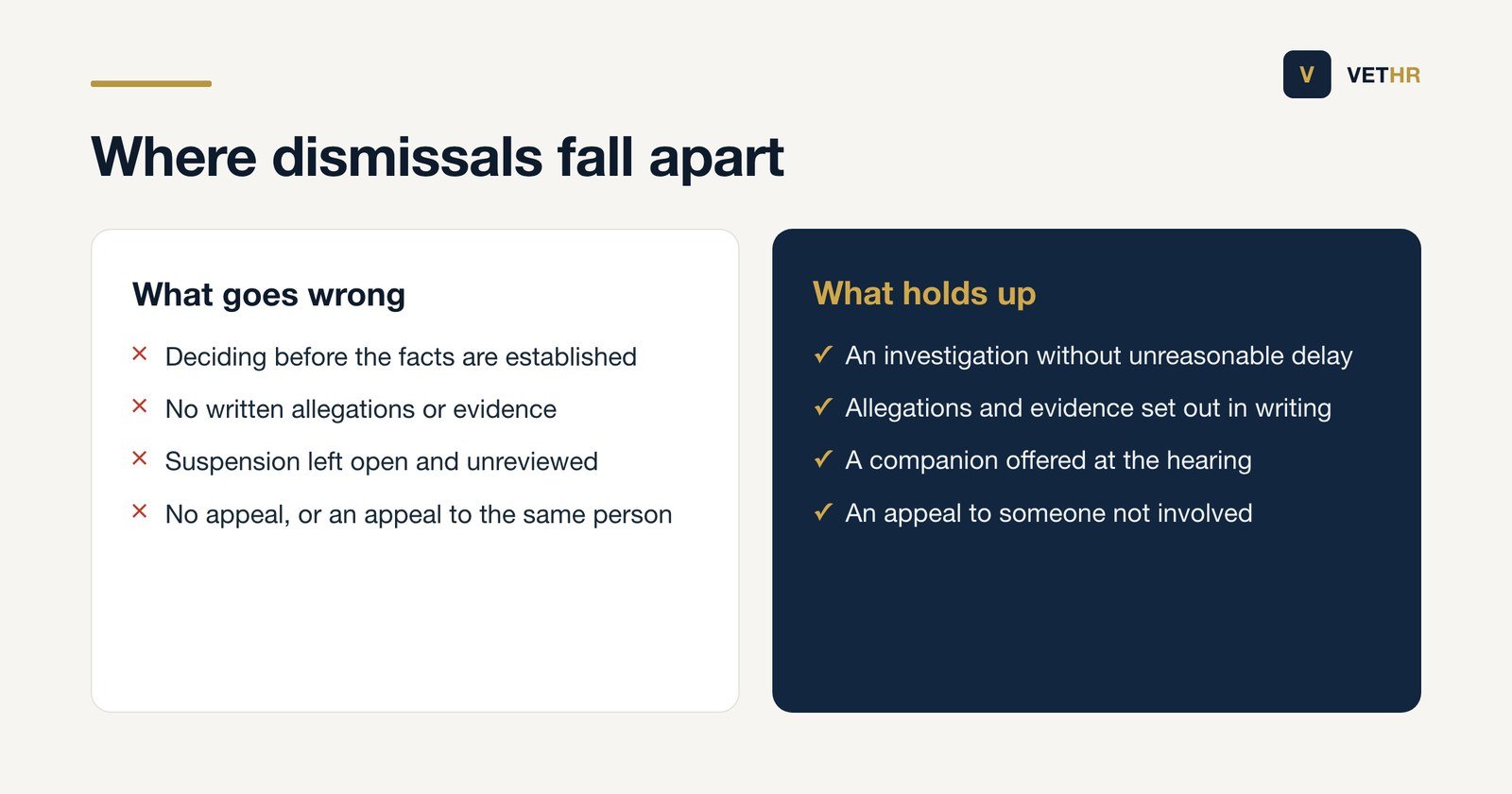
The obvious cases are the dangerous ones. When the whole team saw what happened, managers treat the hearing as a formality and cut corners, and a person who plainly did something wrong can still bring a strong claim about how they were dismissed. Our guide to the employment tribunal sets out what defending a claim involves.
Dismissal is also a decision, never an automatic result. A hearing can find gross misconduct and still conclude that a final written warning is the fairer outcome, for example after many years of clean service or where the person was never trained on the rule they broke.
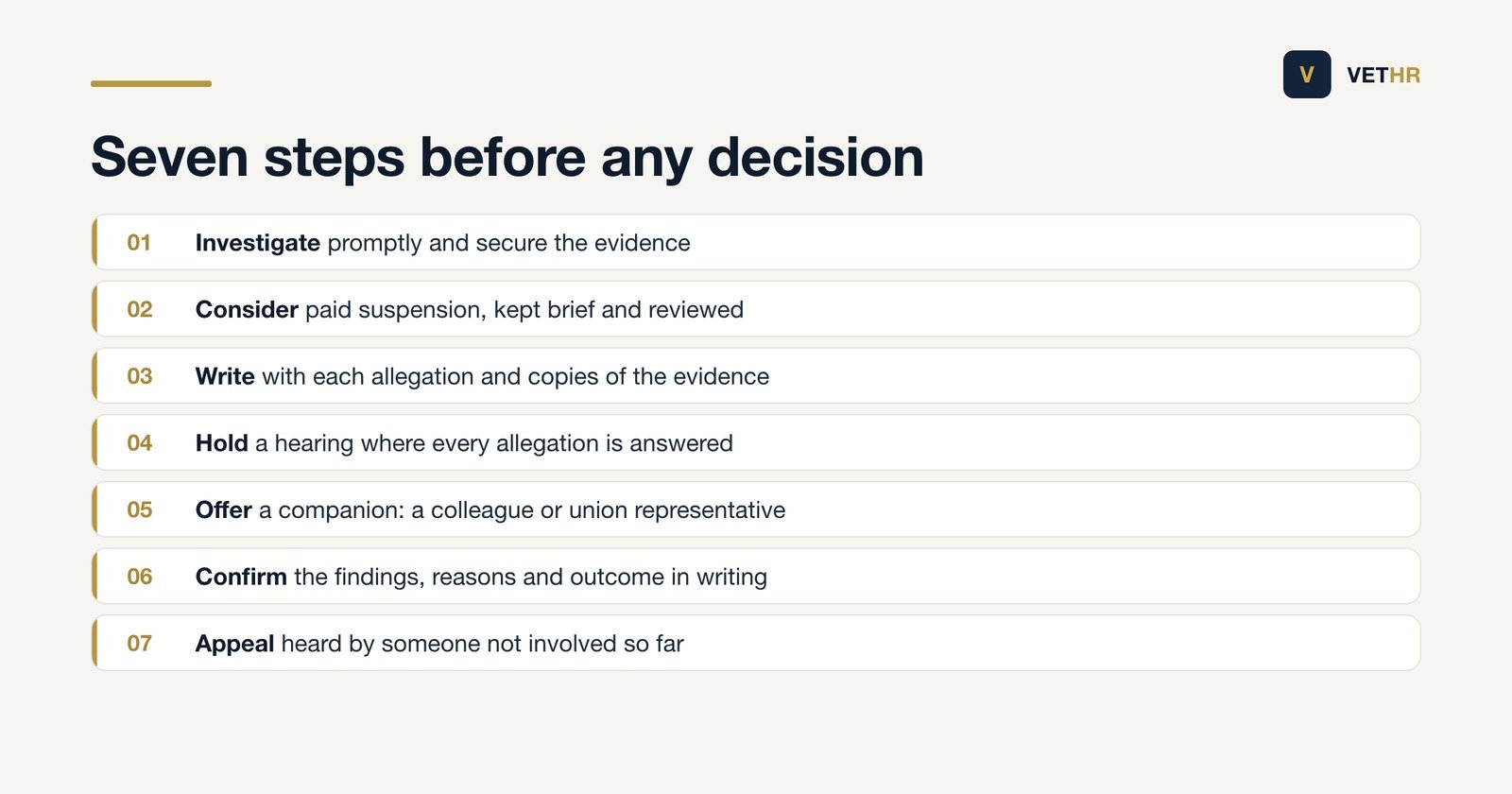
The fair process for gross misconduct follows the Acas Code: establish the facts without unreasonable delay, consider paid suspension, set out the allegations and evidence in writing, hold a hearing, allow a companion, confirm the decision in writing and offer an appeal. In a small practice, deciding who handles each step matters as much as the steps.
In a practice of fifteen people, steps six and seven are where it gets hard. The owner often investigates, decides and would also hear the appeal. Where that cannot be avoided, bring in an independent HR adviser for one of the stages, so the appeal is a genuine second look rather than the same view twice.
Keep every note. If the decision is challenged later, the written record of what was alleged, what was said and why the outcome followed is the practice’s evidence. Our guide to disciplinary procedures sets out the letters and records to keep.
A controlled drugs discrepancy is an investigation before it is an allegation. RCVS guidance says register balances should always tally with the stock in the cabinet, and where they do not, the discrepancy must be reported to the appointed senior veterinary surgeon and investigated. A shortfall can come from a recording error as easily as from theft.
The RCVS controlled drugs guidance adds two points that shape the HR process. Where there are concerns that a vet or veterinary nurse is involved in suspected theft, the practice should consider whether to report it to the police. Where a vet or nurse receives a caution or conviction for theft, it should consider whether to report that to the RCVS.
The register itself is evidence. The same guidance says registers must be kept for a minimum of two years after the date of the last entry, so preserve the register, and any separate registers for other sites, the moment a shortfall is found.
Do not start by questioning the person you suspect. Establish what the records show, who had access to the cabinet and when, and only then put questions to anyone. Where the evidence points towards a dependency, the conversation about support and the conduct process can run alongside each other.
Facing a gross misconduct case right now? A free 30-minute HR health check will help you plan the process before you act. Book your HR health check.
Two things. Acas is revising its Code on disciplinary and grievance procedures, and its consultation closes on 23 September 2026. Separately, from 1 January 2027 the qualifying period for unfair dismissal falls to six months and compensatory awards are uncapped, which raises the stakes of every flawed dismissal.
Acas issued its consultation on a revised Code on 30 July 2026, with responses due by 11:59pm on 23 September 2026. It says the update aims to promote earlier resolution of workplace concerns, and notes the Code was last fully revised in 2009, with specific amendments in 2015. The draft also narrows when suspension should be considered.
Until a revised Code is approved and brought into force, the current Code is the one a tribunal will apply. Keep your procedure in line with it now and review the wording once the final version is published.
The bigger change is service. The government’s Employment Rights Act timeline confirms a six month qualifying period for dismissals from 1 January 2027, with compensatory awards uncapped. Our guide to the unfair dismissal qualifying period explains what that means for probation.
For gross misconduct the practical effect is simple. From January, a rushed dismissal of a nurse with eight months’ service can be challenged as unfair, and the compensation is no longer limited by the cap. The process you build this autumn is the one you will be relying on.
Misconduct, such as lateness or a rude exchange, is handled through warnings that escalate. Gross misconduct is serious enough to justify dismissal without notice for a first offence, such as theft, fraud, violence or gross negligence. Both need a fair process, but only gross misconduct can skip the warning stages.
Yes. The Acas Code accepts that some acts are so serious in themselves, or have such serious consequences, that they may call for dismissal without notice for a first offence. The practice must still investigate, hold a hearing, allow a companion and offer an appeal before it decides.
Where a fair process finds gross misconduct, dismissal can be without notice. Where the facts do not support that finding, or the process was flawed, notice pay may still be owed and the practice may face a wider claim, so take advice before withholding it.
Only where it is genuinely needed, for example to protect evidence, patients or colleagues. The Acas Code says suspension should be with pay, as brief as possible, kept under review, and made clear it is not a disciplinary action. Sometimes a temporary change of duties does the same job.
Someone who has not been involved, wherever possible. The Acas Code expects appeals to be heard promptly by a manager not previously involved. In a small practice that may be a partner who stayed out of the case, or an independent HR adviser brought in for that stage.
Gross misconduct is rare, and it arrives without warning. The practices that handle it well have already written their examples down, decided who investigates, and know who would hear an appeal long before the day comes.
Start with your disciplinary rules and the list of examples inside them. Our HR consultancy helps practices put the rules and the process in place, and a free HR health check is the quickest way to find out whether yours would hold up.
The Vet HR Team provides HR consultancy and white-labelled staff systems exclusively to UK veterinary practices. This guide is general information, not legal advice.
Contracts, rotas, holiday, a difficult conversation. Tell us what you are dealing with and we will come back within one working day. Nothing to sign up to.
Got it. We will come back to you within one working day. If you do not see a reply, please check your spam folder.
