Last updated: 5 September 2026
TL;DR: Employee self service lets staff see their rota, book leave, check balances and access payslips without asking anybody. Electronic payslips are acceptable provided they are given on or before payday and show hours where pay varies with time worked. The gain is not admin time saved, it is the removal of a hundred small interruptions a month.
Count the interruptions a practice manager gets in a week without employee self service. How much holiday have I got left. Can you send me my March payslip. Am I on Saturday. Each one takes two minutes and breaks whatever was being done, and none of them needed a person at all.
Employee self service matters because the admin is concentrated in one or two people who are also doing everything else. In a practice of twenty, the queue at the practice manager’s door is the bottleneck, not the volume of work itself.
The second gain from employee self service is accuracy. A holiday balance someone can see is a balance they will query when it looks wrong, which surfaces errors in March rather than in a December argument.
There is a recruitment angle too. Candidates increasingly ask how the rota is published and whether they can see it on a phone, and a practice offering employee self service is answering a question its competitors are still fumbling.
The third is fairness. When everyone can see the rota, the leave calendar and their own record, decisions look like decisions rather than like favours granted to whoever asked in person.
And it works on the shift patterns practices actually run. Bank staff and part-timers are rarely in the building when the office is open, which is precisely why they end up least informed, as our guide to part-time workers notes.
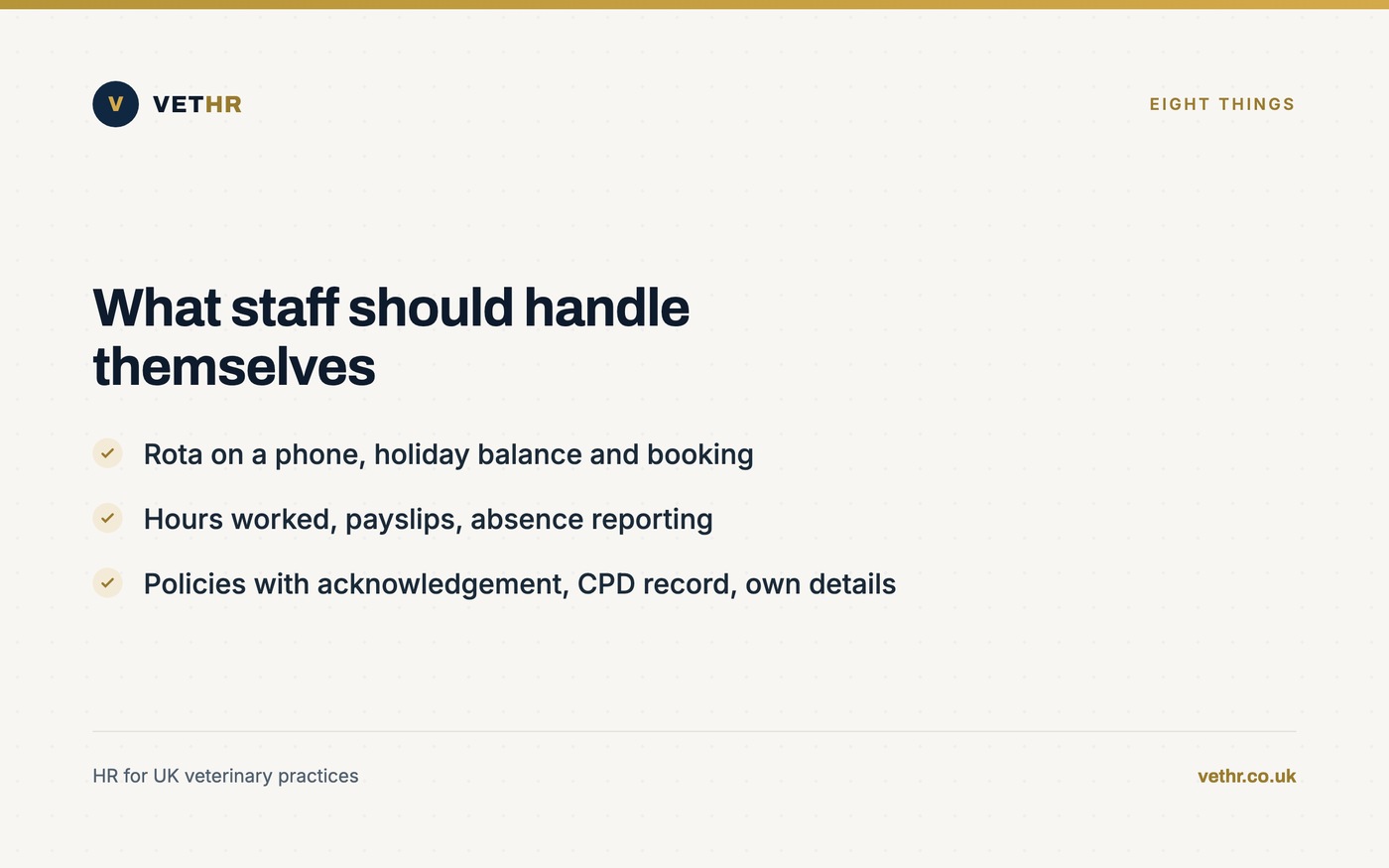
Employee self service should cover eight things, in roughly this order of value. Each one removes a recurring question rather than adding a feature nobody asked for.
Number three is the one that changes behaviour most. When staff can see their recorded hours, disputes about handover time and late finishes get raised in the week rather than at a resignation, as our guide to the minimum wage explains.
Number six removes a genuine compliance headache. Acknowledgements captured automatically are the evidence you need when a policy is later relied on, as our guide to the staff handbook covers.
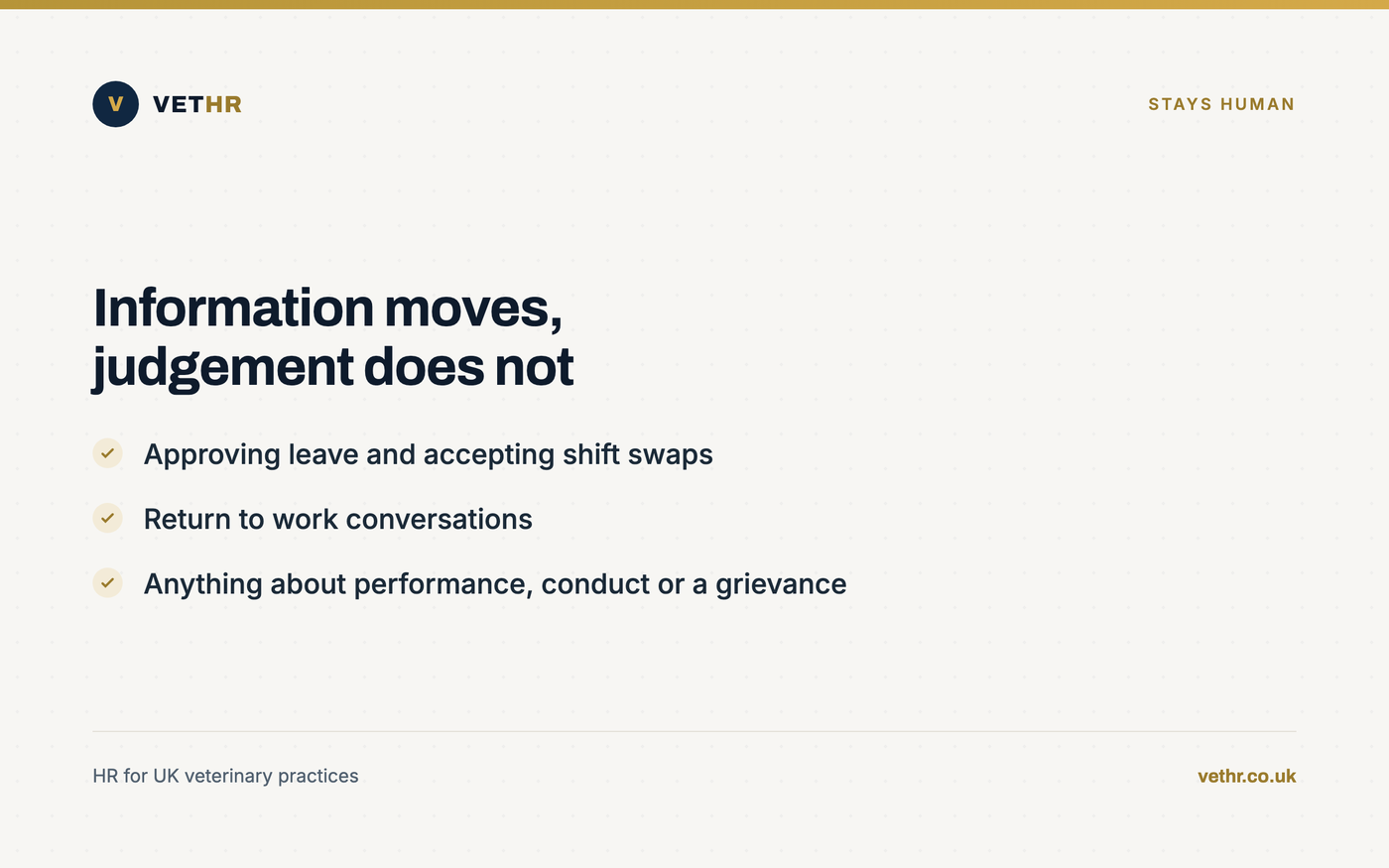
Every decision, and every conversation that carries weight. Employee self service should move information and requests, never judgement.
The absence one needs care. A structured reporting route is useful, and it must not replace the return to work conversation, which is where patterns and underlying causes actually surface.
Shift swaps need a rule as well as a button. Two nurses agreeing between themselves is fine only where cover and skill mix survive it, as our guide to shift swaps sets out.
Employee self service needs access control, minimisation and a retention period, as with any staff records. The ICO publishes guidance on collecting and keeping employment records, and a self service system sits fully inside it.
Payslips are the specific one to get right. GOV.UK confirms employers can provide payslips in printed or electronic form, must give them on or before payday, and must show the number of hours worked where pay varies with time worked.
Getting this right also makes a future information request far less painful, as our guides to GDPR and staff records and the subject access request explain.
Employee self service takes hold by closing the old routes politely and quickly. Every system that fails in a practice fails the same way: it runs in parallel with the WhatsApp group and the paper form, and the paper form wins.
Measure adoption rather than assuming it. If half the team still asks in person after two months, employee self service has not launched, it has merely been installed, and the reason is almost always that the old route still quietly works.
Step five matters more than the technology. Where partners keep approving leave verbally, staff learn correctly that the informal route still works, and the system never becomes the source of truth.
Practice manager buried in balance queries? A free 30-minute HR health check will show you what to automate first. Book your HR health check.
Fit with veterinary working patterns, above all. Generic HR software assumes a nine to five week and struggles with the things a practice does daily.
The holiday calculation is the honest test. Ask any prospective supplier to calculate entitlement for a nurse working three long shifts a week and a bank receptionist on irregular hours, and watch what happens, as our guide to holiday calculations covers.
Ask about support before you sign anything. An employee self service system that fails on a Sunday, when the rota is the only thing anyone needs, is worth considerably less than one with a route to a human at the weekend.
White labelling matters more than practices expect. A staff app carrying your practice branding rather than a software company’s reads as something the practice provides, as our guide to white label HR systems sets out.
Yes. GOV.UK confirms employers can provide payslips in printed or electronic form. They must be given on or before payday, itemise deductions, and show the number of hours worked where pay varies depending on time worked, which covers most bank and hourly paid practice staff.
They should request, not self-approve. The system can show live balances and existing clashes, which removes most of the back and forth, but the decision needs a person who can see cover, skill mix and what else is happening that week.
Keep an alternative route and offer help rather than assuming everyone will adapt. Ten minutes of one to one support at launch resolves nearly all of it, and a small number of people will need a printed rota, which is a reasonable accommodation rather than a failure.
No. Permissions should reflect what each role genuinely needs. Absence reasons and health related information in particular should be visible to as few people as possible, because that is special category data rather than ordinary rota information.
Remove access on their last day as part of the leaver checklist, and keep their record for the retention period you have documented. Leaver accounts left active are one of the most common sources of avoidable data incidents in small practices.
Employee self service is not really about efficiency. It is about a practice where the answer to a reasonable question does not depend on catching the right person in the corridor before they disappear into theatre.
Start employee self service with the rota, add holiday and hours, set a switchover date, control permissions properly and include the partners. Our staff systems are built around veterinary working patterns, and the free HR health check will tell you which of the eight to automate first.
The Vet HR Team provides HR consultancy and white-labelled staff systems exclusively to UK veterinary practices. Handle staff data in line with current ICO guidance.
Contracts, rotas, holiday, a difficult conversation. Tell us what you are dealing with and we will come back within one working day. Nothing to sign up to.
Got it. We will come back to you within one working day. If you do not see a reply, please check your spam folder.
