Last updated: 27 June 2026
TL;DR: White label HR systems for veterinary practices are staff tools, the rota, clock in and out, holiday and incident reporting, that carry your practice name and colours instead of a vendor’s. Your team logs into something that looks like yours, while a specialist runs the engine behind it. The honest truth is that not every practice needs the branding yet. You need it when consistency, professionalism or a multi-site identity start to matter. This guide covers what white label means, how it works, when it earns its place and what to check before you commit.
Branding the back office is the quiet detail most practices never think about, until a new nurse logs into a tool that looks nothing like the place they just joined. This is a calm look at when your own name on the systems is worth it, and when a plain tool is fine.
These are staff management tools, rotas, clock in and out, holiday calculations and incident logs, that wear your practice branding instead of a software vendor’s. The functionality is built and maintained by a specialist, but the logo, name and colours your team sees belong to you. To staff and managers, it simply looks like the practice’s own system.
The term comes from manufacturing, where a product is made by one company and sold under another’s label. Applied to software, the hard part, the building, hosting and updating, sits with the provider, while the front your people use is yours. For a practice that wants to look established without hiring a development team, that split is the whole point: your identity on the surface, someone else’s engineering underneath.
This is different from buying a generic system and tolerating its branding, and different again from building your own. White label sits in the middle: a finished, vet-ready tool that carries your name from day one, without the cost or risk of writing software yourself. Explore our custom white-label systems to see how the surface and the engine separate.
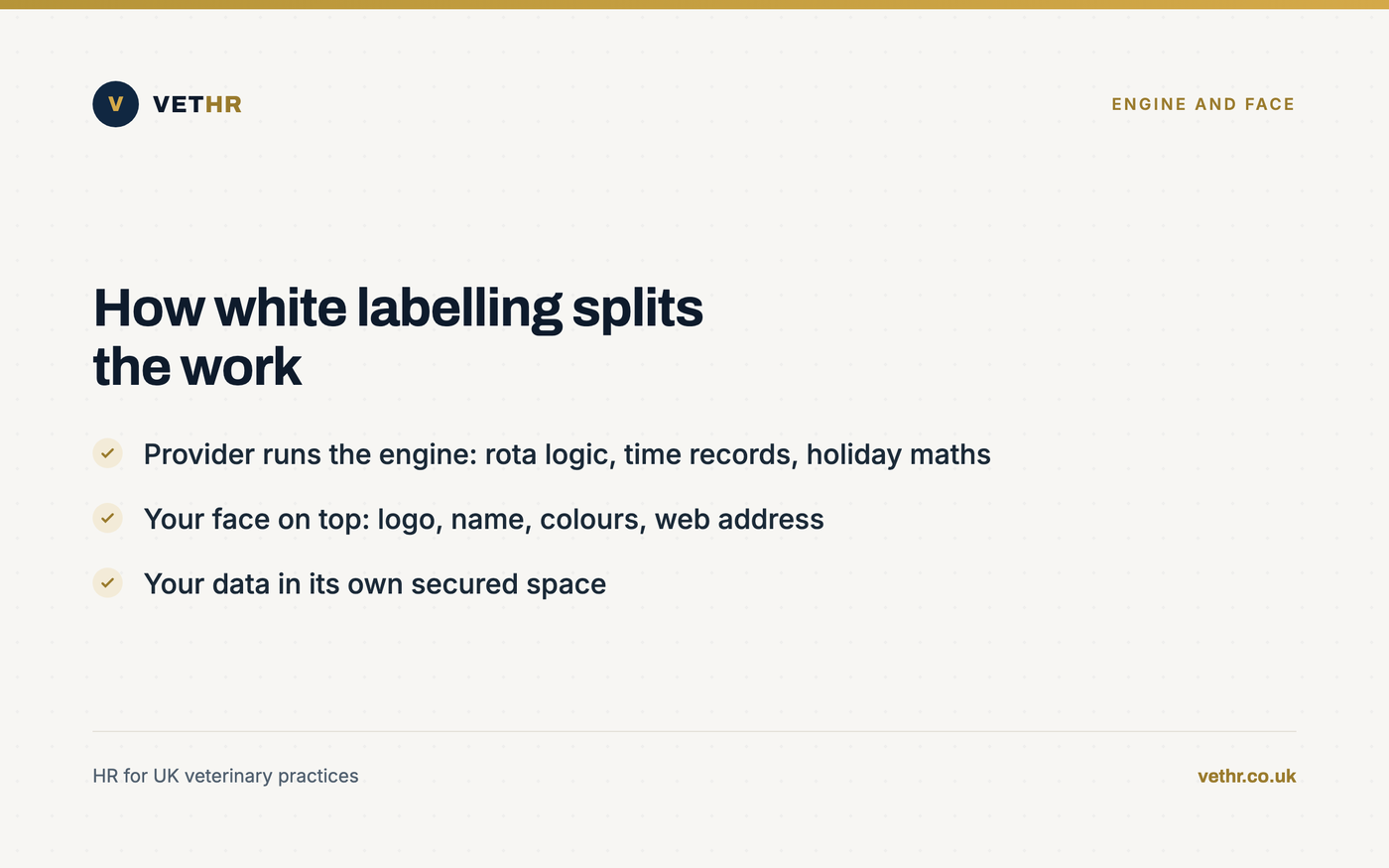
White labelling works by separating the engine from the face. The provider runs the underlying software, the rota logic, the time records, the holiday maths, while your branding sits on top: your logo on the login, your practice name in the title, your colours in the interface, and often your own web address. Your team never sees the vendor.
In practical terms, setup means three things. First, the visual layer is dressed in your identity, so the login screen, dashboards and any staff app read as yours. Second, the system is configured for how your clinic runs, with out-of-hours cover, registered nurses and freelance vet cover treated as normal rather than awkward exceptions. Third, your data lives in its own secured space, separate from other practices using the same engine.
Crucially, the legal duties of running a workplace stay with you, the employer. The system holds the records, but you remain responsible for the personal data. Under the ICO’s employment records guidance, sensitive staff information should sit behind access controls so only those with a genuine need can see it, as the regulator sets out in its guidance on data protection and workers’ health information. A good white label setup makes that easier, not harder.
The systems most often branded are the ones your team touches daily: rota and scheduling, clock in and out, holiday calculations, and incident reporting. Each can carry your practice name and colours so the whole staff experience feels like one joined-up thing, rather than a patchwork of separate vendor logos.
Two of those carry hard legal duties that branding does not change, only houses neatly. Acas states that working time records must be kept for two years from the date they were made, and confirms the 48-hour weekly maximum that staff can only exceed with a written opt-out, in its guidance on the working time rules. A branded clock-in tool timestamps and stores those records, turning a compliance chore into a non-event.
Holiday is the other area where the maths must be right whatever the logo says. For irregular-hours and part-year workers, leave now accrues at 12.07 percent of the hours worked in a pay period, for leave years beginning on or after 1 April 2024, as Acas explains in its guidance for irregular hours and part-year workers. A branded rota and holiday system should handle that automatically, so your name sits on a calculation you can stand behind.
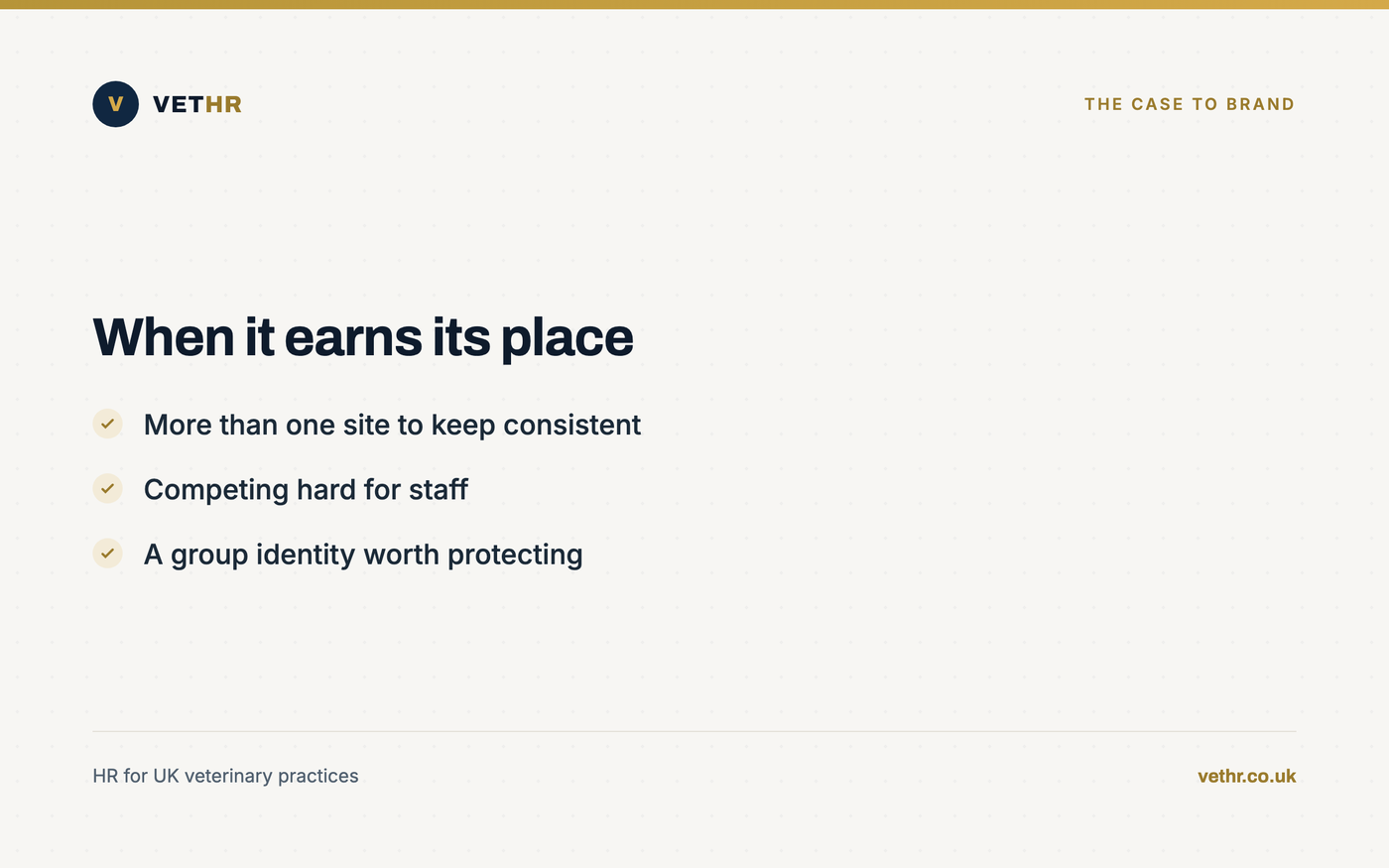
A practice or group needs a white label system when a consistent, professional identity starts to matter, not simply when the team passes a certain size. A single calm clinic may be perfectly happy with a plain tool. The trigger is usually growth, branches or recruitment, the moments when how the practice presents itself begins to carry real weight.
That last point is not vanity. Retention is under real pressure, and presentation is part of the picture. In the RCVS Surveys of the Professions 2024, the share of vets intending to stay in the profession for five or more years fell to 75 percent, down from 79 percent in 2019, according to the RCVS. An employer that looks organised and consistent has one more small advantage in keeping people.
Not sure whether your practice needs its own branding on the systems, or whether a plain tool would do just as well? A 30-minute conversation usually settles it. Book a free HR health check and we will look at how you run rotas, hours, holiday and records today, then tell you honestly where white labelling would help and where you are already fine. No jargon, nothing sold for the sake of it.
The benefits of branded HR software for vets come down to three things: a consistent identity, a more professional staff experience, and the credibility of looking established without building anything yourself. The work happens once, in setup, then pays off every time someone logs in.
Consistency is the headline. When the rota, the clock-in screen and the incident log all carry the same name and colours, the practice reads as one organised whole. For a multi-site group, that shared look is part of what makes separate branches feel like a single employer rather than a loose collection of clinics.
The staff experience is the next gain, and it matters more than it sounds. People who leave often cite work-life balance, chronic stress and not feeling valued; in the RCVS 2024 research the leading reasons given were poor work-life balance at 56 percent, chronic stress at 54 percent, and not feeling rewarded or valued in a non-financial sense at 47 percent, per the RCVS. A tool that feels like the practice cares about the details is a small but real signal in the right direction.
Finally, credibility. Out-of-hours work, which the RCVS found 35 percent of vets and 16 percent of veterinary nurses do, is exactly where systems get tested. A branded tool that handles it cleanly tells your team you have thought the hard parts through, without you writing a line of code. See our staff systems.
Look for a provider built for veterinary practices, not a generic platform with a branding toggle. The branding is the easy bit; what matters is whether the engine underneath understands out-of-hours cover, registrations and freelance vet cover, and whether your data stays yours. Put the same questions to any provider, including us.
That fourth point has teeth. GOV.UK guidance on enforcing the minimum wage states that, from 1 April 2021, employers must keep records for a minimum of six years after the end of the relevant pay reference period, and be able to produce them on request, as set out in its guidance on enforcing the minimum wage. Branding never excuses a system that cannot hand those records over cleanly.
Honestly, it depends, and any firm number quoted before someone has seen your practice should make you cautious. Cost is driven by team size, how many sites you run, how many systems you brand and whether you add HR support alongside. A single clinic and a three-site group are different problems, so a one-size price fits almost nobody.
The cleaner comparison is value, not sticker price. Weigh the cost against the alternatives: building your own software, rarely realistic for a practice, or living with a generic tool that quietly undercuts the brand you have built. For a growing group, white label HR systems often cost less than the polish they add is worth.
A note on how we price, since people ask. Vet HR quotes per practice in writing after a free health check, rather than publishing a one-size figure that would not fit your setup. You can take white label HR systems on their own, or as part of ongoing monthly support, and you will always see the number before you commit. No surprise fees, no pressure.
White label means the system carries your practice branding rather than the software vendor’s. A specialist builds, hosts and maintains the tool, while your logo, name and colours sit on the surface your team uses. To staff, it simply looks like the practice’s own rota, clock-in and holiday system, even though the engine is run for you.
Not always. A single calm clinic may be perfectly happy with a plain tool, since the branding adds presentation rather than core function. White label earns its place when consistency starts to matter: a second site, active recruitment, or a group identity you have invested in and do not want a stranger’s logo undercutting.
It should be, and that is a feature to check rather than assume. Your data should live in its own secured space with access controls, an audit trail and exports you can take with you. You remain responsible for the personal data you hold as the employer, so the system must make protecting it easier, not harder.
Yes, and that is one of the strongest reasons to white label. Shared branding on the rota, clock-in and holiday tools helps separate branches feel like one practice. Staff moving between sites meet the same look and the same login, which keeps the experience consistent and the group’s identity intact.
No. Building your own means writing, hosting and maintaining software yourself, with all the cost and risk that brings. White label gives you a finished, vet-ready tool that carries your name from day one, while the provider handles the engineering. You get the identity without the development team.
There is no shame in a plain tool if your team is small and settled. White label HR systems for veterinary practices are not a status symbol; they are the answer when a consistent, professional identity starts to matter, usually as you add a second site, compete harder for staff, or grow into a group worth presenting well.
If you are weighing it up, start with the brand and let it point to the fit. To see how the pieces work, explore our custom white-label systems, browse the full range of staff systems, or simply book a free HR health check and we will give you a straight recommendation for your practice. Nothing sold that you do not need.
The Vet HR Team provides HR consultancy and white-labelled staff systems exclusively to UK veterinary practices.
Related reading: White labelled systems versus Agilio iTeam modules
Read next: HR Health Check for Veterinary Practices, One-Off HR Project or Monthly Retainer and HR for Multi-Site Veterinary Practices.
Contracts, rotas, holiday, a difficult conversation. Tell us what you are dealing with and we will come back within one working day. Nothing to sign up to.
Got it. We will come back to you within one working day. If you do not see a reply, please check your spam folder.
