Last updated: 28 October 2026
TL;DR: Unauthorised absence is when someone does not turn up and either had no permission beforehand or did not follow the reporting policy. It includes lateness and leaving early. Check for a planned absence first, then work contact details, then personal, then the emergency contact. Treat it as welfare before you treat it as conduct.
It is 8.20am. The nurse opening the branch has not arrived, the first consult is at 8.40, and her phone goes straight to voicemail. The practice manager has ten minutes to decide whether this is an emergency, a car that would not start, or something else entirely. What she does in that ten minutes matters more than any policy.
Acas defines it as when someone does not turn up for work and either has not got permission from their employer beforehand, or does not follow the organisation’s policy for reporting an unexpected absence.
Two halves, and the second is the one that catches practices out. A genuinely ill person who did not follow the reporting route is still technically an unauthorised absence, which is a good reason to make the reporting route easy rather than strict.
Acas also notes that unauthorised absence can include lateness, and that leaving work early without permission can count too. Most practices never think of those as the same issue, and treating them as one category makes the pattern visible.
Acas sets out a sequence, and it is worth following exactly because it moves from the most likely explanation to the most serious.
That first step catches a surprising share of cases. A holiday approved verbally in July and never entered into the system looks exactly like unauthorised absence on the morning it starts, and our guide to the holiday booking system covers why that keeps happening.
Make sure the emergency contact details are current. A number collected at induction four years ago is not a plan, and checking them annually takes one email to the whole team.
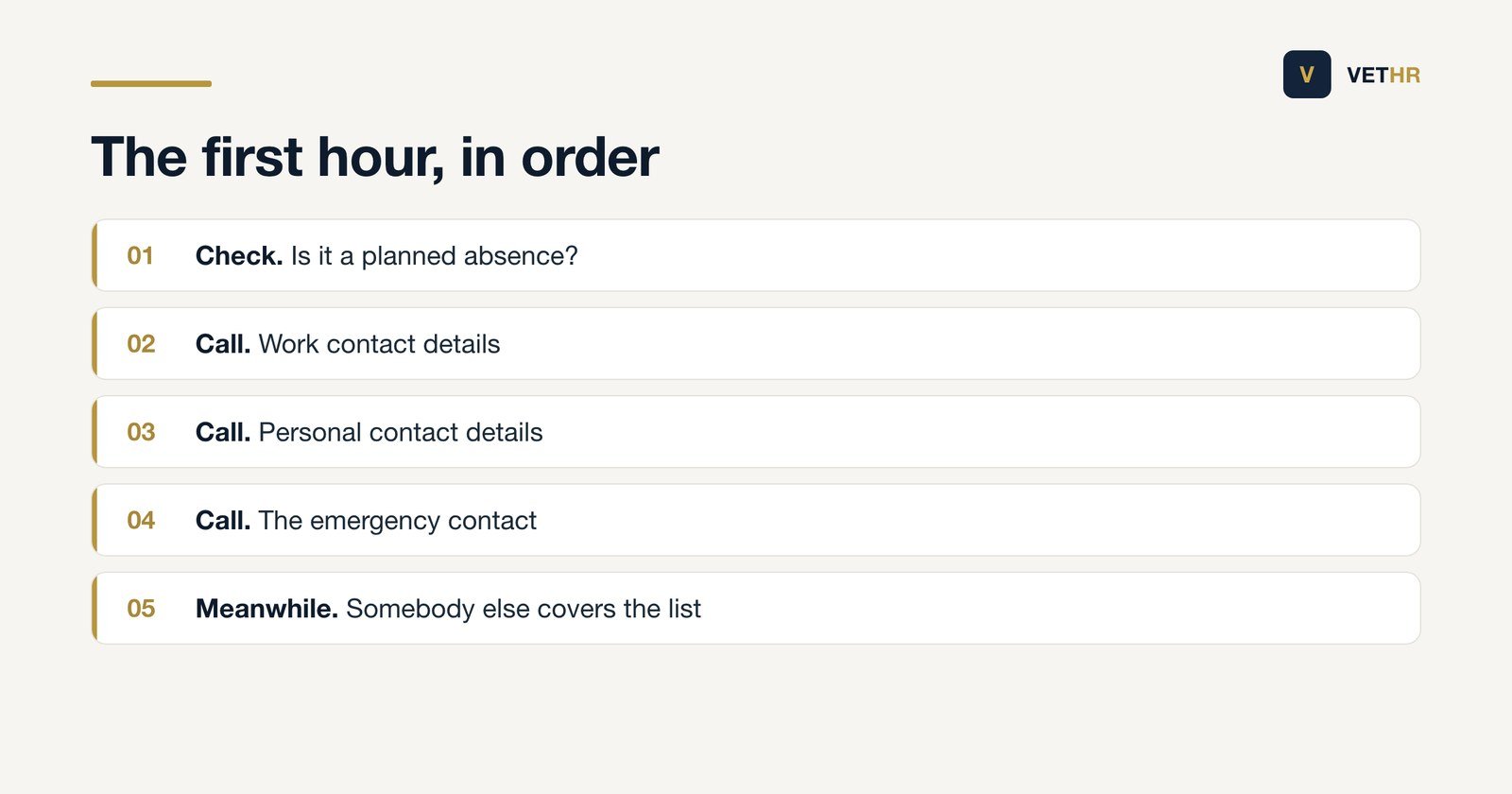
Deal with the clinical day while the contact attempts are running, not afterwards. Somebody else should be on the phone while the consults are being reorganised.
Keep a short standing list of who can come in at an hour’s notice and what each of them can cover, and keep it where the person opening up can find it at 8.20am rather than in the practice manager’s head.
Be careful about lone working. An unauthorised absence can leave one person alone in a building, or alone with a sedated patient, which is a different risk from being short handed. Our notes on lone working and being short staffed cover both.
Decide in advance who makes the calls. On the morning it happens the person opening up is already running a waiting room, so the contact steps should belong to somebody who is not also the one reorganising consults.
Write down what you did and when. Four short lines noting the time of each attempt take a minute, and they are the difference between a considered response and a reconstruction from memory if unauthorised absence ever becomes a formal matter.
Have it on the first day back, privately, and start by asking rather than telling. The most common explanations are the dull ones: a phone that died, a car that failed, a child who was ill, an alarm that did not go off.
Some explanations are not dull at all. A single unauthorised absence from a reliable person is quite often the first visible sign of something serious at home, or of a health problem they have not told anyone about.
So ask the open question before you reach for the procedure, and make sure the person knows what the reporting route is for next time. Confirm the outcome briefly in writing either way.
Pay follows what actually happened. If the absence turns out to be sickness properly reported, it is sick leave and your normal sick pay rules apply. GOV.UK guidance is that for absences of 7 days or less no fit note or other proof is needed, so a late self certification is not a reason to withhold sick pay.
Where there was genuinely no reason and no contact, withholding pay for the time not worked is usually possible, but it depends on the contract. Check the clause before the payroll run rather than after it.
Never take money out of a payslip as a punishment or without telling the person first. That is a separate legal problem, covered in our guide to deductions from wages.

Tell the team something, even if it is very little. A shift that changes at short notice with no explanation invites speculation about a colleague, and one neutral sentence from a manager prevents a week of it.
One incident is an event. Three in a quarter is information, and it needs handling as such rather than as three separate irritations that each get forgotten by the following week.
Look at the shifts before you look at the person. Unauthorised absence clusters around the shifts people dread: the solo Saturday, the first day back after nights, the branch day with no support.
Where the pattern is genuinely about conduct rather than the rota, move to your formal process with proper notice and the right to be accompanied. Our guides to absence trigger points and disciplinary procedures in a veterinary practice cover the route.
Most unauthorised absence is a reporting failure rather than a conduct failure, which means the policy can remove most of it.
Put it in the handbook, say it at induction, and put the number somewhere people can find it on a phone at six in the morning. Our note on the staff handbook covers where it belongs, and a free 30-minute HR health check will tell you whether yours is workable.

Acas says it can be. Unauthorised absence can include when someone is late for work, and leaving work early without permission can count too. Treating all three as one category is what makes a pattern visible.
Yes, and Acas lists it as the third step after work and personal contact details. Use it for welfare rather than to chase, keep the details current, and tell staff at induction that this is what the contact is for.
It depends on what happened and what the contract says. Properly reported sickness is paid under your sick pay rules. Where there was no reason and no contact, withholding pay for time not worked is usually possible, but check the clause first.
When there is a pattern, or a single absence with no acceptable explanation and no attempt to make contact. Even then, start with a conversation, and use the formal procedure with proper notice and the right to be accompanied.
Do not treat silence as a resignation. Keep trying to make contact, write to their home address setting out the position and inviting them to explain, and take advice before treating the employment as ended.
At 8.20am nobody knows yet whether this is a flat battery or something serious. Working through the contact steps in order, while somebody else reorganises the consults, is the whole of a good response.
Then fix the reporting route, because that is what causes most unauthorised absence in the first place. We write absence policies for independent practices through HR consultancy for veterinary practices and ongoing HR support on subscription.
The Vet HR Team provides HR consultancy and white-labelled staff systems exclusively to UK veterinary practices.
Contracts, rotas, holiday, a difficult conversation. Tell us what you are dealing with and we will come back within one working day. Nothing to sign up to.
Got it. We will come back to you within one working day. If you do not see a reply, please check your spam folder.
