Last updated: 21 October 2026
TL;DR: Schedule 3 to the Veterinary Surgeons Act lets a registered veterinary nurse give medical treatment or carry out minor surgery not involving entry into a body cavity, under the direction of their veterinary surgeon employer. Direction does not require the vet to be present. Student veterinary nurses need direct, continuous and personal supervision.
A new RVN is asked to place an intravenous catheter and induce anaesthesia on her second day. She has done it a hundred times at her last practice. Nobody here has seen her do it once, nothing is written down about what she has been signed off to do, and the vet who asked is in a consult room down the corridor. Everything about that is a Schedule 3 question.
RCVS guidance describes the exemption as giving registered veterinary nurses the privilege of giving any medical treatment or carrying out minor surgery, not involving entry into a body cavity, under the direction of their veterinary surgeon employer, to animals under that employer’s care.
RCVS keeps its wider advice on Schedule 3 in one place, including worked case studies. Three conditions sit inside that sentence and all of them matter. The nurse must be registered. The directing veterinary surgeon must be their employer. And the animal must be under that employer’s care.
The employment point is the one practices trip over when they use agency or freelance cover. If the arrangement means the directing vet is not the nurse’s employer, the Schedule 3 position is not as simple as everybody assumes.
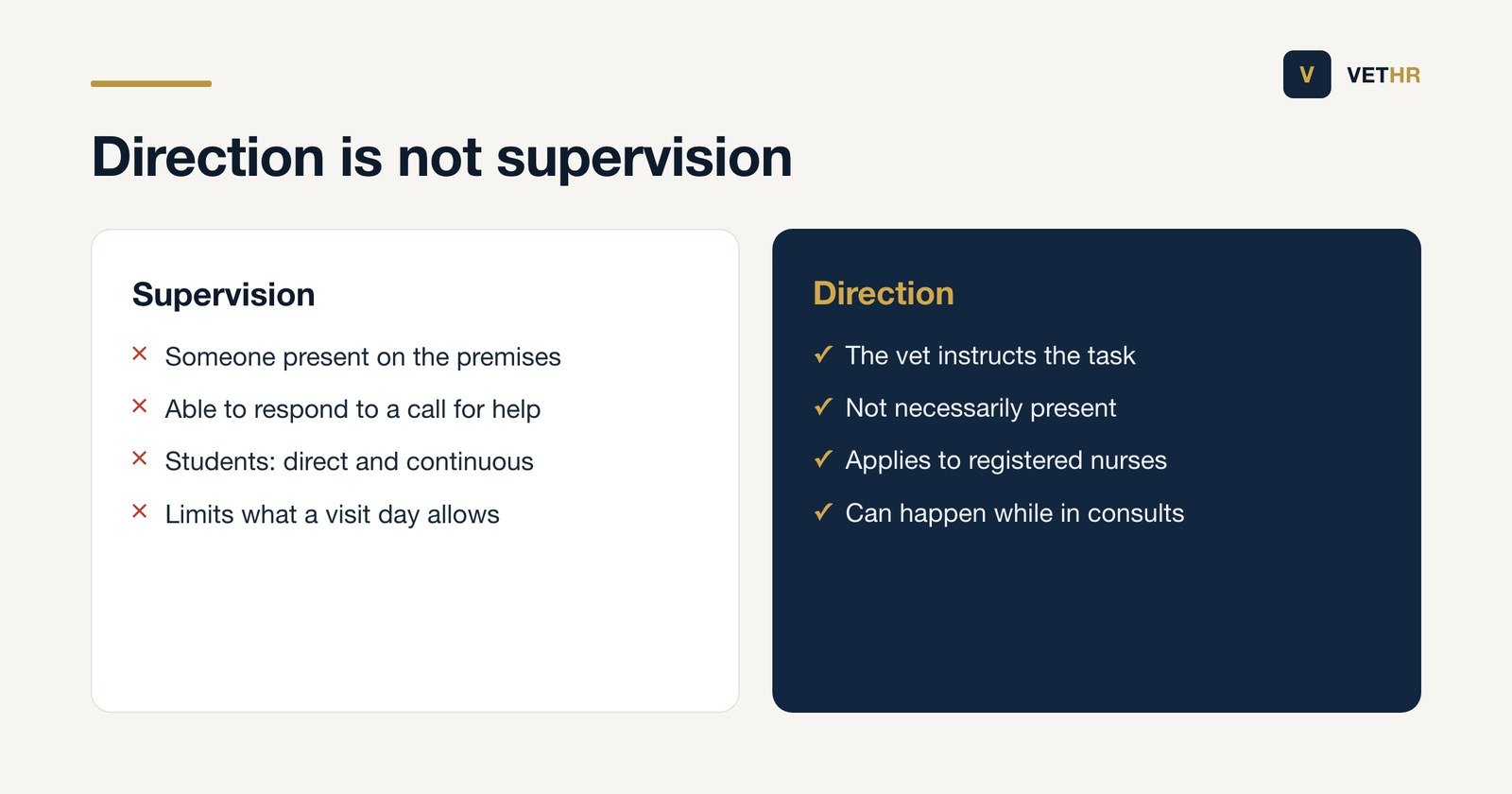
These two words get used interchangeably in practice and they mean different things. RCVS defines direction as the veterinary surgeon instructing the nurse or student as to the tasks to be performed, but not necessarily being present.
Supervision is defined separately: the veterinary surgeon or registered veterinary nurse is present on the premises and able to respond to a request for assistance if needed.
So a Schedule 3 task delegated to an RVN can be done while the vet is in a consult, provided the instruction was given. A task requiring supervision cannot be done while the vet is out on a visit. Knowing which is which is a rota decision as much as a clinical one.
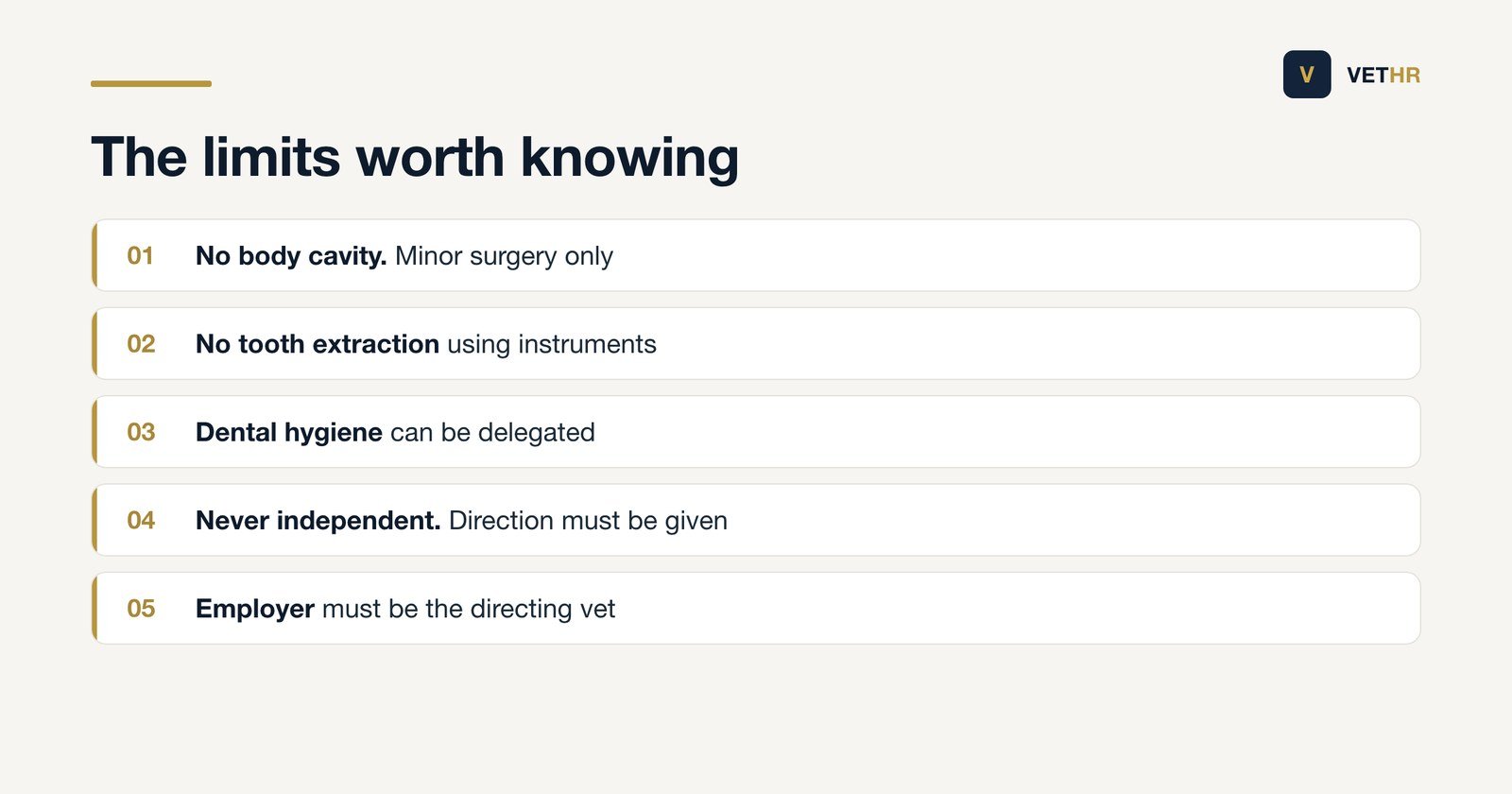
Two limits come up constantly. The first is in the wording itself: minor surgery not involving entry into a body cavity.
The second is dental. RCVS guidance states that extraction of teeth using instruments is not within the meaning of minor surgery in Schedule 3. Routine dental hygiene work is a different matter and can be delegated.
RCVS also notes that a veterinary nurse is not entitled independently to undertake either medical treatment or minor surgery. The direction has to come from a veterinary surgeon; it cannot be assumed from a rota or from custom.
If your practice has a dental list run largely by nurses, that is the list to check your written protocols against first.
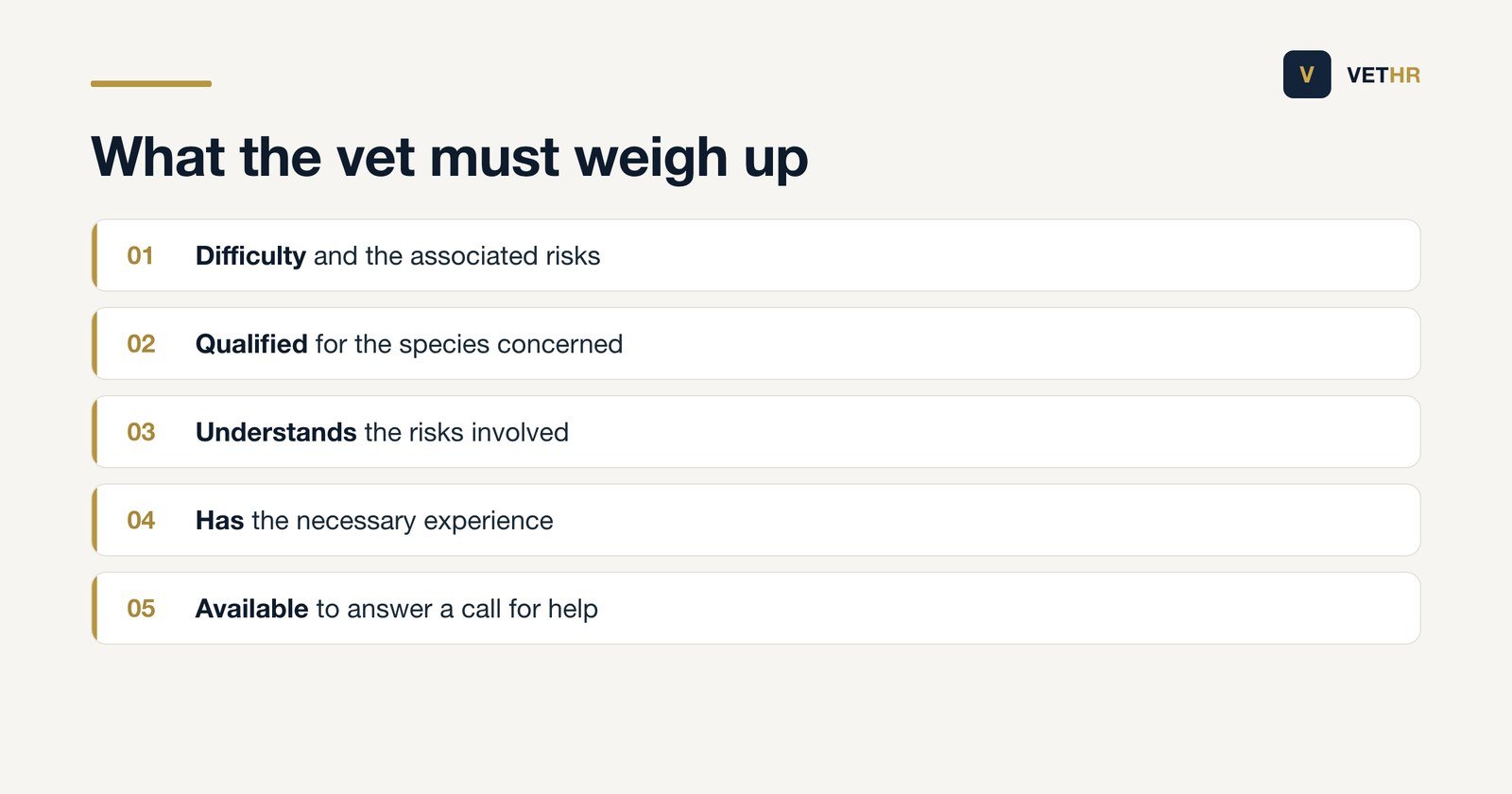
This is where Schedule 3 becomes an HR problem. RCVS guidance says the veterinary surgeon must consider how difficult the procedure is in light of any associated risks, whether the nurse is qualified to treat the species concerned, whether they understand the associated risks and have the necessary experience, and must be available to answer any call for assistance.
Now read that against the new RVN on her second day. The vet cannot be satisfied of her experience, because nobody has any record of it.
The answer is a competency record: a list of procedures, who signed the person off, when, and by observing what. It takes an afternoon to build and it is the document that makes every later delegation defensible. Our notes on the new starter checklist and job descriptions cover where it lives.
Review the record when someone changes role or comes back from a long absence. A nurse returning after a year of maternity leave has the same registration and a different recent experience, and a short refresher signed off before she is rota’d onto theatre protects everybody.
Make it a two way document. The nurse should be able to add the things she wants signed off next, which turns a compliance list into a development plan and gives the appraisal conversation something concrete to work from.
Different rules, and much tighter ones. RCVS guidance says student veterinary nurses may carry out these tasks only under direct, continuous and personal supervision, and in the course of the student’s training.
Direct, continuous and personal is not the same as someone being on the premises. In practice it means standing there, which has an obvious cost in a busy theatre and an obvious consequence for how you build a student’s week.
It also means a student cannot be used to fill a rota gap as though they were registered. Our notes on the clinical coach role and apprentice veterinary nurses cover how to structure that properly.
Schedule 3 decides who can be rota’d to what. That makes it a staffing document, a job description document and a pay document, not only a clinical governance one.
Three HR consequences follow. Job descriptions for RVN roles should reflect the actual delegated scope. Pay bands should recognise that a nurse with a broad signed off scope carries more than one who does not. And a nurse who declines a task she is not confident with must be supported, not marked down.
That last one matters more than any policy. A nurse who has learned that saying no gets a sigh will eventually say yes to something she should not. Our guides to the RVN employment contract and pay bands cover the first two.
Brief the whole team on what Schedule 3 allows, not just the nurses. Receptionists booking a dental list and vets delegating on a busy morning both make decisions that depend on it, and a shared understanding prevents most of the awkward corrections that happen in front of clients.
Build the rota against competence, not job title. Two RVNs with the same contract can have very different signed off scopes, and a rota that treats them as interchangeable will eventually put one of them somewhere she should not be.
Hold the competency list next to the rota so the person building it can see it. Our rota system does that, and our note on staffing levels covers how scope changes what a shift actually needs.
If your practice has no written record of who has been signed off for what, book a free 30-minute HR health check and we will help you build one.
Not for direction. RCVS defines direction as the veterinary surgeon instructing the nurse as to the tasks to be performed, but not necessarily being present. Supervision is the tighter standard, requiring someone present on the premises and able to respond to a call for assistance.
RCVS guidance states that extraction of teeth using instruments is not within the meaning of minor surgery in Schedule 3. Routine dental hygiene work can be carried out by a nurse working under the direction of a veterinary surgeon.
The exemption is framed around the nurse’s veterinary surgeon employer and animals under that employer’s care, so check the arrangement rather than assuming. Where the directing vet is not the employer, take advice before relying on it.
Direct, continuous and personal supervision, and only in the course of their training. That is a stricter standard than being on the premises, and it has to be planned into the week rather than assumed.
There is no set form, but the directing veterinary surgeon has to be satisfied the nurse is qualified and experienced for the task. A dated list of procedures and sign offs is the simplest way to evidence that, and it protects the nurse as much as the practice.
Most Schedule 3 problems in independent practice are not about the law. They are about a practice that knows perfectly well what its nurses can do, and has never written any of it down.
Build the competency record, reflect the scope in job descriptions and pay, and put the list next to the rota. We help independent practices do exactly that through HR consultancy for veterinary practices and employment contract drafting.
The Vet HR Team provides HR consultancy and white-labelled staff systems exclusively to UK veterinary practices.
Contracts, rotas, holiday, a difficult conversation. Tell us what you are dealing with and we will come back within one working day. Nothing to sign up to.
Got it. We will come back to you within one working day. If you do not see a reply, please check your spam folder.
