Last updated: 14 June 2026
TL;DR: An RVN employment contract starts with the written statement of particulars every employee is entitled to on day one: pay, hours, holiday, probation and notice among them. A good one goes further, spelling out OOH and on-call expectations, CPD time for the RCVS requirement of 15 hours a year, registration obligations, and how holiday works when hours are irregular. Nine clauses do most of the work.

Recruiting a veterinary nurse is hard enough without the paperwork letting you down afterwards. This guide walks through the RVN employment contract clause by clause: what the law requires from day one, what a well-drafted contract adds, and the clauses that cause the most trouble in a practice when they are missing.
Every employee and worker, including every RVN, must receive a written statement of the main terms on or before their first day. GOV.UK lists what it must cover: names, start date, pay, hours and how they can vary, holiday, place of work, probation terms and more, with a wider statement due within 2 months.
The detail sits in GOV.UK guidance on the written statement of employment particulars. The day-one principal statement must also point to sick pay, other paid leave and notice periods, which can sit in a separate document the employee can reasonably access. The wider statement, due within 2 months, covers pensions, collective agreements, training and the disciplinary and grievance procedures. If particulars later change, staff must be told in writing within one month.
In practice, the cleanest way to meet all of that is one proper RVN employment contract issued before the start date. Nine clauses do most of the work:
A generic template covers perhaps half of that list well. Our veterinary contracts service drafts the whole thing for the realities of clinical work, from second on-call to registration clauses, and keeps it consistent with your handbook.
Precisely. State the normal hours and pattern, how the rota is published, what OOH and on-call duties the role carries, how on-call time is paid, and what happens to rest after a night call-out. Working time law caps the average week at 48 hours, normally averaged over 17 weeks, unless the individual agrees otherwise.
The 48-hour figure comes from GOV.UK guidance on maximum weekly working hours. An RVN can opt out of the cap, but the same guidance is clear that the opt-out must be voluntary and in writing, and that a worker cannot be sacked or treated unfairly for refusing. If your OOH model relies on an opt-out, it belongs in a signed agreement, not an assumption.
Rest rules sit alongside it. GOV.UK guidance on rest breaks at work gives workers an uninterrupted 20 minute break when the day runs over 6 hours, 11 hours of rest between working days, and 24 hours off each week or 48 hours each fortnight. A rota that quietly breaches these is a contract problem and a clinical risk in the same document.
On-call is where vague drafting costs the most. Say whether cover is from home or on site, how quickly the nurse must attend, what each call-out pays, and how the next day’s shift adjusts after a heavy night. A clause that answers those four questions prevents the argument that otherwise arrives with the first busy weekend.
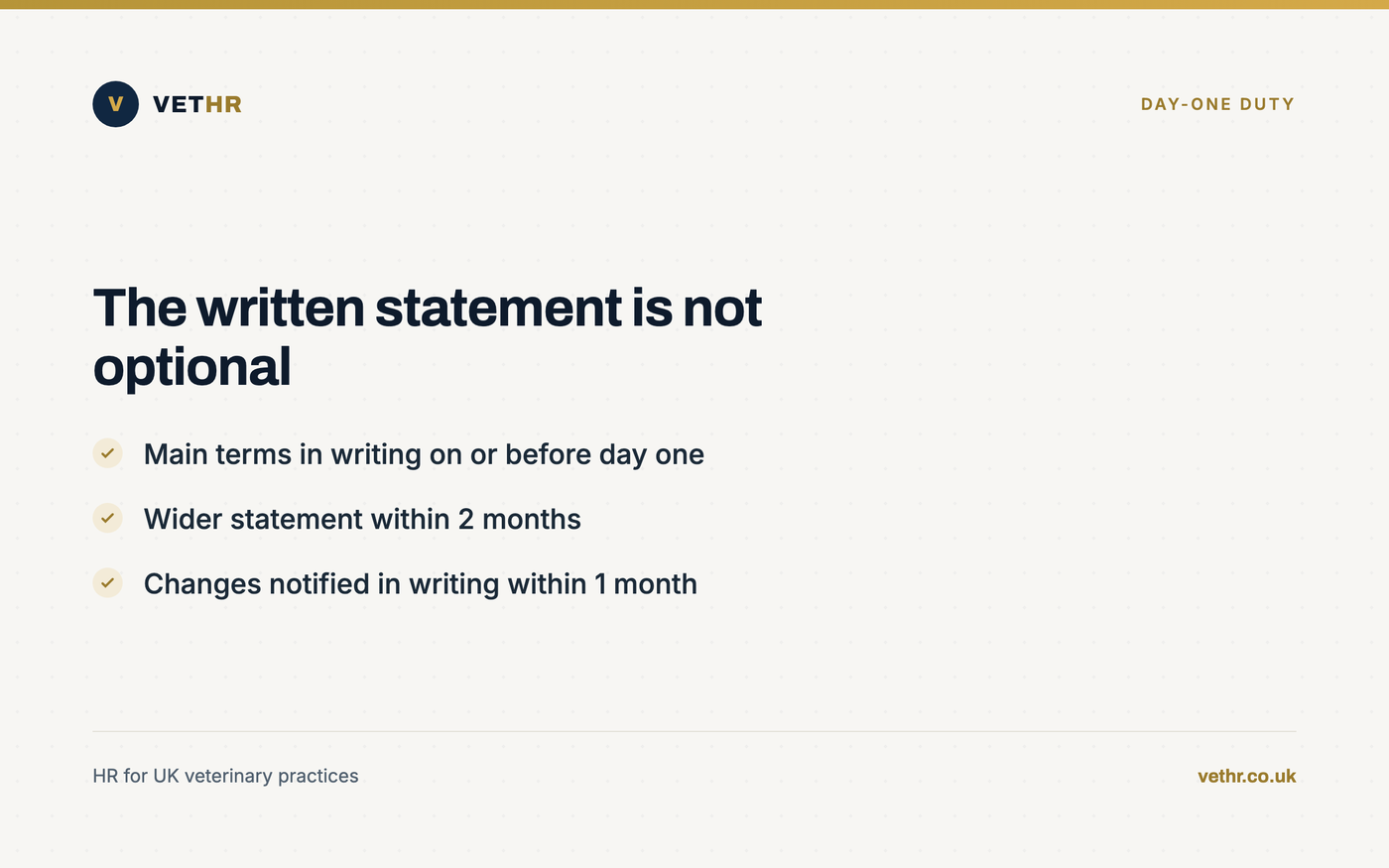
Three things: that remaining on the RCVS register is a condition of the role, how the practice supports the CPD needed to stay there, and who pays for what. The RCVS requires veterinary nurses to complete 15 hours of CPD a year, so the contract should say when that time happens and whether it is paid.
The requirement is set out on the RCVS page on continuing professional development: 15 hours a year for veterinary nurses and 35 for veterinary surgeons, applying to full-time and part-time roles alike, with hours recorded on the 1CPD platform and reflection built into the cycle. Hours cannot be carried forward from year to year, which is why an annual crunch in December is so common.
Employment law does not say who funds CPD or the annual registration fee. That is exactly why the contract should. State whether the practice pays the RCVS fee, how much CPD time is given inside working hours, and what happens to funded training if the nurse leaves soon after. A repayment clause for expensive courses is workable, but it needs careful drafting and proportionate amounts.
Add a registration clause with teeth but no malice: the RVN must remain registered, must tell the practice promptly if registration lapses or is at risk, and the practice will respond through a fair process rather than automatic dismissal. That protects the clinic and treats a professional like one.
Wondering whether your current nurse contracts would pass the day-one test? Book a free HR health check. In 30 minutes we will review what your team has signed, flag anything missing against the GOV.UK particulars list, and tell you plainly what to fix first. No obligation attached.
State the probation length, any conditions and how it can be extended, because probation terms belong in the day-one written statement. For notice, the contract sets the figures, subject to statutory minimums: an employee must give at least a week after a month’s service, and employer notice rises with each year served.
The statutory floors are lower than most practices expect. An employee who has been in the job for more than a month must give at least a week’s notice, per GOV.UK guidance on handing in your notice. Going the other way, GOV.UK guidance on notice periods requires the employer to give at least one week between one month and 2 years of service, a week per year from 2 to 12 years, and 12 weeks at 12 years or more.
A single statutory week from a resigning nurse is rarely enough time to recruit a registered replacement, which is why most well-drafted contracts set longer notice on both sides. Make it mutual, keep it realistic for the role, and remember the contract can improve on the statutory minimums but never undercut them.
Probation earns its keep when it is specific: the length, what is being assessed, when the review happens, and whether notice is shorter during the period. An extension clause used once, with reasons given in writing, is fairer than a quiet decision made in month five with nothing to point to.
Almost all workers are legally entitled to 5.6 weeks of paid holiday a year, capped at 28 days, and bank holidays do not have to be given as paid leave on top. For an RVN whose hours are genuinely variable, entitlement accrues at 12.07% of hours worked in each pay period. The contract should state which model applies.
The baseline sits in GOV.UK guidance on holiday entitlement: 5.6 weeks a year, a 28 day statutory cap, pro rata entitlement for part-time staff, and an employer’s choice over whether bank holidays count within the statutory allowance. Write the leave year, the booking process and the bank holiday position into the contract explicitly, because assumptions here are a reliable source of grievances.
For irregular hours the rules changed recently. GOV.UK guidance on the holiday pay and entitlement reforms says that for leave years beginning on or after 1 April 2024, irregular hours workers accrue leave at 12.07% of hours worked in each pay period, and rolled-up holiday pay is permitted if it is shown as a separate item on the payslip.
This is exactly the calculation that goes wrong on a spreadsheet at a busy practice, especially with part-timers and variable shifts. Our holiday calculations system does the accrual per person automatically, so the contract, the payslip and the rota all tell the same story.
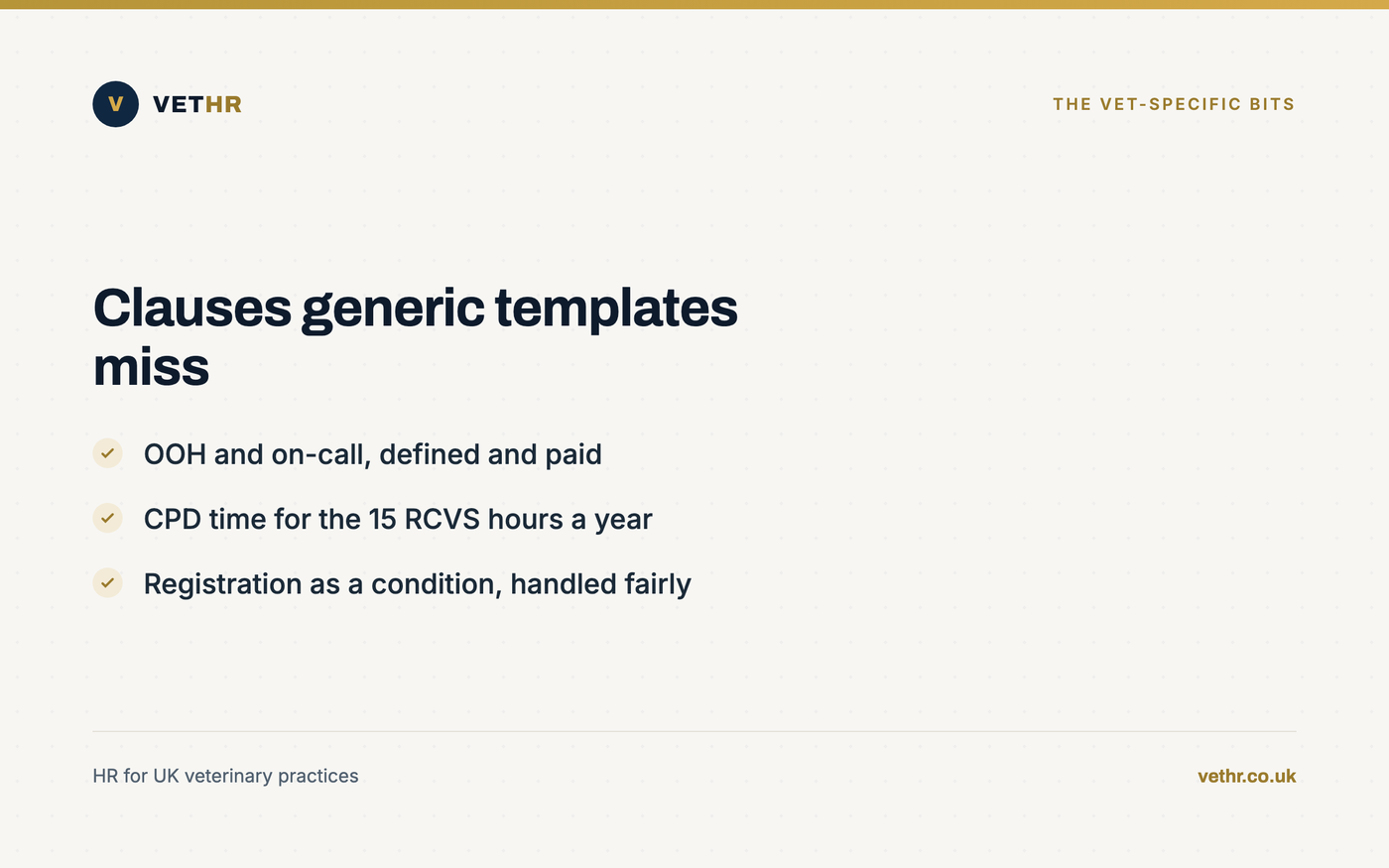
Every employee and worker must receive a written statement of the main employment terms on or before their first day, with a wider statement within 2 months, per GOV.UK. A full written contract is the practical way to meet that duty in one document, and it can cover the veterinary-specific ground the statutory list never mentions.
No employment law rule decides this, so the contract should. The RCVS requires registered veterinary nurses to complete 15 hours of CPD a year, whatever their hours. State whether the practice funds the registration fee, whether CPD time is paid working time, and how any repayment terms work for larger funded courses.
Only if the contract provides for it, so describe the duty, the payment and the rest arrangements in the document itself. Working time rules still apply around it: a 48 hour average weekly cap unless the nurse has opted out voluntarily and in writing, 11 hours of daily rest, and a 20 minute break on shifts over 6 hours.
The statutory minimum is at least one week once they have been employed for more than a month, per GOV.UK. Most contracts set more than that, precisely because replacing a registered nurse takes longer than a week. The signed contract, not the template on the shared drive, is the figure that counts.
No. GOV.UK guidance on holiday entitlement says bank holidays do not have to be given as paid leave, and an employer can count them within the statutory 5.6 weeks. What matters is what the contract says, so state the position clearly rather than leaving the team to assume.
An RVN employment contract has a legal floor and a practical ceiling. The floor is the day-one written statement with everything GOV.UK requires in it. The ceiling is a document that also answers the questions clinical life actually asks: who covers the night, who pays for the CPD, what the probation review looks at, and how holiday accrues when no two weeks match.
If your nurse contracts came from a template, check them against the nine clauses above. See how our veterinary contracts service drafts them properly, browse the common questions on our FAQ page, or book a free HR health check and we will tell you plainly where the gaps are.
The Vet HR Team provides HR consultancy and white-labelled staff systems exclusively to UK veterinary practices.
Contracts, rotas, holiday, a difficult conversation. Tell us what you are dealing with and we will come back within one working day. Nothing to sign up to.
Got it. We will come back to you within one working day. If you do not see a reply, please check your spam folder.
