Last updated: 15 October 2026
TL;DR: A non-disclosure agreement is legally binding, but it cannot stop someone whistleblowing, reporting a crime to the police, or discussing their pay for reasons relating to equal pay, and it should not be used to stop anyone reporting discrimination. From 6 April 2026 sexual harassment becomes a qualifying disclosure under whistleblowing law.
A nurse resigns after raising concerns about a colleague’s behaviour. The practice offers a payment and asks her to sign a document saying she will not discuss anything that happened. She signs, leaves, and tells nobody. Three months later the same complaint arrives from someone else, and the practice discovers what it has actually bought.
Acas describes it as a written agreement that can appear in an employment contract, in a conciliation agreement known as a COT3, in a settlement agreement, or in a separate standalone document, and notes that it is legally binding and enforceable, so both the employer and the worker must keep to what has been agreed.
So a non-disclosure agreement is not one specific document. Most veterinary practices already use one, in the confidentiality clause of their standard contract, without thinking of it as an NDA.
That is worth knowing, because the limits described below apply to the confidentiality clause in your contract just as much as to a dramatic exit document.
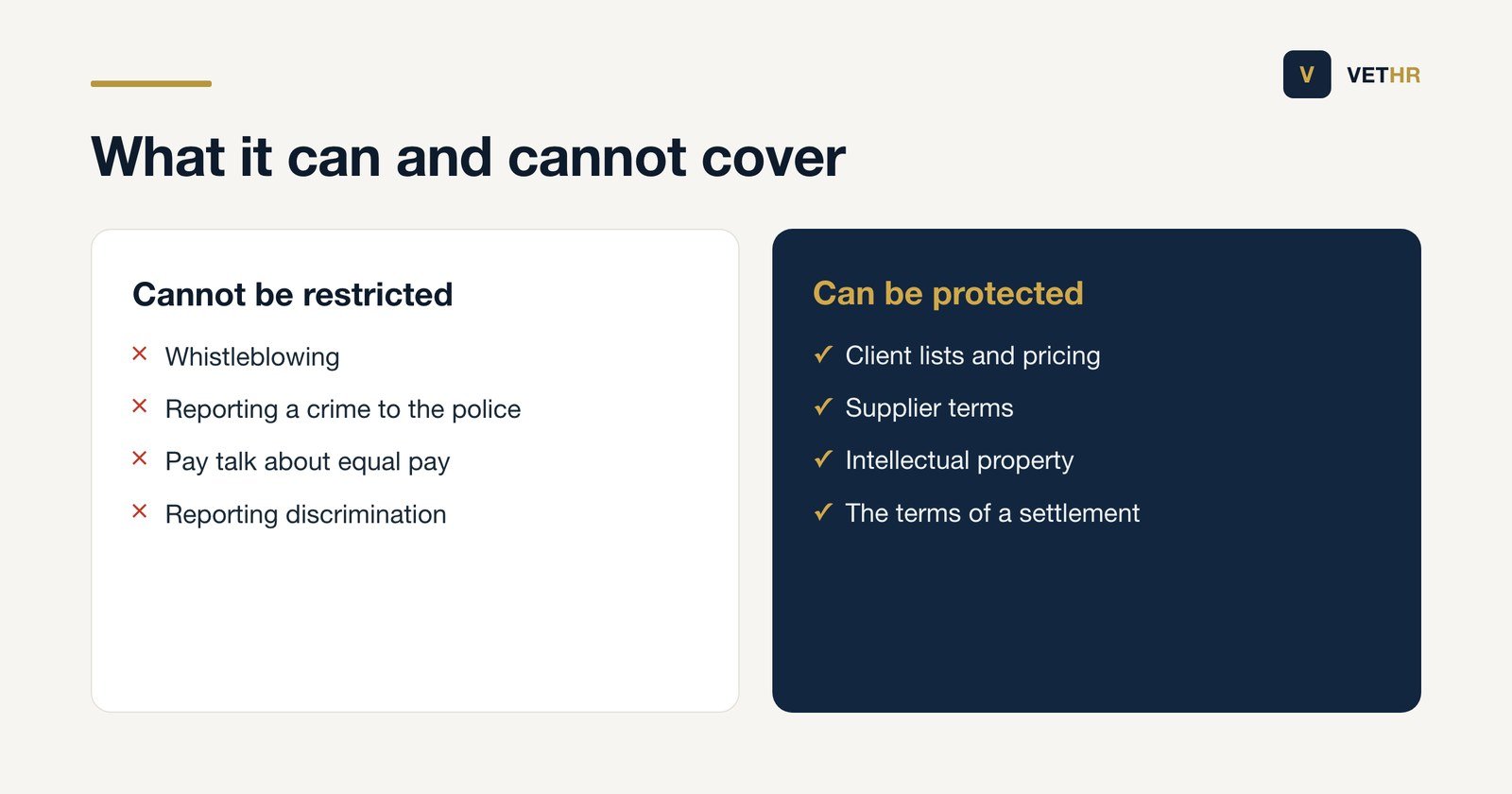
There are several, and Acas sets them out. A non-disclosure agreement can properly be used to protect a business’s confidential information when someone starts a job, to keep the details of a dispute settlement confidential, to protect customer or client identities and intellectual property, and to prevent disclosure of sensitive business information.
In a veterinary practice that covers real things: client lists, pricing and supplier terms, the detail of a white-labelled system, and the terms on which somebody left.
Client confidentiality is a separate professional duty and does not depend on an NDA at all. Keep the two ideas apart in your documents, because conflating them makes the clause harder to read and easier to challenge.
One more area worth separating out is social media. A clause telling staff not to post about clients or patients is protecting confidential information and is entirely reasonable. A clause telling them not to say anything negative about the practice is trying to do something else, and it will not survive contact with a genuine complaint. Our note on the social media policy for a veterinary practice covers where the line sits.
Acas is specific about the limits, and they hold regardless of what the document says.
Read the second one against the staff room conversation every practice worries about. A blanket rule telling people not to discuss their salaries is unenforceable where the discussion relates to equal pay, and our guide to equal pay in a veterinary practice explains why openness is the better strategy anyway.
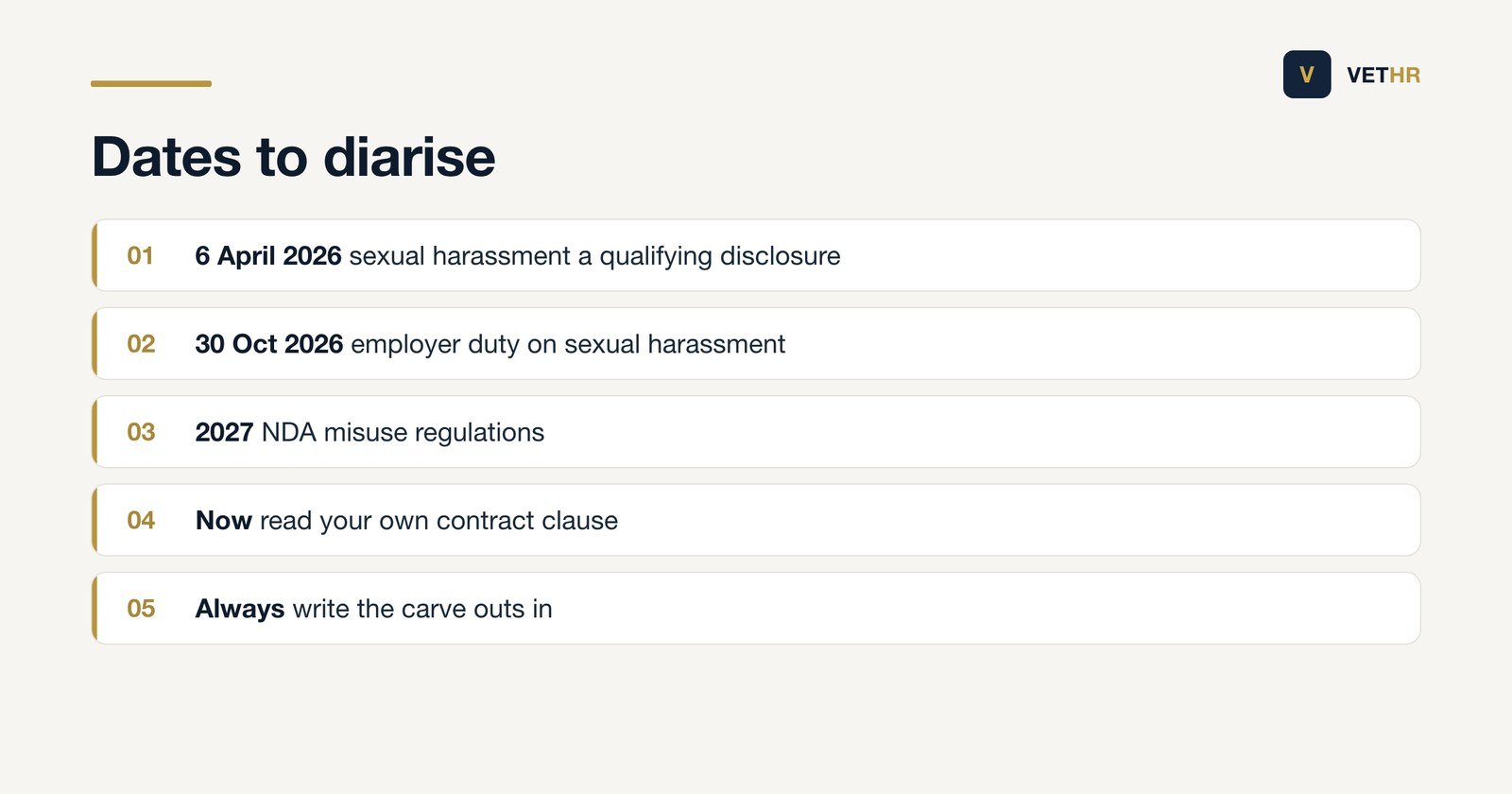
Acas states that from 6 April 2026, sexual harassment is a qualifying disclosure under whistleblowing law, which brings automatic unfair dismissal protection and protection against detriment for someone who discloses it.
Since a non-disclosure agreement cannot prevent whistleblowing, that change puts disclosures about sexual harassment firmly outside what any NDA can restrict.
More is coming. The government’s Employment Rights Act implementation timeline lists regulations on the misuse of non-disclosure agreements in harassment and discrimination cases among the 2027 measures, and the employer duty on sexual harassment on 30 October 2026. Our notes on sexual harassment and employment law changes track both.
Explain it out loud as well as in the paperwork. Somebody being asked to sign a non-disclosure agreement at the end of a difficult few months is rarely in a state to read six paragraphs of clause carefully, and a plain summary of what it does and does not cover is worth more than the drafting.
Give them time. A document handed over with an answer expected the same afternoon looks like pressure, and pressure is exactly what makes an agreement contestable later. Two or three days costs the practice nothing.
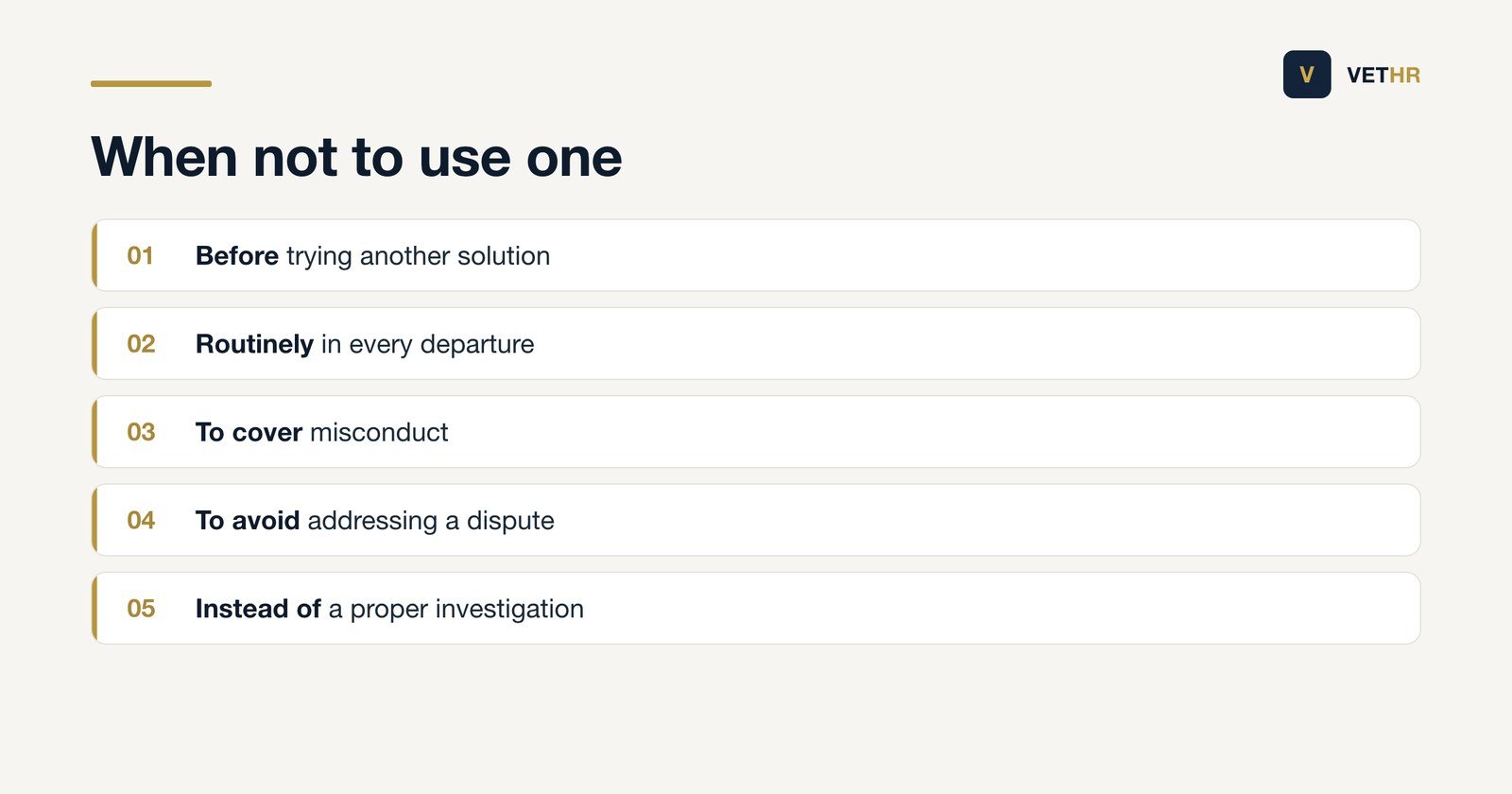
Acas guidance is direct on when an NDA should not be used: before seeing whether another solution could be used instead, routinely, to cover misconduct, or to avoid addressing a dispute.
Each of those four describes something practices do. Reaching for a non-disclosure agreement instead of holding the grievance meeting is the most common, and it is the most expensive, because the underlying problem is still in the building.
Three habits keep you out of trouble. Deal with the substance first. Use the clause only for genuine confidential information. And write the carve outs into the document so the person can see what they are still free to do.
Confidentiality clauses in settlement agreements and COT3s are the version most practices encounter, usually at the end of a difficult departure.
Keeping the terms of a settlement confidential is a legitimate use. Using the same clause to prevent the person ever mentioning the behaviour that caused the dispute is not, and it is the part that increasingly will not hold.
Remember that a settlement agreement needs independent legal advice for the employee to be valid, which is a separate requirement from anything in the non-disclosure agreement itself. Our guide to a settlement agreement in a veterinary practice covers the process.
Consider what you would want a reference to say afterwards. A departure settled quietly still produces a reference request in six months, and GOV.UK guidance is clear that a reference, if given, must be fair and accurate. Agreeing the wording at the same time as the settlement saves an awkward exchange later.
The practice at the top of this article had a behaviour problem and bought silence. Three months later it had the same behaviour problem plus a settlement payment and a document that would not have stopped the second complaint anyway.
Deal with the conduct. Investigate properly, use the disciplinary procedure, and record what you found. Our guides to a workplace investigation and handling a grievance in a veterinary practice set out both routes.
And review your standard contract. A confidentiality clause written in 2018 is a non-disclosure agreement that predates the current position, and it is worth reading with the five limits in front of you. Book a free 30-minute HR health check and we will look at yours.
No. Acas states plainly that a non-disclosure agreement cannot stop someone whistleblowing. From 6 April 2026 sexual harassment is a qualifying disclosure under whistleblowing law, which puts those disclosures beyond the reach of any NDA.
Not where the discussion relates to equal pay. Acas lists that among the things an NDA cannot prevent, so a blanket confidentiality rule about salaries is unenforceable as well as counterproductive.
Effectively yes. Acas notes that an NDA can appear in an employment contract as well as in a settlement agreement, COT3 or standalone document, so the same limits apply to the clause already in your template.
Keeping the terms of a settlement confidential is legitimate. Preventing the person from ever raising the underlying conduct is not, and regulations on the misuse of NDAs in harassment and discrimination cases are listed for 2027. Take advice before drafting one.
Yes. Writing the carve outs into the document, so the person can see they may still whistleblow, report a crime and discuss pay for equal pay purposes, makes the agreement clearer and far more likely to be respected.
A non-disclosure agreement is a reasonable tool for protecting genuinely confidential information and the terms of a settlement. It is a very poor tool for managing a problem you have not dealt with.
Deal with the conduct, use the clause narrowly, and write the limits into the document. We review contracts and settlement paperwork for independent practices through employment contract drafting and fixed-price HR consultancy.
The Vet HR Team provides HR consultancy and white-labelled staff systems exclusively to UK veterinary practices.
Contracts, rotas, holiday, a difficult conversation. Tell us what you are dealing with and we will come back within one working day. Nothing to sign up to.
Got it. We will come back to you within one working day. If you do not see a reply, please check your spam folder.
