Last updated: 18 September 2026
TL;DR: There is no general statutory bereavement leave yet. Employees can take time off for dependants when a dependant dies, and parents who lose a child under 18 or have a stillbirth after 24 weeks get two weeks of Parental Bereavement Leave from day one. A day-one right to at least one week of unpaid bereavement leave, including pregnancy loss, is expected in 2027.
Veterinary teams deal with death every working day, and they are skilled at supporting clients through it. That skill does not always extend to looking after a colleague whose own parent, partner or child has died. How the practice responds in the first week is remembered long after the rota has moved on.
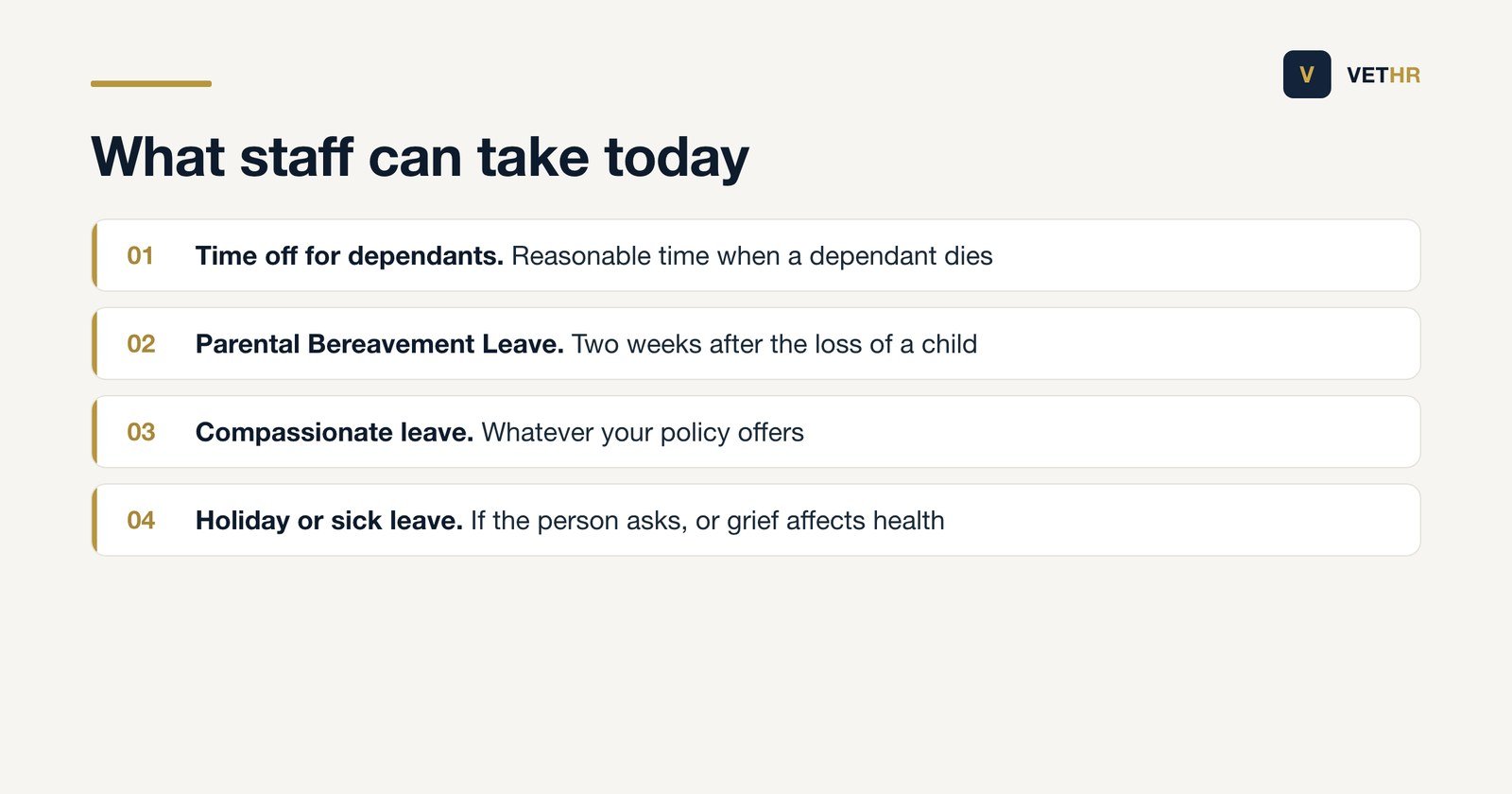
Today there is no general legal right to bereavement leave. Employees can use their right to time off for dependants when a dependant dies, parents who lose a child get two weeks of statutory leave, and anything beyond that depends on the practice’s own policy. Most people will need a mix of these.
Acas guidance on leave when someone dies confirms that employees have a legal right to time off if a dependant dies, or if their child is stillborn or dies under the age of 18. It also notes that agency workers, casual workers and people on zero-hours contracts are unlikely to be employees, and that employers should still support them as much as they can.
Acas also stresses that grief is not a linear process. Someone who seems fine in week two may struggle badly in month three, and a practice that offers time off only as a single block misses that.
Parental Bereavement Leave gives an employee two weeks off for each child who dies before turning 18 or is stillborn after 24 weeks of pregnancy, from their first day of employment. It can be taken as one block of two weeks or as two separate weeks, and must be finished within 56 weeks of the death.
The GOV.UK guidance on Parental Bereavement Pay and Leave sets out the detail:
The notice rules are deliberately light, and a practice should be lighter still. Nobody in the first days after losing a child should be filling in a form, so let a text message be enough and handle the paperwork yourself.
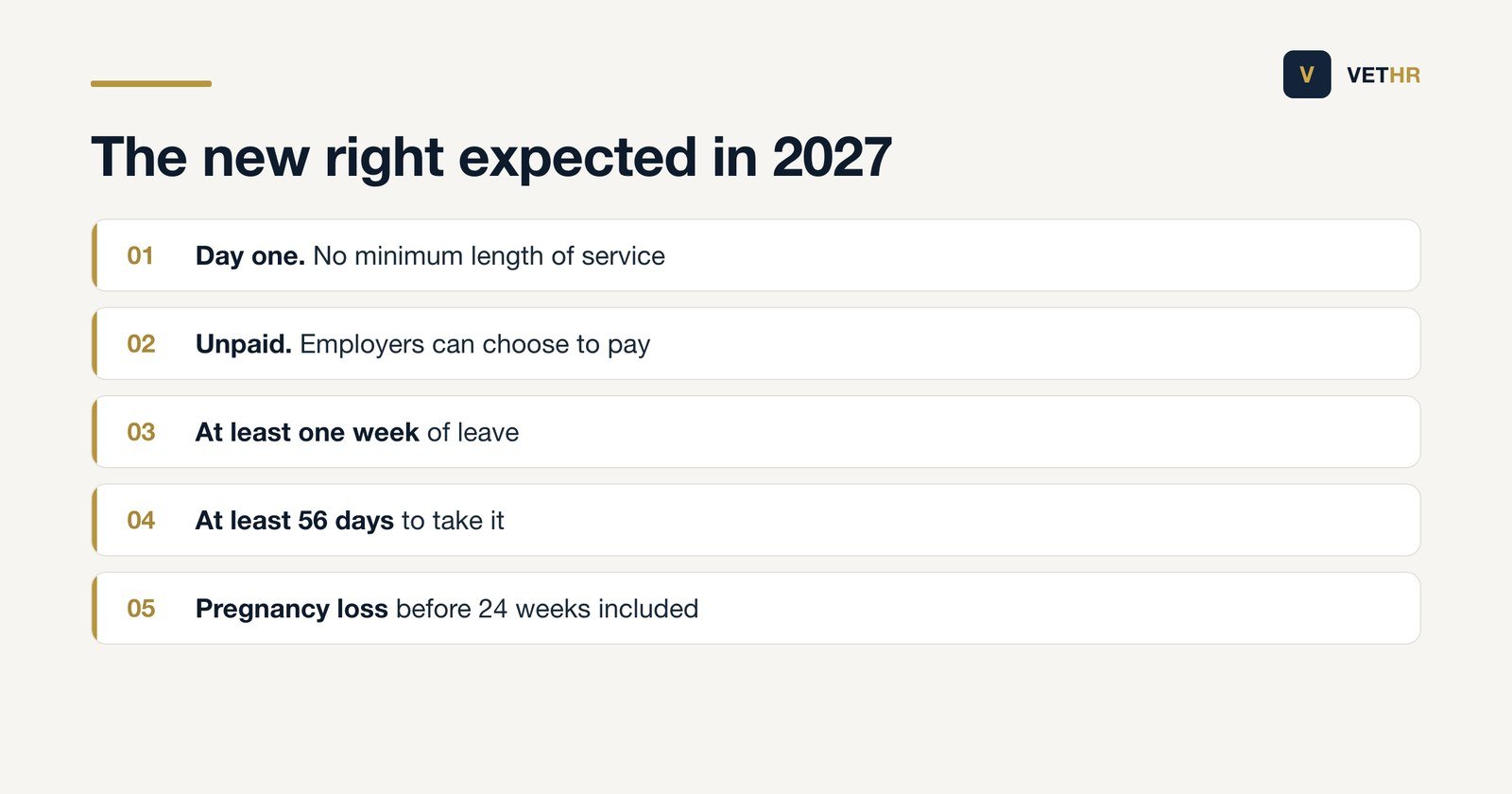
The Employment Rights Act 2025 creates a new day-one right to unpaid bereavement leave for employees who lose a loved one, including pregnancy loss before 24 weeks. The leave must be at least one week, and employees must have at least 56 days to take it. The government expects it to start in 2027.
A Department for Business and Trade factsheet confirms those minimums, says the Act also provides protection around redundancy and dismissal, and lists the extended entitlement, including pregnancy loss, for 2027. The detail, including who qualifies by relationship to the person who died, will be set in regulations.
The government consultation on those details ran from 23 October 2025 to 15 January 2026, and asked about eligibility, which types of pregnancy loss are in scope, how the leave can be taken, and notice and evidence. At the time of writing, the government says it is analysing the feedback.
The scale is significant. The same factsheet, citing Sue Ryder research, says bereavement causes nearly two million working people to suffer intense grief each year, and cites an estimate that 1 in 5 women in the UK experience a miscarriage in their lifetime. In a team of twenty, someone will need time off to grieve sooner or later.
The law does not require it, apart from Statutory Parental Bereavement Pay for those who qualify, and the 2027 right will be unpaid. The factsheet notes that employers can choose to enhance the entitlement in length or pay, as a number already do. For a small practice, a few paid days is a modest cost for a large amount of goodwill.
Whatever you decide, apply it consistently. Acas advises employers to be consistent and clear in their approach and to confirm decisions in writing, because two colleagues treated differently for the same loss is how resentment starts.
There is no statutory right to leave when a pet dies. The current rights are built around people: dependants, and parents who lose a child. A practice can still choose to offer a day of compassionate leave, and a veterinary practice is the one employer where everyone understands why that matters.
There is a particular version of this in veterinary work. A nurse or vet may be present at, or carry out, the euthanasia of their own animal. Offering them the rest of the day, and not rostering them onto a euthanasia appointment that week unless they ask, costs almost nothing.
If you offer leave when a pet dies, write it into the policy with a clear limit, so it is applied the same way for the receptionist as for the clinical director.
Want a bereavement policy that is clear, kind and ready for 2027? A free 30-minute HR health check is the place to start. Book your HR health check.
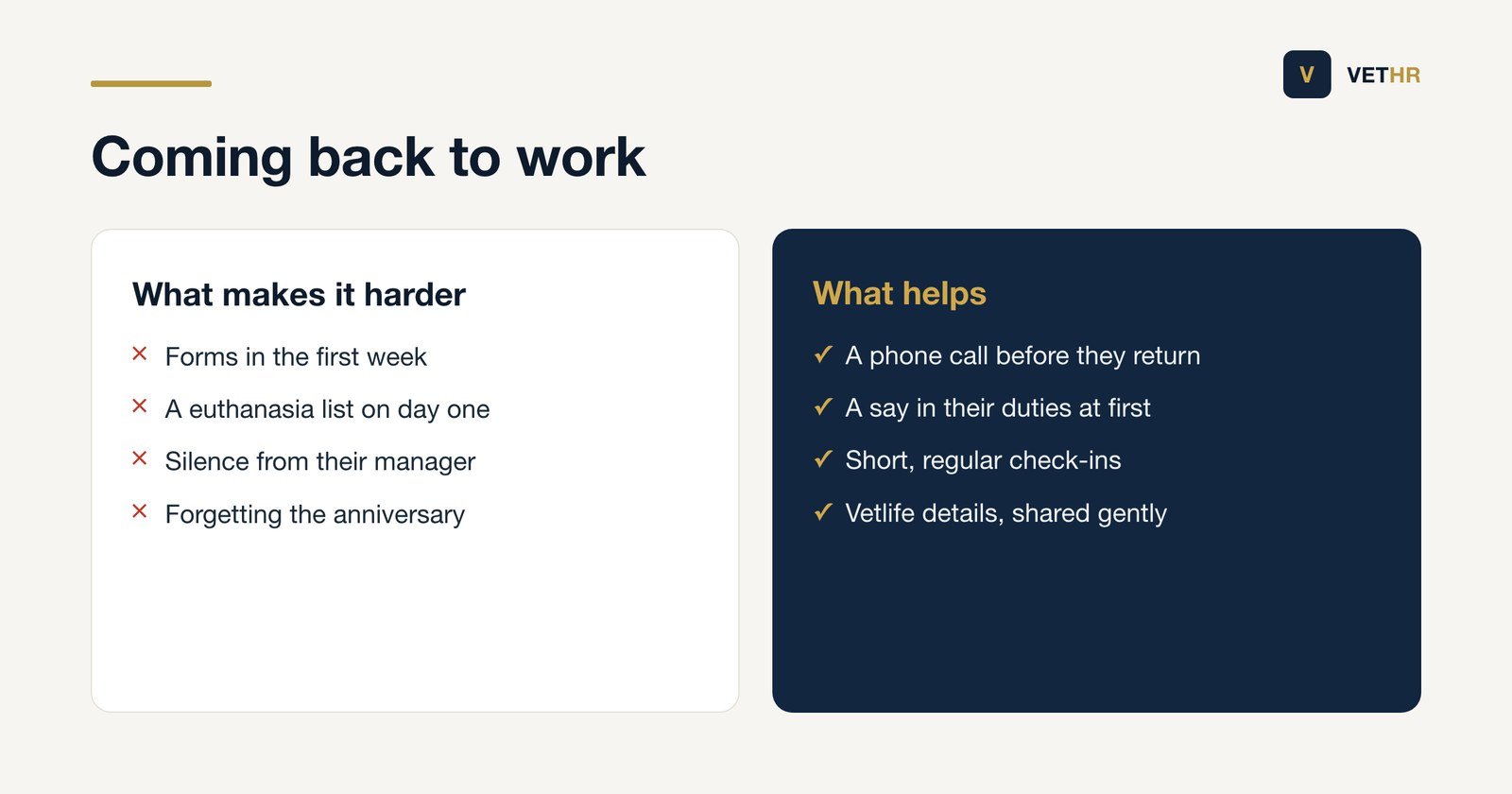
Plan the return with them, not for them. Acas advises employers to be sensitive to what each person needs, consider their physical and emotional wellbeing, and recognise that grief can affect people at different times. In practice that means a conversation before day one back, some say over duties at first, and check-ins that continue after the first week.
Make support easy to find. Vetlife runs a confidential helpline for the veterinary community on 0303 040 2551. Our guides to return to work interviews and managing burnout cover the wider conversation.
Acas says a bereavement policy should set out when leave applies, how much leave is available, and whether it is paid and how much. A good veterinary practice policy adds what happens after pregnancy loss, whether pet loss is covered, how to tell the practice, and what support is available on return.
Keep the policy in the staff handbook and review it when the 2027 regulations are published. Our guide to employment law changes tracks what is coming and when.
Not in general. Employees can take reasonable time off when a dependant dies, and parents who lose a child under 18 or have a stillbirth after 24 weeks get two weeks of Parental Bereavement Leave. A wider day-one right to unpaid bereavement leave is expected in 2027.
By law, a reasonable amount of time to deal with the death, such as arrangements and the funeral, under the right to time off for dependants. A practice can offer more through compassionate leave. Set the amount in your policy and apply it consistently.
Parental Bereavement Leave covers stillbirth after 24 weeks of pregnancy. The new bereavement leave expected in 2027 will include pregnancy loss before 24 weeks. Until then, handle it with compassionate leave in your policy, and take advice on the individual situation.
Only Statutory Parental Bereavement Pay, for parents who qualify. Other bereavement leave is unpaid unless your contract or policy says otherwise, and the 2027 right will be unpaid, although employers can choose to pay.
There is no statutory right, but a practice can offer compassionate leave for the loss of a pet. If you do, put it in your policy with a clear limit so it is applied fairly across the team.
A bereavement policy is one of the few HR policies every member of your team will eventually need. The minimum will rise in 2027, but the practices people stay loyal to are the ones that already go further: a few paid days, a gentle return and someone who remembers the anniversary.
Our HR consultancy can write or update your policy ahead of the 2027 regulations, and a free HR health check will show where your current handbook falls short.
The Vet HR Team provides HR consultancy and white-labelled staff systems exclusively to UK veterinary practices. This guide is general information, not legal advice.
Contracts, rotas, holiday, a difficult conversation. Tell us what you are dealing with and we will come back within one working day. Nothing to sign up to.
Got it. We will come back to you within one working day. If you do not see a reply, please check your spam folder.
