Last updated: 16 November 2026
TL;DR: HSE’s core principle is that a smooth, clean, dry floor is rarely a slip risk. A veterinary practice spends all day making floors not dry, so the control is contamination and cleaning rather than signage. Assess the risk, keep floors suitable and free from obstructions, and clean in sections so there is a dry path through.
Every veterinary practice has the same photograph somewhere: a yellow folding sign, standing in a corridor, next to a floor that dried two hours ago. It is the clearest possible sign that a practice has thought about slips and trips exactly once.
HSE sets out what employers have to do about slips and trips in two sentences. Ensure the health and safety of all employees and anyone affected by their work, so far as is reasonably practicable. And assess risks, including slip and trip risks, and where necessary take action to address them.
There is a specific requirement about floors too. HSE says floors must be suitable, in good condition and free from obstructions.
Note who is covered. Anyone affected by their work means clients, their animals and the delivery driver, not just staff. In a waiting room that matters more than anywhere else in the building, because a client who falls in reception is both an injury and a claim.
HSE puts it in a single line that is worth pinning up: a smooth, clean, dry floor is rarely a slip risk.
Read it backwards and you have your whole assessment. Slips and trips appear when the floor stops being clean or stops being dry. Everything else is detail.
Which is uncomfortable for veterinary work, because a practice is a machine for putting liquid on floors. Urine, blood, saline, surgical spirit, rain off six dogs, mop water and spilled coffee, all day, every day. The question is not whether your floors get contaminated. It is how fast you deal with it.

HSE’s list of contamination sources is generic, covering fluids, swarf, saw dust, food and drink, polythene and cardboard. Translate it into your building and the veterinary causes of slips and trips are obvious.
Each of those has a different answer. Spot cleaning for fluids, absorbent matting at the entrance for rain, a rule about drinks, and a delivery routine that ends with the packaging gone rather than stacked in a corridor.
Writing that translation down is most of the work. A slips and trips assessment that lists fluids and packaging in the abstract tells nobody anything. One that names the waiting room, the prep room floor and the Tuesday wholesaler delivery is a document people can actually act on, and it takes about an hour to produce.
This is the part nobody expects. HSE states that the cleaning process often introduces slip or trip hazards, namely wet floors and trailing cables.
The guidance is practical about what to do instead. Leave smooth floors dry after cleaning, or exclude pedestrians until the floor is dry. Clean in sections, so there is a dry path through the area. And a dry mop or squeegee will reduce floor drying time, but while the floor is damp it will still be slippery.
That last clause is the one that catches practices out. Damp is not dry. A corridor that has been squeegeed is faster to become safe, not instantly safe, and the difference is where slips and trips actually happen.
HSE does say to use warning signs, but with a condition attached: remember to remove them when the area is clean and dry.
A permanent sign is worse than no sign. It trains everybody, staff and clients alike, to walk past it without looking, which is precisely the opposite of what it is for. It is also the first thing that undermines you if a slips and trips claim is ever made, because it shows the hazard was known and left in place.
Treat the sign as part of the cleaning task. It goes out when the mop comes out and it goes away when the floor is dry, in the same way that you would not leave a ladder up after changing a bulb.
The same applies to the temporary fix that quietly becomes permanent. A rubber mat over a cracked tile, a length of tape over a lifted edge of vinyl, a bin standing where the ceiling drips. Each one starts as a sensible response to slips and trips and ends up as evidence that the floor was never actually repaired. Put a date on every temporary measure and a name against the permanent fix.

Floors being free from obstructions is the requirement, and a busy practice violates it hourly without meaning to. Trips are the quieter half of slips and trips and they cause the same injuries.
Oxygen cylinders parked against a wall. Fluid pump leads across a prep room. Extension cables to a warming blanket. Stacked crates in a corridor because there is nowhere else. Cardboard from a wholesaler delivery waiting for someone with five minutes. None of that is negligence, it is just a small building doing a lot of work.
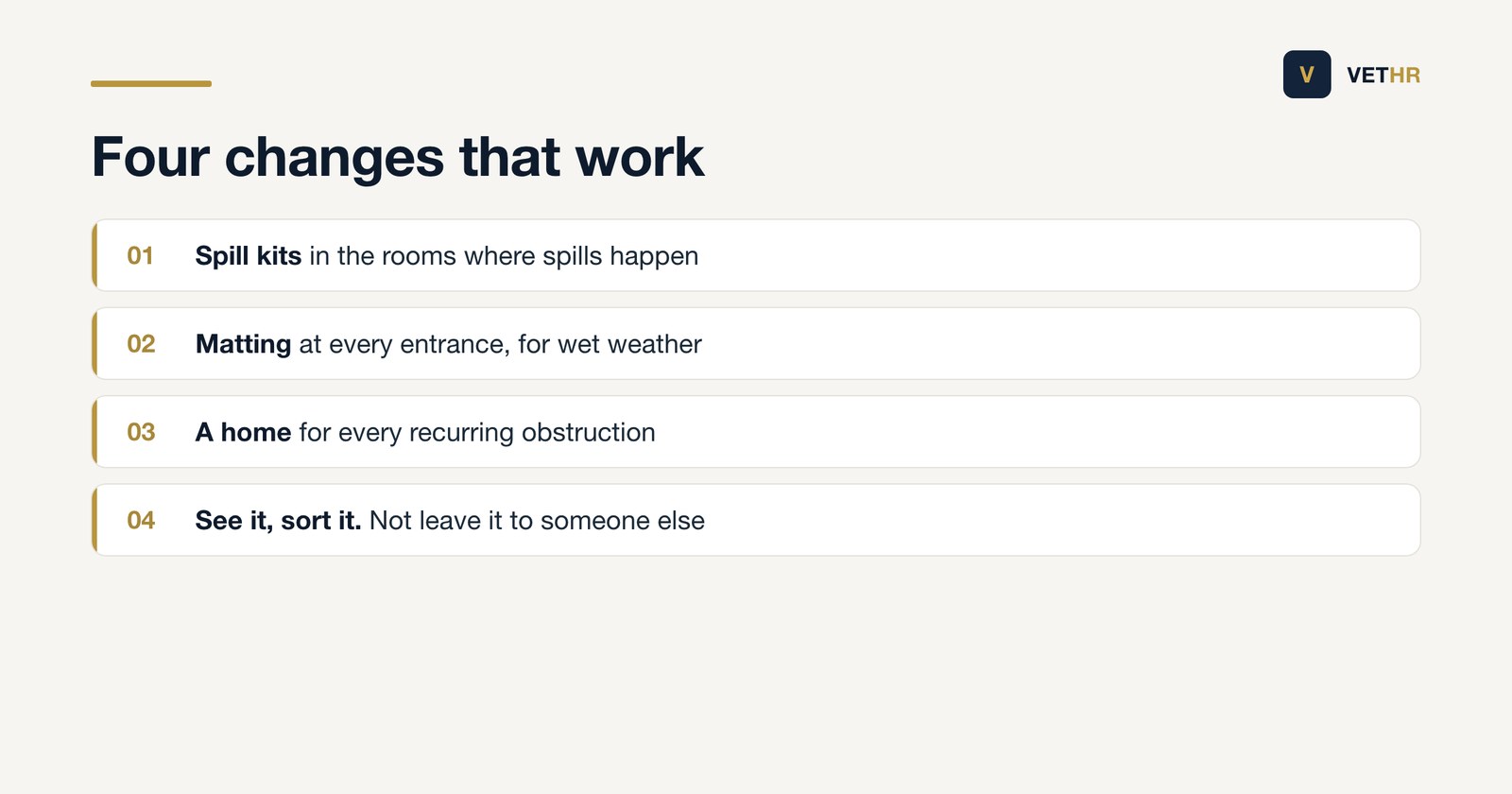
The fix is storage rather than vigilance. Every recurring obstruction that has no home is a storage decision waiting to be made, and until it is made the trip risk comes back every week. Our notes on manual handling and lone working cover the related risks in the same rooms.
HSE’s own words for the housekeeping culture to aim at are a see it sort it mentality, rather than a leave it to someone else attitude.
In practice terms that means the vet who spots urine in the waiting room deals with it rather than telling reception. It also means the kit to deal with it has to be within reach, because a culture of sorting things out collapses if the paper towel is two rooms away.
Put spill kits where spills happen. Waiting room, consult rooms, prep, kennels. That single change does more for slips and trips than any poster ever printed, because it removes the delay between somebody noticing a hazard and somebody being able to deal with it.
Then write the assessment down, because an unwritten one is indistinguishable from none. Our guides to RIDDOR reporting, first aid at work and the COSHH assessment cover what sits next to it in the file. Book a free 30-minute HR health check if you want the gaps listed for you.
Ensure the health and safety of all employees and anyone affected by your work, so far as is reasonably practicable, and assess risks including slip and trip risks, taking action where necessary. Floors must be suitable, in good condition and free from obstructions.
No. HSE says to use warning signs but to remember to remove them when the area is clean and dry. A sign left out permanently stops being read, and it does nothing to make the floor dry, which is the actual control.
Yes, if you do it in sections so there is a dry path through the area, or exclude people until the floor is dry. HSE also notes that a dry mop or squeegee reduces drying time, but the floor is still slippery while damp.
Yes. The duty covers all employees and anyone affected by your work, so far as is reasonably practicable, which includes clients in the waiting room and anyone delivering to the building.
Putting spill kits in the rooms where spills happen, so contamination is dealt with in seconds by whoever sees it. HSE describes the target culture as see it sort it rather than leave it to someone else.
Take the yellow sign away and ask instead how quickly a spill gets cleaned in your building, and who is expected to do it. That is the honest slips and trips assessment, and it is a better one than most written records contain.
We write the health and safety file and the cleaning schedule that sits behind it through HR consultancy for veterinary practices and the policy document set.
The Vet HR Team provides HR consultancy and white-labelled staff systems exclusively to UK veterinary practices.
Contracts, rotas, holiday, a difficult conversation. Tell us what you are dealing with and we will come back within one working day. Nothing to sign up to.
Got it. We will come back to you within one working day. If you do not see a reply, please check your spam folder.
