Last updated: 10 November 2026
TL;DR: A written warning must set out what the misconduct or performance issue is, the changes needed with a timescale, what could happen if they are not made, and how long the warning will stay in place. Acas also expects any support or training to be named where the issue is about performance.
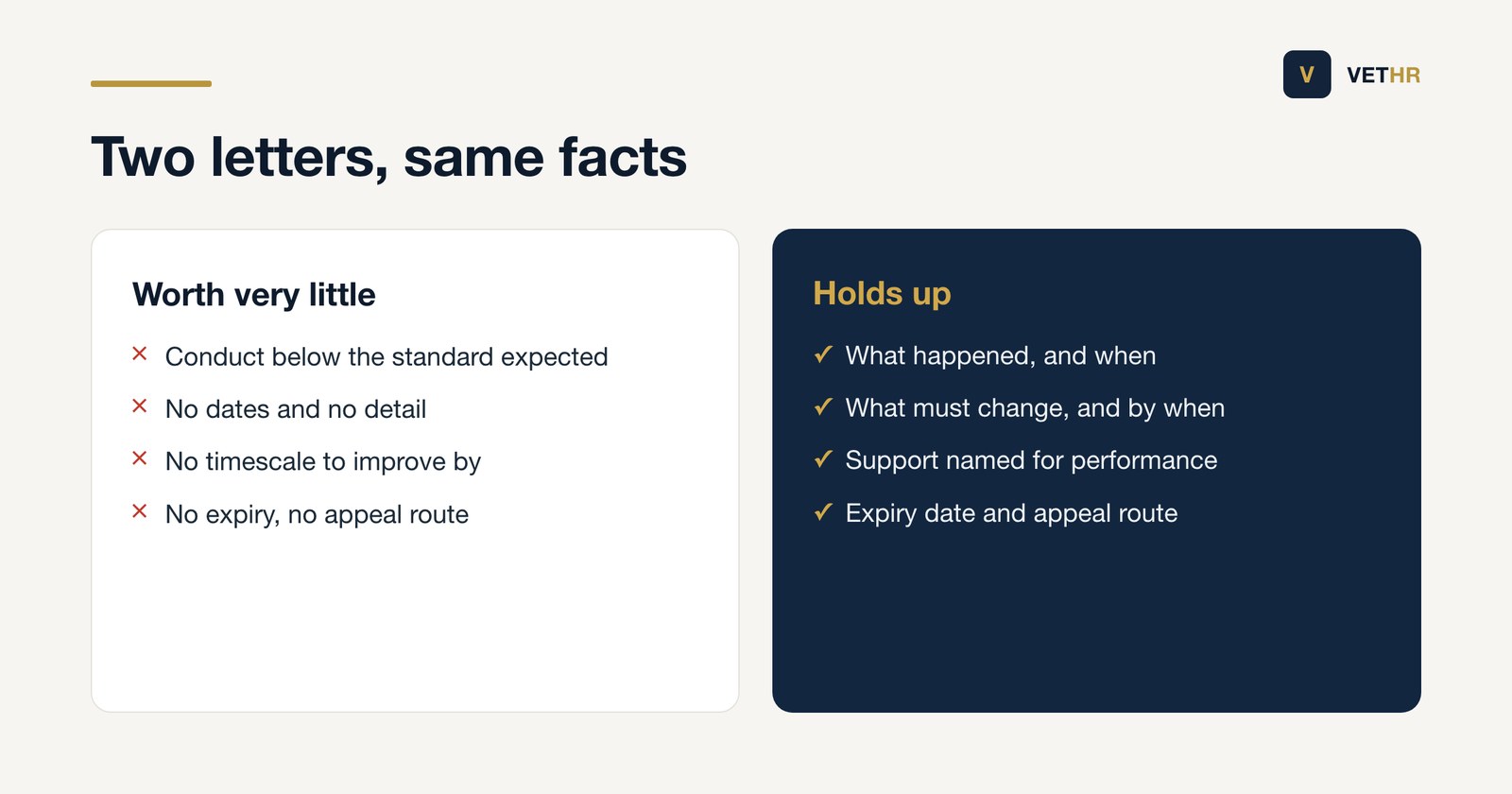
A receptionist receives a letter saying her conduct has fallen below the standard expected and that further issues may result in dismissal. It does not say what she did, what she should do differently, by when, or how long the letter counts for. Six months later the practice tries to rely on it, and discovers it is worth very little.
Acas describes three. An informal talk where the issue is small and not serious. A first written warning, which is usually the first step an employer will take when misconduct or poor performance is confirmed. And a final written warning where there is a repeat or a lack of improvement, or immediately in serious cases.
Most practice problems belong at the informal stage and never need a letter at all. Reaching for a written warning for a first, small, fixable issue makes the next conversation harder and is the most common overreaction in small practices. A nurse who was five minutes late twice does not need paperwork. She needs somebody to ask why.
Equally, an informal chat repeated five times is not a procedure. If nothing has changed after two conversations, the formal route is fairer to everybody because it finally tells the person where they stand.
Acas lists it precisely, and this is the part practices skip.
Read that against the receptionist’s letter. It contained one of the six, and the one it contained was the threat.
Be specific about the conduct. Dates, what happened, and why it matters clinically or to clients. Vague wording about attitude or professionalism cannot be improved against, which means it cannot be fairly enforced either.

Acas requires the letter to say how long the warning will stay in place, but does not set a fixed period. That is a decision for your policy rather than a number the law hands you.
Common practice is six months for a first written warning and twelve for a final one, and there is nothing magic about either figure. What matters is that the policy states it, the letter repeats it, and the practice applies it consistently.
Put the expiry date in the letter as an actual date rather than a duration. It removes an argument later about when the clock started.
Different periods for different levels are fine, and normal. What is not fine is deciding the length of a written warning after the event, once you know whether you want it to still be live. Set it in the policy, then follow the policy.
Once a written warning has expired, treat it as spent. Relying on it to justify a heavier sanction later undermines the whole point of telling somebody it would expire.
If a pattern genuinely repeats every seven months, that is a reason to look at whether the expiry period in your policy is right, or whether the underlying issue has ever actually been addressed. It is not a reason to quietly resurrect an old letter.
Where you think an exception is justified, take advice first. This is one of the areas where an otherwise sound dismissal comes apart.
The same letter format covers both, but the content should not read the same. Conduct is about choices. Performance is usually about capability, training or workload.
That is why Acas asks for any support or training to be named where the issue is performance. A performance warning with no support offered says the practice has decided the person cannot improve, which is rarely true and never persuasive.
Ask too whether something else explains it: a health condition, a disability, a caring responsibility, or a reasonable adjustment nobody has made. Our notes on managing underperformance, reasonable adjustments and neurodiversity cover what to check before anything formal.
GOV.UK is blunt about why the detail matters. You should have written disciplinary rules and procedures covering performance and conduct, you must tell your staff about them, and those rules should follow the Acas Code of Practice on disciplinary and grievance procedures.
Not following the code is not illegal in itself. But GOV.UK states that if someone wins an employment tribunal against you and you did not follow the code, their award could be up to 25% more.
That is the commercial case for spending twenty minutes on a written warning rather than five. A vague letter does not only fail the person holding it. It adds a quarter to the cost of getting the next decision wrong.
It also means a written warning is only ever as strong as the policy behind it. GOV.UK says the rules must state what is acceptable and unacceptable behaviour and what action you will take if they are broken. Without that, the letter arrives out of nowhere and the person can fairly say they were never told. Our notes on the staff handbook for a veterinary practice cover what belongs in there.
Every written warning carries a right of appeal, and the letter has to say so, naming who to write to and by when.
Acas sets out a six step procedure running from understanding the options through investigation, the hearing, the outcome and what happens afterwards. The outcome letter is step five of six, not the end.
Our guide to the disciplinary appeal in a veterinary practice covers who should hear it, which is the hardest question in a small team.
On the personnel file, with the investigation notes, the invitation letter and the hearing notes. Not in a manager’s inbox and not in a shared drive the whole team can open. A written warning is category-sensitive employment data and the rest of the team has no business reading it.
Diarise the expiry date when you issue it, so the file can be marked when the warning lapses. A practice that cannot say whether a warning is live is not in a position to rely on it.
Our notes on digital staff records and disciplinary procedures cover the filing and the process around it. Book a free 30-minute HR health check if you have a letter to write and want it checked first.

Acas requires the letter to say how long it will stay in place but sets no fixed period. Six months for a first warning and twelve for a final one are common, and the important thing is that your policy states it and you apply it consistently.
Acas indicates a final written warning can be given immediately in serious cases, as well as after a first warning where conduct is repeated or performance does not improve. Record why the seriousness justified skipping a step.
Treat an expired warning as spent. Having told someone it would lapse, using it afterwards to justify a heavier sanction is difficult to defend and is a common reason an otherwise sound dismissal fails.
No, and giving one blurs the line. Acas describes an informal talk as appropriate where the issue is small and not serious. Keep a short private note for yourself, but do not dress it up as a formal outcome.
Yes, and the letter should name who to appeal to and by when. Acas treats the appeal as part of a fair procedure, and a tribunal looking at fairness will check whether a genuine opportunity to challenge the decision existed.
The receptionist’s letter failed not because the practice was wrong about her conduct, but because it never said what she did, what to change, by when, or for how long it counted.
Put the six items in, date the expiry, and name the appeal route. We write disciplinary templates for independent practices through HR consultancy for veterinary practices and the policy document set.
The Vet HR Team provides HR consultancy and white-labelled staff systems exclusively to UK veterinary practices.
Contracts, rotas, holiday, a difficult conversation. Tell us what you are dealing with and we will come back within one working day. Nothing to sign up to.
Got it. We will come back to you within one working day. If you do not see a reply, please check your spam folder.
