Last updated: 2 November 2026
TL;DR: Neurodiversity describes the natural differences in how people’s brains behave and process information. Acas says being neurodivergent will often amount to a disability under the Equality Act 2010, which brings a legal duty to make reasonable adjustments. The employer pays for them, and should talk to the person rather than assume.

A nurse who is excellent clinically keeps missing things in verbal handovers. She has asked twice for the handover to be written down and been told the team has always done it this way. She is now being described as not a great communicator, which is how a solvable working problem turns into a performance file.
Acas defines it simply. Neurodiversity describes the natural differences in how people’s brains behave and process information.
Neurodiversity covers a range of conditions and ways of thinking, and it is not a synonym for a problem. Many of the traits that come with it are exactly what a veterinary team wants: pattern recognition, deep focus, precision with protocols, an unwillingness to let an inconsistency go.
Acas also notes that some neurodivergent people do not view themselves as disabled, which matters for how the conversation is framed. The legal duty exists whether or not the person uses that word about themselves.
On neurodiversity, Acas states that being neurodivergent will often amount to a disability under the Equality Act 2010, which brings protection from discrimination and the right to reasonable adjustments.
Often is the operative word. It is not automatic and it is not decided by a diagnosis alone, but a practice that waits for certainty before doing anything useful has usually waited too long.
The practical position is straightforward. If an adjustment is cheap, sensible and would help, make it. Working out whether you were legally obliged to is a conversation for a situation that has already gone wrong.
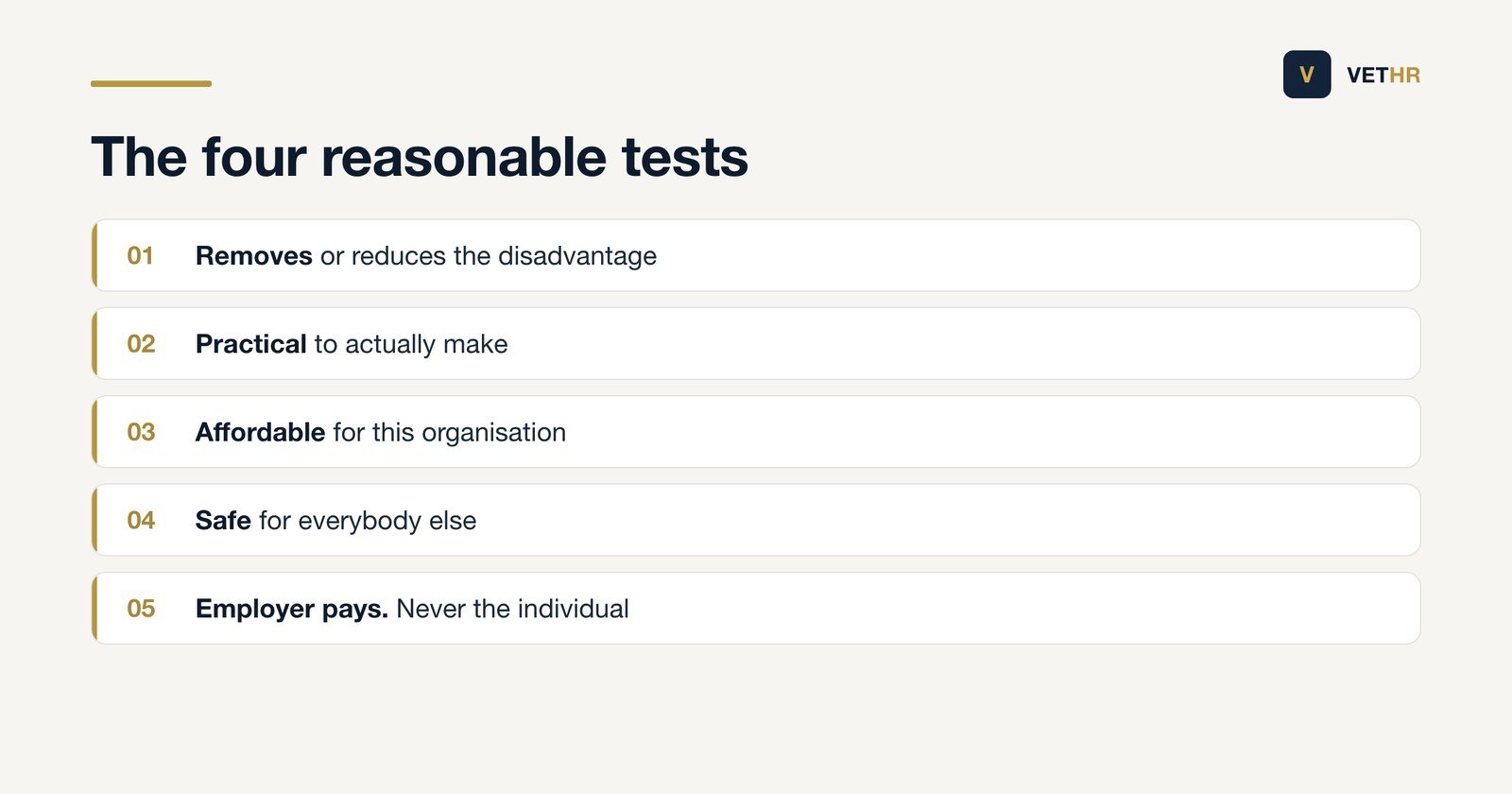
Acas describes reasonable adjustments as changes an employer makes to remove or reduce a disadvantage related to someone’s disability, and says employers must make them by law.
Four questions decide whether an adjustment is reasonable: will it remove or reduce the disadvantage, is it practical to make, is it affordable, and could it harm the health and safety of others. Acas adds that the employer does not have to change the basic nature of the job.
Two more points that settle most arguments. The employer is responsible for paying for any reasonable adjustments. And the duty extends beyond employees to workers, contractors and job applicants.
Acas is also clear on approach: the employer should talk with the person and not make assumptions. Our guide to reasonable adjustments in a veterinary practice covers the process.
Review adjustments when the work changes. A move to a different branch, a new practice management system or a switch onto the out of hours rota can undo an arrangement that was working perfectly well, and nobody thinks to revisit it.
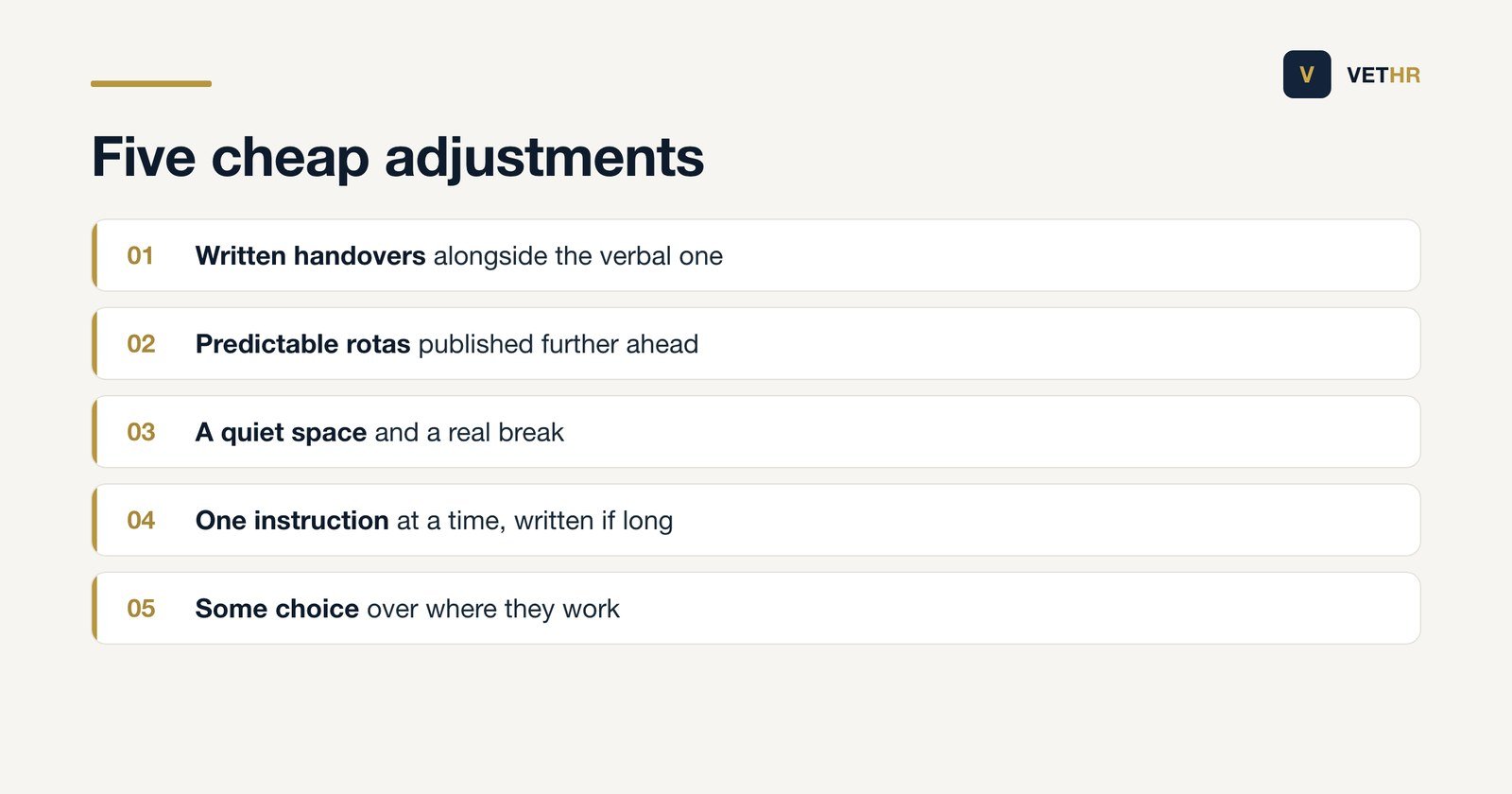
These neurodiversity adjustments come up repeatedly in veterinary settings, and none of them costs much.
Notice how many of those are just good practice management. Written protocols, published rotas and protected breaks help everyone, which is why the best adjustments are usually the ones you can make for the whole team. Our notes on the shift handover and rota system cover the first two.
Acas encourages employers to make their organisations neuroinclusive so that people do not feel they have to mask, meaning to hide traits in order to fit in.
Masking is exhausting, and in a clinical setting the exhaustion lands on top of an already demanding job. People who mask all week are the ones who burn out, and the practice usually reads that as a resilience problem.
Very few people will disclose to a manager who has never mentioned the subject. Saying once, in a team meeting, that the practice makes adjustments and that people should ask, does more than any policy document.

Train the people who hear it first. A disclosure about neurodiversity usually arrives sideways, in the middle of something else, to whoever happens to be on shift, and the response in that moment decides whether anything useful follows. A manager who says thank you for telling me and asks what would help has done the whole job.
Keep what you are told to the people who need it. An adjustment can be arranged without the reason being circulated, and treating neurodiversity information as health data rather than team news is what makes the next person willing to speak up.
This is where practices create real legal risk on neurodiversity. Acas warns against applying rigid zero-tolerance policies without considering neurodivergent factors, and indicates that failing to account for neurodivergence in how a policy is applied is likely to be discrimination.
Read that against a lateness trigger, a communication style complaint, or a bluntness that a colleague found rude. Each of those can be a conduct issue, and each of them can also be a disadvantage the practice was already on notice about.
So before any formal step, ask whether an adjustment was requested and refused, or never considered. Our guides to disciplinary procedures and absence trigger points cover where discretion belongs.
Acas also says complaints about unwanted behaviour should be taken seriously and investigated promptly. Neurodiversity is never a reason to leave a colleague unprotected, and both things have to be true at once.
The neurodiversity duty covers job applicants, so it starts before anyone is employed. Send interview questions in advance, say what the format will be, and offer an alternative to a timed practical if one is not essential to the role.
Probation is the other pinch point. A new starter still learning the building, the systems and the team is the least likely to ask for anything, and the most likely to be judged on how quickly they settle.
Ask every new starter in week one what helps them work well. Asked of everybody it is a normal question, and it gets answers that a policy never will. Our notes on interview questions and probation periods cover both stages, and a free 30-minute HR health check is a good place to start if a situation is already live.
Acas says being neurodivergent will often amount to a disability under the Equality Act 2010, which brings protection from discrimination and the right to reasonable adjustments. It is not automatic, and some people do not view themselves as disabled.
No. If an adjustment is practical, affordable and would remove a disadvantage, make it. Waiting for paperwork while somebody struggles is both unkind and risky, because the duty can arise once the employer knows about the disadvantage.
Acas states that the employer is responsible for paying for any reasonable adjustments. What counts as affordable varies with the size of the organisation, but the cost never falls on the individual.
Yes. The employer does not have to change the basic nature of the job. What you must not do is apply a policy rigidly without considering neurodivergent factors, which Acas indicates is likely to be discrimination.
Take it seriously and investigate promptly, as Acas advises. Supporting one person never means leaving another unprotected. Look at whether an adjustment or a clearer expectation would resolve it before anything formal.
The nurse asking for a written handover was not asking for special treatment. She was naming a cheap, practical change that would have helped her and probably half the team, and she was told the practice has always done it this way.
Ask everyone what helps them work well, make the easy changes, and keep discretion in your policies. We help independent practices with adjustment conversations and policy wording through HR consultancy for veterinary practices and ongoing HR support on subscription.
The Vet HR Team provides HR consultancy and white-labelled staff systems exclusively to UK veterinary practices.
Contracts, rotas, holiday, a difficult conversation. Tell us what you are dealing with and we will come back within one working day. Nothing to sign up to.
Got it. We will come back to you within one working day. If you do not see a reply, please check your spam folder.
