Last updated: 24 November 2026
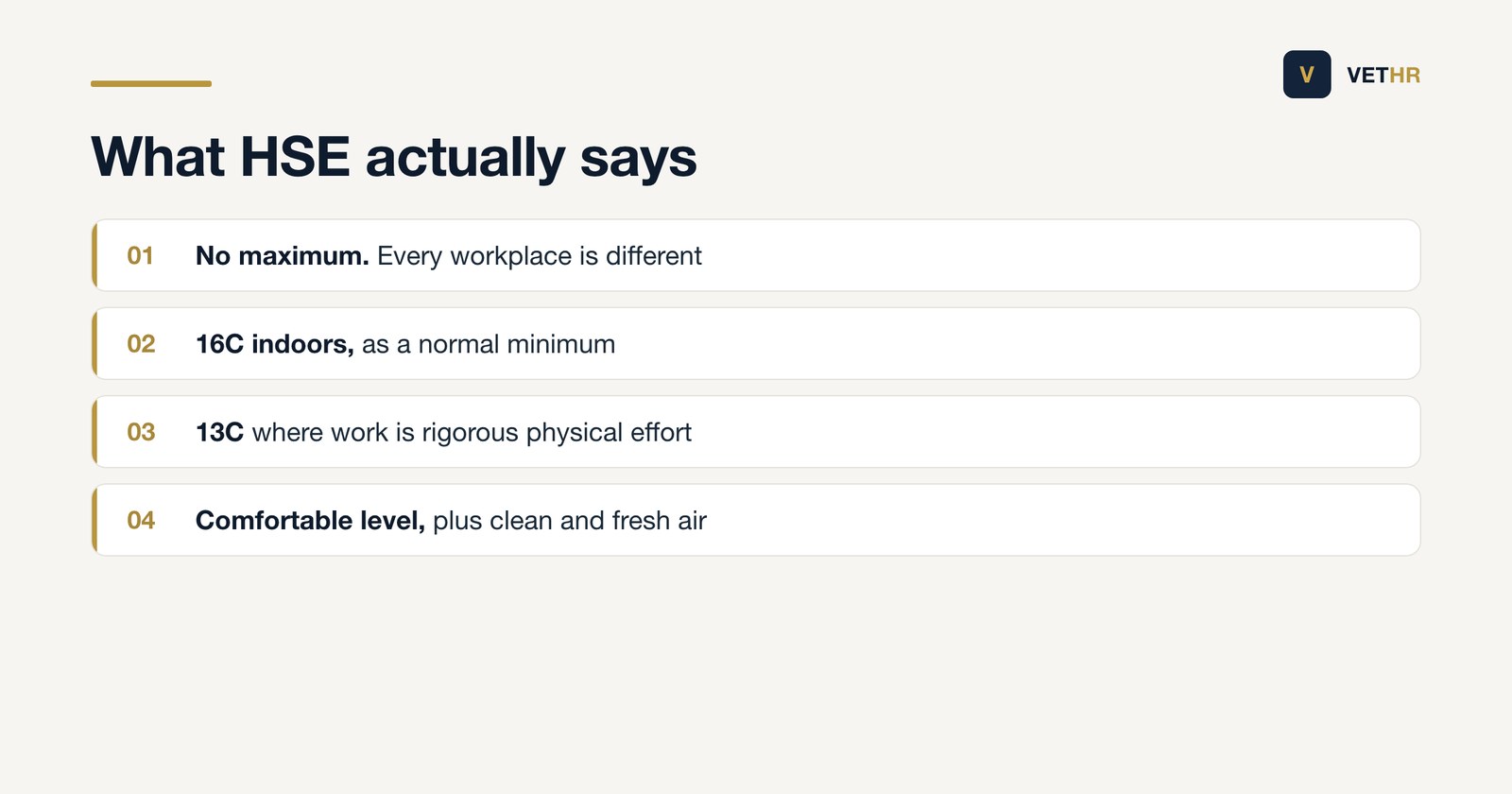
TL;DR: HSE says there is no law for maximum working temperature, or when it is too hot to work, because every workplace is different. The minimum temperature in an indoor workplace should normally be at least 16C, or 13C if much of the work involves rigorous physical effort. Everything else is thermal comfort, and that is assessed by asking people.
Theatre is warm because the patient is anaesthetised and losing heat. The surgeon is gowned, masked and standing under a light. Kennels is cold because the doors keep opening. Reception is cold because the door is always opening. Everybody is uncomfortable in a different direction, and the practice manager is expected to solve it with one thermostat.
HSE’s guidance for employers on workplace temperature is short on figures, deliberately.
There is no law for maximum working temperature, or when it is too hot to work, because every workplace is different. That sentence disposes of the office myth about 30 degrees, and it disposes of it in both directions: no number to point at, and no number to hide behind. Workplace temperature at the hot end is a judgement, not a threshold.
At the other end there are figures. The minimum temperature in an indoor workplace should normally be at least 16C, or 13C if much of the work involves rigorous physical effort. Kennel cleaning on a January morning is plausibly the second. Reception is definitely the first.
The reason a single number cannot settle it is that thermal comfort means taking into account a range of environmental, work-related and personal factors when deciding what makes a comfortable workplace temperature.
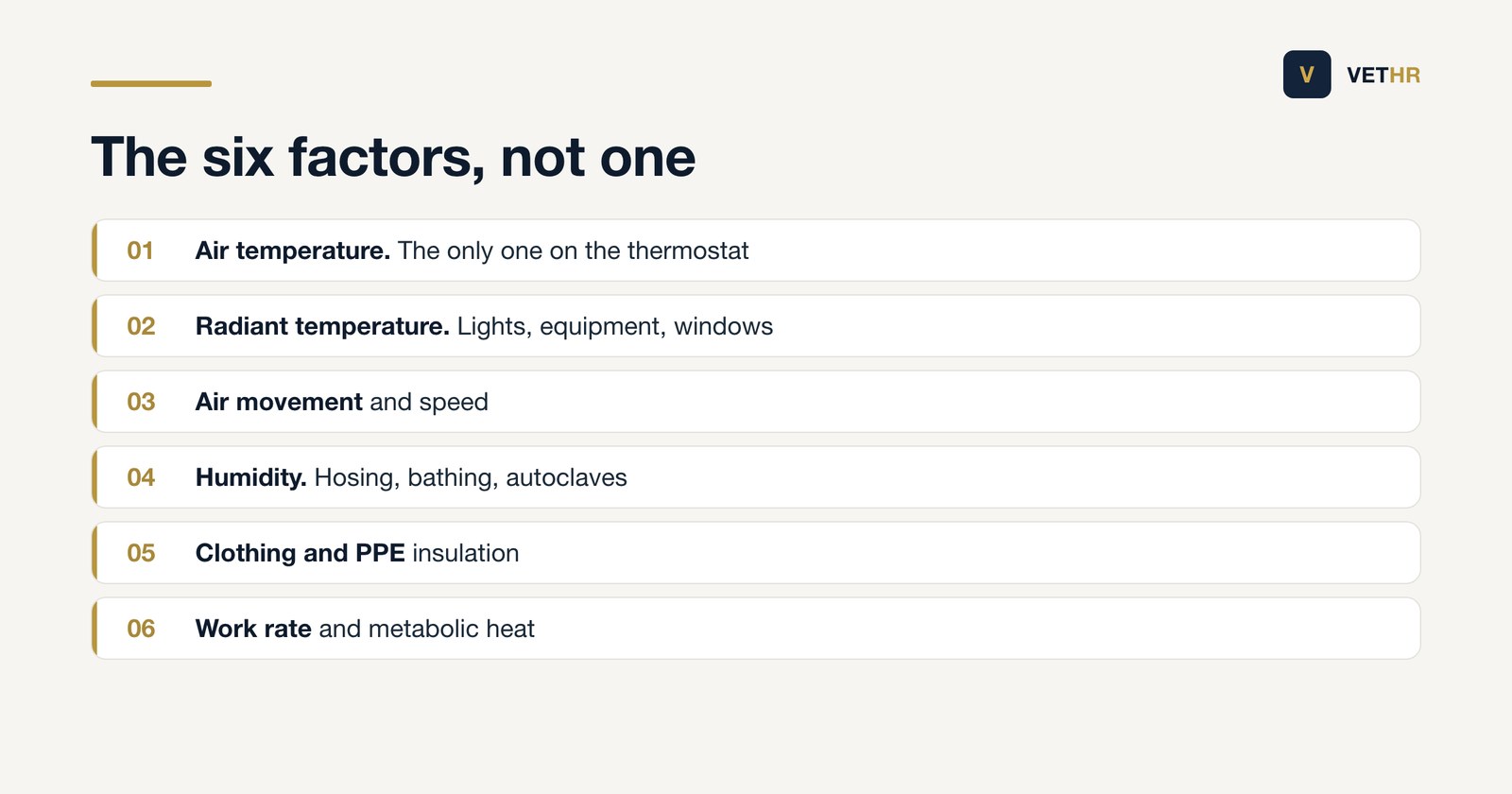
HSE lists six basic factors: air temperature, radiant temperature, air movement and speed, humidity, clothing and PPE insulation, and work rate and metabolic heat.
Only the first is on the thermostat. The other five explain why the same workplace temperature feels fine to a receptionist sitting still and unbearable to a nurse in a gown who has been restraining a labrador.
A practice does not have one workplace temperature. It has six or seven, and they conflict on purpose.
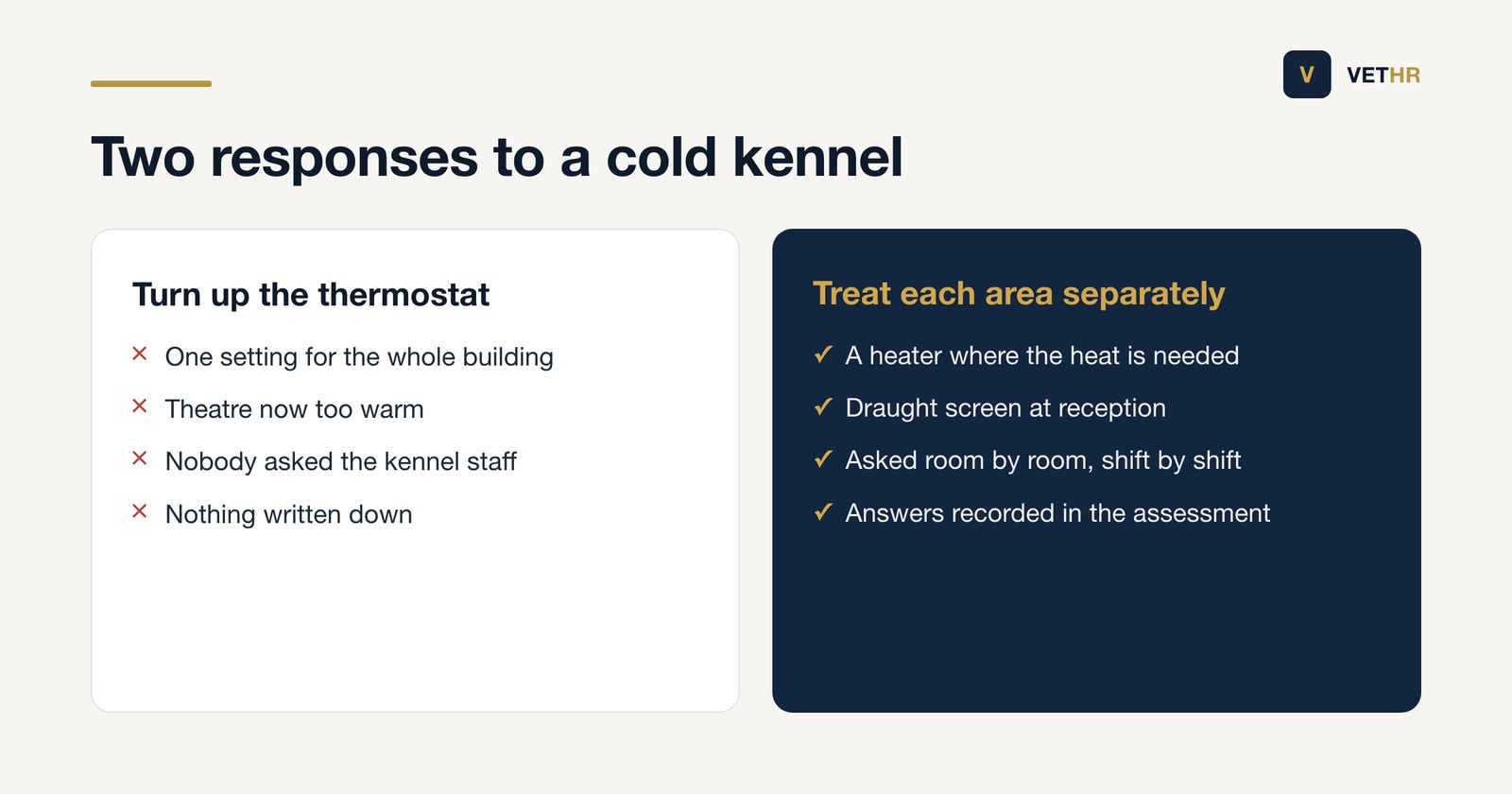
Solve them as separate problems. A draught screen at reception, a heater in kennels, and better airflow in theatre are three different answers to three different workplace temperature questions, and none of them is the main thermostat.
Clothing and PPE insulation being one of the six factors matters more in veterinary work than in almost any office.
Scrubs, a gown, a plastic apron, double gloves and a mask add up. So do the lead aprons worn for radiography, which are heavy as well as warm. A room that reads as a perfectly reasonable workplace temperature on a wall thermometer can still be genuinely unpleasant for the person wearing all of it.
The answer is rarely to remove the PPE, because that is there for a reason. It is airflow, shorter stints, and somewhere cool to go afterwards. Our notes on PPE in a veterinary practice and radiation protection cover what has to stay on.
HSE gives a method that costs nothing. A simple way of estimating the level of thermal comfort in your workplace is to ask your workers or their safety representatives if they are satisfied with the thermal environment.
Ask room by room and shift by shift, because the workplace temperature in kennels at seven in the morning is not the one at two in the afternoon. Write down what people say.
HSE is also explicit that a basic checklist does not replace a suitable and sufficient risk assessment taking account of thermal comfort. So the conversation is the start of the assessment, not the whole of it. Our note on the stress risk assessment covers the same discipline applied elsewhere.
There is no legal ceiling, but there is a duty. HSE’s guidance frames the employer obligation as keeping the temperature at a comfortable level and providing clean and fresh air.
It also tells employers to manage workplace temperature to allow the chance for workers to adapt, and to provide adequate ventilation or air conditioning plus windows that can be easily opened or closed. Several practices we work with have exactly one of those and consider the matter closed.
There is a sharper point in the thermal comfort guidance too. Employers should be aware of the risks of unsafe behaviours brought on by discomfort, and make sure the underlying reasons are understood and actively discouraged and prevented. In a practice that means a propped fire door, a removed mask, a fan blowing across a sterile field. The heat is a hazard because of what it makes people do.
The cold end is where a practice is most likely to be genuinely below the line, because the 16C figure is a real number and a wet kennel block in February is a real room.
Buy a cheap thermometer for each area and take a reading at the worst moment of the day rather than at lunchtime. First thing on a Monday, doors open, hosing under way, is the honest test of workplace temperature in kennels.
If you are under, the fixes are ordinary. Heating that reaches the room rather than the corridor, a door that closes itself, warm waterproof clothing that people will actually wear, and hot drinks available on shift. None of that is expensive next to the cost of somebody leaving because the job is physically miserable in winter.
Four lines of workplace temperature policy will cover it for most practices.
Keep the workplace temperature notes with the rest of the health and safety file, next to noise at work and slips and trips, which are the other two environmental assessments practices tend not to have. Book a free 30-minute HR health check if you want to know which of yours are missing.
No. HSE says there is no law for maximum working temperature, or when it is too hot to work, because every workplace is different. The duty is to keep the temperature at a comfortable level and provide clean and fresh air.
HSE says the minimum temperature in an indoor workplace should normally be at least 16C, or 13C if much of the work involves rigorous physical effort. Kennel work in winter is a plausible candidate for the lower figure.
Because air temperature is only one of six factors. HSE also lists radiant temperature, air movement and speed, humidity, clothing and PPE insulation, and work rate and metabolic heat. A gowned nurse and a seated receptionist are in different thermal environments.
HSE says a simple way of estimating it is to ask your workers or their safety representatives whether they are satisfied with the thermal environment. It also says a basic checklist does not replace a suitable and sufficient risk assessment.
The guidance points to adequate ventilation or air conditioning, along with windows that can be easily opened or closed. Ventilation that actually works can satisfy that where air conditioning is impractical, but one openable window in a six-room building probably does not.
No maximum, a 16C indoor minimum, 13C where the work is strenuous, and six factors that explain why one thermostat will never satisfy a veterinary practice.
Ask people room by room, write down what they say, and treat each area as its own problem. We build the health and safety file that holds it through HR consultancy for veterinary practices and the policy document set.
The Vet HR Team provides HR consultancy and white-labelled staff systems exclusively to UK veterinary practices.
Contracts, rotas, holiday, a difficult conversation. Tell us what you are dealing with and we will come back within one working day. Nothing to sign up to.
Got it. We will come back to you within one working day. If you do not see a reply, please check your spam folder.
