Last updated: 13 November 2026
TL;DR: The lower exposure action value is a daily or weekly exposure of 80 dB(A). The upper is 85 dB(A). The exposure limit value is 87 dB(A), and it must not be exceeded. A kennel full of barking dogs can sit in that range, and almost no independent practice has ever measured it.
Ask a practice manager about health and safety and you will hear about sharps, zoonoses, radiation and anaesthetic gas. Noise at work almost never comes up, which is odd, because the one room in a veterinary practice that is genuinely, measurably loud is the one with twelve dogs in it.
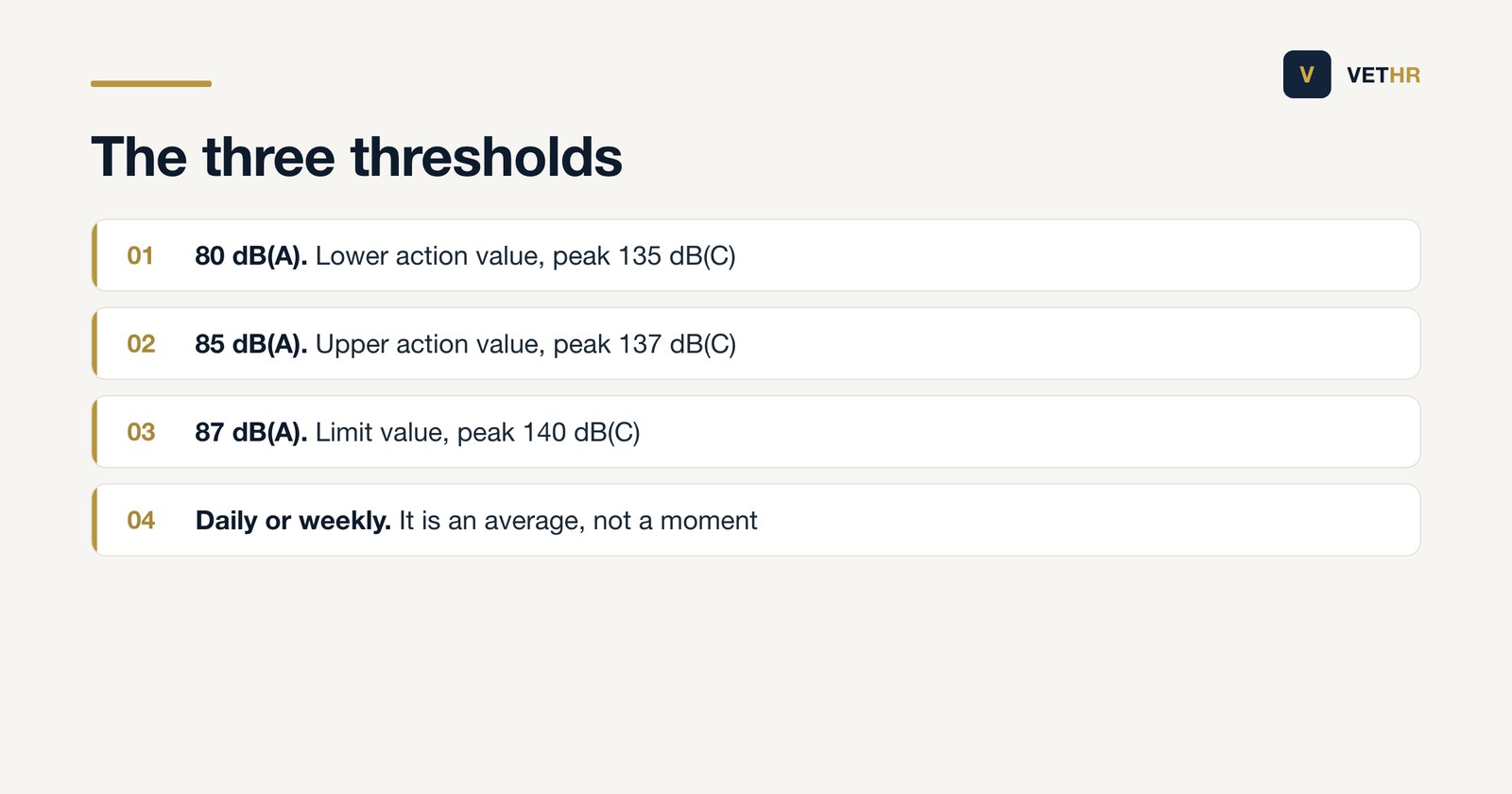
HSE sets out the thresholds for noise at work as three pairs of figures, and they are the same in a kennel block as they are on a building site.
Two features of that scale matter. It is a daily or weekly average, so a short, very loud period counts differently from a long, moderately loud one. And the decibel scale is logarithmic, which means 88 dB(A) is not a shade above 85. It is roughly twice the sound energy.
HSE lists the duties plainly. Assess the risks to your employees from noise at work. Take action to reduce the noise exposure that produces those risks. Provide your employees with hearing protection if you cannot reduce the noise exposure enough. Make sure the legal limits on noise exposure are not exceeded. Provide information, instruction and training. And carry out health surveillance where there is a risk to health.
The order is the point. Assess first, reduce second, protect third. A box of earplugs bought before anyone measured anything is not compliance, it is a purchase.
Notice too that noise at work carries a training duty of its own. People who spend their day in a loud room are entitled to know what the risk is, what the practice has done about it and how to use whatever protection they are given. That conversation takes ten minutes at a team meeting and it is part of the legal duty, not an optional extra.
Assessment does not have to mean hiring a consultant on day one. HSE publishes noise exposure calculators, and a hire-in sound level meter for an afternoon will tell you whether you have a problem or not. Most practices will find they do not. The ones that do need to know.
Hard surfaces, tiled walls, stainless steel, no soft furnishings anywhere, and a group of anxious dogs setting each other off. A kennel block is acoustically about as bad as a room can be designed to be, and the design is deliberate for infection control reasons that are not going to change.
The people at risk are not the vets doing a ten-minute round. They are the animal care assistants and student nurses who are in there for hours, cleaning, feeding and walking, often first thing when the whole block is awake and loud.
That is exactly who a noise at work assessment is for, and exactly who tends not to be asked. If you only take one action after reading this, ask the kennel staff whether their ears ring at the end of a shift.
HSE is blunt about this. You should not use hearing protection as an alternative to controlling noise by technical and organisational means.
It is there where extra protection is needed above what noise control has already achieved, or as a short-term measure while other methods are being developed. In a kennel that means looking first at sound-absorbing panels, at how dogs are grouped, at whether anxious patients can be housed away from the main run, and at how long one person spends in there at a stretch.
Rotating the cleaning round between two people halves the exposure for each of them, and costs nothing. Our note on PPE in a veterinary practice covers where protective equipment sits in the hierarchy generally.

Two different triggers, and practices routinely conflate them. Getting them the wrong way round is the most common noise at work mistake we see.
Between the lower and upper exposure action values, HSE says to provide your employees with hearing protectors if they ask for it. Above the upper exposure action values, you must provide them and make sure they use them properly. Asking becomes telling.
At that point you also identify hearing protection zones, meaning areas where use is compulsory, and mark them with signs. A sign on a kennel door is a small thing, and it is also the clearest evidence you ever assessed noise at work at all.
HSE lists carrying out health surveillance where there is a risk to health as one of the employer duties. In noise terms that means hearing checks for the people genuinely exposed, run on a schedule rather than after somebody complains.
It matters because noise-induced hearing loss arrives slowly and nobody notices it happening. By the time someone mentions it, the damage is already done and permanent. That is what separates noise at work from most other hazards in a practice: there is no moment where it obviously goes wrong.
Keep the records with the rest of your occupational health file. Our guides to RIDDOR reporting and digital staff records cover where health information should and should not sit.
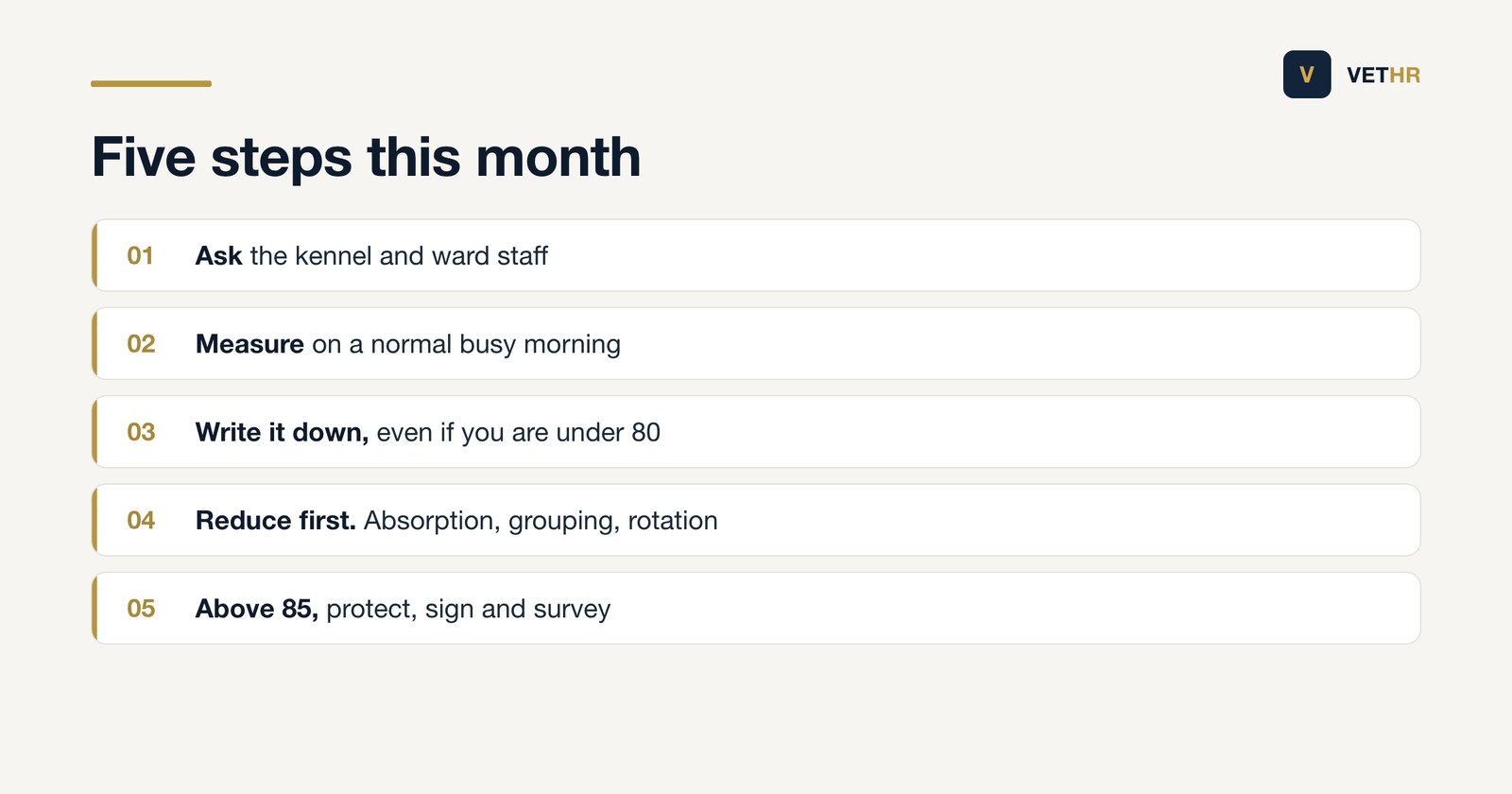
Five steps, none of them expensive, and together they are a complete noise at work response for a small practice.
The written assessment is the bit practices skip and the bit an inspector asks for. Ours sits alongside the COSHH assessment and the zoonoses risk assessment in the same folder. Book a free 30-minute HR health check if you want to know which of your assessments are missing.
HSE sets lower exposure action values at a daily or weekly exposure of 80 dB(A) and a peak of 135 dB(C), upper action values at 85 dB(A) and 137 dB(C), and exposure limit values at 87 dB(A) and 140 dB(C), which must not be exceeded.
It can be, and the only way to know is to measure. Hard surfaces, no absorption and a group of anxious dogs are the conditions that push a room up the scale, and kennel staff spend far longer in there than clinical staff do.
HSE says to provide hearing protectors if employees ask for them and their exposure is between the lower and upper action values, and to provide them and make sure they are used properly where exposure exceeds the upper action values.
No. HSE states you should not use hearing protection as an alternative to controlling noise by technical and organisational means. It is for extra protection above what control has achieved, or as a short-term measure while other methods are developed.
Where exposure exceeds the upper action values, yes. HSE says to identify hearing protection zones, meaning areas where the use of hearing protection is compulsory, and to mark them with signs.
Every practice has one, and almost nobody has ever put a meter in it. Noise at work is a five-minute conversation, an afternoon with a sound level meter and one page of written assessment.
We build the health and safety file that holds it through HR consultancy for veterinary practices and the policy document set.
The Vet HR Team provides HR consultancy and white-labelled staff systems exclusively to UK veterinary practices.
Contracts, rotas, holiday, a difficult conversation. Tell us what you are dealing with and we will come back within one working day. Nothing to sign up to.
Got it. We will come back to you within one working day. If you do not see a reply, please check your spam folder.
